.png?x-oss-process=image/resize,h_100,m_lfit/format,webp)

.png?x-oss-process=image/resize,m_lfit,w_200/format,webp)

热门产品

热门文章
如何利用CRM系统提升外贸SOHO客户管理效率:实用指南
机械行业快速多语言网站搭建:60 分钟内上线,抢占中东和北非市场
错过ABKE Pro,您将失去怎样的市场机会?
快收藏!3个高回复率开发信模板,助您成功吸引客户!
提升B2B外贸网站建设效率的秘诀:揭秘AI赋能下,从品牌信息录入到上线,3小时搞定
国际贸易中谈判反要约和接受的关键见解
你的信用证为何总是被拒?常见欺诈性文件类型及防范策略详解
打造高效的外贸内容营销体系:从认知到转化的实用指南
零代码网站创建在全球贸易中的应用干货大揭秘!
网站内容资料管理:网站素材高效整合指南
推荐阅读








2026 Chemical & Raw Materials Foreign Trade Growth Trend White Paper - Save it now!
This in-depth analysis of the trends in the chemical and raw materials foreign trade industry in 2026 covers compliance requirements, changes in procurement behavior, and the evolution of SEO and exhibition channels. It systematically dissects the growth paths and long-term customer acquisition logic of chemical companies of different sizes.

While the apparel and consumer goods industries are dominated by "visual, social media, and content marketing," the chemical and raw materials industries are heading down a completely different growth path .
This is an industry that values information more than visual appeal ;
This is an industry where procurement decisions are highly rational and the judgment cycle is extremely long .
It is also an industry that is being reshaped by compliance, technology content, and brand trust .
Entering 2026, the core competitive logic of chemical and raw material foreign trade has gradually shifted from "who can offer the lowest price" to—
Whose information is more professional, whose compliance is clearer, whose supply is more stable, and who is more worthy of long-term cooperation?
This article will break down the system:
-
Key Trends in Chemical & Raw Materials Foreign Trade in 2026
-
The fundamental change in buyer behavior
-
Growth watershed for companies of different sizes
-
Why are "technical content + compliance information" becoming prerequisites for transactions?
AB Customer Recommendation:
Customs data for chemicals and raw materials Website building for the chemical and raw materials industry Customer acquisition in the chemical and raw materials industry | Social Media Operations in the Chemical & Raw Materials Industry | CRM specifically designed for the chemical and raw materials industry | Promotion and lead generation for the chemical and raw materials industry
I. The underlying logic of the industry is changing: from "selling products" to "selling certainty".

Chemical and raw material procurement is essentially a risk management activity .
For buyers, what they really care about is never "how good your website looks," but rather:
-
Are the product specifications stable and can they be reproduced over a long period of time?
-
Are the test reports (COA / TDS / MSDS) complete and traceable?
-
Does it comply with the compliance requirements of the country and downstream customers (REACH / TSCA / GHS, etc.)?
-
Are the storage and transportation capabilities for dangerous and restricted materials mature?
-
Are prices transparent and are price fluctuations predictable?
-
Whether you "live long" and won't have your money cut off midway.
Certainty is replacing low price as the primary decision-making factor.
This directly determines:
The growth of the chemical industry is not achieved through media exposure, but through the accumulation of "information credibility".
II. Compliance Trends: Not a Cost, but a Screening Threshold

1. Global compliance is continuing to tighten, not loosen.
Around 2026, typical trends facing the chemical industry include:
-
The EU REACH list is continuously updated.
-
The US TSCA is tightening its scrutiny.
-
GHS classification and labelling standards are being implemented in more countries.
-
Carbon emissions and sustainable materials are beginning to appear on some procurement lists.
These changes don't simply mean "making more documents," but rather:
A large number of suppliers who do not meet compliance requirements are being directly excluded from the inquiry list.
2. The "visibility" of compliance information has become extremely important.
Many companies have compliance capabilities, but the problem is:
-
Compliance information is hidden in the PDF
-
The website does not have a dedicated module for this.
-
The procurement process couldn't be found at all during the search phase.
turn out:
You are in compliance, but the purchasing department doesn't know that.
Starting in 2026, compliance will no longer be just something "provided during the negotiation stage," but a necessary condition for the search and initial screening stages .
III. Changes in Buyer Behavior: Procurement is now "completing 80% of the decision-making process through the search engine."
In the chemical industry, the procurement decision-making process is moving significantly upstream.
More and more overseas buyers will make purchases before formal contact:
-
Search for a specific product name + CAS No.
-
Search for specifications and application scenarios.
-
Check if you can download the technical documents directly.
-
Assess the company's size, certifications, and export experience.
When they send out their first inquiry, they have often already completed 80% of the screening.
This is why:
-
Technical keywords (specification terms, application terms) have extremely high conversion rates.
-
The quality of inquiries from organic SEO traffic is significantly higher than that from general advertising traffic.
-
The completeness of website information directly affects whether a candidate is included in the "candidate supplier pool".
IV. Channel Trends: The Reordering of SEO, Trade Shows, and Brand Trust

1. SEO is becoming the most stable long-term channel in the chemical industry.
Unlike consumer goods, SEO for the chemical industry has three distinct characteristics:
-
Keywords have a long lifespan
-
The content has a high professional threshold and few competitors.
-
Once the ranking stabilizes, the quality of inquiries will be extremely high.
Especially technical SEO related to the following:
-
Product Specifications Page
-
Application Scenario Description
-
Technical White Paper / Download Center
-
Compliance and Certification Guidelines
This information itself forms the basis for procurement decisions.
2. Trade shows remain important, but their role has changed.
Exhibitions such as CHINAPLAS, CPhI, ChemSpec, and ArabPlast are still:
-
Major clients
-
Long-term contract
-
Regional Agent
An important source.
But exhibitions are transforming from a "customer acquisition portal" into:
High-value customer screening and trust accelerator.
Many buyers had already completed the first round of evaluation through the official website before coming to the exhibition.
3. Brand trust is beginning to influence whether a brand is chosen.
In scenarios involving dangerous or restricted goods, the purchaser naturally prefers:
-
Information transparency
-
Corporate Image Professional
-
The official website has a clear structure.
-
Content is continuously updated
This is not "brand packaging," but rather an instinct for risk aversion .
V. Growth Watershed for Enterprises of Different Sizes
Key issues for startups
-
Can it be searched?
-
Can you quickly prove "I am not an unreliable supplier"?
During this phase, B2B platforms, email development, and small-scale advertising testing remained effective, but the official website began to assume the role of "endorsement."
Key issues for growth-stage enterprises
-
How to improve inquiry quality
-
How to break free from dependence on a single platform
During this phase, SEO and technical content began to become the main drivers of growth.
Key issues for mature companies
-
How to continuously acquire high-quality major clients
-
How can the brand itself become a screening advantage?
At this stage, the official website is no longer a "marketing tool," but a central hub for corporate trust .
VI. The Fundamental Change in the Official Website's Role: From a Display Page to a "Professional Information Hub"
In 2026, the official websites of chemical companies are undergoing three fundamental changes:
-
Information density is higher than visual expression
-
Structure serves the purpose of searching and judgment, not design aesthetics.
-
System capabilities that support compliance, technology, applications, and brand trust
More and more companies are beginning to realize:
The official website is not a one-off project, but a long-term, growing infrastructure .
Therefore, a trend is gradually emerging in the industry:
Through an intelligent and modular website building system , the following capabilities are integrated at once:
-
Technical content structuring
-
Multilingual automatic adaptation
-
SEO-friendly page logic
-
Centralized management of documents and compliance information
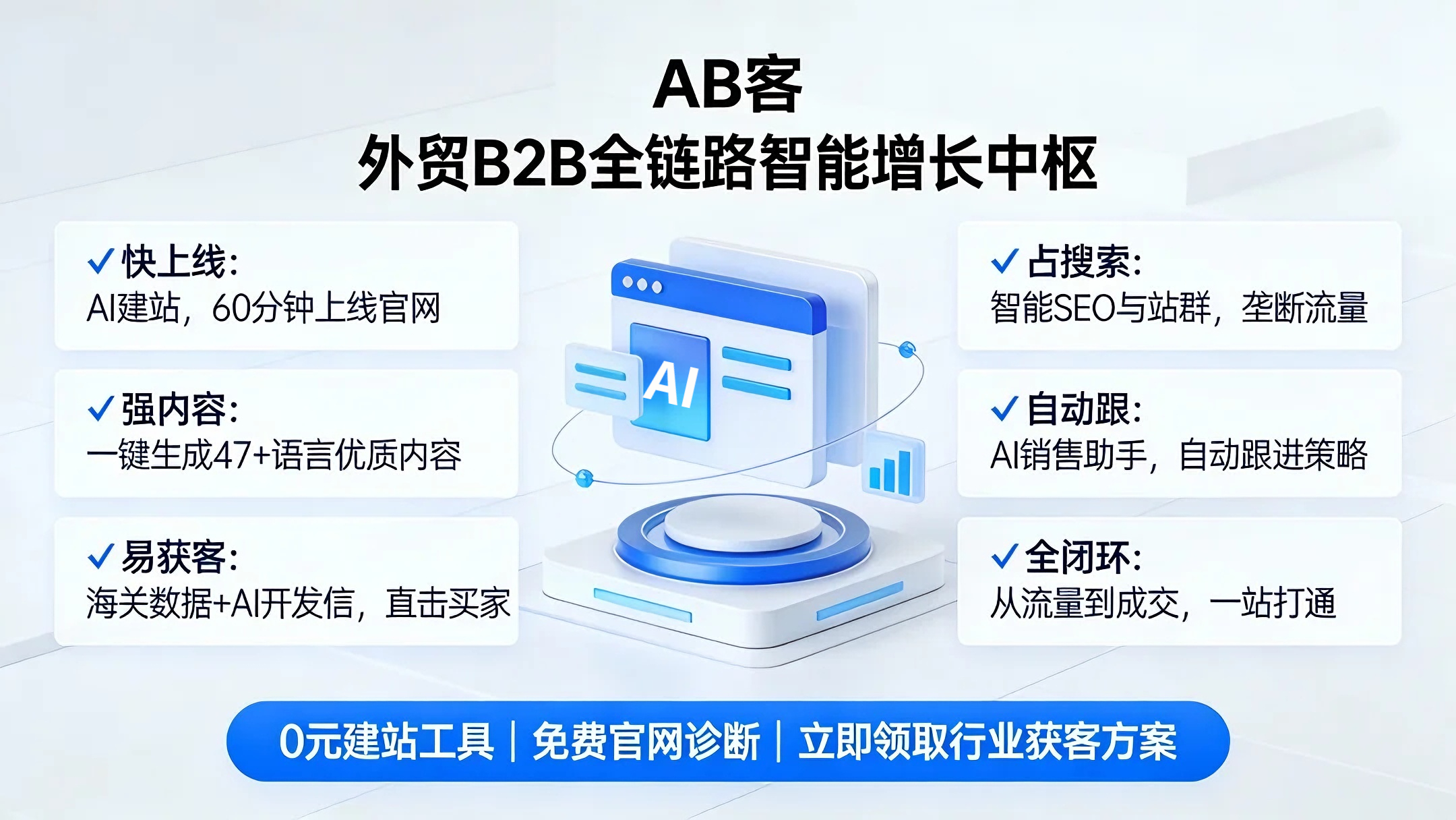
In the practice of some enterprises, this type of systematic website (such as those using ABK Intelligent Website Builder as the underlying architecture) is more like a "digital information foundation" —
It does not replace a company's professional capabilities, but rather allows these capabilities to be presented clearly, continuously, and at low cost.
In conclusion: After 2026, the chemical industry will be competing on "who is more worthy of being chosen".
The chemical and raw materials industry has never been one that grows on gimmicks.
What it always strives for is:
-
major
-
Stablize
-
Compliance
-
Long-termism
As the industry enters a new phase characterized by information transparency, rational procurement, and stricter compliance ,
Companies that can systematically output professional information and transform it into long-term digital assets.
This will lead to lower customer acquisition costs, higher inquiry quality, and more stable customer relationships.
The starting point for growth is often not the channel itself, but rather—
Do you have a "basic system" to carry this professional information?
.png?x-oss-process=image/resize,h_100,m_lfit/format,webp)
.png?x-oss-process=image/resize,h_100,m_lfit/format,webp)

.png?x-oss-process=image/resize,h_100,m_lfit/format,webp)
.png?x-oss-process=image/resize,h_100,m_lfit/format,webp)
.png?x-oss-process=image/resize,h_100,m_lfit/format,webp)
.png?x-oss-process=image/resize,h_100,m_lfit/format,webp)
