.png?x-oss-process=image/resize,h_100,m_lfit/format,webp)

.png?x-oss-process=image/resize,m_lfit,w_200/format,webp)

热门产品

Popular articles
LME Suspends Non-Dollar Metal Options: Challenges for USD Dominance and RMB Globalization
A must-read for exporters! The most comprehensive review of the certification systems of countries around the world, a copy for everyone in foreign trade!
A Beginner’s Guide to Starting Foreign Trade: How to Find Overseas Customers and Succeed
Why is your B2B export website failing to generate potential customers? AB Customer Advantages
Interactive Q&A: Answers to 20 common trade terms for foreign trade novices!
Understanding the Differences Between Diamond and Circle PSE Marks: A Comprehensive Guide to Japan's PSE Certification Process
Unlock the Secrets of Automated SEO: 5 Essential Tools to Boost Your International Trade Website Traffic!
How do foreign trade companies use AI to generate "customer DNA"? ——Intelligent portrait practice based on AB customer "global search"
Recommended Reading

.jpg?x-oss-process=image/resize,h_1000,m_lfit/format,webp)






2026 Electronic Components Industry Trend Forecast: Supply Chain Structure, Price Trends, and New Opportunities!
Authoritative analysis of 2026 electronic component industry trends: global supply chain resurgence and expansion into Southeast Asia, price trend forecasts for core components such as MLCCs, MOSFETs, and connectors, three major growth drivers (lightweight consumer electronics, new energy vehicles, and industrial automation), and changes in procurement models in 2026. This analysis helps electronic manufacturers, traders, R&D, and procurement teams fully grasp industry trends.

Over the past three years, the global electronics supply chain has experienced a typical cycle of "shortage → overcapacity → demand recovery". Entering 2026 , the industry has returned to normalcy from chaos, and the supply chain structure, price curve, demand structure, and procurement models will undergo a new round of reshaping.
The following five dimensions provide you with the most actionable industry insights: supply chain, pricing, key growth areas, procurement models, and recommendations for suppliers .
I. Global Supply Chain Trends: Finding a New Balance After "De-Sinicization"
The global electronics manufacturing capacity adjustment has gone through several stages:
-
2020–2022: Europe and the United States actively promoted “decoupling from China”; supply chains were forced to relocate.
-
2023–2024: Rising manufacturing costs and efficiency losses due to supply chain fragmentation.
-
Starting in 2025: We will enter the "return cycle + rebalancing phase".
The supply chain landscape will become clearer in 2026.
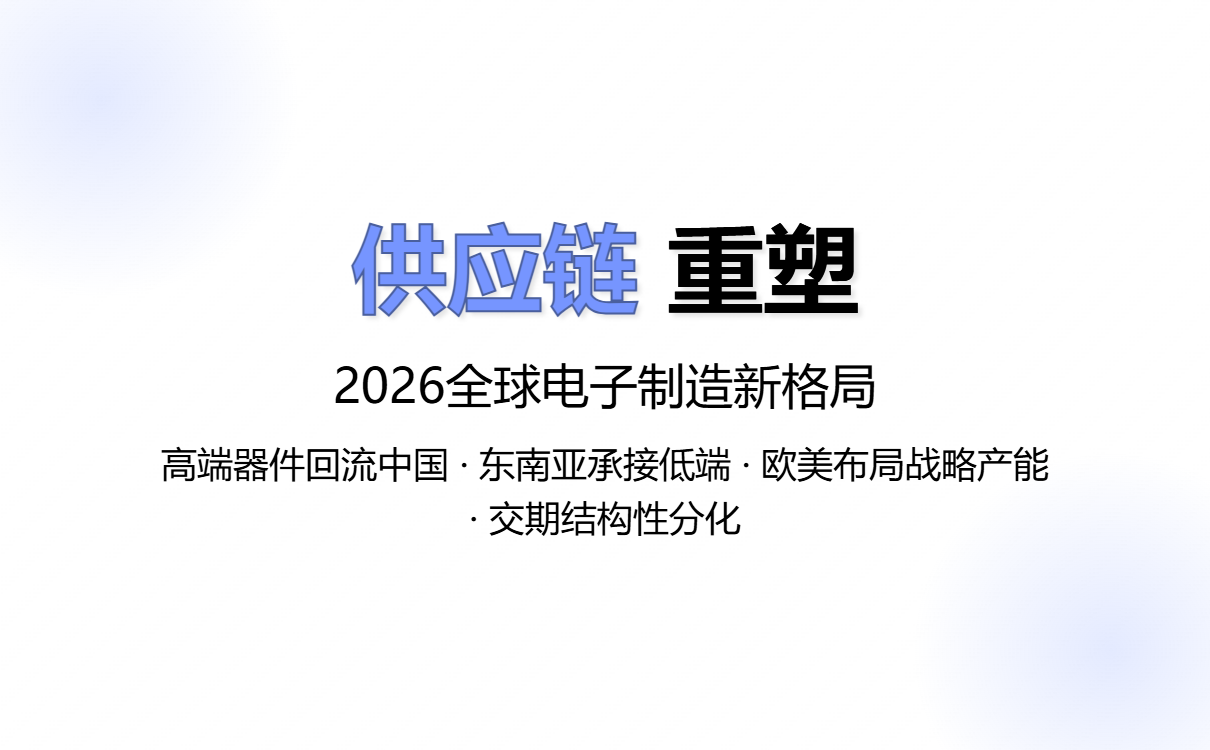
1) The return cycle after "de-Sinicization": Efficiency takes precedence again
In the past, "de-Sinicization" was more policy-driven than a commercial outcome.
However, as production capacity gradually comes online in various regions, three trends will emerge in 2026:
-
Some mid-to-high-end electronic components are returning to the Chinese supply chain (because they are more mature and of more stable quality).
-
Low value-added assembly will continue to remain in Southeast Asia or South Asia.
-
Europe and the United States retain strategic production capacity (such as automotive electronics and power devices).
👉What does that mean?
It's not about "going back to the past," but rather:
Highly complex components are still manufactured in China, low-cost production is in Southeast Asia, and high-value products are strategically produced in Europe and the United States.
2) Manufacturing expansion in Southeast Asia: but supporting facilities and delivery times are not as good as in China.
Southeast Asia, particularly Vietnam, Thailand, and Malaysia, will continue to expand in 2026.
-
Connector manufacturing
-
Consumer electronics assembly
-
Partial PCB/PCBA
-
Basic passive components
However, the problem is also very obvious:
-
Incomplete industrial supporting chain
-
engineer shortage
-
Quality stability is still in the improvement stage
This means:
Southeast Asian supply is more suitable for low-cost orders than for high-end categories that require extremely stable delivery times.
3) Delivery forecast: Overall stabilization, but a clear hot/cold market structure.
There is no overall risk of "out-of-stock periods" in terms of delivery time in 2026, but there are significant differences among various products:
| Product Type | Delivery time trend (2026) | Key reason |
|---|---|---|
| High-end MOSFET/SiC devices | Slightly stressful (8–20 weeks) | Strong demand for automotive electronics |
| MLCC standard material | Stable (4–8 weeks) | The excess capacity has been balanced. |
| Connectors (Precision/Ultra-thin) | Easily stretchable (6–12 weeks) | Iteration of consumer electronics structural components |
| Custom power supplies | Fluctuations with the project | Long certification cycle |
In short:
A wave of shortages will not recur, but structural tensions will persist.
II. Price Forecast for Mainstream Electronic Components: More "Moderate Fluctuations" Expected in 2026
The prices of electronic components are no longer experiencing large fluctuations, but have entered a range of "stability + minor adjustments".
1) MLCC (Multilayer Ceramic Capacitor)
-
Standard models: Prices remain low , with expected fluctuations of ±5%.
-
High-capacity/miniaturized models: Slight increase (±10%)
-
Automotive-grade MLCCs: Strong demand continues
Influencing factors:
Mobile phone sales have seen limited recovery; however, demand for in-vehicle components has experienced more significant structural growth.
2) Power supplies (AC/DC, DC/DC, power modules)
-
Standard power supply: stable price
-
High-power & industrial control grade: Due to rising copper and magnetic material prices, prices may increase by 5% to 10%.
-
Custom power supplies: Prices depend more on certification and volume.
3) MOSFETs (especially medium and high voltage MOSFETs)
-
Low- and medium-voltage MOSFETs: Limited room for further price declines
-
High Voltage & Automotive Grade MOSFETs: Maintaining a Stable and Tight Supply
-
SiC MOSFETs: Prices remain high, but will slowly decrease as more suppliers enter the market.
4) Connectors (especially ultra-thin, precision types)
-
Popular models: Stable
-
Ultra-thin/High-speed models : There is significant upward pressure on prices (complex structure/strong demand).
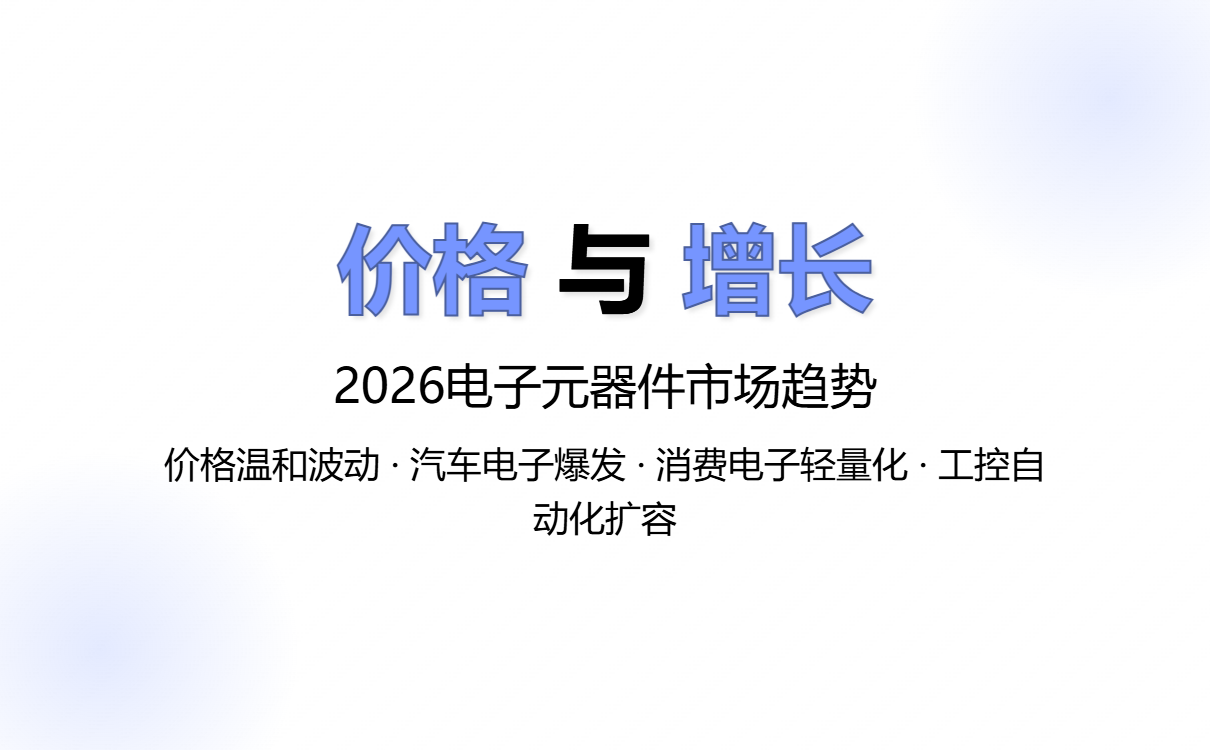
III. Hot Growth Drivers in 2026: Three Certain Tracks
The industry is highly differentiated, with growth mainly coming from three major application categories.
1) Lightweighting of consumer electronics: ultra-thin connectors, flexible PCBs
The focus of consumer electronics in 2026 is not "innovation," but rather:
-
Thinner body
-
More compact modules
-
More folded and rolled structures
Popular components:
-
0.2mm~0.35mm Ultra-thin FPC/BTB Connectors
-
Flexible PCB (FPC)
-
Integrated power module
Keywords: High density & High precision.
2) New Energy Vehicles: High-voltage relays and SiC devices continue to see explosive growth.
The penetration rate of new energy vehicles continues to increase, but the biggest growth comes from two directions:
(1) 800V high voltage platform → Demand for high voltage relays is growing significantly.
-
Mainstream models have been upgraded from 400V to 800V
-
New demand for high-voltage relays, current sensors, and DC-DC modules
(2) SiC devices are becoming the norm (increased power density + increased battery life requirements)
-
SiC MOSFET
-
SiC module
-
New thermal management materials
Automotive electronics is the most stable growth sector in the components industry in 2026, bar none.
3) Industrial Control & Automation: Continuous expansion of sensors, I/O modules, and power supply modules.
With the digitalization of global manufacturing and the convergence of OT/IT:
Growth points include:
-
Industrial sensors (temperature, pressure, position)
-
I/O Module (Remote Control)
-
24V → Multi-output intelligent power supply module
-
EtherCAT/Industrial Ethernet Interface Products
Core driving force: factory automation + production line transformation and upgrading.
IV. The procurement model will be fully upgraded in 2026: faster, more transparent, and more standardized.
The procurement model is undergoing a structural change, shifting from being primarily based on "human communication" to being "data-driven".
1) Fast Samples Become Standard
R&D/engineering teams are no longer willing to wait for long confirmation cycles:
Typical demand in 2026 is:
-
Place an order → Receive samples in 3–5 days
-
Complete parameters, ready for direct testing
-
Inventory available
Whoever can do that will be able to secure front-end development resources.
2) Online parameter comparison will become the mainstream.
Engineers hope:
-
Online model lookup
-
Parameter
-
Look at alternative materials
-
Download 3D/STEP directly
-
Check delivery time and inventory
In other words:
Engineers don't want to chat; they want data and answers.
3) More companies will establish "online BOM review processes".
-
Automatic specification comparison
-
Automatically provide a second supply source
-
Automatically recommend alternative materials
-
Automatically calculate cost changes
This means:
Supplier responsiveness is more important than price.
V. Recommendations for Suppliers: To win in 2026, you need "speed + accuracy + transparency".
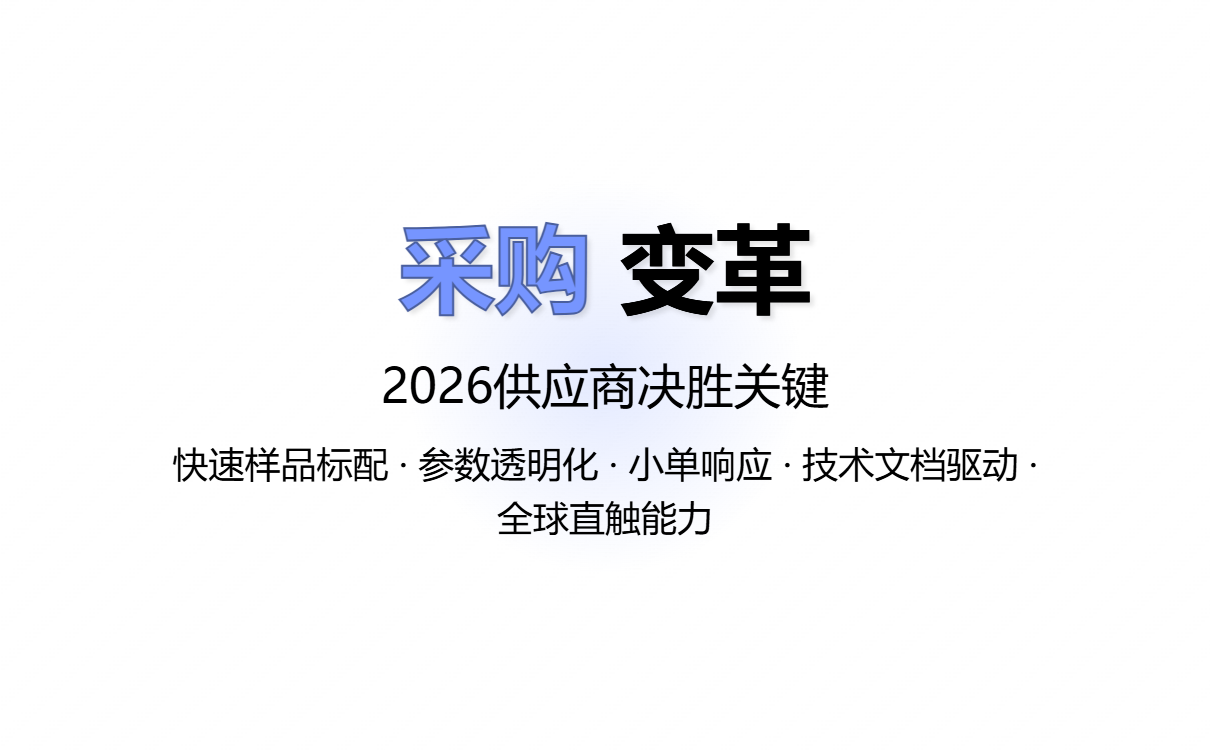
In the coming year, suppliers need to shift from "sales-driven" to "information-driven".
1) Parameter transparency: Disclosing more technical details
Customer needs:
-
Parameter table (Datasheet)
-
Dimensions
-
Failure curve
-
Application Cases
-
Safety certification documents
The more transparent you are, the easier it is to enter your customer's supply chain.
2) Improve BOM response speed
Best practices:
-
Establish a standardized BOM receiving interface
-
90% of scenarios achieve feedback within 24 hours.
-
Real-time alternative solutions for "critical models"
Speed is the most critical competitive advantage in 2026.
3) Prepare an English technical white paper.
Foreign engineers rely heavily on:
-
Explanation of principles
-
Application Architecture
-
Test methods
-
Reliability certification
-
Installation Guide
The more professional your English white paper, the more you resemble a Tier 1 supplier.
4) Smaller inventory orders & readily available samples
The "fragmented needs" will be even greater in 2026:
-
10pcs
-
20pcs
-
50pcs trial production
-
Small-batch upgrade iteration
Suppliers that can offer "low MOQ + fast delivery" will be significantly more competitive.
5) Strengthen overseas direct-to-engineer capabilities
The shorter the supply chain, the more willing buyers are to cooperate.
The tools include:
-
Multilingual materials
-
Online sample application
-
Global site layout (e.g., using ABK to build multilingual independent websites)
-
Online technical Q&A
Conclusion: The industry will enter a phase of "stable growth + new differentiation" in 2026.
The electronic components industry in 2026 will not experience drastic fluctuations, but structured opportunities will emerge:
-
Automotive electronics rise
-
Industrial control system grows steadily
-
Lightweighting in consumer electronics drives demand for new structural components
-
Supply chains are rebalancing in many places
Whoever can provide "more transparent parameters, faster response, and stronger technical documentation" will be able to seize the next wave of industry dividends.
.png?x-oss-process=image/resize,h_100,m_lfit/format,webp)
.png?x-oss-process=image/resize,h_100,m_lfit/format,webp)

.png?x-oss-process=image/resize,h_100,m_lfit/format,webp)
.png?x-oss-process=image/resize,h_100,m_lfit/format,webp)
.png?x-oss-process=image/resize,h_100,m_lfit/format,webp)
.png?x-oss-process=image/resize,h_100,m_lfit/format,webp)
