.png?x-oss-process=image/resize,h_100,m_lfit/format,webp)

.png?x-oss-process=image/resize,m_lfit,w_200/format,webp)

热门产品

Popular articles
New regulations in July! A summary of trade policies and bans to be implemented in major countries and regions around the world in July!
WordPress初学者指南:创建专业网站的完整步骤与常见问题解答
How SMEs Can Navigate Currency Fluctuations: 3 Real Cases to Protect Export Profits
A Step-by-Step Guide to Leveraging the '1+AI' Foreign Trade Marketing Model for Business Growth
Breaking B2B Customer Quality Bottlenecks: Weighted Model Based on Transaction Records and Social Media Activity
How to Predict Currency Fluctuations Early with Smart Tools for Optimized Foreign Trade Operations
AI intelligent translation: Overcoming language barriers and easily obtaining international orders
How Can Foreign Trade SOHOs Improve Customer Follow - up Efficiency with CRM Systems? A Practical Configuration Guide
Recommended Reading






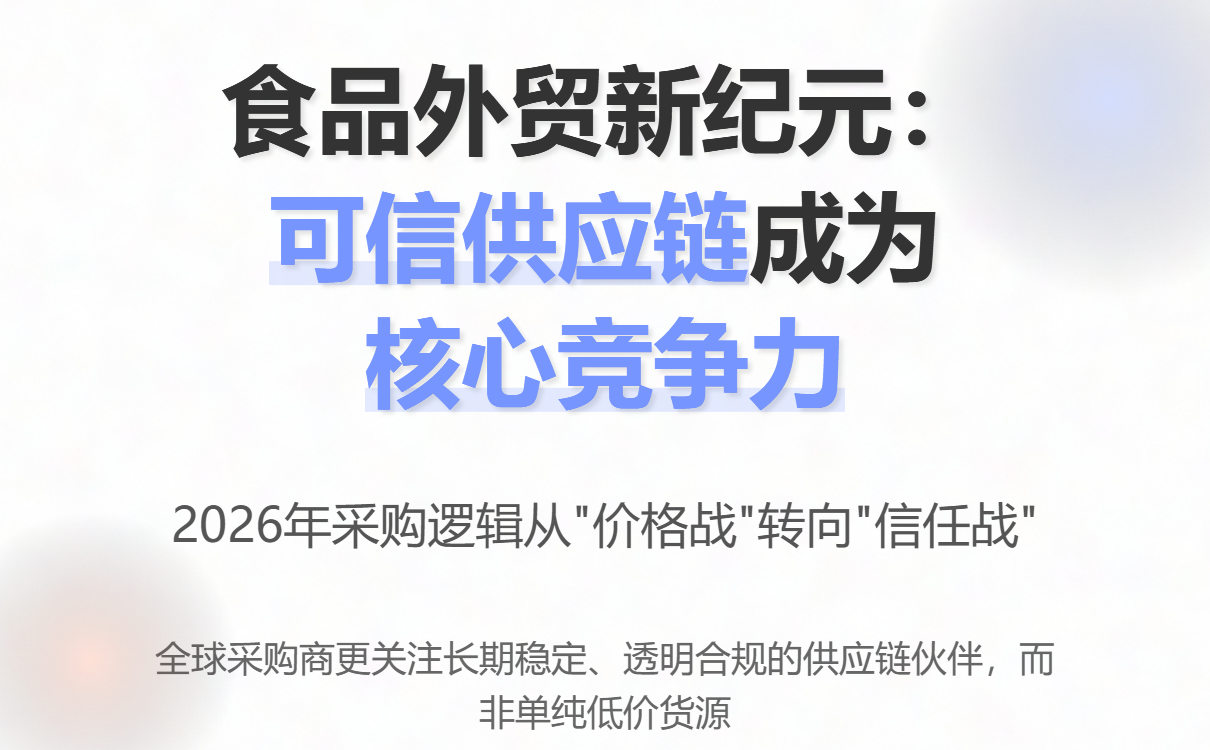
2026 Food & Agricultural Products Going Global Trends: From "Finding Sources" to "Finding Reliable Supply Chains"!
Gain insights into food and agricultural product foreign trade trends in 2026 and analyze how global buyers can screen trustworthy suppliers based on origin, compliance systems, certifications, and supply chain transparency.

Over the past decade, the core competitive logic of food and agricultural product foreign trade has always revolved around three key words: price, supply, and distribution channels .
Whoever offers the lowest price, has the most stock, and can reach buyers faster is more likely to secure orders.
But as we enter 2026, this logic is undergoing a fundamental change.
More and more global buyers are shifting their focus from "Can you supply the goods?" to a more fundamental and critical question:
Are you a reliable, verifiable, and sustainable supply chain partner?
This article will take a real-world purchasing perspective from the food and agricultural products industry, systematically analyze the foreign trade growth trend in 2026, and provide clear conclusions:
Competition in the food industry is shifting from "finding sources of goods" to "finding reliable supply chains".
Practical tools for food and agricultural products:
Food & Agricultural Products Customs Data Inquiry ⎪ Food & Agricultural Products Email Mining ⎪ Food & Agricultural Products Website Building ⎪ Food & Agricultural Products Customer Management ⎪ Food & Agricultural Products Email Marketing
I. The global procurement logic has completely changed in 2026.
1. Buyers don't lack supply; what they lack is a sense of security.
Looking at the world:
-
The supply of staple commodities such as grains, nuts, dried fruits, spices, meat, and canned goods is never scarce ;
-
B2B platforms, trade intermediaries, and regional agents are already extremely saturated.
-
What is truly scarce is a stable, transparent, compliant supply chain that allows for long-term cooperation .
This trend has been amplified, especially in the following contexts:
-
Global food safety regulations are becoming increasingly stringent (FDA, EFSA, Halal, Kosher, etc.).
-
International trade uncertainty rises
-
Procurement responsibility is shifted upfront, increasing individual risks for buyers.
For buyers:
Choosing the wrong supplier will not only result in "goods not selling well," but also in compliance risks, brand risks, and professional risks .
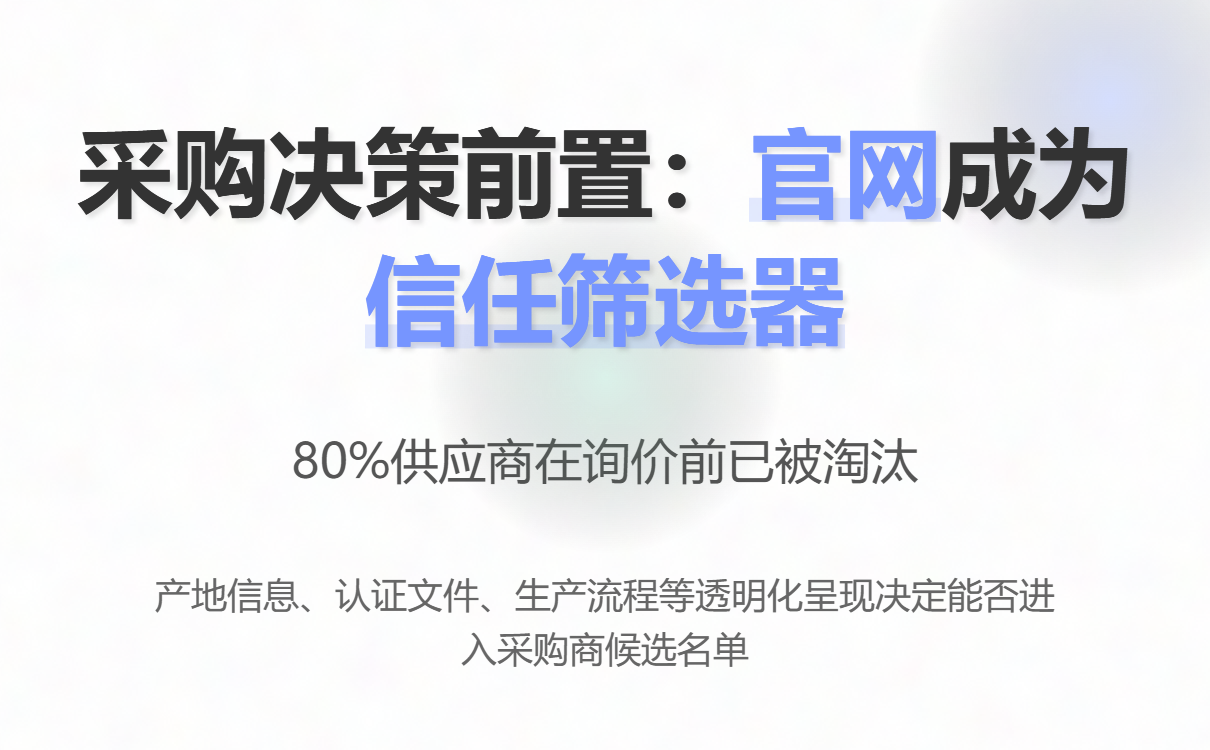
2. The "first screening" has already begun before the trade show and inquiries.
A fact that is often overlooked by many food companies is:
The real elimination happens before you even have a chance to make a offer.
The typical procurement path in 2026 is:
-
Search (Google / AI Search / Industry Platforms)
-
Click on the official website/brand page
-
Quick assessment: Is it worth contacting?
-
Then proceed to the inquiry, exhibition communication, and sample stage.
If, in step 2, your official website cannot clearly answer the following questions:
-
Who are you?
-
Where do you manufacture?
-
Are you compliant?
-
Are you stable?
Then you won't even make it onto the buyer's shortlist .
II. Why does the food and agricultural products industry place greater emphasis on trust than other industries?
1. The "trust cost" in the food industry is extremely high.
Unlike clothing, daily necessities, and industrial products, the food industry has three inherent attributes:
-
Direct Entry : Zero Tolerance for Security Issues
-
Short repurchase cycle : Once trust is established, the cooperation stickiness is extremely high.
-
Brand-related risks : Any quality problem will be magnified infinitely.
This means:
-
Buyers are extremely cautious before their first collaboration;
-
Once approved, suppliers are rarely changed easily.
Therefore, trust is not a bonus, but an admission ticket.
2. Origin and supply chain are becoming "core competitive advantages".
By 2026, the following content will be transforming from "supporting information" into "key decision-making information":
-
Origin of raw materials
-
Primary and deep processing flow
-
Factory size and stability
-
Quality control system
-
Testing and Certification Documents
For example:
-
Xinjiang walnuts ≠ ordinary walnuts
-
Yunnan coffee ≠ OEM coffee
-
Shandong garlic ≠ Market group buying
Place of origin, professional processes, and verifiable information are directly impacting the quality of inquiries.
III. Changes in search and AI are amplifying the value of "trustworthy supply chains".
1. Search engines are "understanding content," not "matching keywords."
Entering 2026, Google and AI search are showing a clear trend:
-
No longer preferring "keyword-stuffed pages"
-
I prefer content that is structurally complete, informative, and logically clear.
For the food industry, this means:
-
A single product page is far from enough.
-
The system must present:
-
Product Specifications
-
Food safety standards
-
Certification Certificate
-
Test report
-
Packaging and Logistics Solutions
-
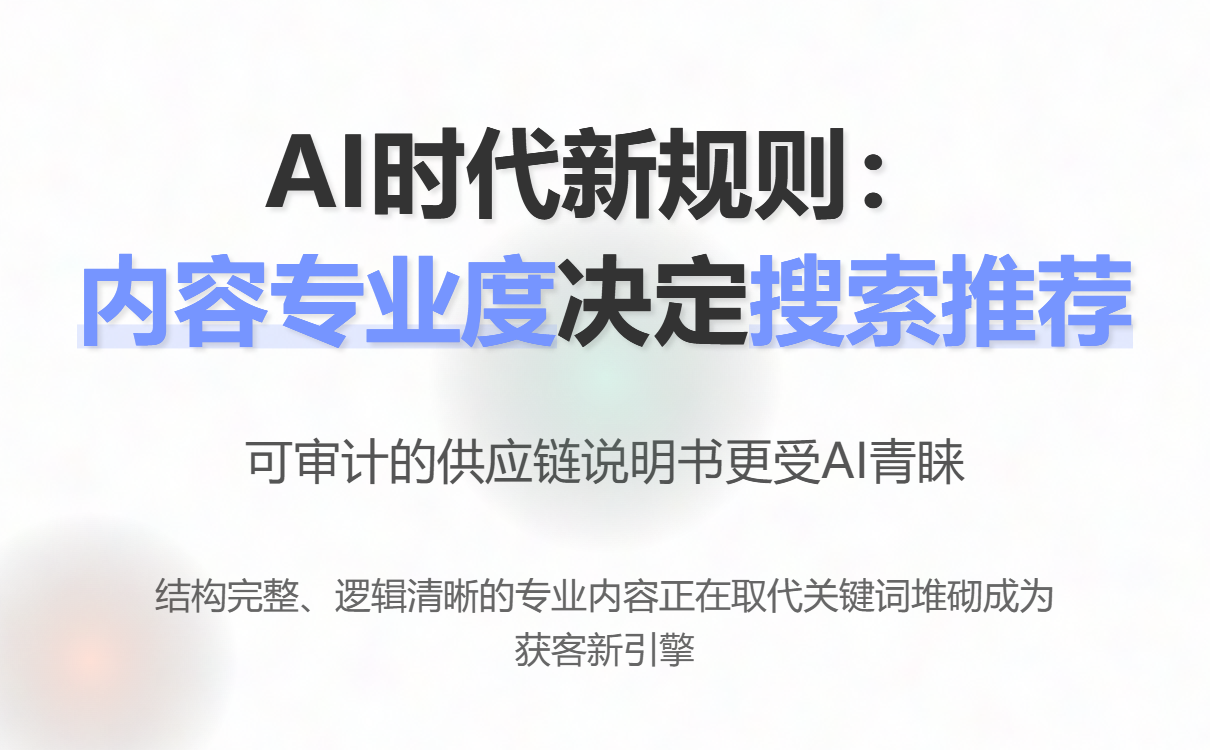
The more professional the content, the more likely search engines are to recommend it.
2. AI is becoming the "first advisor" in procurement.
More and more overseas buyers have become accustomed to:
-
Directly recommend AI consulting suppliers
-
Comparing information from multiple official websites
-
Quickly filter trustworthy objects
The AI's judgment criterion is not advertising budget, but rather:
-
Is the information complete?
-
Is the logic professional?
-
Is the supply chain transparent?
This means:
The company whose website resembles an "auditable supply chain manual" is more likely to be recommended.
IV. Why is it said that in 2026, the official website will be the "core asset" of a food company?
1. Platforms and advertising are merely "entry points," not "moats."
-
B2B platform:
-
There are many inquiries, but the price war is fierce.
-
The customer does not belong to you
-
-
Advertising placement:
-
It can increase the quantity
-
Once it stops, it's gone.
-
The official website is different:
-
All content will exist indefinitely.
-
All trust can be built.
-
All customers can be retained.
This is especially evident in the food industry.
2. A qualified food website plays four roles.
Filter : Helps buyers determine if you are reliable.
Supporting materials library : Supporting certification, testing, and processes
Brand endorsement : Strengthening confidence in long-term cooperation
Growth Hub : Handling SEO, advertising, exhibition, and social media traffic.
The question is no longer whether an official website exists, but rather:
Does your website possess "supply chain level persuasiveness"?
V. From "Showcase Websites" to "Growth-Driven Digital Assets"
It is under this trend that more and more food and agricultural product companies are beginning to realize:
-
Traditional official websites only solve the problem of "being able to see" the website.
-
But it cannot solve the problem of "being trusted".
A truly effective official website in 2026 must possess the following:
-
Sustainable content production
-
SEO Long-Term Accumulation
-
Collaboration with advertising, exhibitions, and social media
-
Customer data can be stored and tracked.
By systematically integrating content, search, customer acquisition, and customer management around the official website, the website can transform from a cost item into a growth-oriented digital asset for the enterprise.
This is why more and more food export companies are starting to reposition their official websites using intelligent website building and growth systems like ABK .
Instead of relying on "constantly running ads," we aim to ensure that every piece of content and every display continuously builds trust and customer base for the company.
.jpg)
Conclusion: 2026 marks a turning point for food foreign trade.
If we were to summarize the core trend of food and agricultural product foreign trade in 2026 in one sentence, it would be:
In the past, the competition was about who could be seen; now, it's about who is more deserving of being chosen.
When a buyer's first judgment is based on the official website and content...
Whoever first systematically presents the concept of a "trustworthy supply chain"
Whoever does so will occupy a more stable and higher-quality growth position in the next three to five years.
.png?x-oss-process=image/resize,h_100,m_lfit/format,webp)
.png?x-oss-process=image/resize,h_100,m_lfit/format,webp)

.png?x-oss-process=image/resize,h_100,m_lfit/format,webp)
.png?x-oss-process=image/resize,h_100,m_lfit/format,webp)
.png?x-oss-process=image/resize,h_100,m_lfit/format,webp)
.png?x-oss-process=image/resize,h_100,m_lfit/format,webp)
