.png?x-oss-process=image/resize,h_100,m_lfit/format,webp)

.png?x-oss-process=image/resize,m_lfit,w_200/format,webp)

热门产品

Popular articles
AB客外贸B2B GEO全链路:深度证明而非功能广度
一套完整的全球买家需求洞察应包含哪些模块:从画像、意图到采购顾虑的标准结构
The Role of External Channels, Third-Party Platforms, Directories, Social Media and Industry Sites in Brand Recognition
5 Common Pitfalls in Global Content Distribution: Why More Distribution May Harm Your Brand
Common GEO Misconceptions for Export B2B Companies: What You Really Need Before You Start
Global Content Distribution: A Comprehensive Guide to Brand Consistency Control
Enterprise Digital Persona, Knowledge Atoms, and Evidence Chains: The Underlying Logic of AB客's GEO Methodology
Defining Verifiable Results in Global Content Distribution: From URL Assets to Brand Consistency
Recommended Reading



Beware of Cheap GEO Packages with 500 “Overseas Media” Posts
ABKE explains why low-cost GEO packages with hundreds of overseas media posts often fail to build real AI trust, search visibility, or B2B leads—and what trustworthy GEO should include.
Beware of Cheap GEO Packages with 500 “Overseas Media” Posts
Recently, many export business owners have asked the same question: why do some GEO providers promise one year of service for only a few thousand dollars, plus 100, 300, or even 500 “overseas media” posts? It sounds attractive—but in AI search, volume alone does not create trust, visibility, or leads.
Cheap GEO is not the same as trustworthy GEO. AI search visibility comes from structured knowledge, credible sources, question-driven content, and measurable brand signals—not from mass posting alone.
1. Let’s be clear: why does a “few-thousand-dollar GEO package” already raise concerns?
GEO, or Generative Engine Optimization, is not simple article posting. It is the work of making your company understandable, trustworthy, and quotable by AI systems such as ChatGPT, Gemini, Perplexity, and Google AI Overviews. For B2B exporters, the goal is not “more internet links.” The goal is to make sure AI can identify who you are, what you do, why you are credible, and which buyers you are best suited to serve.
Google has made it clear that AI search features rely on web content to generate responses and send users to useful pages. OpenAI has also stated that ChatGPT Search shows sources in its answers. That means AI search competition is no longer about who publishes the most pages—it is about who presents the most understandable company knowledge, the most credible evidence, and the most relevant answers to real buyer questions.
ABKE perspective
A real GEO system should combine company knowledge architecture, buyer question mapping, content production, SEO/GEO website structure, global distribution, CRM lead capture, and AI visibility tracking. If a service cannot explain these parts, it is probably selling something far weaker than GEO.
2. The first trap: fake “overseas media” that only looks authoritative
Many low-cost GEO offers use the phrase “overseas media” to create confidence. Export buyers may assume these are real industry publications with real readers, real editorial review, and real AI value. In reality, many are just English-language content sites, network blogs, or article farms that accept almost any paid submission.
These sites often look impressive on the surface, but they rarely have focused industry coverage, consistent editorial standards, or stable audience trust. For AI, a source is not valuable simply because it has a URL. It becomes valuable when it can be recognized as a credible, relevant, and repeatable evidence source.
- Big-sounding site names, but no real editorial team
- Mixed topics across unrelated industries
- Template-style articles with little original value
- No clear reader community or industry authority
- Weak long-term search visibility and poor topical relevance
In other words, not every English site is a media outlet, and not every media outlet is a trustworthy signal. Google’s spam policies also warn against content and practices designed to manipulate search systems or synthetic AI answers. Low-quality mass posting can be a liability, not an asset.
3. The second trap: AI-generated bulk content disguised as strategy
Why can some vendors “give” 500 articles so cheaply? Because the content cost is pushed to the lowest possible level. In many cases, the writing is not built from company interviews, product data, buyer questions, or industry expertise. It is generated in bulk with generic prompts and then lightly edited to look polished.
The result is predictable: many articles say the same things—“leading,” “professional,” “high-quality,” “global,” “one-stop solutions”—without giving buyers anything specific. They may lack product models, technical standards, quality control processes, certification details, or comparison guidance. These pages may look busy, but they do not help AI answer real procurement questions.
How do I choose a reliable supplier? What certifications should I check? What quality risks should I avoid before placing an OEM or custom order?
Answer the question directly, show evidence, explain the process, and help the buyer compare options with confidence.
That is the difference between bulk posting and GEO. One is written to satisfy a delivery sheet. The other is designed to satisfy buyer intent and AI retrieval.
4. The third trap: counting links instead of building a source network
Low-cost GEO packages usually celebrate link quantity. Clients receive an Excel sheet with article titles, publication URLs, dates, and a few screenshots. It looks substantial. But the real questions remain unanswered: Are these pages indexed? Do they have relevant traffic? Are they connected to the same industry topic? Can AI actually use them as reliable evidence?
For B2B exporters, source quality matters more than link quantity. A small number of well-placed industry-relevant sources can outperform dozens of weak pages. A structured FAQ page can be more useful to AI than many generic “brand news” articles. A technical certification explanation page can build more trust than ten “we are a global leader” posts.
- Links are not the same as source quality
- Posts are not the same as visibility
- Index screenshots are not the same as leads
- Quantity without relevance creates noise, not trust
ABKE’s GEO framework emphasizes multi-source consistency, professional content signals, brand entity signals, industry relevance, and verifiable trust signals. In short: GEO should be a source architecture, not a random posting service.
5. The fourth trap: no company knowledge base, only surface-level content
Real GEO starts with knowledge governance. Before publishing anything, a company needs a clear answer to: Who are we? What do we sell? Which markets do we serve? What problems do we solve? What evidence proves that we are credible?
Without this foundation, content becomes unstable. Different pages may describe the company differently. The brand may appear as a machinery supplier on one page, a technology company on another, and an industrial solutions provider somewhere else. This confuses both buyers and AI systems.
Core company knowledge should include:
This is why ABKE places company knowledge sovereignty at the center of its GEO growth infrastructure. If your knowledge base is weak, more publishing only magnifies confusion.
6. The fifth trap: random posting instead of structured source planning
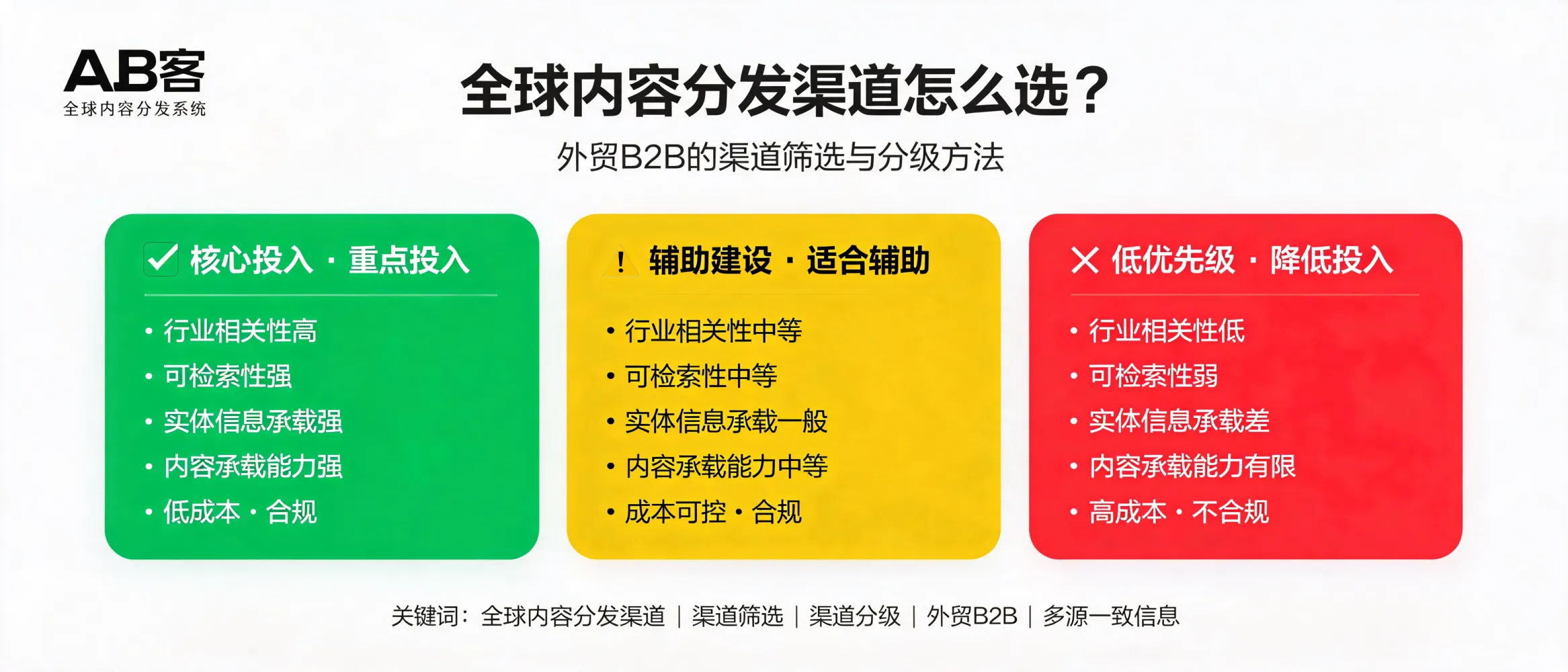
Source building is not “wherever we can post, we post.” It should be organized by purpose. For export B2B companies, sources usually fall into several layers: owned channels, platform channels, industry channels, public-trust channels, and multi-source verification networks.
A good GEO plan asks practical questions: Which sources fit your industry? Which sources strengthen entity recognition? Which sources help answer buyer questions? Which sources support certification or compliance? Which sources are just noise and should be avoided?
Website, product pages, FAQ, case studies, technical blog, knowledge base
LinkedIn, YouTube, B2B directories, profile optimization, showcase pages
Trade media, associations, exhibitions, supplier guides, sector-specific publications
ABKE’s global content distribution system is built around multi-source consistency and verifiable trust signals—not random mass distribution.
7. The sixth trap: no AI visibility monitoring
Many vendors can show published links, but they cannot explain whether AI is actually noticing the brand. That is a major problem. GEO should measure whether AI mentions the brand, cites the company, answers correctly, and places the company into relevant supplier comparisons.
If you do not monitor AI visibility, you are not running a GEO system—you are simply doing publishing. A serious GEO program should track AI mention rate, citation rate, recommendation appearance, answer accuracy, brand visibility on key buyer questions, and lead outcomes such as form submissions, WhatsApp clicks, email clicks, and downloads.
What should be tracked?
- AI mentions and citations
- Brand visibility on high-intent questions
- Competitor comparison performance
- Lead sources and conversion paths
- Content performance and optimization actions
That is the difference between “we posted a lot” and “we built measurable AI visibility.”
8. Why low-cost GEO is especially risky for export B2B companies
For exporters, the risk is not only wasted money. It can also damage brand perception, weaken entity clarity, and delay real growth work.
- Brand signal pollution: low-quality pages can dilute professional perception.
- Entity confusion: inconsistent descriptions make it harder for AI to understand the company.
- Window-of-opportunity loss: time spent on cheap posting is time not spent on knowledge building.
- Wrong conclusions: if a bad service fails, the company may wrongly believe GEO itself is useless.
ABKE’s strategic point is simple: GEO is not “buying links.” GEO is building trustworthy growth assets for the AI search era. If a package does not improve comprehension, credibility, and conversion, it is not a real GEO investment.
9. What should a trustworthy GEO source-building project actually deliver?
Before signing a GEO contract, ask whether the provider can deliver these six essentials:
Company facts, products, positioning, proof points, and service logic
Real procurement questions, comparison questions, and trust questions
Clear distinction between strong sources, weak sources, and risky sources
Fact-based, question-driven, evidence-backed, and SEO/GEO-ready content
Indexing, AI mentions, citations, and competitor comparisons
Website, inquiry form, WhatsApp, CRM, and sales follow-up workflows
ABKE’s view is that exporters do not need more “media counts.” They need a growth system that helps AI understand them, helps buyers trust them, and helps sales convert attention into revenue.
10. Ten questions to ask before signing any GEO service
Do not get lost in slogans. Ask the provider these questions directly:
- Which exact websites will you use for publishing?
- What is the industry relevance of those sites?
- Do they have real traffic, real editors, and real audiences?
- Will the content be based on my company materials or bulk AI generation?
- Do you build a company knowledge base before publishing?
- Do you separate effective sources from low-value sources?
- Do you verify indexing instead of only providing links?
- Can you monitor AI mentions in ChatGPT, Perplexity, or Gemini?
- Can you show which sources competitors are being cited by?
- How do you connect GEO activity to leads and revenue?
If the answers are vague and the vendor keeps repeating “we have many resources,” “we post a lot,” “we are cheap,” or “everyone does this,” then the offer is probably not the trustworthy GEO you need.
11. Why ABKE does not recommend buying “media volume promises”
Because media volume promises often mislead companies into thinking they have solved GEO when they have only bought publishing activity. What exporters really need is not “500 overseas media posts.” They need a system that answers five business-critical questions:
- Can AI identify who you are?
- Can AI understand your products and capabilities?
- Can AI find credible content to cite?
- Can AI verify you across multiple trusted sources?
- Can buyers trust you enough to submit an inquiry?
Low-cost posting sells noise. Real GEO builds trust. ABKE helps B2B exporters create AI-readable digital identity, question-driven content networks, SEO/GEO websites, and inquiry conversion loops—so visibility becomes a business asset, not a vanity metric.
12. Final thought: the most expensive part of cheap GEO is the mistake
A few thousand dollars is not expensive. The expensive part is misunderstanding what you bought. If you believe you have built GEO but you only bought low-quality posts, you may lose time, clarity, and opportunity while your competitors build real knowledge assets.
In the AI search era, GEO is not about buying links. It is about building trustworthy growth assets. A credible GEO system should ask: Who are you? What do you sell? Why do customers need you? What questions do buyers ask? What proof makes you reliable? Can AI read your website? Can it cite your content? Can it verify your brand across sources? Can your sales team convert that attention into business?
ABKE recommends: build a GEO system around knowledge, source quality, AI visibility, and conversion—not around cheap publishing promises.
If you want GEO that helps your company be discovered, understood, trusted, and recommended by AI, focus on structure first, then distribution, then measurement, then ongoing optimization.
.png?x-oss-process=image/resize,h_100,m_lfit/format,webp)
.png?x-oss-process=image/resize,h_100,m_lfit/format,webp)

.png?x-oss-process=image/resize,h_100,m_lfit/format,webp)
.png?x-oss-process=image/resize,h_100,m_lfit/format,webp)
.png?x-oss-process=image/resize,h_100,m_lfit/format,webp)
.png?x-oss-process=image/resize,h_100,m_lfit/format,webp)
