.png?x-oss-process=image/resize,h_100,m_lfit/format,webp)

.png?x-oss-process=image/resize,m_lfit,w_200/format,webp)

热门产品

热门文章
如何用技术内容快速赢得采购信任?电子元器件企业的资料体系建设指南
推荐高效客户开发渠道及领英销售导航使用技巧
如何利用人工智能工具识别西班牙语市场采购高频词汇:面向外国贸易商的多语言关键词监测实用方法
8月1日起全球贸易/关税/海关新规与禁令一览!
行业研究:外贸B2B报价谈判中的心理战术与策略
一文读懂外贸智能CRM系统!什么是智能CRM?有哪些突出优势?
B2B出口客户画像构建指南:从行业到采购周期的精准分类方法
INMETRO认证指南:解码能效标签与年度监督检查(巴西)
2025外贸全流程知识点大揭秘,小白实操干货分享!
B2B制造商如何通过竞争对手关键词监测反向优化网站内容:揭秘智能SEO机制
推荐阅读



.png?x-oss-process=image/resize,h_1000,m_lfit/format,webp)



A daily tip for building a foreign trade website: The 3 roles a foreign trade website plays in the minds of customers!
Is a foreign trade website merely a product showcase? Experienced foreign trade professionals, drawing on real-world case studies, provide an in-depth analysis of the three key roles a foreign trade website plays in customer decision-making: a first impression filter, a hidden salesperson, and a basis for trust. They also offer practical methods for building and optimizing B2B websites for foreign trade, helping companies continuously generate high-quality inquiries.

Many foreign trade companies have only one goal in mind when creating their official websites:
"Could you help me generate inquiries?"
The goal itself is not wrong, but it is too "results-oriented," which can easily turn the official website into a tool page with incomplete functions and insufficient persuasiveness .
From the perspective of a veteran in foreign trade with over a decade of experience and thousands of overseas clients, I can tell you this very clearly:
A foreign trade website is not a "customer acquisition tool," but rather a "key player" in the customer decision-making process.
Especially in B2B foreign trade, a truly effective official website should simultaneously fulfill at least three roles in the minds of customers.
If any one of these is missing, your inquiry quality, conversion rate, and trust cost will be significantly higher.
Below, I will break down real-world foreign trade scenarios and both successful and unsuccessful cases for you.
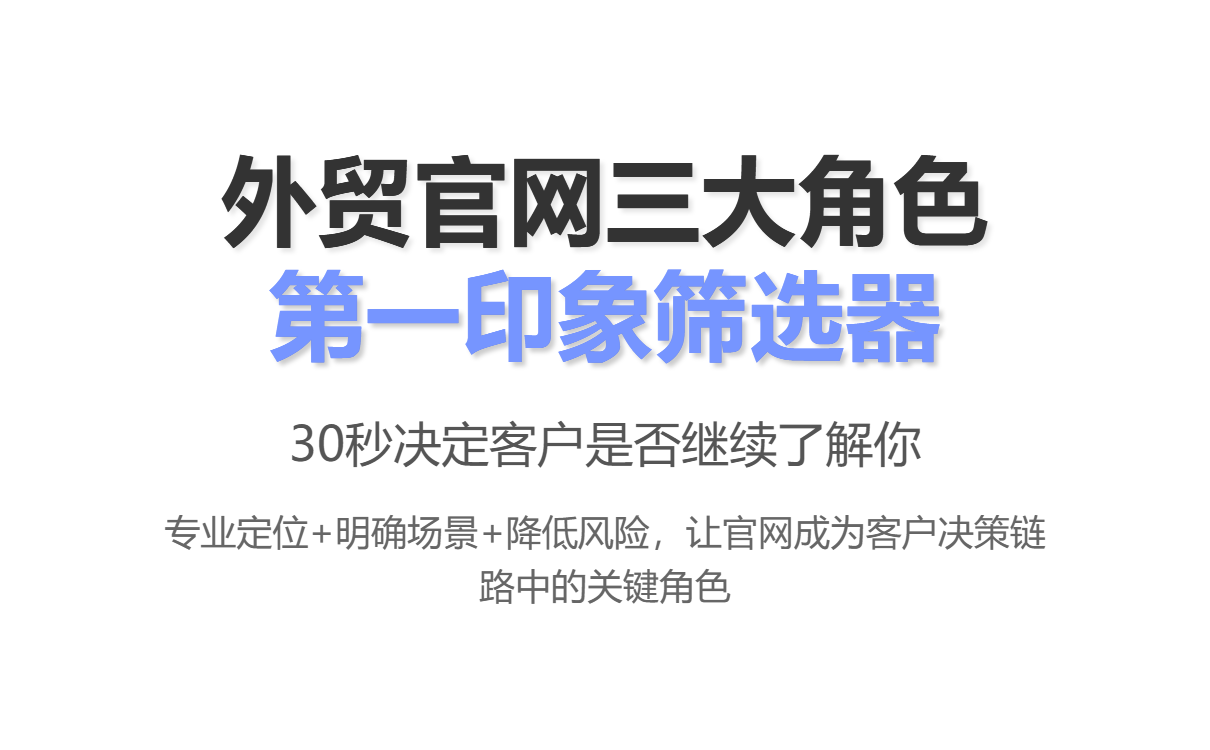
Role 1: The official website serves as a "first impression filter" for customers.
1️⃣ Real experiences of veteran foreign trade professionals
Years ago, when I was still working on the front lines of sales, I often encountered situations like this:
The customer asked very proactive questions in the email.
I've also looked at the quotes.
The technical specifications have also been confirmed.
But then it suddenly "disappeared".
Later, I slowly realized a fact:
Many customers have already visited your official website before replying to you.
The official website is often their first filter for determining whether you are "worth continuing the conversation".
2️⃣ What are customers looking at? Not what you think of as the "product".
When B2B customers open a website, they are actually quickly answering these questions in their minds:
-
Is this company "professional in this field," or is it just selling it as a side business?
-
Do their scale, positioning, and industry understanding match mine?
-
Is the risk high if I continue to spend time communicating?
Notice:
They weren't seriously "reading the product description," but rather doing risk assessment .
3️⃣ Common mistake: Turning the official website into an "electronic product catalog"
Many problems with foreign trade websites fall into three categories:
-
The homepage immediately displays product images and specifications.
-
There is almost no industry background or application scenarios.
-
There isn't a single sentence that clearly states "who you are, who you're suited for, and who you're not suited for."
The result is:
Customers cannot determine in 30 seconds whether you are "the right person".
4️⃣ Practical modification methods (even beginners can follow them)
You can directly change your homepage using these 3 steps:
Step 1: Industry Positioning in One Sentence
We specialize in XXX solutions for XXX industries.
Step 2: Define the use case
Used in / Designed for / Widely applied in …
Step 3: Reduce Trust Risk
-
Years/Market/Customer Type/Standard Certifications
-
Not an exaggeration, but the truth.
Only when you achieve this can your official website truly fulfill the role of a first impression filter .
II. Role Two: The official website serves as the customer's "invisible salesperson".

This is a role that most foreign trade companies completely underestimate .
1️⃣ The harsh reality of B2B foreign trade
In B2B foreign trade:
-
Decision-making cycle: 3–12 months
-
Decision-making roles: Procurement + Technology + Management
-
Communication frequency: repeated, multiple rounds, across time zones
You can't be online 24/7.
But clients will study you repeatedly when you're not around .
At this time, who is "speaking up for you"?
There's only one answer: the official website.
2️⃣ A high-conversion website ≠ a beautiful website
I've seen many "highly designed" foreign trade websites, but they hardly generate any inquiries.
The problem isn't with the design, but with—
The page lacks sales logic.
A qualified B2B website must internally complete this process:
Ask a question → Demonstrate expertise → Provide evidence → Guide the next step
Instead of:
Add image → Write parameters → Leave form
3️⃣ Real-world case comparison
Website A (no sales mindset)
-
Product Page: Specifications + Images
-
Inquiry Form: Direct RFQ
-
Result: Numerous visits, but very few inquiries.
Website B (with a sales structure)
-
First, let's talk about common customer questions.
-
Here are some ideas for solutions.
-
Use case studies/FAQs to dispel concerns
-
Finally, let's discuss "next steps."
result:
The number of inquiries did not double, but the quality improved significantly.
4️⃣ Page structure templates that beginners can use directly
You can copy this logic:
-
Why do customers need this product?
-
What are the common failure scenarios?
-
What key problem does your solution solve?
-
What are some real-world applications or case studies?
-
Next step: Consultation/Solution/Technical communication
When you design the page like this
The official website truly becomes your invisible salesperson .
Thirdly, the official website serves as a basis for customers' trust and decision-making.
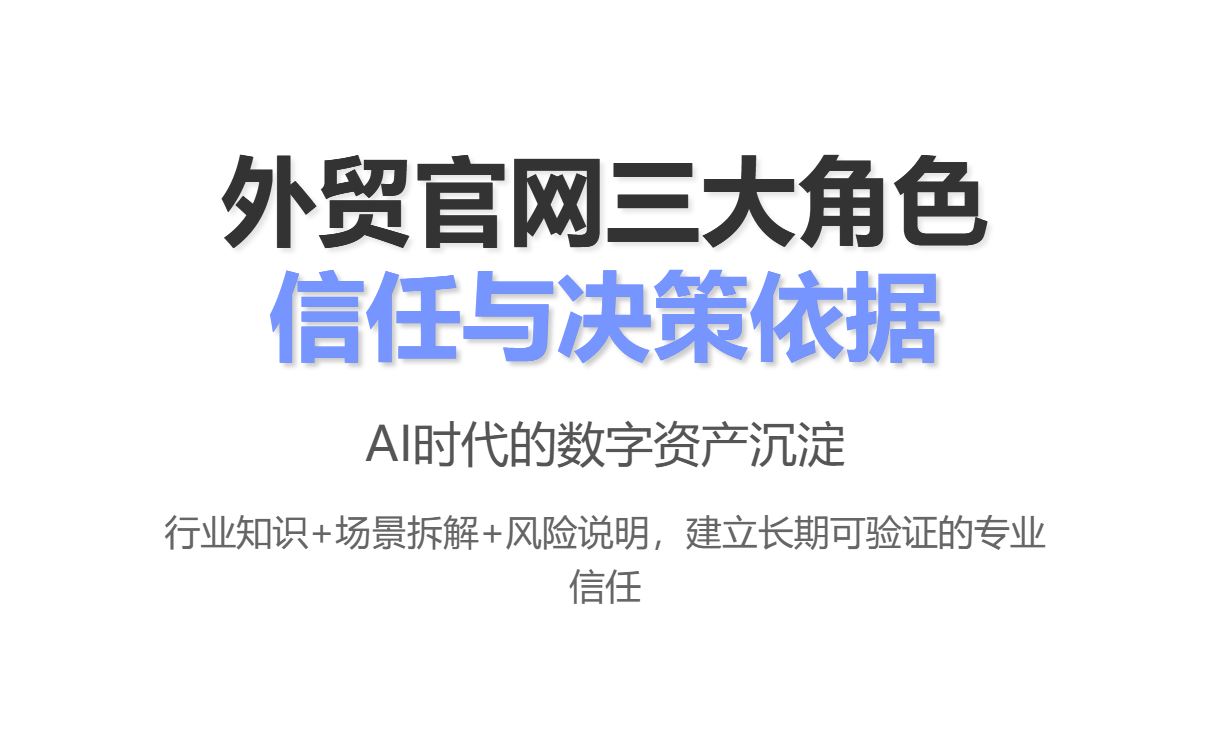
This is the most difficult but most valuable part of an official foreign trade website.
1️⃣ A fact that many people overlook
In the current foreign trade environment:
Customers are no longer just "searching for suppliers".
Instead, it's about "verifying who is worth cooperating with".
Especially for medium to large-scale procurements, they will check repeatedly:
-
Have you been working in this field for a long time?
-
Do you have systematic content?
-
Can you make your point and justify it?
Their official website is their most important verification material .
2️⃣ What kind of content is most effective at building trust?
Not advertising slogans, but these types of content:
-
Industry knowledge-based content (not product descriptions)
-
In-depth analysis of application scenarios
-
Frequently Asked Questions and Risk Statement
-
Project-based case studies, not logo walls
The common thread among these contents is:
They're not in a hurry to sell; instead, they're "proving you know a lot."
3️⃣ A key trend: Official websites are being evaluated simultaneously by "AI and search engines".
More and more customers will use:
-
Google Search
-
ChatGPT / Gemini / AI Assistant
To determine whether a supplier is "worth recommending".
This means:
An official website should not only be "understandable to people",
It also needs to be "understandable by search engines and AI".
It is against this backdrop that more and more foreign trade companies are beginning to realize:
The official website is no longer a one-time delivery project, but a continuously growing digital asset .
Fourth, only by combining the three characters can the official website truly become "valuable".
We can summarize it simply:
| Role | What problem is being solved? |
|---|---|
| First Impression Filter | Does the customer want to learn more about you? |
| Hidden Salesperson | Is the client willing to communicate further? |
| Trust and Decision Basis | Would clients dare to entrust their projects to you? |
If even one is missing, there will be problems.
V. A Checklist for New Foreign Trade Trade Professionals (Very Important)
If you are now re-evaluating or rebuilding your official website, you can use this checklist directly:
-
Does the homepage clearly explain "who you are + who you are suitable for" in 30 seconds?
-
Does the core page have sales logic, or is it just a collection of parameters?
-
Is there industry content that can be accumulated over a long period?
-
Have you prepared structured content for search engines and AI?
-
Is the official website continuously "growing new content" instead of being completed and then abandoned?
VI. A final piece of truth
After so many years in foreign trade, I'm increasingly convinced of one thing:
A truly effective website that consistently generates inquiries.
It has never been a product of "cheap, fast, and one-time delivery".
Instead, it is:
-
Centered on the official website
-
Can be understood by both search engines and AI
-
Continuously produce high-quality content
-
Continuously reduce customer acquisition and trust costs
Long-term growth assets .
This is why more and more foreign trade B2B companies are now choosing methods like AB Ke Intelligent Website Builder —not simply "making a website."
Instead, they built the official website as a sustainable, sustainable, and scalable growth system .
AB Customer Intelligent Website Builder
It's not about delivering a website, but about building a long-term digital asset for businesses, centered around an official website and integrating industry-specific content, search engine optimization, sales conversion, and AI recommendation capabilities.
It serves both today's SEO and advertising ROI needs, and also lays the groundwork for future AI search and brand recommendations. >>> For further information and a demonstration, please click here: https://www.cnabke.com
.png?x-oss-process=image/resize,h_100,m_lfit/format,webp)
.png?x-oss-process=image/resize,h_100,m_lfit/format,webp)

.png?x-oss-process=image/resize,h_100,m_lfit/format,webp)
.png?x-oss-process=image/resize,h_100,m_lfit/format,webp)
.png?x-oss-process=image/resize,h_100,m_lfit/format,webp)
.png?x-oss-process=image/resize,h_100,m_lfit/format,webp)
