.png?x-oss-process=image/resize,h_100,m_lfit/format,webp)

.png?x-oss-process=image/resize,m_lfit,w_200/format,webp)

热门产品

热门文章
全面实操攻略:如何精准开发俄罗斯市场 & 客户(适合外贸小白的落地手册)
自动化部署工具在多站点集群构建中的应用:批量建站与模板复用实用指南
一天一个建站小知识 | 建站前必做的事情有哪些?
营销负责人的效率革命:告别琐碎与黑洞,我的团队终于能聚焦在“策略”本身
外贸人必读|哪些海外客户过七夕?七夕如何给客户发“既暖心又专业”的祝福?
2026 机械设备出口重点市场:东南亚、中东、非洲、拉美谁最值得做?(含行业需求拆解)
实用指南:有效克服跨文化交际中的常见障碍
如何用ABKE智能建站群系统打造高效全渠道营销生态?
一天一个外贸建站小知识:产品页文案公式——小白也能写出转化率高的描述
从0到1:掌握B2B线索生成数据——中小企业实用指南
Recommended Reading

.png?x-oss-process=image/resize,h_1000,m_lfit/format,webp)







A daily tip for building a foreign trade website: Why are B2B foreign trade websites not suitable for simply copying cross-border e-commerce websites?
Many newcomers to foreign trade simply copy the practices of cross-border e-commerce websites to create their own B2B foreign trade websites, yet they consistently fail to generate any inquiries. This article, drawing on the real-world experience of seasoned foreign trade professionals, delves into the fundamental differences between B2B foreign trade websites and cross-border e-commerce websites in terms of user decision-making, site structure, content logic, SEO, and the sales conversion process. It then provides the correct approach and replicable practical guidelines for B2B foreign trade websites.

I. Concepts and business models are fundamentally different
1. Cross-border e-commerce websites: targeting end consumers (B2C)
Cross-border e-commerce websites (such as Shopify and Amazon's self-built websites) primarily sell to individual consumers .
-
Large order volume, low unit price
-
User behavior is rapid, requiring no sales follow-up.
-
Short transaction path, instant payment.
This model emphasizes: user experience, visual impact, fast payment, automated logistics, and real-time customer service response .
2. B2B Foreign Trade Platform: Targeting corporate clients (business-to-business)
B2B foreign trade platforms are sold to enterprise users with complex procurement and decision-making chains :
-
High average order value
-
Procurement decision-making cycle is long
-
Quotation, contract, negotiation, samples, qualification review are required.
-
Professional buyers place greater emphasis on technical details, reputation, and service.
This model emphasizes: trust building, information transparency, customization capabilities, sales follow-up, and in-depth industry content .

II. Comparative Analysis: Where exactly do the core differences lie?
Cross-border e-commerce website VS B2B foreign trade website
| project | Cross-border e-commerce site | B2B Foreign Trade Station |
|---|---|---|
| Target users | End individual consumers | Enterprise procurement & business decision-makers |
| Value Proposition | Instant purchase, convenient payment | Customized pricing, long-term cooperation |
| Site Structure | Product page highlights, shopping cart purchase process | Product technical parameters, case studies, qualifications, and sales leads |
| Content Format | Strong UX / Strong Visual Poster | Strong technical content, detailed specifications, and industry case studies |
| Search engine logic | Keyword conversion (low price, special offer, customer review) | Long-tail keywords, industry terminology, and solution content |
| Trading Logic | Direct purchase | After a quote request or inquiry is converted into a lead, it is manually followed up. |
| Measurement indicators | Conversion rate, order volume | Inquiry volume, business opportunity quality, and transaction cycle |
III. Experiences from Real Foreign Trade Professionals: Three Reasons Why They Cannot Be Simply Replicated
1. Different user decision chains
Veteran foreign trade professionals often say:
"Individual buyers will place an order if they see something they like, while corporate buyers will ask: Can you provide your qualifications? MOQ? Is the price inclusive or exclusive of tax? Can you customize it?"
Cross-border e-commerce platforms pursue rapid purchasing behavior, while B2B foreign trade is a process of communication, trust, and negotiation .
This dictates that B2B pages should focus more on technical specifications, certifications, partnership advantages, and business touchpoints , rather than a "Buy Now" button.
2. Content structure and SEO focus differ.
E-commerce websites emphasize visuals and promotions, such as "holiday promotions" and "limited-time discounts".
B2B foreign trade platforms emphasize:
-
Product Specifications Details and Comparison
-
Industry Solutions
-
White Paper / Typical Cases
-
Customer reviews and cooperation qualifications
This dictates a different content organization method: cross-border e-commerce follows the format of "Homepage → Category → Product → Buy Now".
B2B foreign trade websites follow a process of "industry solutions → product details page → download technical data → fill in inquiry → sales follow-up".
3. The transaction methods are fundamentally different.
Cross-border e-commerce sites can complete transactions directly using a shopping cart and payment gateway.
A successful transaction on a B2B foreign trade platform involves a long process : lead generation → business follow-up → quotation → contract → delivery .
If you simply copy the "Buy Now" logic of e-commerce websites, you will overlook the most important metrics for a true B2B website: the number of valid inquiries and the quality of lead conversions .

IV. In-depth comparison: B2B foreign trade websites VS cross-border e-commerce websites
1. Page Structure Design
Cross-border e-commerce site
-
Emphasis on product display and order placement process
-
Large images, discounts, banners
-
Quick payment portal
B2B Foreign Trade Station
-
Emphasis on technical information and industry authority
-
The following should be included: company qualification page, solutions page, product series page, download center, FAQ, case study page, etc.
-
CTA doesn't mean "Place an order now," but rather "Contact us / Get a quote / Download materials / Submit a request form."
2. Differences between lead generation and retention strategies
Cross-border e-commerce
-
Primarily relies on traffic promotion (Facebook / Google Shopping / TikTok)
-
Conversion depends on price and promotion
B2B Foreign Trade Station
-
SEO is a long-term strategy (industry keywords + technical long-tail keywords)
-
Content marketing is more important than advertising
-
Pay attention to traffic from LinkedIn, professional forums, and professional search engines.
3. Differences in data indicators
| index | Cross-border e-commerce | B2B Foreign Trade Station |
|---|---|---|
| Transaction cycle | instantaneous | Weekly → Monthly → Quarterly |
| Key KPIs | Number of orders | Inquiry conversion rate, business opportunity quality |
| Repeat purchase | high | The cooperation cycle is long but the frequency is low. |
| Average order value | Low | high |
V. Why "Blindly Copying Cross-Border E-commerce Sites" is a Failed Strategy on B2B Foreign Trade Sites
1. User behavior and purchasing logic are completely different.
E-commerce users value fast browsing and instant transactions;
B2B users value the depth and credibility of information and require time for analysis and internal verification.
2. The structure and content do not match the objectives.
A page with strong promotional elements may be invalid in B2B environments.
For example:
Poster → Visuals → Discounts → Order Placement
In a B2B system, it would become:
Large, useless marketing content instead of clearly conveying solutions and technological advantages.
3. Inconsistent data collection indicators
E-commerce platforms value the number of completed payments.
B2B values the "quantity and quality of valid inquiries" plus the "success rate of follow-up conversion".
Copying an e-commerce website will give you "a beautiful page, but no business opportunities."
In reality, many foreign trade companies complain:
"Our website is beautiful, but no one is sending us any inquiries."
The reason is not that the page is beautiful or ugly, but that the content and logic are not aligned.
The specific reasons have been explained in detail in this article: [ One Small Tip for Building a Foreign Trade Website Every Day: Why Do 90% of Independent Foreign Trade Websites Have Visits but No Inquiries? Root Cause Analysis ]. Those who are interested can take a look.
VI. How can a beginner create an effective B2B foreign trade website? (Steps + Key Points + KPIs)

The following is a replicable practical solution :
Step 1: Define positioning and target users
To answer the following questions:
-
Who do I sell to? (Industry + Decision-maker role)
-
What are they most concerned about? (Price? Specifications? Service? Sample delivery?)
-
What is the procurement process? (Is an NDA required? What are the import standards?)
Output: User profile + Procurement process map
Step 2: Develop the content and information architecture
The following core pages were built based on user needs:
-
Homepage : Reflecting Corporate Strength and Value Proposition
-
Company Introduction & Qualifications : Building a Foundation of Trust
-
Industry solutions (more important than product pages)
-
Product Series Page
-
Product details page (detailed specifications, certifications, downloadable materials)
-
Case Studies / Customer Testimonials
-
Inquiry page / Contact information / Form
-
Download Center (PDF Technical Documents)
-
Blog/Technical Information (SEO Long-Term Accumulation)
Each content page should have a clear CTA (Get a quote, download materials, submit your request, schedule a call, etc.).
Step 3: SEO and Long-Tail Content Strategy
For B2B:
-
Industry keywords > Product keywords > Brand keywords
-
The content should prioritize addressing industry pain points before introducing product features.
-
Write more articles that include "solutions + industry guidelines + technical analysis + use cases".
For example:
It shouldn't be written as "Product ABC Features".
Instead, it should be titled "How to Choose High-Efficiency ABC Products to Reduce Production Line Costs".
This type of content is easier for buyers to find.
Step 4: Website Conversion Logic Design
The design revolves around the following core elements:
-
Enhancing Trust : Qualifications/Factory Photos/Certificates/Case Studies
-
Reduce communication costs : Simple forms, automatic replies, and online customer service.
-
Lead conversion and follow-up mechanisms : CRM / email / telephone script templates
-
Data tracking and optimization : Google Analytics + Search Console + form conversion tracking
Performance indicators:
-
Visitors
-
Average visit duration
-
Form submissions (Leads)
-
Lead conversion rate (Leads → Negotiation → Transaction)
Step 5: Use professional website building tools to improve efficiency
Especially for those new to foreign trade, it is not recommended to build a complex system from scratch .
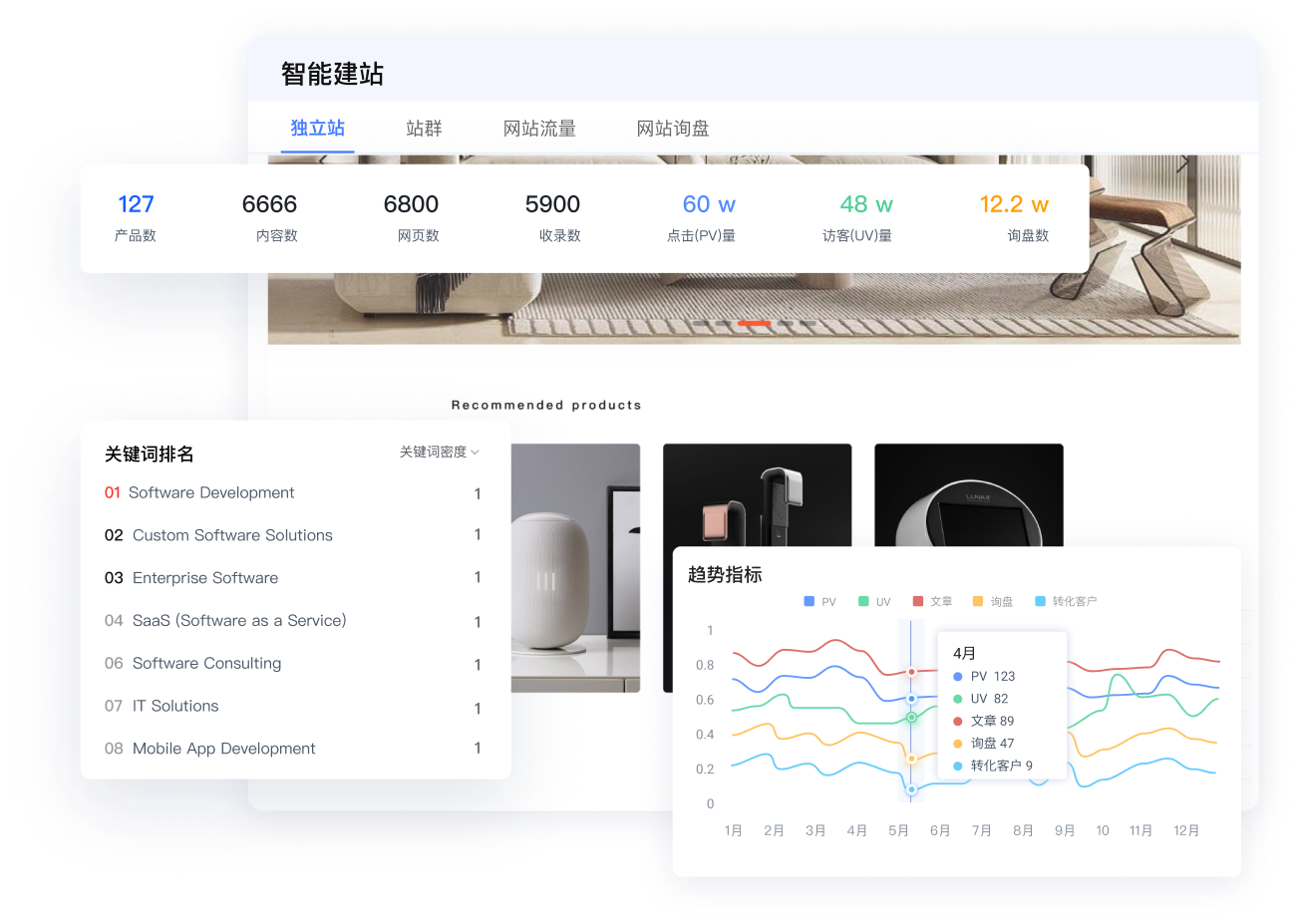
We recommend using a professional foreign trade website building platform, such as ABke Smart Website Builder.
It is optimized for the characteristics of foreign trade websites:
-
Built-in industry templates adapted for B2B structure
-
Supports multilingual SEO
-
Automatic form lead tracking integration
-
Easily add industry solution content modules
With such tools, even beginners can quickly build a search-friendly, clearly structured foreign trade website focused on converting business opportunities .
VII. Summary and Key Practical Points
Key conclusions:
-
B2B foreign trade websites and cross-border e-commerce websites are not the same type of products; they have fundamental differences.
-
B2B websites will only lose their conversion rate by simply copying the design logic of e-commerce websites .
-
The core of a successful B2B website lies in its content, structure, and lead conversion system.
-
For beginners building a website, the key is to focus on three core elements: "building trust, guiding inquiries, and following up."
Practical checklist:
-
Create a company qualification page + solutions page
-
Build standardized product detail pages
-
Output valuable technical content
-
Design a business lead conversion process
-
Improve efficiency by using professional website building tools (such as ABke Smart Website Builder ).
.png?x-oss-process=image/resize,h_100,m_lfit/format,webp)
.png?x-oss-process=image/resize,h_100,m_lfit/format,webp)

.png?x-oss-process=image/resize,h_100,m_lfit/format,webp)
.png?x-oss-process=image/resize,h_100,m_lfit/format,webp)
.png?x-oss-process=image/resize,h_100,m_lfit/format,webp)
.png?x-oss-process=image/resize,h_100,m_lfit/format,webp)
