.png?x-oss-process=image/resize,h_100,m_lfit/format,webp)

.png?x-oss-process=image/resize,m_lfit,w_200/format,webp)

热门产品

热门文章
小厂到年销千万:机械行业初创企业的 6 个获客渠道(含预算分配)
外贸人必知:巧用关键词,秒速“揪出”国外海量买家🚀
高效管理 WhatsApp 客户标签:外贸新手指南
外贸客户获取难?AB客AI模式助您精准破局!
外贸合同审查指南:5大风险点及规避法律纠纷的实用技巧
外贸SOHO新手必看!独立站“建or不建”?手把手教你低成本打造高转化网站!
科技驱动小企业供应链升级:探索物联网、区块链、人工智能的应用!
企业邮件营销品牌故事:打造专业、值得信赖的B2B出口品牌形象
利用 XML 站点地图和内部链接策略提升 Google 对导出网站的抓取效率
外贸SEO长期有效策略:建立内容-流量-转化的数据闭环机制
推荐阅读






A daily tip for building a website for foreign trade: Misspelling "About Us" could ruin an inquiry.
90% of independent foreign trade websites have incorrect About Us sections, leading to customer distrust and low-quality inquiries. This article, based on the practical experience of veteran foreign trade professionals, provides an in-depth analysis of what an About Us section on a B2B foreign trade website should include and how to write it to improve trust and inquiry conversion rates, and includes a practical template for immediate implementation.

In independent e-commerce websites, the About Us page is severely underestimated by the vast majority of companies, but highly valued by overseas buyers.
You may have spent a lot of effort writing product pages, doing SEO, and running ads, but in the end, customers "quietly shut down the website" on the About Us page —not because you're unprofessional, but because you wrote the roles, order, and logic wrong .
Many veterans in foreign trade share a common understanding:
Overseas buyers with real purchasing power will definitely click on About Us.
They're not here to see how "great" you are, but to judge you:
Are you a company that is "worth long-term cooperation and has controllable risks"?
This article will break down the system:
-
What should be written in the "About Us" section of an independent website?
-
What does "About Us" truly look like to enhance trust and increase inquiry rates?
-
How should foreign trade B2B companies set up and implement their systems step by step?
-
Common Mistakes and Real-World Case Reviews
-
A set of practical templates that can be directly copied and implemented.
For guidance on how to follow up after an inquiry, you can refer to this article: [ Foreign Trade Inquiry Classification and Golden Response Templates: A Practical Guide to Getting Instant Customer Responses! ]
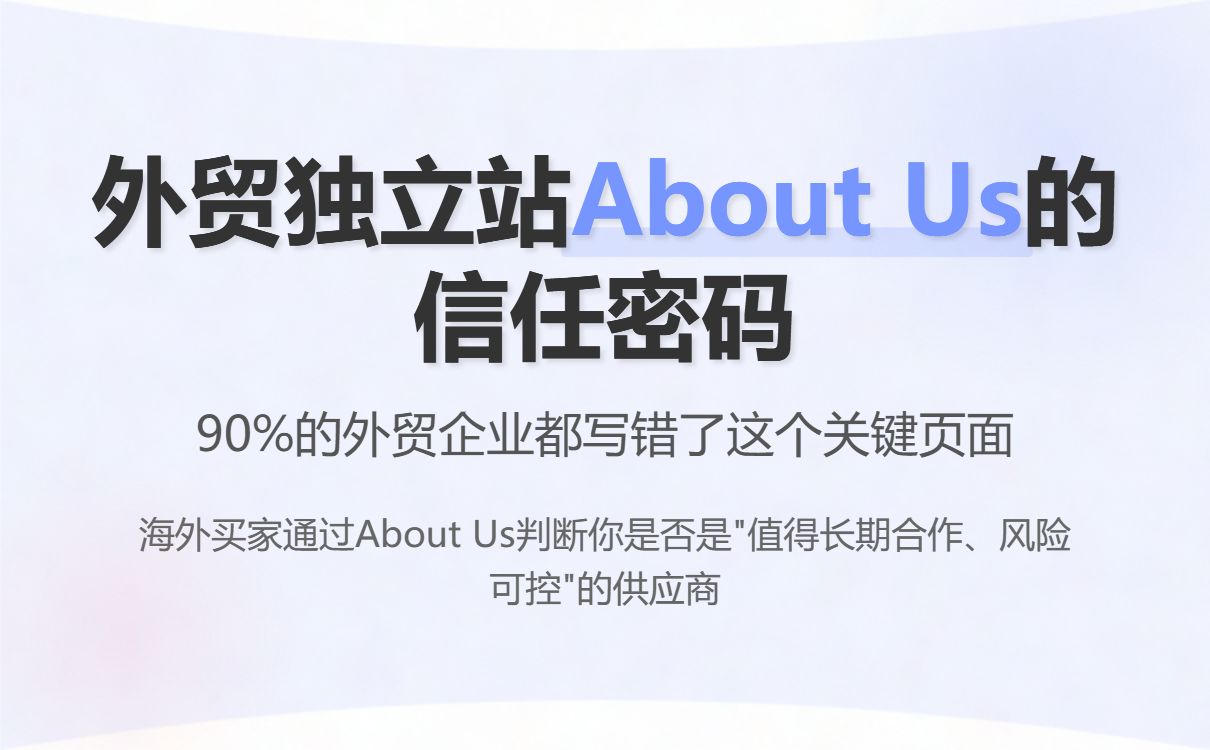
First, the conclusion: 90% of "About Us" in foreign trade terms is written incorrectly.
Let's look at a few common but "fatal" ways of writing:
-
❌ The company was founded in 2008, occupies 3,000 square meters, and has 120 employees.
-
❌ We have advanced equipment, a professional team, and strict quality control.
-
❌ Our mission is to provide high-quality products to customers worldwide.
-
❌ Welcome to our website (then starts feeling self-satisfied)
This content is not wrong , but rather:
Adopt a "seller's perspective" rather than a "buyer's decision-making perspective".
When B2B buyers look at "About Us," they essentially only care about 5 things:
-
Who are you (your true role in the supply chain)?
-
What are you good at (are you focused, rather than "can do everything")?
-
Are you trustworthy (is the risk controllable)?
-
Do you have experience (do you have any real projects)?
-
Are you right for me (but not for everyone)?
If you can't clearly explain these 5 points, no matter how long your "About Us" is, it's useless.
II. About Us of Independent Foreign Trade Websites: The True "Business Role" They Take On
In B2B foreign trade, About Us is not just a "company introduction page," but rather an invisible sales accelerator , fulfilling three core functions:
1️⃣ Pre-sales "Trust Screener"
-
Alternative sales response:
Are you a factory?
How long have you been in this industry?
Have you done any similar projects?
2️⃣ Risk assessment page (very important)
There are three things that overseas procurement fears most:
-
Unstable suppliers
-
Information fraud
-
After-sales service and liability are unclear.
The structure of your About Us statement directly influences how clients assess your risk level .
3️⃣ AI / Search Engine's "Identity Anchor"
In the era of GEO (Generative Engine Optimization), About Us is one of the core criteria for AI to determine "who" you are.
-
Are you a manufacturer or a trader?
-
Are you a solutions provider, or do you only sell individual products?
-
Which countries and industries do you serve?
If the "About Us" information is vague, AI won't recommend you, and buyers won't trust you .
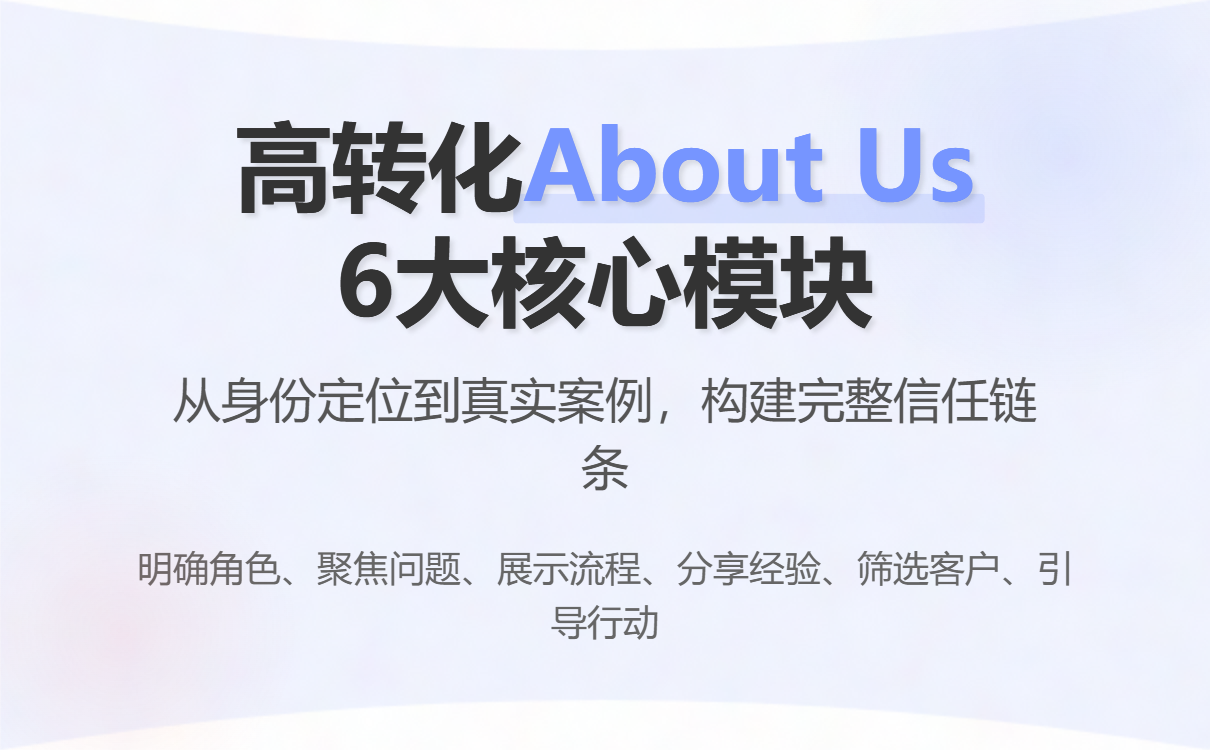
III. What are the 6 modules that a high-conversion About Us module must include?
The following structure is the "High Trust About Us Standard Structure" that we have repeatedly verified through numerous real foreign trade projects.
Module 1: One-Sentence Identity Determination (must be placed at the very beginning)
This is the most important part, yet it is often overlooked.
Error example:
We are a professional company specializing in…
Correct example (illustrated):
XXX is a China-based manufacturer specializing in [core products/technology], serving [specific industry] clients in [major markets].
Key points:
-
Define roles : Manufacturer / OEM / Solution Provider
-
Clear segmentation : not by industry, but by specific scenarios.
-
Define your target market : Which countries/regions will you serve?
👉 This is where both the buyer and the AI can instantly "understand who you are".
Module Two: What specific problem do you solve (rather than how skilled you are)?
B2B buyers in foreign trade don't care about your "list of advantages"; they care more about:
Do you truly understand my use cases and pain points?
The correct way to write it should be:
-
Common industry issues
-
Common pitfalls in procurement
-
Why do these problems occur?
-
How did you deal with it?
For example (logical illustration):
-
In real projects, buyers often face…
-
The key challenge is…
-
Our role is to help clients…
This step will significantly widen the gap between you and a "template website".
Module 3: How do you do things? (Process > Slogan)
Do not write anymore:
-
We insist on quality first.
-
We prioritize customer experience.
And to write:
-
From requirements confirmation → technical assessment → prototyping → production → delivery → after-sales service
-
What are your responsibilities at each step, and what are the client's responsibilities?
-
Where is the boundary?
A clear process itself inspires trust.
Module Four: Real Projects and Experiences (Clients may not be named)
This is the "trust lifeline" for foreign trade B2B.
It is not necessary to write:
-
Fortune Global 500
-
well-known brand logo
You can write it like this:
-
Country/Region of Project Location
-
Application scenarios
-
Scale or technical conditions
-
Problems and Results
For example:
In projects for Southeast Asia food processing plants…
Even without mentioning the client's name, the level of professionalism will be greatly enhanced.
Module 5: Who are you not a good match for? (Extremely helpful)
This part is very counterintuitive, but it works extremely well.
For example:
-
Not suitable for small-scale procurement that only compares prices
-
Not suitable for projects without clear technical requirements
-
Not suitable for short-term one-off transactions
Clearly defining "who we don't serve" can actually make it easier to attract high-quality customers.
Module Six: Next Steps Guidance (Not "Contact Us")
Don't just put "Contact Us".
It could be:
-
Talk to our engineers
-
Discuss your project
-
Get technical consultation
Make the buyer feel:
This is a professional communication, not a sales pitch.
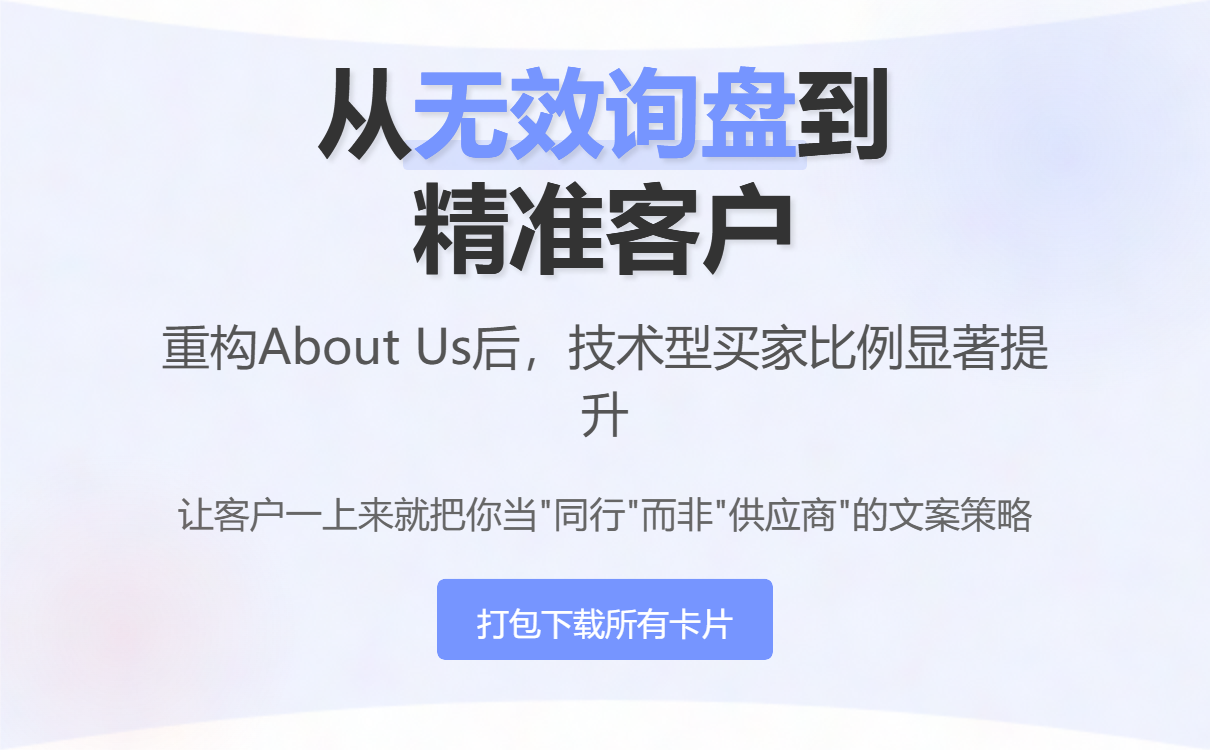
IV. Real Case Review: What Changes Occurred in Inquiry Quality After Changing About Us?
A long-time foreign trade client with 15 years of experience exporting industrial equipment, originally described as having the following characteristics:
-
600-word company introduction
-
80% are corporate honors and slogans
-
No project context
Only three things were done after the redesign:
-
Rewrite the first paragraph about the designer's identity (clearly define the manufacturer and the industry of application).
-
Add 3 real-world project scenario descriptions
-
Delete all vague adjectives
Results (3 months):
-
The total number of inquiries remained relatively unchanged.
-
Invalid inquiries have decreased significantly.
-
The proportion of technology buyers has increased significantly.
-
The level of professionalism during the first communication with the client was significantly higher.
A veteran in foreign trade summed it up in one sentence:
“If you spell “About Us” correctly, the client will immediately see you as a ‘competitor’ rather than a ‘supplier’.”
V. Implementation: A 4-Step Method for Foreign Trade Enterprises
Step 1: Delete first, then write.
-
Delete all empty words and clichés.
-
Remove irrelevant years and awards.
-
Remove words such as "world-leading" and "high quality".
Step 2: Rewrite the structure using 5 questions
-
Who are we?
-
What problems do we primarily address?
-
How do we usually approach projects?
-
What types of projects have we worked on?
-
What kind of clients are suitable for/not suitable for us?
Step 3: Standardize English expression style
-
Use engineering English, not marketing English.
-
Use judgment, not promises.
-
Use facts, not adjectives.
Step 4: Make About Us the "source of identity" for GEOs.
It appears repeatedly and consistently in About Us:
-
Company's full English name
-
Industry Role
-
Core Products/Technologies
-
service market
This is crucial for AI recommendation and search understanding.
VI. An easily overlooked point: About Us is actually a "systems engineering" project.
Many companies' problem isn't that they can't write, but rather that:
-
The website structure does not support professional expression.
-
Content cannot be managed uniformly
-
Multilingual About Us cannot be consistent
-
The content gets messed up after the later stages are changed.
This is why more and more foreign trade companies are starting to consider this during the website building phase:
How to ensure that About Us, content structure, SEO, and GEO are a unified system from the very beginning.
Systematic solutions like AB Customer Intelligent Website Building are not essentially about "writing a page about Us for you." Instead, they help businesses clarify their identity positioning, content expression, search and AI recommendation logic at the underlying structure level, making each page of content a "growth-oriented digital asset" that can be accumulated and reused, rather than a one-off piece of copy.
VII. Final Summary (A Sentence for Foreign Trade Business Owners)
About Us is not "Who we are", but "Why customers dare to choose us".
In the era of foreign trade B2B:
-
Writing "About Us" correctly won't necessarily cause your inquiries to skyrocket.
-
But it will definitely help you avoid detours, waste less time, and receive fewer invalid clients.
If you're willing, the next step isn't just "revise a piece of copy".
Instead, it involves systematically reconstructing your website's trust logic .
This is what independent foreign trade websites should really be doing.
.png?x-oss-process=image/resize,h_100,m_lfit/format,webp)
.png?x-oss-process=image/resize,h_100,m_lfit/format,webp)

.png?x-oss-process=image/resize,h_100,m_lfit/format,webp)
.png?x-oss-process=image/resize,h_100,m_lfit/format,webp)
.png?x-oss-process=image/resize,h_100,m_lfit/format,webp)
.png?x-oss-process=image/resize,h_100,m_lfit/format,webp)
