.png?x-oss-process=image/resize,h_100,m_lfit/format,webp)

.png?x-oss-process=image/resize,m_lfit,w_200/format,webp)

热门产品

Popular articles
High Customer Acquisition Costs in Traditional B2B? A Comprehensive Guide to How AB客 Engine Helps Foreign Trade Enterprises Reduce Costs and Increase Efficiency
Boost Russian Market Ad Click-Through Rates: 3 Proven Steps to Find High-Intent Local Keywords
What are the benefits of building an independent foreign trade website? How difficult is it to do so?
A Step-by-Step Guide to Leveraging the '1+AI' Foreign Trade Marketing Model for Business Growth
Practical Guide to Multilingual SEO Optimization: Key Strategies for Improving International Search Rankings of Chemical Products
A daily tip for building a website for international trade: Struggling to write Google SEO content? Quickly learn this "pain point reverse engineering" method!
Essential Strategies for Global Market Expansion: Context Adaptation of Multilingual Website Clusters and Application of Automatic Optimization Tools
Global Halloween Celebration Guide for B2B: Locations, Cultural Sensitivities, and Channel-Specific Greeting Phrases
海外建站关键词布局指南:提升搜索引擎可见性的实用方法
Can you use the packaging method specified by us?
推荐阅读








.png?x-oss-process=image/resize,h_1000,m_lfit/format,webp)

A daily tip for building a website for foreign trade: The core KPIs of a foreign trade website are not website traffic, but these 3 metrics.
Many foreign trade websites have traffic but no inquiries, the root cause being incorrectly set KPIs. This article breaks down the three core KPIs of a foreign trade website from a practical perspective: effective inquiry volume, inquiry conversion rate, and inquiry quality, and provides quick and easy-to-implement website building and optimization methods to help foreign trade companies transform their websites into a continuous customer acquisition system.

Many foreign trade business owners, marketing managers, and even veteran salespeople with over a decade of experience in foreign trade, when discussing the effectiveness of official websites, all share the same first thought:
How's the website traffic lately?
The question itself is not wrong.
However, if you treat "visit volume" as the core KPI of your foreign trade website, you've likely gone astray from the start.
I've seen far too many foreign trade websites:
-
Hundreds or thousands of visits per day
-
The Google Analytics data looks great.
-
However, inquiries were few and far between, sometimes even zero, over the course of a month.
The problem isn't with traffic, but with the KPIs being defined incorrectly.
The essence of a foreign trade website is never a "display website", but a continuous and quantifiable customer acquisition system .
Truly valuable KPIs focus on only three things.
I. What are the core KPIs of a "foreign trade website"?

Let's start with the conclusion.
The core KPI of an international trade website has only one goal:
We continue to generate overseas inquiries that are "follow-up and can lead to a transaction".
To achieve this goal, there are only three types of KPIs that are truly instructive:
-
Valid Inquiries (Leads)
-
Inquiry conversion rate
-
Inquiry quality (Lead Quality)
"Visits" can only be considered a preliminary reference indicator , not a decision-making indicator.
Let's break it down one by one.
II. Core KPI 1: Valid Inquiries (not the number of messages, but "leads that can be followed up")
1️⃣ What is "effective inquiry volume"?
The "inquiries" that many companies track are essentially:
-
Garbage Inquiry
-
Price comparison emails without a specific requirement
-
He left an email address and then disappeared.
A truly effective inquiry must meet at least three conditions:
-
Define the product/application scenario
-
Leave traceable contact information
-
Possesses the potential for procurement (rather than students or research).
in other words:
A valid inquiry = a lead that sales are willing to follow up on.
This is the first and most important KPI for the official website of foreign trade.
2️⃣ How to quickly increase the number of "effective inquiries"?
The core issue is not "adding forms," but rather reducing "invalid access" and increasing "purchasing-related access."
There are only 3 key points in practical application:
✔ The page must be "procurement-oriented".
-
Product Page: Specifications + Applications + MOQ + Delivery Time
-
Solution page: Problem → Solution → Why you?
-
Industry Page: Written from the buyer's perspective, not just for the company's own amusement.
A page is valuable if it allows buyers to determine whether you are a suitable supplier.
✔ The inquiry entry point should be "clear and restrained".
-
Not aiming for a full-screen CTA
-
One or two specific actions are sufficient for key pages.
-
Form fields should be few, but they must be used to "filter for valid customers".
✔ Content should prioritize "screening people first, then acquiring customers"
You don't want everyone to leave an inquiry, but rather:
Let unsuitable people leave on their own, and let suitable people contact you.
III. Core KPI Two: Inquiry Conversion Rate (The ability to turn "visits" into "actions")
1️⃣ What is inquiry conversion rate?
Inquiry conversion rate =
Number of visits that generated inquiries ÷ Total number of valid visits
This metric directly determines the fate of an official website:
-
It's a "traffic black hole"
-
Still the "transaction entry point"
Many foreign trade websites don't have a lack of traffic, but rather:
90% of visitors leave immediately after viewing.
2️⃣ Why is the conversion rate of foreign trade websites generally very low?
I have summarized three of the most common "fatal flaws":
-
The page structure is messy and I can't understand what problem you're trying to solve.
-
The content reads too much like a brochure and lacks any "procurement logic."
-
Without a guarantee of trust, procurement staff will be hesitant to contact you.
3️⃣ How to quickly improve inquiry conversion rate?
This is the KPI that is easiest to see results in the short term .
✔ The homepage only addresses one question: Are you right for me?
The homepage of the foreign trade website is not a brand showcase, but a procurement filter .
A quick answer is required:
-
What products do you make?
-
Which type of buyer is it suitable for?
-
What are the core advantages?
✔ Key pages must have "trust anchors".
For example:
-
Which countries/industries have you served?
-
Certifications, standards, factory capabilities
-
Real photos, case studies, and data
The core psychology of buyers can be summed up in one sentence:
Are you a reliable supplier?
✔ The behavioral path should be "short".
The fewer steps between entering the page and submitting an inquiry, the better:
-
Less redirection
-
Less interference
-
Less "irrelevant content"
IV. Core KPI Three: Inquiry Quality (The key to determining your "closing cost")

1️⃣ Why is the quality of inquiries more important than the quantity?
If you find:
-
Salespeople deal with spam inquiries every day
-
10 bids, 0 successful bids
-
Time wasted on a large number of low-quality customers
The problem must lie in:
The official website does not have a "screening mechanism".
2️⃣ What constitutes a high-quality inquiry?
High-quality inquiries typically have the following characteristics:
-
Define the requirements or application scenarios
-
Have some knowledge of the product
-
Accepting a reasonable price range
-
Willing to communicate the next step
Even if the number of these inquiries is small, the conversion rate is much higher than that of "massive general inquiries" .
3️⃣ How to improve inquiry quality through the official website?
✔ The content first "discourages unsuitable people"
For example:
-
Define MOQ
-
Define the service market
-
Clearly define the requirements not to do
This step, which may seem like "reducing inquiries," actually increases the conversion rate .
✔ The page logic is aligned with "B2B procurement".
-
Focus more on applications, solutions, and delivery.
-
Stop using empty brand slogans.
-
Use "professionalism" rather than "excitement" to screen people.
✔ The form design itself is a filter.
By designing the fields, we can encourage people who genuinely need them to fill them out.
5. Why do many foreign trade websites never achieve their KPIs?
Ultimately, it boils down to three questions:
-
The website was not designed around KPIs during the construction phase.
-
Content production cannot be sustained
-
Without a data-driven perspective for review and optimization
Many companies aren't lacking in effort; rather, they're simply trying to cram in a systemic problem using only manpower .
VI. A practical solution: Get "website building + content + conversion" working smoothly all at once.

In real-world projects, we are increasingly finding that:
If your foreign trade website's KPIs aren't met, it's not a problem with a particular page, but rather that "the system isn't set up properly."
This is why more and more foreign trade companies are now adopting integrated intelligent website building solutions , solving the following issues all at once during the website building phase:
-
The page structure is naturally designed around "inquiry conversion".
-
Content is continuously generated based on the procurement logic, rather than being delivered all at once.
-
Keywords, semantics, and internal links are automatically matched to the actual search needs.
-
Each page has a clearly defined KPI.
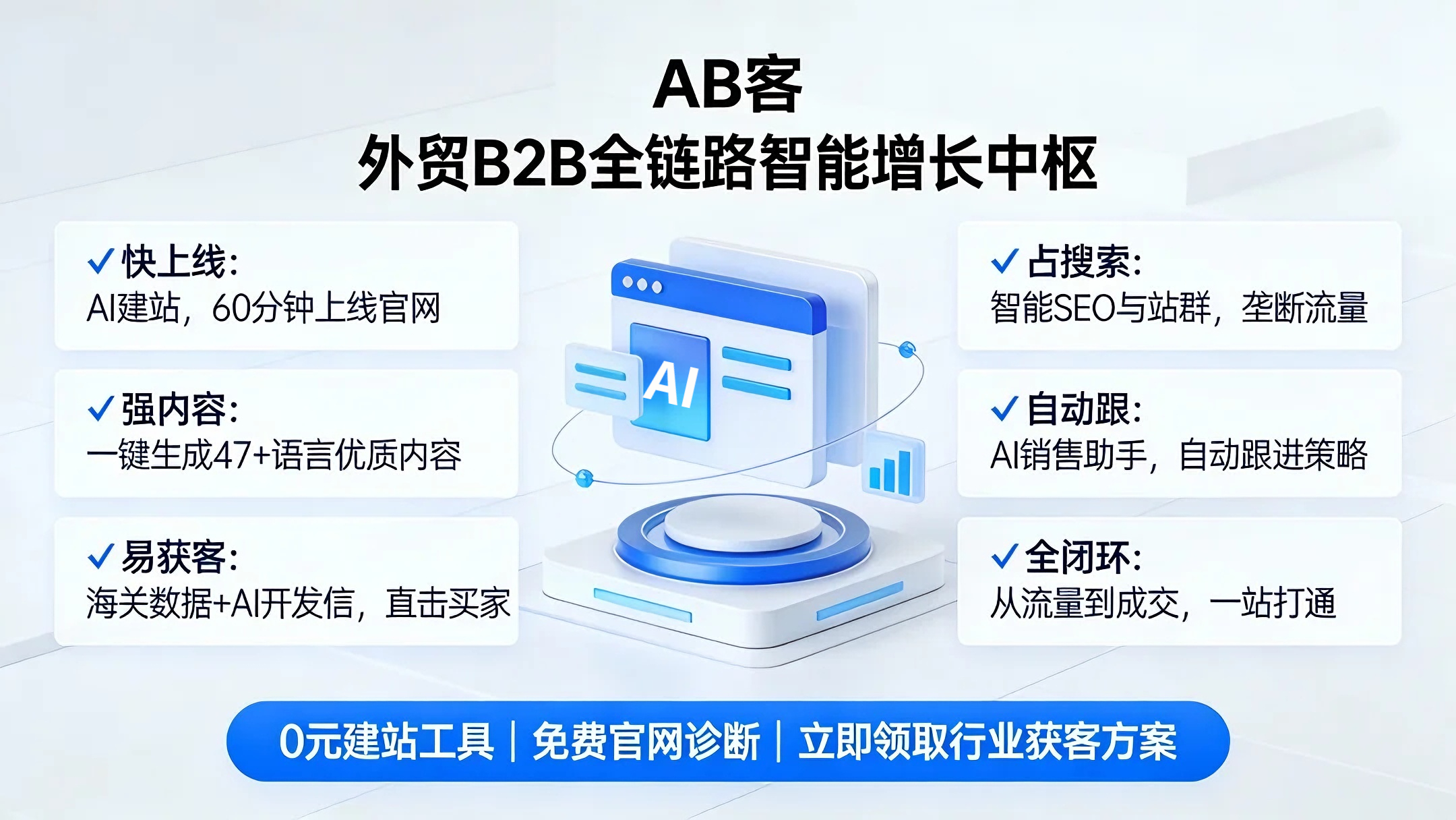
For example, in actual projects using AB Customer Intelligent Website Builder , the official website is not a "finished and done" site, but a continuously iterative growth system :
-
Content can be expanded sustainably.
-
The page can be continuously optimized based on inquiry data.
-
KPIs are quantified from day one, rather than being remedied afterward.
For foreign trade companies, this is far more important than "changing the page again".
VII. In conclusion: Stop comforting yourself with "page views".
If you can only remember one sentence:
The value of an international trade website lies not in how many people have viewed it, but in how many suitable people are willing to contact it.
Starting today, switch your KPIs from "website traffic" to these three metrics:
-
Valid Inquiry Count
-
Inquiry conversion rate
-
Inquiry quality
You'll find that the official website is finally starting to "act like a salesperson" rather than an expensive electronic business card.
.png?x-oss-process=image/resize,h_100,m_lfit/format,webp)
.png?x-oss-process=image/resize,h_100,m_lfit/format,webp)

.png?x-oss-process=image/resize,h_100,m_lfit/format,webp)
.png?x-oss-process=image/resize,h_100,m_lfit/format,webp)
.png?x-oss-process=image/resize,h_100,m_lfit/format,webp)
.png?x-oss-process=image/resize,h_100,m_lfit/format,webp)
