.png?x-oss-process=image/resize,h_100,m_lfit/format,webp)

.png?x-oss-process=image/resize,m_lfit,w_200/format,webp)

热门产品

Popular articles
Boost Russian Market Ad Click-Through Rates: 3 Proven Steps to Find High-Intent Local Keywords
Analysis of the Function Highlights and Application Advantages of Intelligent Website Building Platforms: Creating Marketing-Oriented Official Websites for Foreign Trade B2B Business Goals
A look at new global trade/tariff/customs regulations and bans starting August 1st!
Why Your Alt Text Isn’t Working: 5 Hidden SEO Tips for Foreign Market Image Optimization
Mastering International Social Media Content Creation and B2B Customer Engagement for Global Trade SOHOs
Competitor Keyword Monitoring and Real-time Optimization: Intelligent Website Building Platform Empowers Foreign Trade Enterprises to Precisely Boost Website Organic Traffic
Will RFQs still be effective for getting orders in 2025? A beginner's guide to turning RFQs into high-quality inquiries in 3 steps.
Recommended Reading


(1).jpg?x-oss-process=image/resize,h_1000,m_lfit/format,webp)


A daily tip for building a website for foreign trade: Why do many factory websites "look like scam sites"?
This article provides an in-depth analysis of why export factory websites are not trusted by overseas buyers. It breaks down the essential structure, content, and SEO strategies for high-conversion foreign trade B2B websites using real-world case studies and offers replicable, practical website building methods.

A poignant but true statement:
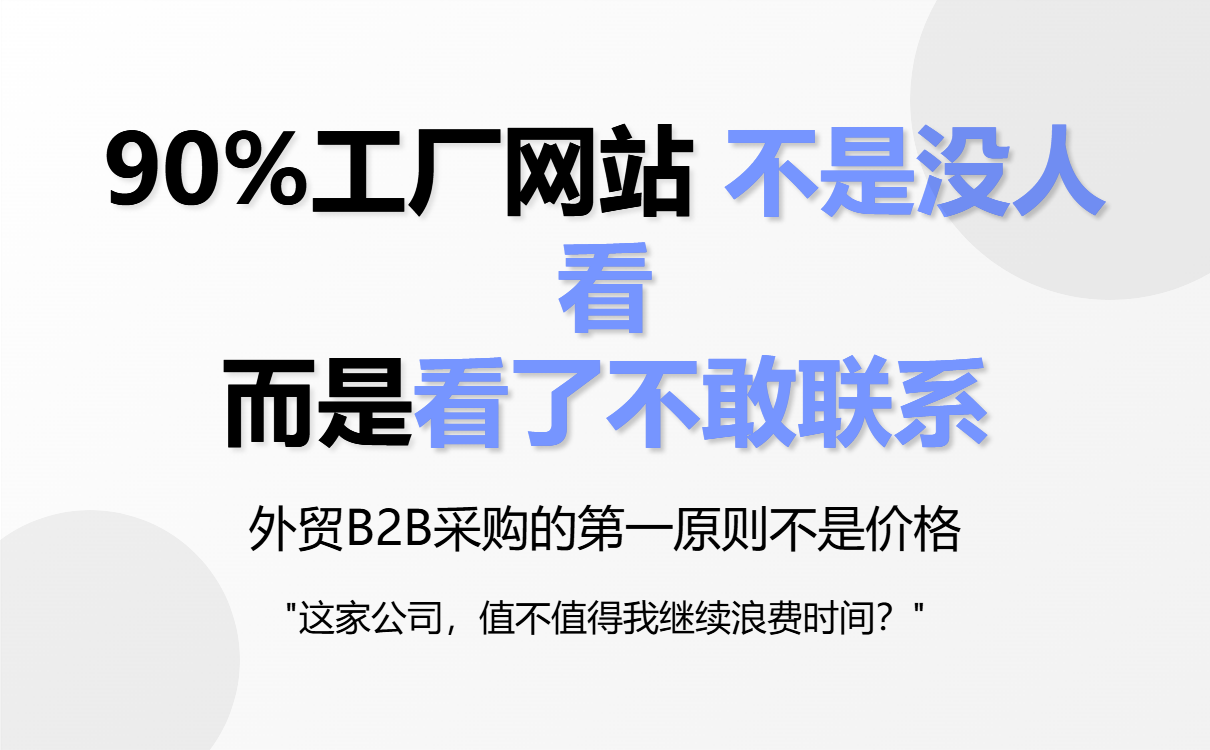
90% of export factory websites are not ignored, but rather people are "afraid to contact them after seeing them".
Many factory owners are confused:
-
The website was clearly paid for.
-
Products, certificates, and pictures are all included.
-
You can also find it on Google.
But the result is:
👉Almost no inquiries
👉 Most inquiries are low-quality, price comparison, or even scams.
The problem isn't traffic, but rather— trust hasn't been established.
1. Why do many export factories' websites look like "scam sites" at first glance?
I'll break it down for you from the perspective of the real psychology of overseas buyers.
1️⃣ From the perspective of foreign buyers, they are "risk-averse," not "product-checking."
The first principle of B2B procurement in foreign trade is not price, but:
"Is this company worth my continued waste of time?"
Many factory websites trigger these "high-risk signals" as soon as they are opened.
❌ Issue 1: The template-like design is too strong, resembling a "disposable website".
Typical characteristics:
-
The homepage features a large banner with the message "Welcome to our website".
-
Product page structures are all the same.
-
Copywriting is like a direct translation by translation software
-
All factories boast "20 years of experience / best quality / competitive price".
From the buyer's perspective:
"This doesn't look like a factory that's actually in operation; it looks more like a page that exists just to cater to search engines."
❌ Question 2: It only asks "Who are we?", but not "Why did you choose me?"
Most factory websites say:
-
Who are we?
-
What equipment do we have?
-
How many employees do we have?
-
How many certificates do we have?
But they almost never answer the five questions that buyers care about most :
-
What type of procurement problem are you better at solving?
-
What types of projects are you suited for, and what types are you not?
-
What are the key differences between you and your peers?
-
How do real customers work with you?
-
If a problem arises, how will you handle it?
👉No decision-making support = Inability to build trust
❌ Question 3: The website resembles a "product catalog" rather than a "pre-sales system".
Many factory websites serve only one real purpose:
"We'll explain it manually when the customer asks."
But the reality is:
-
Before contacting you, the foreign supplier has already screened 5-10 suppliers.
-
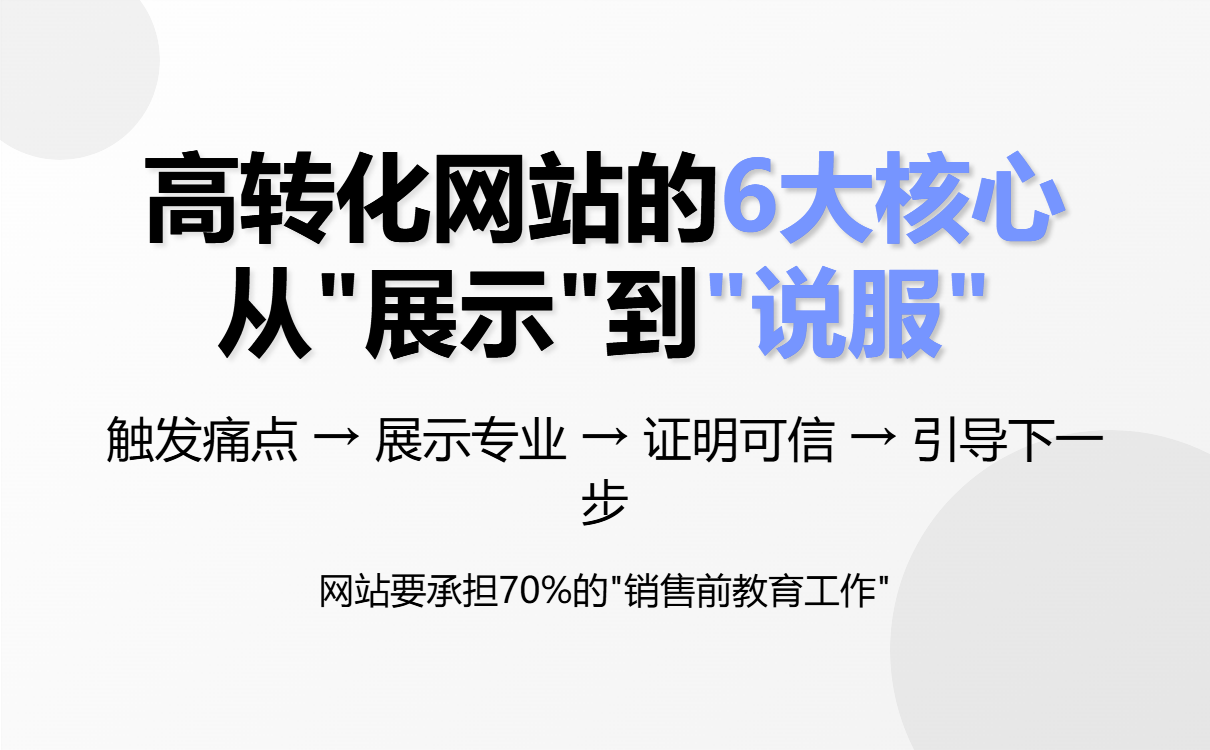
The official website should be responsible for at least 70% of the "pre-sales education work".
If your website only "shows" but doesn't "persuade,"
Then it will forever remain just a decoration.
II. A real-world comparison case: Why do competitors' websites, which don't look as appealing as yours, get inquiries more easily?
This is a real case that I have personally witnessed (the information has been desensitized).
🏭 The contrast between two similar export factories is quite stark.
Factory A (Traditional Website)
-
WordPress Template Sites
-
Product pages 200+
-
Her English is "very standard".
-
Google can find it
-
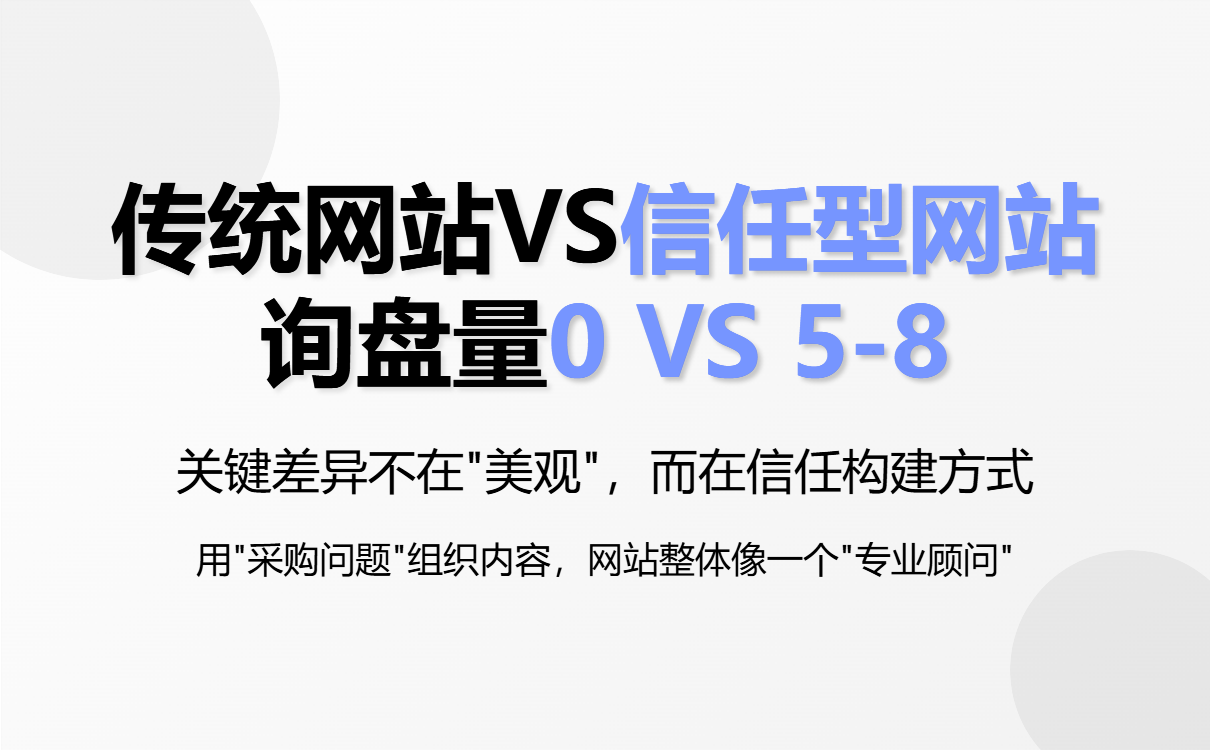
3 months, 0 valid inquiries
Factory B (Structured Website)
-
Not many pages
-
Much of the content consists of "problem + solution".
-
It contains a large number of FAQs, application scenarios, and selection comparisons.
-
A stable 5-8 valid inquiries per month
👉 The key difference lies not in "aesthetics," but in how trust is built .
What three things did Factory B's website do right?
-
Organize the content using "procurement issues" instead of "product models".
-
Each page answers a specific search intent.
-
The website functions more like a "professional consultant" than a "brochure."
This is the underlying logic of a truly high-conversion export factory website .
I've shared other real-world examples before that explain this point in detail. For more information, please click here: [ The Successor's Transformation Battle: Using Digital "Weapons" to Give a New Engine to a 20-Year-Old Family Export Factory ]
III. Six Core Elements That a Truly High-Traffic, High-Conversion Export Factory Website Must Possess
The following section is what you can directly refer to and follow.
✅ Element 1: Website structure based on B2B procurement decision-making logic
Export factory websites must be designed around this decision-making chain:
Problem identification → Solution evaluation → Supplier comparison → Risk confirmation → Communication and coordination
The corresponding website pages should include:
-
Industry Issues Breakdown Page (Pain Points)
-
Application Scenario Solution Page
-
Technical parameters + engineering logic description
-
Real-world project examples (not logo walls)
-
FAQ (covering genuine procurement objections)
👉It 's not about writing a lot, but about writing "correctly".
✅ Element Two: A content system driven by search intent (not keyword stuffing)
Keywords for high-quality factory websites should fall into at least 6 categories:
-
Product core keywords (What)
-
Application scenario terms (Where)
-
Problem/Pain Point Keywords (Why)
-
Solution terms (How)
-
Comparison/Selection of Keywords (Which)
-
Case/Project Keywords (Proof)
Each category of words corresponds to a different page role , instead of being mixed together.
✅ Element Three: The page is the sales pitch, and the structure is the sales script.
A qualified export factory page must have the following internal logic:
Trigger pain points → Demonstrate professionalism → Prove credibility → Guide the next step
Instead of:
“Here is our product, please contact us.”
✅ Element 4: Multi-layered conversion design, not just a single form.
A truly effective B2B website must have a tiered conversion path :
-
Low barrier to entry: Download materials / View solutions / Read FAQ
-
China promises: Technical consultation/Project communication
-
High interest: RFQ / Customized quote / Video conferencing
👉 This will greatly improve the quality of the clues .
✅ Element Five: SEO + GEO (AI Recommendation) Dual-Adaptive Structure
The current reality is:
-
Customers not only use Google search
-
They would also directly ask ChatGPT, Claude, and Gemini.
A high-quality factory website must achieve the following:
-
The content modules are clearly defined and can be understood by AI.
-
Question-and-answer structure
-
Authoritative statement + chain of evidence
-
Schema / FAQ Structured Data
The goal is not ranking, but:
When clients ask AI, "Who should we choose in this field?", you are the one who gets singled out.
✅ Element Six: This is a "long-term asset," not a one-time delivery.
What's truly valuable is:
-
Content assets
-
Search weight
-
Data accumulation
-
Sustainable customer acquisition capabilities
Not a specific page.
Fourth, here's the question: How can an ordinary export factory "quickly" build such a website?
To be honest, building a website using traditional methods is very difficult , and the reasons are quite practical:
-
Writing content is too slow
-
English proficiency is difficult to guarantee
-
SEO/GEO is too complicated.
-
High cost and long cycle
-
It is difficult to verify the effect.
This is why many factories , despite knowing the importance of their official website, struggle to develop one properly .
Fifth, here's a very restrained but truthful statement.
If what you want is:
-
A B2B website truly designed around export factories.
-
Consider "how to get orders" from the perspectives of structure, content, search, and conversion.
-
And we hope it continues to generate inquiries, rather than dying as soon as it's built.
The significance of AB customers lies precisely in this.
AB Customer Intelligent Website Builder doesn't fundamentally solve the problem of "website building," but rather addresses three key aspects:
-
Transform the factory's expertise into content assets that can be searched and understood by AI.
-
Use a systematic approach to replace manual content writing, SEO, and website clustering.
-
Make the official website a long-term, operational customer acquisition system, not just a display page.
Many factories choose AB customers not because they are "fast".
Rather, it's because:
👉Finally , someone has built a website based on the actual transaction logic of foreign trade B2B.
.jpg)
VI. A practical suggestion for export factory owners (very important)
If you are planning to rebuild your official website, I suggest you first check these three issues:
-
Is my website really helping me screen customers ?
-
Does my content answer the real purchasing questions of my clients?
-
If I don't run ads today, will my website still be able to generate inquiries?
If two out of three questions are negative—
What you have now is likely just a "cost item that looks like it's on the official website".
Final summary
The websites of export factories are not designed to "look professional".
Rather, it's about "being trusted before the client actually makes a decision."
Once trust is established...
Traffic, inquiries, and transactions.
Everything will fall into place naturally.
.png?x-oss-process=image/resize,h_100,m_lfit/format,webp)
.png?x-oss-process=image/resize,h_100,m_lfit/format,webp)

.png?x-oss-process=image/resize,h_100,m_lfit/format,webp)
.png?x-oss-process=image/resize,h_100,m_lfit/format,webp)
.png?x-oss-process=image/resize,h_100,m_lfit/format,webp)
.png?x-oss-process=image/resize,h_100,m_lfit/format,webp)
