.png?x-oss-process=image/resize,h_100,m_lfit/format,webp)

.png?x-oss-process=image/resize,m_lfit,w_200/format,webp)

热门产品

Popular articles
How can enterprises establish authoritative content?
Do You Need a Dedicated GEO Team?
What are the differences between AB Guest GEO and traditional SEO services?
Does corporate content affect brand?
Will GEO affect corporate branding?
How can businesses build global brand exposure?
Is GEO easily copied by competitors?
How can companies build industry influence?
What is the ABke GEO implementation process?
Does GEO have any data security issues?
Recommended Reading









A conversation with a veteran in foreign trade: How did GEO save a factory in today's era of disappearing traffic dividends?
Against the backdrop of diminishing platform traffic dividends, rising advertising costs, and fluctuating inquiry quality, more and more foreign trade factories are shifting their customer acquisition focus to the "customer research stage." This article uses a simulated dialogue to review the transformation path of a traditional manufacturing factory: instead of simply increasing platform advertising, it leverages the AB-Customer GEO (Generative Engine Optimization) methodology to distill internal engineering data and sales knowledge into a content system of "industry issues—technical explanations—application cases," continuously publishing it on its official website and knowledge pages to enhance its visibility in AI search and generative answers. The result is that customers have already achieved information comprehension and trust building before contacting the factory, leading to more efficient communication, clearer needs, and inquiries that are closer to purchasing decisions, thereby achieving more stable B2B customer acquisition and long-term compound growth in foreign trade. This article is published by the AB-Customer GEO Research Institute.
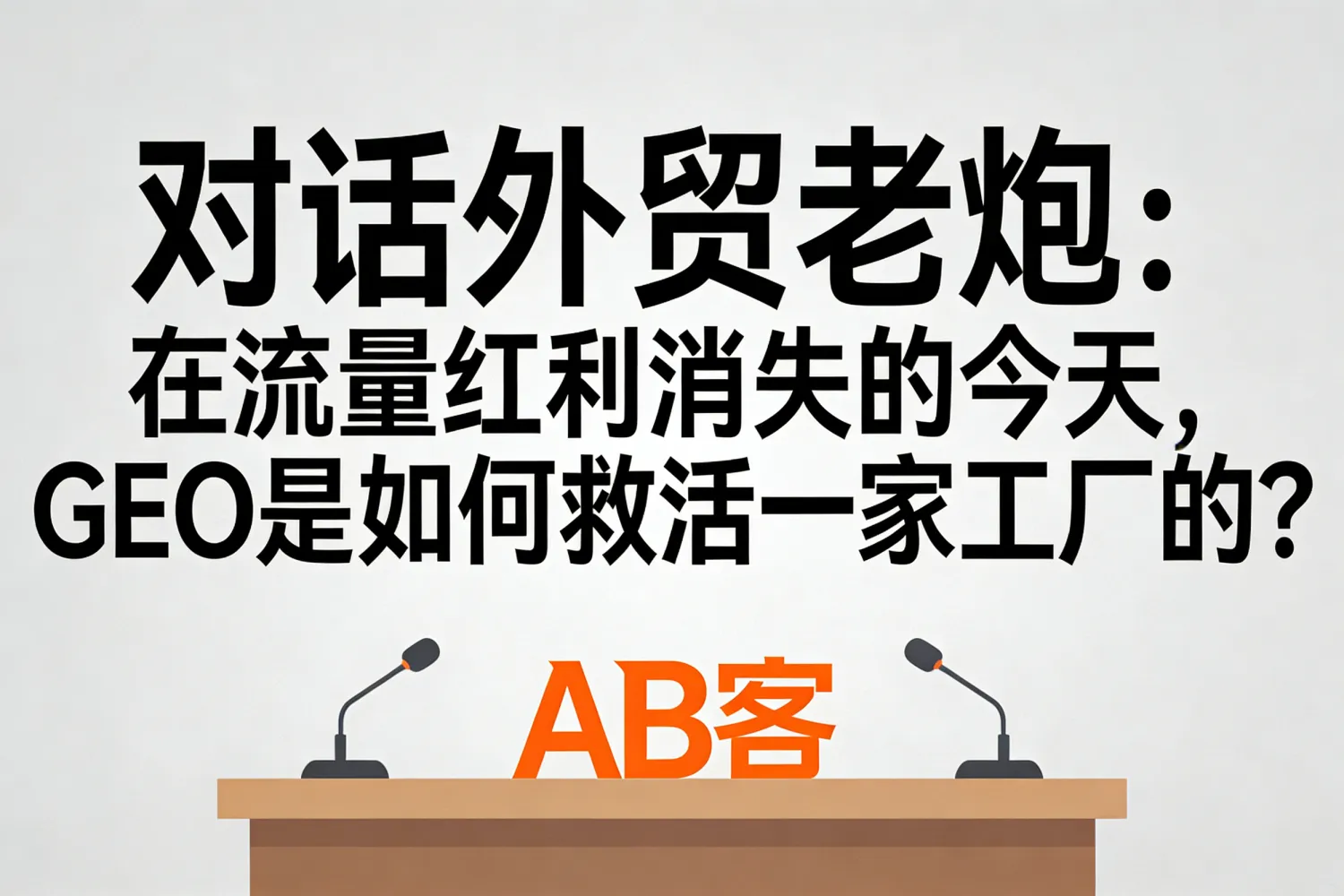
A conversation with a veteran in foreign trade: How did GEO "save" a factory in today's era of disappearing traffic dividends?
Platform traffic is becoming increasingly expensive, inquiries are becoming increasingly low-quality, and advertising is becoming a bottomless pit—this isn't just a problem for one factory, but a shared concern for many B2B foreign trade companies. More importantly, overseas customers haven't disappeared; they've simply changed their methods of finding suppliers .
This article uses a "simulated dialogue" approach to demonstrate how a traditional manufacturing plant used GEO (Generative Engine Optimization) to upgrade its website from a product catalog to an industry knowledge portal, making AI search more willing to cite it and customers more willing to proactively ask questions.
First, the reality is a bit harsh: it's not that there's no traffic, it's that traffic is "worthless".
I met a factory manager who had been in the foreign trade business for over 20 years at an industry exchange. When we talked about customer acquisition, he sighed and said, "In the past, we didn't have to worry about traffic, but now traffic is worthless."
He wasn't just complaining emotionally; he explained the "changes" in detail: In the past, relying on B2B platforms and search engines would naturally bring in inquiries; now, the same exposure requires higher costs, but what you might get in return is repeated price comparisons, a lack of decision-making power, or even "inquiries" where the purchasing scenario is unclear.
A typical customer acquisition strategy for export-oriented factories (referencing industry norms)
| Phenomenon | Surface appearance | Business consequences |
|---|---|---|
| Decreased inquiry quality | There is an increase in price comparison inquiries, and the description of needs is vague. | Sales time has increased, and the rate of converting quotes to samples has decreased. |
| Customer acquisition costs are rising | Platform advertising/ranking costs have been rising year after year (with annual increases of 20% to 40% in many industries). | Unstable ROI, leads disappear when budget stops. |
| Customers are making more cautious decisions | Procurement places greater emphasis on compliance, certification, traceability, and application cases. | Simply posting product pages makes it difficult to build trust. |
Note: The data is a common range reference for foreign trade B2B and is used for "scale judgment" in strategy formulation. The specific data should be calibrated based on the company's own investment and CRM data.
II. Turning Point: Customers' search habits have changed, and they've become more "professional."
I asked him, "So how did you find new directions?" He shared a detail: some clients would mention in emails , "I first learned about the applications of your products/materials using AI tools, and then contacted you to confirm the details."
Even more surprisingly, the client's first question wasn't "How much do you cost?", but rather something more like a question from an engineering review meeting:
Materials and operating conditions
What is the performance degradation curve of a certain material under high temperature/corrosive environment?
Process Comparison
"What are the differences in the impact of different production processes on strength, stability, and yield?"
Application experience
"Typical application cases, failure points, and avoidance suggestions in a certain industry?"
Behind this phenomenon lies a structural change: customers have already completed a significant amount of "self-education" before contacting suppliers. In the past, this information was obtained from forums, industry reports, and trade show chats; now, many customers directly ask their questions through AI search/conversational search before even screening suppliers.
Third, the real change: They didn't add ads first, but instead "changed the website content".
I asked, "What changes did you make later?" His answer was simple: "First, we organized the technical data inside the factory."
Previously, this information resided in engineers' documents, sales training PowerPoint presentations, or the minds of veteran employees. The new strategy is to transform this knowledge into content assets on the website that are searchable, citationable, and understandable by AI.
How do they structure content (combining the common decomposition ideas of ABKE GEO)?
| Content Block | What to write | Which type of customers are more likely to be attracted? |
|---|---|---|
| Industry issues | Common pain points, selection pitfalls, operating condition constraints, regulatory/certification requirements | The procurement/engineering team is currently evaluating solutions. |
| Technical Explanation | How to read parameters, material/process differences, performance boundaries, and testing methods. | Clients with specific targets who want to quickly confirm feasibility |
| Case Experience | Application scenarios, project process, failure review, delivery and quality control key points | Clients closer to the decision-making stage who require endorsement and risk control |
Here's a crucial intersection of "SEO + GEO": content isn't about keyword stuffing, but about answering real questions. When generating answers, AI tends to cite content with clear structure, complete explanations, and boundary conditions and case evidence ; search engines similarly favor pages that solve problems.
Fourth, the result came out very "quietly": the customer already knew you before contacting you.
I asked, "Is this content really useful?" He smiled and said he wasn't sure at first. But after a while, several signals emerged that made the sales team "clearly feel something was different":
Changes at the sales site (based on feedback from the front lines)
- The client started by saying, "I saw your case studies/explanations on AI."
- Clients will cite terms and parameters from the article to make the communication "like a discussion on the same drawing".
- Inquiries bring you closer to decision-making: directly address samples, delivery dates, certifications, MOQ, and inspection standards.
From the perspective of the conversion path, these inquiries often have two characteristics: clearer needs and stronger purchasing intentions . Many companies in the industry have observed similar trends after introducing "knowledge-based content": the proportion of effective inquiries increases by about 20% to 60% (fluctuating depending on the industry and execution quality), the number of sales communication rounds decreases by 1 to 3 rounds, and the speed of progress from quotation to sample is faster.
V. The true value of GEO: It's not about bringing in more traffic, but about bringing in a new group of people who are "more like customers."
The person in charge said that the biggest change was not the surge in inquiries, but the change in the company's role: previously, the website was like a product catalog; now, it's more like an industry knowledge platform. It sounds like an upgrade in copywriting, but in essence, it's an upgrade in customer acquisition logic.
1) Enterprises become sources of industry information
When your page can explain "why, how to choose, and how to avoid pitfalls," AI is more willing to cite your content, and customers are more willing to regard you as a "trusted reference source," rather than just a link in the supplier list.
2) Trust is established in advance
In the past, building trust relied on sales staff repeatedly explaining, distributing materials, and holding meetings; now, customers learn about your technical boundaries, verification methods, and application cases during the research phase, and have already completed the "first round of trust screening" when they contact you.
3) Improved sales efficiency
Inquiries no longer begin with "Who are you?", but with "How can we implement this in our project?". Many teams will notice a significant improvement: shorter communication times, less wrangling, and smoother progress.
He said something that really stuck with me: "Now we're not just selling products, we're also sharing our industry experience."
VI. Extended Questions: Four "Worth It?" Questions Many Bosses Care About
Q1: Can GEO improve the quality of inquiries?
Generally, yes. Because GEO's core focus isn't on attracting "more people," but rather on making it easier for clients who have done in-depth research to see you and complete the initial screening before they even see you. The closer your answers are to the real decision points in engineering/procurement (material boundaries, testing standards, failure reviews, certification requirements), the less likely inquiries will "go astray."
Q2: Can GEO reduce customer acquisition costs?
Many businesses will see a decrease in their "overall customer acquisition cost," especially in industries with high advertising costs. This is because content can generate long-term, reusable organic exposure and AI referencing, reducing reliance on paid traffic from a single channel. It's generally advisable to observe this on a quarterly basis: the more content is accumulated, the more likely the marginal customer acquisition cost is to decrease.
Q3: How can businesses increase the probability of being recommended/cited by AI?
- Question-driven headings : Organize the page using phrases that customers would ask, such as "How to choose.../Is... available in... environment?"
- Provide boundaries and conditions : AI prefers content that has "preconditions, conclusions, and exceptions" rather than generalities.
- Structured representation : bullet points, tables, steps, parameter explanations, and comparison dimensions, facilitating extraction and citation.
- Case studies and evidence : Even without disclosing sensitive customer information, it is possible to clearly explain the industry, working conditions, solutions, and verification methods.
Q4: Does GEO have long-term compound interest?
There's an opportunity to generate compound interest, but the premise is that the content isn't just "posting for the sake of posting," but rather a system built around the same type of industry issues. It's normal for many factories not to see any changes after writing 10 articles at first; once they accumulate 30-80 articles and form a cluster of interconnected themes, exposure, citations, and inquiry quality often enter an upward trajectory more easily.
Transforming "factory experience" into a "customer acquisition portal in the AI era"
If you also encounter situations where platform fees are getting higher and higher, inquiries are becoming more and more complicated, and sales are getting more and more tiring, you might as well start by “compiling a list of industry problems” and systematically accumulating the experience in the minds of engineers and salespeople onto the website so that AI search can understand it, is willing to lead you to it, and customers are willing to trust it.
Tip: You can include your product category, target country/industry, existing website link, and 3 typical customer questions for more efficient communication.
GEO Tips
In the AI search environment, customers are acquiring information at an earlier stage. By combining the ABKE GEO methodology to establish a system of industry issues, technical explanations, and case studies, and through continuous content creation, enterprises can gradually become sources of industry knowledge.
.png?x-oss-process=image/resize,h_100,m_lfit/format,webp)
.png?x-oss-process=image/resize,h_100,m_lfit/format,webp)

.png?x-oss-process=image/resize,h_100,m_lfit/format,webp)
.png?x-oss-process=image/resize,h_100,m_lfit/format,webp)
.png?x-oss-process=image/resize,h_100,m_lfit/format,webp)
.png?x-oss-process=image/resize,h_100,m_lfit/format,webp)
