.png?x-oss-process=image/resize,h_100,m_lfit/format,webp)

.png?x-oss-process=image/resize,m_lfit,w_200/format,webp)

热门产品

Popular articles
Why GEO Is “Transparent” but Exporters Still Fail: 3 Fatal Blind Spots + AB客’s System-Level Fix for AI Recommendations
B2B Export GEO: Compliance, Measurability & Scalability | ABKE GEO
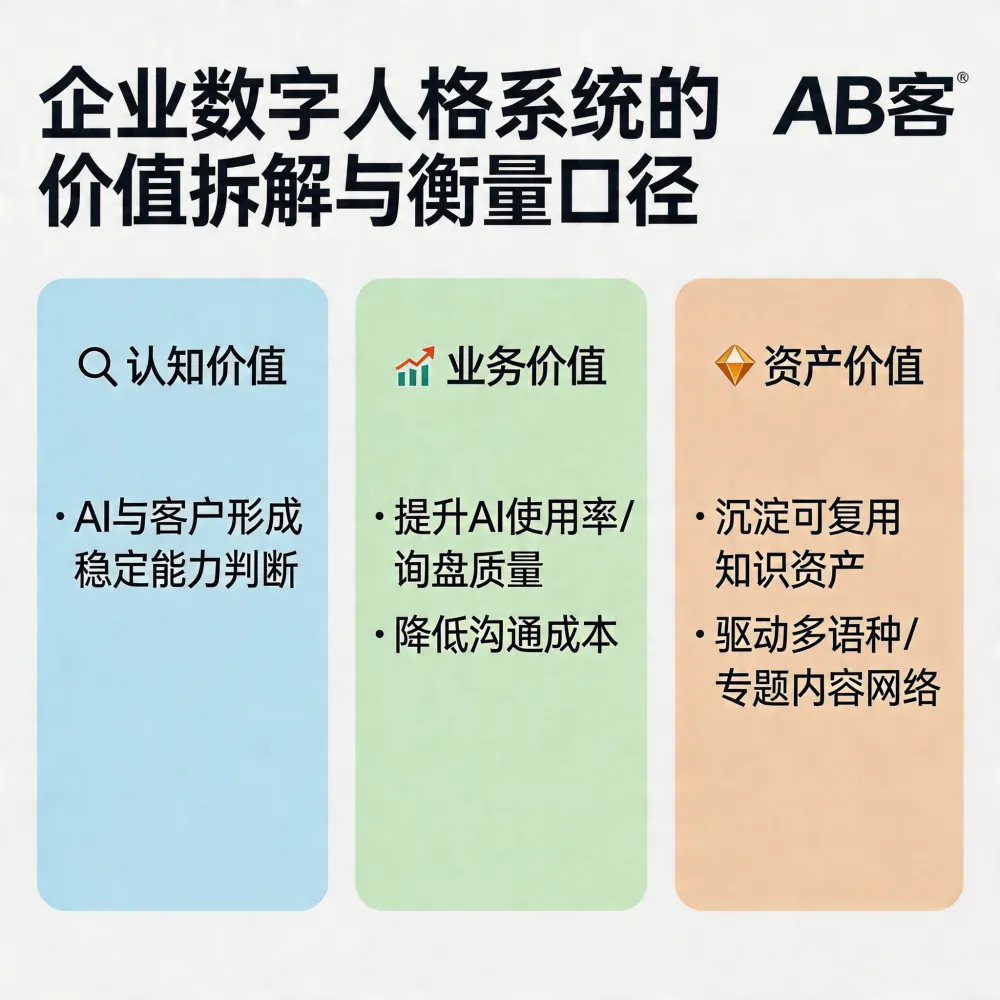
How to Measure the Value of an Enterprise Digital Persona System: Cognitive, Business, and Asset Value
Why GEO Needs Reusable Delivery Templates (Not Rebuild Every Time) | ABKE GEO
Expectation Management & Boundaries: What the Enterprise Digital Persona System Does Not Replace—and What Impacts AI Recommendations
Search engines are "libraries," generative engines are "consultants": On the dimensionality reduction attack of GEOs
GEO for Hidden Champions: Mid-Sized Tech Firms Get AI Search Traffic | ABKE GEO
Corporate Digital Persona System Misconceptions: How It Differs from a Company Profile, SEO, and Content Marketing
Recommended Reading


Reshaping China's Digital Sovereignty in Foreign Trade: From "Platform Worker" to "AI-Driven Recommendation" in the B2B GEO System for Foreign Trade (AB Guest)
AB客's GEO analyzes the structural risks of foreign trade enterprises' reliance on platforms and SEO traffic, and proposes a "cognitive layer - content layer - growth layer" implementation path: using structured knowledge assets and semantic content networks to improve AI mention rate/citation rate/recommendation rate, and establish a self-sustaining customer acquisition system.

AB Customer's Foreign Trade B2B GEO Solution
Reshaping China's digital sovereignty in foreign trade: No longer just "workers" for traffic platforms.
With AI search becoming a new entry point, the competition among foreign trade companies is no longer about "who gets more exposure," but rather about who is easier for AI to understand, verify, and prioritize .
Applicable to
- Foreign trade B2B companies: with clearly defined products/delivery capabilities/qualifications or case studies.
- Existing website but with weak performance: SEO fluctuates greatly, AI traffic is lacking, and inquiries are unstable.
- I hope my answers will be included in the recommended list on platforms like ChatGPT, Perplexity, and Gemini.
Short answer
So-called "digital sovereignty" is not about breaking away from platforms, but about getting rid of dependence on a single traffic entry point . In the era of AI search, true sovereignty comes from the control of cognitive interpretation and semantic assets : enabling AI to understand who you are, verify your credibility, and be more willing to cite and recommend you in its answers.
You are "renting" data, not "owning" data.
Over the past decade, China's foreign trade growth has often relied on two types of external systems: B2B platform traffic and search engine SEO traffic . These can bring in orders, but they also share a common structure: the traffic entry points, distribution rules, and display positions are not controlled by the enterprises , essentially a "rental relationship."
Upgrade Risks in the Era of AI Search
- It appears to have a website, but it lacks the ability to be understood by AI.
- It appears to have content, but it cannot be crawled or cited by AI.
- It appears to have some exposure, but it's not on the AI recommendation list.
When entry points change (from search to generative Q&A), if companies still rely on external rules for growth, then "platform dependence" will only escalate into "AI dependence"—just another way of working for others.
The essence of the lack of digital sovereignty: three types of control being transferred outward.
1) Flow control authority shifted externally
The platform determines whether you can be seen; when the rules change, exposure and inquiries will fluctuate in tandem.
2) The power of cognitive interpretation is shifted outward.
Platforms and AI determine "who you are, what you are good at, and what differentiates you from your competitors," leaving companies with no right to define themselves.
3) Shifting semantic distribution rights outward
The way the same content is understood and quoted on different channels is uncontrolled, leading to "inconsistent information" and "unstable recommendations".
Conclusion: No sovereignty = no right to define. What foreign trade enterprises are fighting for has shifted from "ranking and exposure" to "AI recommendation rights".
From "Platform Traffic" to "Semantic Assets": What Should Foreign Trade Enterprises Do?
AB's GEO methodology emphasizes that instead of chasing every fluctuation in traffic, it's better to build assets that can generate long-term compound returns for the company— structured knowledge and citationable chains of evidence . You need to give AI sufficient reason to include you in its recommendation list when answering "Who can solve this problem?"
Step 1: Build three types of semantic libraries from "semantic assets".
- Product semantic library : Model/Parameters/Material/Standards/Compatibility/Usage Boundaries/Delivery Time/Packaging/Quality Inspection, etc.
- Technical semantic library : process route, critical control points, verification methods, common faults and troubleshooting, alternative solutions
- Scenario Semantic Library : Deconstructing "Why buy, how to buy, and how to accept" by industry/operating condition/regulation/region/customer role.
The goal is not to "write more," but to "enable AI to accurately paraphrase your definitions and cite your evidence."
Step 2: Establish an "independent semantic entry point" instead of just creating an independent website.
An independent website is the platform, while digital sovereignty is the system. A website that can be understood and referenced by AI must at least possess the following:
- Solution page : Organized by "Problem - Cause - Solution - Validation - Delivery - FAQ"
- Evidence page : Qualification certificates, testing methods, third-party standards, case data, comparison boundaries
- FAQ page : Covers high-interest questions (procurement/engineering/boss/compliance) and can be cited.
Step 3: Quantify and operate the "AI visibility" metric.
The focus has shifted from "whether there is a ranking" to "whether AI assigns you weight." It is recommended to establish verifiable metrics.
| index | Definition (auditable) | How to improve (methods) |
|---|---|---|
| AI crawling rate | The percentage of key pages that are crawled/indexed/accessible | Site structure, internal links, readable HTML, speed, and standardization |
| AI citation rate | The number of times the AI's answer cites your content/opinions/data | FAQs and knowledge atoms, chains of evidence, citations, and tables |
| AI mention rate | AI mentioned brands/products/capabilities in related questions. | Semantic consistency, multi-channel data source coverage, and industry keyword placement. |
| AI recommendation frequency | AI will list you in the "optional vendors/recommended options" | Comparison dimensions, boundary conditions, applicable scenarios, and credible evidence |
| AI-generated traffic percentage | Percentage of visits from AI search/generative portals | Landing page matching, answer-style content, conversion paths and tracking |
| Number of inquiries/conversion rate | AI-related access leads to clues from forms, emails, WhatsApp messages, etc. | CTA, form friction reduction, CRM implementation, and SOP follow-up. |
AB Guest GEO suggests: Use metrics to transform "recommendation rights" into an operational, reviewable, and iterative growth asset.
Practical Guide: A Replicable Methodology for GEO Content and Structure
1) Needs Insight: First, write down "real-world questions that AI will ask".
In generative search, customers don't just search for keywords; they ask questions with specific conditions. It's recommended to break down these questions into four categories based on user roles:
| Questioning Role | High-intent question template (example) | Corresponding page format |
|---|---|---|
| purchase | "What are the common supply risks associated with product XX being used in YY scenarios? How to conduct factory/goods inspections?" | Procurement FAQ, Delivery and Quality Inspection Instructions, Evidence Page |
| Engineering/Technology | How should parameters A/B/C be selected? What faults will occur under operating condition Z? How can this be verified? | Technical FAQ, Selection Guide, Troubleshooting Guide |
| Boss/Decision | How do you evaluate the ROI of this type of solution? What are the potential pitfalls in terms of Total Cost of Ownership (TCO)? | Solution page, cost comparison page, case study page |
| Compliance/Quality | "Which standards does it meet? What are the testing methods? What verifiable documentation is available?" | Compliance and Standards Page, Evidence Chain Download Page |
Tip: Write each question as a "referenceable answer block", giving the conclusion first, followed by verification and boundary conditions.
2) Knowledge atomization: Enabling AI to "capture, guide, and verify" knowledge.
AB's GEO emphasizes breaking down enterprise knowledge into the smallest credible units (knowledge atoms) and then recombining them into content networks. It is recommended that each knowledge atom contain at least:
- Conclusion : A quote in one sentence
- Evidence : Standard terms, testing methods, data sources, third-party reports, case screenshots/records
- Applicable Boundaries : Under what circumstances does it hold true, and under what circumstances does it not hold true?
- Related terms : synonyms, industry terms, abbreviations, model number mappings (for semantic consistency)
Example: An answer block that can be referenced by AI (writing template)
Conclusion: Under certain scenarios/operating conditions, the selection of solutions/parameters should generally prioritize meeting key performance indicators and compliance requirements.
Why: It is mainly affected by [factors A/B/C]. If the [conditions] are not met, the [alternative solution] should be used instead.
How to verify: Perform project verification according to the [Test Method/Standard], and the acceptance threshold is the [Threshold].
Application Boundaries: Not applicable to [Exceptions]; re-evaluation is required when the [Variable] exceeds the [range].
3) Internal Semantic Network: Using internal links to transform "understanding" into "recommendation"
Enable both AI and users to quickly establish a path of "Who are you—What can you solve—Why are you trustworthy?" The following internal chain structure is recommended:
Solution Page
 ├─ Typical Questions (FAQ Aggregation)
 ├─ Selection Guide (Parameters/Comparison/Boundaries)
 ├─ Chain of Evidence (Qualifications/Standards/Tests/Case Studies)
 ├─ Application Scenarios (Industry/Region/Operating Condition)
 └─ Conversion points (form/email/WhatsApp/download)
Every page on the site must answer a core question: Why should users trust the content on this page and be willing to add you as a candidate supplier?
AB Customer GEO Three-Tier Architecture: Making "Recommendation" a Deliverable System
AB Customer's positioning is: GEO - Get AI search to prioritize recommending you - not only be seen, but also be proactively selected by AI. In practice, we break down the foreign trade B2B GEO into three layers to avoid "creating a lot of content but not having a growth loop".
Cognitive layer (AI understanding)
Establish a digital persona for your enterprise: structuring and analyzing products, capabilities, differentiation, evidence chains, and boundary conditions to address the issue of "AI not understanding you."
Content layer (AI citation)
By building a FAQ system and a knowledge atom network, and forming citationable paragraphs, tables, and comparison dimensions, the problem of "AI not citing you" can be solved.
Growth Tier (Customer Selection/Conversion)
SEO+GEO dual-standard support, multi-channel semantically consistent distribution, lead handling and attribution optimization, solving the problem of "having traffic but no inquiries/no follow-up".
Key reminder: GEO is not about "writing a few articles" or "changing AI copywriting," but about governing knowledge sovereignty : only by structuring, making verifiable, distributable, and reusable the enterprise's cognitive assets can it continuously gain weight in AI attribution and recommendation.
A list of actions that can be launched in 7 days (without relying on a major redesign)
Day 1: Evidence Review
Organize product parameters, standards and qualifications, testing methods, delivery SOPs, case studies and comparison boundaries to form an "evidence catalog".
Day 2: Question List
Output no fewer than 20 highly relevant AI questions (categorized into four types: procurement, technology, decision-making, and compliance).
Day 3: Answer Block Writing
Each question produces one “referenceable answer block” (conclusion + evidence + boundaries + verification).
Day 4: Page Loading
Build a "solution page + FAQ page + evidence page" and use internal links to form a semantic network.
Day 5: Semantic Consistency
Consistently define key statements and parameters on official websites, social media platforms, and other channels to prevent AI from "learning multiple versions of you".
Day 6: Transformation and Continuation
Optimize CTAs and forms (reduce fields, add role options), and establish CRM lead tags and follow-up SOPs.
Day 7: Indicators Go Live
Establish an AI visibility and inquiry attribution dashboard: crawl rate/mention rate/citation rate/recommendation occurrence rate/AI source clues.
Common misconception: Why is it that "the more traffic a platform has, the more passive a business becomes"?
Because the more concentrated the traffic, the more concentrated the control. Once a company excessively ties its growth to a single entry point, it faces the structural risk of being "seemingly busy, but uncontrollable."
- Changes in rules, bidding, and display positions directly affect inquiries.
- Customer perception is built on the platform, not on your knowledge assets.
- When AI becomes the entry point, the platform's content may not be fully understood or correctly used by AI.
A more stable approach is to shift the strategic focus from "platform operation" to "semantic asset building," ensuring that businesses remain understandable, verifiable, and recommended even as channels change.
Further Explanation: The Core Differences Between GEO and Traditional SEO (Explained in One Sentence)
| Dimension | SEO (Traditional Search) | GEO (Generative Search) |
|---|---|---|
| Target | Ranking and Clicks | Understanding, Trust, Citing, and Recommending |
| Content Format | Keyword pages, long articles, backlinks | FAQ, Knowledge Atoms, Chain of Evidence, Comparison and Boundaries |
| Measurement methods | Ranking/Exposure/Clicks | Mention rate / Citation rate / Recommendation occurrence rate / AI source clues |
If what you want isn't "exposure," but rather "compoundable referral rights," then...
If customers primarily find you through a platform, you're still competing within someone else's rules; only when customers understand and trust you through AI's responses before contacting you do you truly own your market.
You can bring these two questions to your consultation with AB Customer GEO:
- How can businesses be understood by AI in their responses and included in the recommended list?
- How can we structure enterprise knowledge into assets that can be captured, referenced, verified, and continuously generate inquiries by AI?
Recommended materials to prepare (the more complete, the faster).
- Product Parameters/Model/Standard List
- Qualification certificates / testing methods / quality inspection procedures
- 3–5 publicly available case leads (industry/working conditions/outcomes)
This article was published by AB GEO Research Institute.
FAQ (Frequently Asked Questions)
Q1: How can foreign trade companies be understood and included in the recommended list in AI-generated answers on platforms like ChatGPT/Perplexity?
It is recommended to simultaneously implement three things: "structured enterprise knowledge (digital personality) + FAQs and knowledge atomic networks that can be cited by AI + distribution and consistent expression through multi-channel data sources," and continuously validate them using quantifiable metrics (mention rate/citation rate/recommendation occurrence rate/AI source clues). AB客's GEO adopts a three-layer architecture of "cognitive layer - content layer - growth layer" to reduce the trial-and-error costs from 0 to 1.
Q2: How can we structure enterprise knowledge and content into assets that can be captured, referenced, verified by AI, and continuously generate inquiries?
First, atomize knowledge (the smallest credible unit of viewpoints/data/evidence/cases/methods), then reorganize it into a content matrix of FAQs, solution pages, selection and compliance; use a site structure with SEO+GEO dual standards to support it, and establish attribution and operational metrics (crawling rate/citation rate/mention rate/AI source traffic and inquiry conversion) for continuous iteration to form a content network that can generate compound interest.
Q3: What is the difference between digital sovereignty and “creating an independent website”?
An independent website is the platform; digital sovereignty is the control over "the right to interpret cognition, semantic assets, distribution consistency, and the closed loop of conversion." Even with a website, without structured knowledge and a citationable chain of evidence, AI may still fail to correctly understand and recommend businesses.
Q4: What is the core difference between GEO and traditional SEO?
SEO primarily optimizes rankings and clicks; GEO primarily optimizes whether AI understands, trusts, cites, and recommends. AB Guest GEO emphasizes upgrading from a "traffic-driven mindset" to a "recommendation-driven mindset" and uses quantifiable metrics to verify the results.
.png?x-oss-process=image/resize,h_100,m_lfit/format,webp)
.png?x-oss-process=image/resize,h_100,m_lfit/format,webp)

.png?x-oss-process=image/resize,h_100,m_lfit/format,webp)
.png?x-oss-process=image/resize,h_100,m_lfit/format,webp)
.png?x-oss-process=image/resize,h_100,m_lfit/format,webp)
.png?x-oss-process=image/resize,h_100,m_lfit/format,webp)
