.png?x-oss-process=image/resize,h_100,m_lfit/format,webp)

.png?x-oss-process=image/resize,m_lfit,w_200/format,webp)

热门产品

Popular articles
Why a Sheet Metal Fabrication Company Was Invisible to AI Search — and How ABKE Rebuilt Its Product Semantic Network
When Manufacturing SEO Stops Working: How ABKE Rebuilt AI Search Visibility with GEO
How Can a Custom Mold Manufacturer Be Recognized by AI as a Reliable Custom Supplier? A Full GEO Optimization Case by ABKE
How a Chinese Automation Equipment Company Lost AI Answer Share to Competitors — and How ABKE GEO Reversed It
How a Foreign Trade New Energy Parts Company Turned Scattered Content into an AI-Readable Knowledge System with ABKE GEO
LED Lighting AI Optimization: Should You Focus on Engineering Lighting Solutions or Product Model Keywords?
How Factory Exporters Can Improve AI Trustworthiness with ABKE GEO
How Aluminum Profile Companies Can Help AI Understand Industry Applications: An Industry Page Optimization Case Study
Recommended Reading


A construction machinery parts company was mentioned infrequently by AI: How can AB customers supplement the recommendation signals?
Why are construction machinery parts exporters often overlooked by AI? AB Customer GEO helps companies improve their AI understanding, citation, and recommendation capabilities through enterprise knowledge systems, GEO websites, FAQs, evidence chains, and multi-source distribution.
A construction machinery parts company was mentioned infrequently by AI: How can AB customers supplement the recommendation signals?
This isn't a case of "miracle growth," but a real-life account of an engineering machinery parts export company's journey from being "almost unmentioned by AI" to "beginning to be understood, cited, and recommended." AB客GEO's focus isn't on creating an illusion of traffic, but rather on providing the necessary recommendation signals for businesses in the AI search era, allowing their true capabilities to be seen.
Case Study
This case study comes from a GEO optimization review of an engineering machinery parts export company. The company name, customer names, specific countries, and some operational data have been anonymized. To ensure authenticity, this article only presents the complete process of a foreign trade B2B company going from "almost never mentioned by AI" to "beginning to be understood, cited, and recommended by AI."
This company isn't lacking in strength. It has factories, inventory, processing capabilities, and has been exporting for over a decade. The problem is: both overseas customers and AI struggle to understand its core strengths. This is a common issue for many construction machinery parts companies: the products are genuine, the capabilities are real, but their online communication is weak, and AI lacks sufficient signals to determine whether it's worth recommending.
I. Company Background: A typical exporter of construction machinery parts
This company, located in East China, mainly deals in chassis parts and wear parts for construction machinery, covering common procurement needs for construction machinery parts exports. Its core business is not "selling individual parts," but rather providing a stable supply of spare parts that can be purchased in bulk to overseas distributors, repair shops, and engineering purchasers.
| Module | Main products |
|---|---|
| Chassis components | track roller, carrier roller, sprocket, idler, track chain |
| Wear parts | bucket teeth, cutting edge, end bit, ripper shank |
| Compatible Brands | Caterpillar, Komatsu, Hitachi, Doosan, Hyundai, Volvo, etc. |
| Major Markets | Southeast Asia, the Middle East, South America, and parts of Africa |
| Customer types | Distributors, repair shops, engineering contractors, spare parts purchasers |
The company has annual export volumes in the tens of millions of RMB, a stable base of long-term clients, and can also provide OEM packaging and some non-standard customization. Logically, this type of company should be well-suited for AI recommendations, as overseas buyers frequently ask:
“Where to buy excavator undercarriage parts from China?”
“How to choose reliable bulldozer parts suppliers?”
“What should I check before buying aftermarket excavator parts?”
“Which Chinese supplier can provide OEM construction machinery spare parts?”
But the actual test results are embarrassing: the AI basically doesn't mention it proactively.
II. Problem before optimization: The issue wasn't a lack of content, but rather a lack of "recommendation signals".
When the AB Customer team conducted their first AI visibility detection, they selected 30 common questions from overseas buyers and simulated asking them in scenarios such as ChatGPT, Perplexity, and Gemini. The initial results showed that the companies "existed" online, but the AI could not determine whether they were "worth recommending."
| Test items | Performance before optimization |
|---|---|
| Brand mentioned by AI | It appeared only twice out of 30 questions. |
| Recommended by AI as a supplier | 0 times |
| Official website content cited by AI | 0 times |
| Brand keyword answer accuracy | Approximately 45% |
| Product capability identification accuracy | Approximately 38% |
| Can AI identify the main product category? | Unstable, sometimes mistaken for a regular machinery trader |
| Google indexed pages | Approximately 80+ pages, but very few effective product pages. |
| English FAQ content | Almost none |
| Third-party brand signals | extremely weak |
| Main sources of inquiries | Referrals from existing customers, platform and exhibition history customers |
This result illustrates a key point: what companies lack is not capability, but rather a chain of evidence that can be recognized by AI. The core of AB客's GEO is not "forcing AI to recommend a particular company," but rather reconstructing product capabilities, industry experience, and trust evidence into growth assets that AI can understand, search engines can index, customers can trust, and inquiries can be processed.
III. Why doesn't AI recommend it? There are 5 core reasons.
1. The official website resembles a product catalog, rather than a supplier evaluation system.
The original website had a very traditional structure: Homepage, About Us, Product Center, News Center, and Contact Us. The problem was that each product page was very thin, containing only images, model numbers, and a vague description, which couldn't support purchasing decisions or AI-powered analysis.
2. Product keywords are present, but scenario keywords are missing.
The website has product keywords, but lacks keywords related to the purchasing scenario. In the era of traditional SEO, product keywords could still gain some exposure, but AI question answering is more "question-driven" and requires a complete context, not isolated keywords.
3. The company's strength was not used as a chain of evidence.
The boss's verbal statements about "years of experience," "sufficient inventory," and "stable quality" were not presented in a structured way. Since AI cannot see chat logs and can only recognize facts from publicly available data sources, its capabilities must be broken down into verifiable information.
4. There are too few third-party signals, so AI dares not use them.
Information is mainly concentrated on official websites and B2B platforms, while LinkedIn, YouTube, industry directories, English press releases, and external company profile pages have almost no systematic development, resulting in unstable entity recognition.
5. There were inquiries, but a CRM loop was not formed.
Inquiries come from scattered sources, sales follow-up relies on personal habits, and companies cannot clearly determine which content generates effective leads. Without an attribution loop, it is impossible to continuously optimize the GEO content strategy.
AB Guest GEO's conclusion: First, supplement the "recommendation signals," then discuss AI recommendations. AI's failure to recommend doesn't necessarily mean the company lacks capability; more often, it's due to incomplete information structure, unclear evidence, or inconsistent distribution.
IV. AB Customer's Diagnostic Conclusion: First, supplement the "recommendation signal," then discuss AI recommendations.
AB Guest didn't immediately promise "AI will recommend you." Their initial assessment was straightforward: the short-term problem wasn't that AI was unfair, but rather that it lacked sufficient reasons to recommend it. Therefore, the first phase wasn't about pursuing a surge in inquiries, but rather about addressing the four basic signal types.
physical signal
Enable AI to reliably identify who the company is, what it sells, and who it serves.
Product Signal
Enable AI to understand specific products, suitable scenarios, and procurement value.
Evidence signals
Let AI see the process, quality inspection, inventory, delivery and case studies.
Distribute signal
Ensure that AI sees consistent information from multiple public sources.
This step is crucial. Many companies fail at GEO because they jump straight to "publishing articles" without establishing a solid foundation of company information, product structure, evidence chain, and external signals.
V. How exactly does AB customer service work? A complete breakdown of the process.
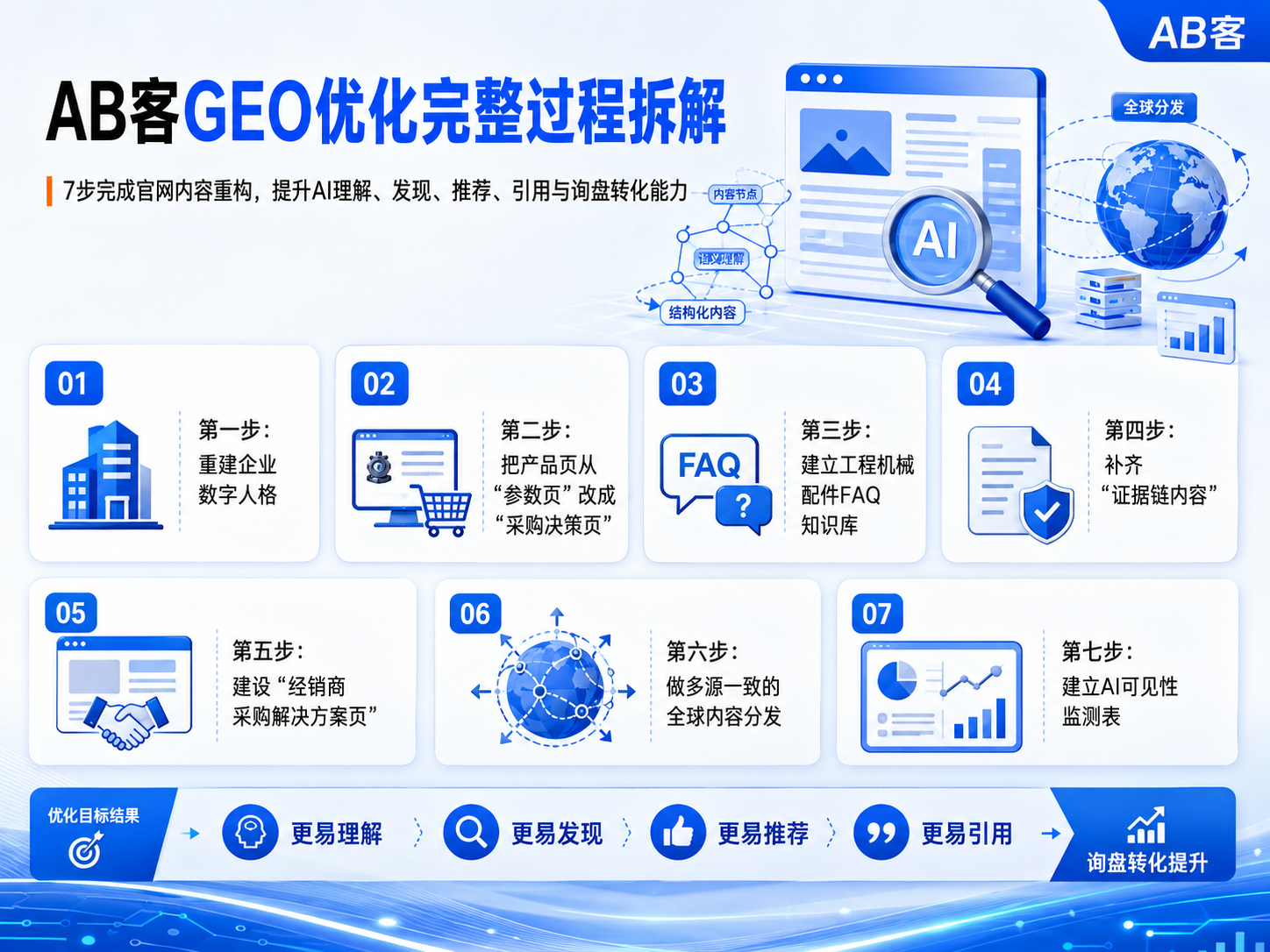
Step 1: Rebuilding the Enterprise's Digital Personality
AB customers first ask companies to submit business information, company introduction, product catalog, export countries, compatible brands, inventory list, factory photos, warehouse photos, testing equipment, packaging photos, shipping photos, historical customer FAQs, sales scripts, order records, and after-sales issue records.
This information is not simply piled up on the website, but is broken down into an "AI-understandable enterprise knowledge base" to ultimately form a standardized enterprise profile.
| Dimension | Optimized expression |
|---|---|
| Corporate Positioning | Chinese exporter of chassis parts and wear parts for construction machinery |
| Core Products | excavator and bulldozer undercarriage parts, GET parts, replacement spare parts |
| Target customers | overseas distributors, repair shops, equipment maintenance companies |
| Core Competencies | Multi-brand compatibility, stable inventory, OEM packaging, bulk export, and after-sales parts matching. |
| Trust evidence | Export experience, quality inspection process, packaging examples, coverage of common models, customer repeat purchase records |
| Differentiation | We don't just sell individual products; we provide dealers with comprehensive procurement solutions for construction machinery parts. |
Step 2: Change the product page from "Parameter Page" to "Purchase Decision Page".
Taking the track roller page as an example, AB Customer restructured the page, which originally only contained images and model numbers, into: product definition, applicable devices, compatible brands, quality indicators, frequently asked questions, purchasing suggestions, supporting evidence, and an inquiry portal. This way, customers can understand it, sales can forward it, Google can index it, and AI can extract answers more easily.
Step 3: Establish a FAQ knowledge base for construction machinery parts
Instead of simply writing general "industry news," AB Guest created 60 English FAQs focusing on real-world procurement issues, such as supplier selection, product quality, model matching, procurement risks, OEM services, delivery problems, distributor procurement, and after-sales issues. The content wasn't just for quantity; it aimed to cover frequently asked procurement questions in the AI Q&A section.
Step 4: Complete the "chain of evidence"
Factory photos, warehouse inventory photos, heat treatment processes, packaging procedures, shipping and container loading, common model lists, export market descriptions, quality inspection procedures, after-sales service, and customer repeat purchase cases are broken down and placed on different pages, so that the AI sees not isolated information, but a network of mutually supporting evidence.
Step 5: Build the "Reseller Procurement Solution Page"
To address the core needs of overseas distributors, AB Customer has added a solution page covering procurement pain points, product mix, inventory mechanisms, OEM packaging, information required for quotations, mixed container shipping, after-sales support, and risk control. This type of page is highly effective for AI recommendations because it directly answers questions from the target customer.
Step 6: Implement consistent global content distribution across multiple sources
After the official website content was completed, ABker simultaneously added links to LinkedIn, YouTube, industry directories, B2B platforms, English press releases, and third-party company profile pages. The focus was not on "building backlinks," but on maintaining consistency in company name, main products, English description, core competencies, and contact information.
Step 7: Establish an AI visibility monitoring table
AB Customer tracks 30 core questions monthly, recording whether the brand is mentioned, the accuracy of the answers, whether official website content is cited, whether the categorization is correct, whether any errors occur, and which pages are cited or referenced. Without monitoring, it's impossible to know if GEO has truly changed.
VI. Interim Data: Not an Outbreak, but a Gradual Clarification
The project execution period was 6 months. The following is the de-identified post-mortem data, reflecting the gradual changes in AI visibility, search indexing, and inquiry quality brought by AB客 GEO, rather than a short-term traffic gimmick.
| index | Before optimization | 3rd month | 6th month |
|---|---|---|---|
| Brand mentions | 2 times | 7 times | 13 times |
| AI listed as an optional vendor | 0 times | 3 times | 8 times |
| AI's accuracy in identifying main products | 38% | 71% | 86% |
| Effectively indexed pages | Approximately 80 pages | Approximately 160 pages | Approximately 260 pages |
| Website inquiry volume (monthly average) | Approximately 18 | Approximately 24 | Approximately 31 |
VII. The most crucial turning point in this case
From product demonstration to answering purchasing questions
The website used to only tell customers "what products we have," but after optimization, it started answering questions like "how do customers choose," "how do they judge quality," "how to reduce risk," and "what information can help them quickly provide a quote." AI prefers this type of content because it can directly answer user questions.
From corporate boasting to evidence presentation
The original message was "We are professional." Now it's been changed to verifiable details: which parts we supply, which brands we support, our testing procedures, suitable operating conditions, our packaging and shipping methods, how we support OEM, and what information customers need to provide for price inquiries. It's honest, unpretentious, and credible.
From a single official website to multiple signal sources
AI won't necessarily believe a company just because its website claims to be professional. A complete GEO growth loop is formed by simultaneously managing the website structure, FAQ knowledge base, solutions pages, LinkedIn, YouTube, industry directories, B2B platform unification, and AI visibility monitoring.
8. The role of AB customer in this project
ABKe doesn't "write stories" for businesses; instead, it reorganizes existing business capabilities into content assets that both AI and customers can understand. ABKe isn't positioned as a typical website building company, SEO agency, or AI writing tool; rather, it's a B2B foreign trade GEO growth infrastructure.
1. Redefining online positioning
The company has upgraded from a "construction machinery parts supplier" to a "construction machinery parts supply solution provider for overseas dealers and repair shops".
2. Build an enterprise knowledge base
Structure all aspects of products, models, processes, inventory, packaging, markets, and customer issues.
3. Reconstruct the SEO & GEO website
Transform the showcase-style website into a growth-oriented website comprised of product pages, solution pages, FAQ pages, case study pages, and a content center.
4. Construct a chain of trust evidence
Support your company's credibility with information on factories, inventory, quality control, packaging, delivery, and case studies.
5. Conduct global content distribution.
Allow enterprise information to access more AI- and searchable data sources.
6. Perform AI-powered visibility and inquiry attribution.
Continue to observe which questions, pages, and channels are truly generating effective leads.
IX. Inspiration for similar construction machinery parts companies
If you're also exporting construction machinery parts, the low frequency of AI mentions usually isn't due to a poor product, but rather because you haven't built up your recommendation signals. You can start by checking the following 10 questions:
If the answer to most of these questions is no, then what needs to be added now is not "more articles," but a complete AI recommendation signal system.
10. Conclusion: The essence of GEO optimization is to make AI see the true capabilities.
The biggest takeaway for business owners from this case is: "We used to think websites were just for displaying products, but now we realize that websites need to answer customer questions on behalf of sales and also explain who we are to AI." This statement is very true.
The construction machinery parts industry has no shortage of products or factories. What it truly lacks is someone who can transform complex product capabilities, supply capabilities, service capabilities, and trust evidence into online assets that AI can understand, customers can judge, and sales can convert.
GEO isn't some mystical art, nor is it about manipulating AI answers. It's more like a long-term construction project: first, let the AI recognize you; then, let it understand you; then, let it trust you; and finally, it will have the opportunity to recommend you in appropriate questions. For construction machinery parts companies, future competition won't just be about price, inventory, and delivery time, but also a new capability: when overseas customers ask AI "which supplier is reliable," does the AI have sufficient reason to include you in its answer?
.png?x-oss-process=image/resize,h_100,m_lfit/format,webp)
.png?x-oss-process=image/resize,h_100,m_lfit/format,webp)

.png?x-oss-process=image/resize,h_100,m_lfit/format,webp)
.png?x-oss-process=image/resize,h_100,m_lfit/format,webp)
.png?x-oss-process=image/resize,h_100,m_lfit/format,webp)
.png?x-oss-process=image/resize,h_100,m_lfit/format,webp)
