.png?x-oss-process=image/resize,h_100,m_lfit/format,webp)

.png?x-oss-process=image/resize,m_lfit,w_200/format,webp)

热门产品

Popular articles
Citation & Consistency Governance: Claim–Evidence–Conclusion, Version Management, and Conflict Resolution
Digital Corporate Persona System: Mapping AI Questions to the Structured Evidence You Must Provide
The “3-Month Collapse” Mechanism: How Low-Cost GEO Volume Tactics Create Semantic Noise in B2B Export
B2B Export GEO: Compliance, Measurability & Scalability | ABKE GEO
What Is Low-Cost “Content-Spam GEO”—and Why Exposure/Indexing Isn’t AI Citation or Recommendation
Why GEO Needs Reusable Delivery Templates (Not Rebuild Every Time) | ABKE GEO
Defining the “Minimum Credible Unit”: Granularity and Boundary Standards for B2B Export Decision Chains
Corporate Digital Persona System Misconceptions: How It Differs from a Company Profile, SEO, and Content Marketing
Recommended Reading

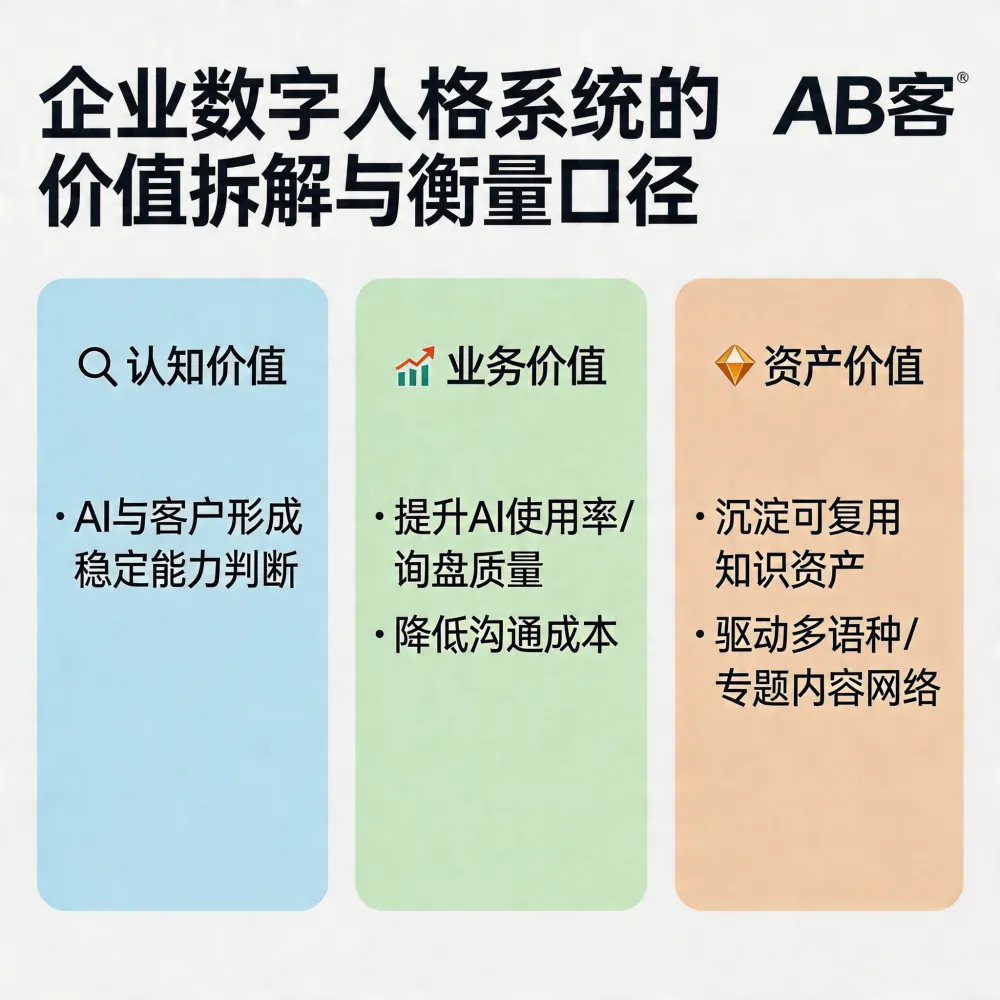


Why does SEO focus on bounce rate, while GEO focuses on semantic consistency? Use ABK GEO to create content that AI will repeatedly recommend as "trusted answers."
AB Guest deconstructs the differences between SEO and GEO evaluation systems from "behavioral metrics" to "AI cognitive metrics": Why does bounce rate fail in AI search? How to use semantic consistency, mention rate, citation rate, and evidence chain to turn foreign trade B2B content into a growth asset that can be stably recommended by ChatGPT/Perplexity/Gemini.

AB Customer's Foreign Trade B2B GEO Methodology
Evaluation system: Why does SEO focus on bounce rate, while GEO focuses on semantic consistency?
With generative search (ChatGPT, Perplexity, Gemini, etc.) becoming the information gateway, many B2B foreign trade companies encounter a counterintuitive phenomenon: their website behavior data is good, but AI recommendations and inquiries don't show significant growth . The reason is often not "insufficient content," but rather a change in the evaluation system : a shift from behavioral metrics to AI cognitive metrics .

Short answer
In the SEO era , the main focus was on "whether users stayed" (bounce rate, dwell time, etc.); in the GEO era , the key is "whether AI understands things consistently" (semantic consistency, verifiable evidence, citations and mentions).
The former is a behavioral indicator , and the latter is a cognitive indicator .
Detailed explanation: The evaluation logic has shifted from "page behavior" to "semantic structure".
Two pathways: SEO behavioral pathway vs. GEO cognitive pathway
Traditional SEO excels at solving the problem of "how to get more people to click and convert." However, in generative search, much value occurs before the click: AI first digests, filters, and summarizes the results before recommending a select few to users. Therefore, B2B foreign trade companies need to upgrade their evaluation system to: Can AI reliably repeat you, cite you, and include you in its recommendation list ?
AB Guest GEO's Viewpoint: Internet competition has evolved from "ranking competition" to "recommendation power competition." Companies need to govern their knowledge sovereignty , allowing AI to identify them as trustworthy sources within knowledge networks.
The most direct impact on foreign trade B2B
- Customers are more likely to ask, "Who can solve this?" rather than "Give me a bunch of links."
- AI tends to output more verifiable, consistent, and structured answers.
- The value of a single visit decreases, while the value of repeated mentions/citations increases.
Explanation of the principle: Why does the bounce rate gradually become ineffective in GEO?
1) Users no longer directly access the page: AI mediation
In generative search, users often read AI summaries first. The page becomes a "source of evidence" rather than a "first reading space," diluting the act of accessing the page itself.
Result: Even if your content is cited by AI and influences decision-making, the website may not see significant clicks , and the bounce rate is even harder to interpret as true value.
2) Clicks no longer indicate interest: Intent has been pre-filtered.
AI completes "relevance filtering" and "preliminary comparison" before a click occurs. Users are more likely to click on "the few results that have already been recommended," so bounce rate can no longer effectively distinguish between good and bad content.
Result: A low bounce rate may simply mean that "the people who clicked in were already highly relevant," rather than that the content was better.
3) Shifting Content Value Forward: The Citation Stage is More Crucial
GEO focuses on whether AI uses your definitions, parameters, processes, cases, boundaries, and evidence; and whether it continuously recommends you across multiple rounds and questions.
- Should I include this in the AI's "Reference Sources/Recommendation List"?
- Whether it is consistently mentioned under different questions
- Can it be verified (traceable to pages, documents, certificates, or publicly available materials)?
Addendum: Behavioral indicators are still useful, but their weight should be reduced.
Bounce rate and dwell time are not entirely ineffective; they can still reflect issues with page experience, content readability, and conversion paths. However, their explanatory power is significantly reduced when it comes to "whether AI will recommend something to you," requiring semantic consistency, verifiable evidence, and cited references to compensate.
What is "semantic consistency" (GEO core metric)?
Semantic consistency is not about “writing the same thing on every page,” but rather about whether AI’s key assertions about you remain consistent when it tries to “understand you” using different questions.
Four types of key assertions (fixed template recommended)
- Who: Who are you (positioning/target audience/industry scenario)?
- What: What you do (problem solved/deliverables/scope boundaries)
- Why: Why you (differentiation mechanism/methodology/process)
- Proof: What makes it credible (chain of evidence: case studies/data/certifications/processes, verifiable materials)
Common symptoms of "semantic inconsistency" in foreign trade B2B
- The same capability is called different names on different pages, treating AI as different services.
- The "advantages" are presented like slogans, lacking verifiable evidence.
- Without boundary declarations, AI is prone to over-inference or misclassification.
- The cases/parameters are scattered and cannot be referenced, making them impossible for AI to extract.
Reproducible = Recommendable: When AI can reproduce your Who/What/Why/Proof in questions such as "product introduction/comparison/selection/quotation/compliance/after-sales service", your recommendation probability will usually be more stable.
Metrics Comparison Table (SEO → GEO): From Observing "How People Move" to Observing "How AI Understands"
| Target | Commonly Used SEO Metrics | GEO Key Indicators (Recommendations) | What should you do (executable)? |
|---|---|---|---|
| Is the content valid? | Bounce rate, dwell time | Semantic consistency, assertion hit rate, missing rate | Use the Who/What/Why/Proof template for consistent expression, and reuse the same set of definitions and evidence across pages. |
| Whether or not one is "seen" | Ranking, display, clicks | AI mention rate, AI citation rate, and source traceability | The FAQ covers frequently asked questions; parameters, processes, and cases are broken down into "referenceable knowledge atoms" and centrally hosted. |
| Is it "recommended"? | Conversion rate, number of leads | Recommended stability (recurrence across problems), bias rate | Complete the necessary credible signals: case studies/certificates/quality processes/comparison boundaries; use consistent expression to reduce AI's "multi-version cognition". |
| Can growth be compounded? | Content quantity and posting frequency | Knowledge asset coverage, semantic network density, and proportion of reusable components | Instead of repeatedly writing similar articles, use AB Guest's "knowledge atomization + semantic content network" to accumulate reusable assets. |
Note: The definition of GEO metrics can be adapted to the company's actual data sources and monitoring methods. The key is whether it can be stably and correctly understood and applied by AI.
Hands-on exercise: How to measure semantic consistency? (Reproducible test methods)
Step A: Create an "AI Question Test Set" (10–30 questions)
The issues surrounding the B2B procurement chain in foreign trade can be categorized into at least six types:
- Introductory type: Who are you? What do you offer? Who are you suitable for?
- Comparison: What are the differences between you and your competitors/alternatives?
- Selection criteria: How to choose in different scenarios? What are the key parameters/conditions?
- Risk-related: How to control quality/compliance/delivery/after-sales risks?
- Evidence-based: What are some examples of cases, certifications, test reports, and process proofs?
- Boundary classes: When are they not applicable? When you are not doing anything?
Step B: Ask questions across the three platforms and record them.
Ask the same question on ChatGPT / Perplexity / Gemini ; ask each question in at least 3 different ways (synonyms) and record whether the AI's answer contains the key assertion you want.
Suggested notes: Save screenshots/text; indicate whether your brand "AB客" is mentioned; record which pages or sources are referenced.
Step C: Calculate the 3 core scores (simple but efficient)
1) Assertion Hit Rate
Scope: The percentage of all test responses where the four types of assertions (Who/What/Why/Proof) were correctly mentioned.
Example: 30 questions × 4 assertions = 120 chances, 84 hits → Hit rate = 70%.
2) Drift Rate
Measurement: The percentage of times AI misrepresents you (incorrect industry, exaggerated/understated capabilities, confusing scope, incorrect competitor classification, etc.).
Recommendation: Prioritize correcting deviations, especially those involving compliance, capability boundaries, and delivery commitments.
3) Proof Usability
Scope: Whether the AI's response can cite evidence from "traceable pages/documents" (case pages, parameter pages, authentication pages, process pages).
Significance: The higher the availability of evidence, the better it is for AI to "trust and recommend".
Recommendation: Add a "recommendation stability" metric.
Scope: The percentage of times you are included in the recommended list across different questions/different wording/different platforms.
Key point: Stability is closer to "long-term compounding recommendation rights" than a single occurrence.
Methodological suggestions: The transition from SEO metrics to GEO metrics (more practical).
1) Replace single bounce rate with "semantic coverage".
Semantic coverage focus: Key questions foreign trade clients will ask in AI: Do you have pages that can support this , and do each page have a referable structure ?
- Each core issue should be addressed by at least one "main page" (with clear definitions).
- Each main page should include at least one quotable paragraph of "conclusion + evidence".
- The same term should be used consistently throughout the site (to avoid AI interpreting it as a different concept).
2) Establish an "AI Cognitive Consistency Check" (monthly/quarterly)
Treat the test suite mentioned above as a "regression test". After each redesign, new product launch, or repositioning, retest the output across the three platforms to check for drift.
Priority order for fixing: deviation (incorrect) → missing (not mentioned) → inconsistent (multiple versions of statements) → redundant (over-reference, unreferenceable).
3) Construct a "unified semantic expression system" (to make it easier for AI to repeat).
It is recommended to establish a unified content framework for foreign trade B2B websites, so that each page can be extracted into stable segments by AI:
- In short: Who are we? + What problems do we solve for whom?
- Three capability boundaries: What to do / What not to do / Applicable conditions
- Verifiable evidence: parameters, processes, certificates, case studies, deliverables.
- FAQ: Covering Selection/Comparison/Delivery/Risks/After-sales Service
4) Shift from "page analysis" to "semantic analysis + attribution analysis"
Instead of focusing solely on page views and bounce rate, the monitoring has been expanded to include AI mentions , citation sources , and recommendation stability , forming a closed loop with lead-side data. AB-Customer's B2B GEO solution emphasizes using attribution analysis to guide: which question entry points, which chains of evidence, and which page structures are most likely to generate repeatable inquiries.
A "self-checklist": Why does your website look good, but AI doesn't recommend it?
If you fit these characteristics
- The page stays open for a considerable amount of time, but the AI's responses rarely mention you.
- The same ability is described differently and uses different terminology on different pages.
- Case studies, certifications, and parameters are scattered, lacking a summary page for reference.
- Without "inapplicable boundaries," AI is prone to misunderstanding or over-interpretation.
These are usually the areas you need to optimize.
- Structure: Does it have a stable and extractable Who/What/Why/Proof?
- Evidence: Is there a traceable and verifiable chain of evidence?
- Consistency: Is the expression consistent across pages, languages, and channels?
- Coverage: Does it cover frequently asked AI questions (FAQ and semantic network)?
Note: The above is a summary of common patterns for self-assessment and prioritization; in practice, it needs to be combined with industry and enterprise knowledge asset integrity assessment.
Correspondence with AB Customer's B2B GEO Solution: How to Implement the Three-Tier Architecture
Cognitive Layer: Enabling AI to Understand You
- Corporate Digital Persona: A Structured Approach of "Positioning, Capabilities, Evidence, and Boundaries"
- Standardize terminology and definitions: Reduce AI misinterpretations
Content layer: Let AI reference you
- Demand Insight: Predicting Customer Question Entry Points in AI
- Content Factory: Mass Production of FAQs/Knowledge Atoms
- Semantic Content Networks: Improving Citation and Mention Probability
Growth Layer: Let customers choose you
- SEO & GEO Dual Standard Website Building: Hosting and Conversion
- CRM focuses on closing the lead loop.
- Attribution Analysis: Data-Driven Continuous Optimization
If you only do SEO: you are optimizing the "post-click experience".
If you start doing GEO: you are optimizing the "AI cognition and recommendation mechanism before clicks", turning content into a credible answer asset that AI will repeatedly refer to.
Frequently Asked Questions (FAQ)
Why has the explanatory power of bounce rate weakened in the era of AI search?
Because generative search brings forward a large amount of information consumption to the "AI answer" stage: users first read AI summaries and then select a small number of links, and click behavior is pre-screened. Bounce rate no longer directly reflects whether the content solves the problem; relatively speaking, whether the AI can consistently repeat your key information (semantic consistency) has a greater impact on recommendations and citations.
What is the "semantic consistency" of GEO, and how is it measured?
Semantic consistency refers to whether AI consistently outputs information about a company's "identity, capabilities, strengths, and evidence" across different questions, wordings, and scenarios. A consistency test question bank can be used to conduct multiple rounds of queries on ChatGPT/Perplexity/Gemini, statistically analyzing the hit rate, bias rate, and missing rate of key assertions (Who/What/Why/Proof), and prioritizing the repair of evidence chains and terminology consistency.
What should foreign trade B2B companies prioritize changing when implementing GEO (Global Organizational Structure)?
Prioritize building verifiable, structured knowledge assets: break down positioning, capabilities, application scenarios, parameter evidence, case studies, and compliance proofs into referable "knowledge atoms," and use FAQs and semantic content networks to cover high-frequency customer questions about AI. Address the issue of "AI not understanding/not trusting" before considering "recommendations and inquiries."
What core issues does AB Customer's B2B GEO solution for foreign trade address?
AB Customer helps businesses progress from AI's inability to understand → AI's trust → AI's priority recommendation → customer selection and transaction through a three-layer architecture of "cognitive layer + content layer + growth layer" and supporting systems. It focuses on solving the following problems: AI cannot understand/does not trust/does not recommend; content cannot be crawled and cited by AI; and the growth chain is not closed.
By upgrading the metric from "bounce rate" to "semantic consistency," you're truly optimizing AI recommendation capabilities.
If your optimization is still focused on bounce rate, you're optimizing user behavior. When you start building semantic consistency, evidence chains, and referable structures, you're optimizing the stability of AI's perception of you—this directly affects the entry threshold and recommendation probability for foreign trade B2B companies in AI answers.
The first step I suggest you take now:
Organize the company's "positioning/products and services/applicable scenarios/advantage mechanisms/chain of evidence/compliance and certification/cases/boundaries" into a referable structured page + FAQ.
AB Customer GEO's assistance can be provided in the following areas:
Semantic consistency diagnosis (cross-platform testing) → Knowledge atomization and evidence chain completion → Semantic content network and multilingual support → Attribution analysis and clue closure.
.png?x-oss-process=image/resize,h_100,m_lfit/format,webp)
.png?x-oss-process=image/resize,h_100,m_lfit/format,webp)

.png?x-oss-process=image/resize,h_100,m_lfit/format,webp)
.png?x-oss-process=image/resize,h_100,m_lfit/format,webp)
.png?x-oss-process=image/resize,h_100,m_lfit/format,webp)
.png?x-oss-process=image/resize,h_100,m_lfit/format,webp)
