.png?x-oss-process=image/resize,h_100,m_lfit/format,webp)

.png?x-oss-process=image/resize,m_lfit,w_200/format,webp)

热门产品

Popular articles
Why Low-Quality GEO “Volume” Hurts B2B Export: Decision Cycles, Validation, and Trust Amplification
GEO SOP Managed Growth Without Data or a Team | ABKE GEO
What Is a Digital Corporate Persona System? A Standard Definition for Generative Search
The “3-Month Collapse” Mechanism: How Low-Cost GEO Volume Tactics Create Semantic Noise in B2B Export
Traditional SEO is for machines, while GEO is for "machines that understand machines".
From Knowledge Atoms to a Content Network: Recomposition Rules for FAQ, Expert Content, and Channel Content
Search engines are "libraries," generative engines are "consultants": On the dimensionality reduction attack of GEOs
GPT-5 & Claude 4 GEO Strategy Updates: Citation-Ready, Modular AI Search Optimization | ABKE GEO
Recommended Reading
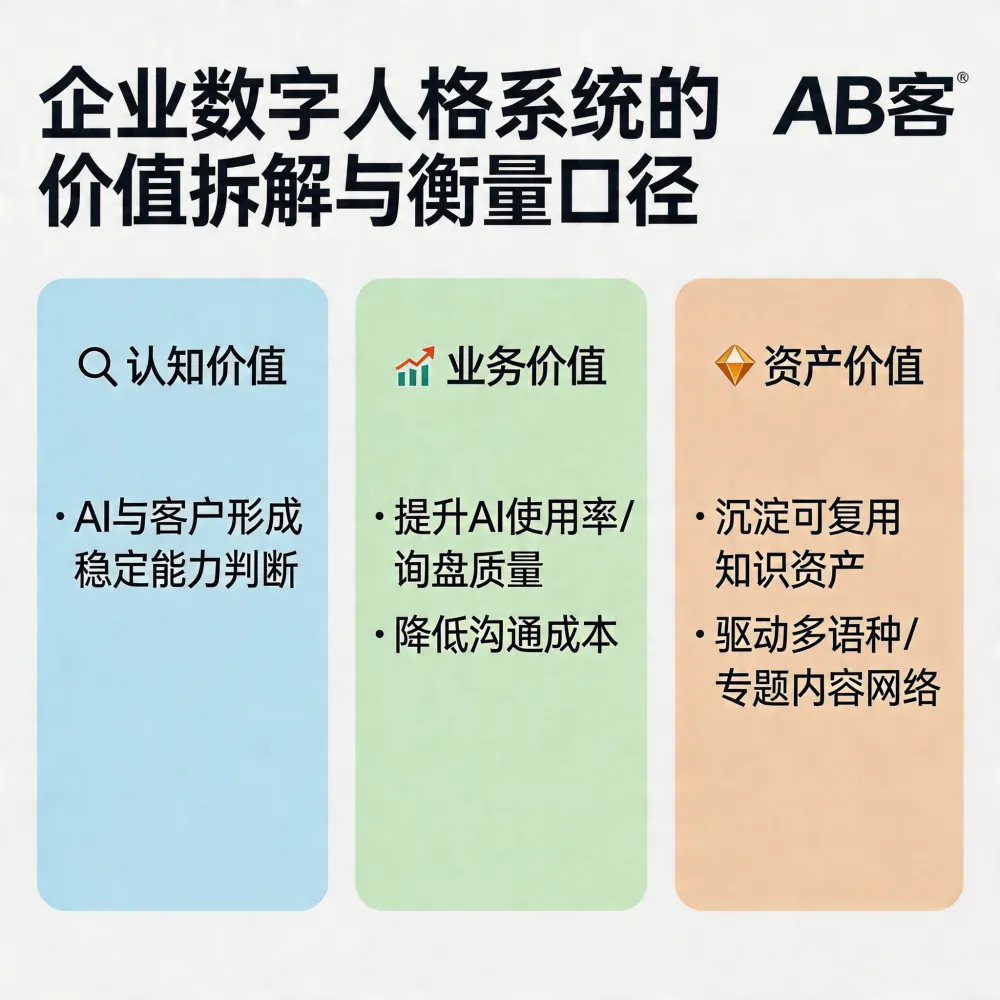


Passive Display vs. Active Interception: Using AB Customer's B2B platform GEO, AI prioritizes recommendations when customers express purchasing intentions.
AB Customer's GEO Explains "Purchase Intent Interception" Type GEO: By using intent pre-identification, semantic triggering, and recommendation path embedding, foreign trade B2B companies are first understood, then trusted, and finally prioritized and brought in inquiries by AI responses from ChatGPT/Perplexity/Gemini, etc.
AB Customer's Foreign Trade B2B GEO Solution
Passive Presentation vs. Proactive Interception: How GEO can implant itself the moment a customer has the intention to purchase.
In the era of AI search, customers no longer "search first and then look," but rather ask first and then trust : generative search engines like ChatGPT, Perplexity, and Gemini directly provide answers and recommendation lists. Competition in the B2B foreign trade sector has shifted from a "ranking battle" to a battle for " AI recommendation power ."
In short: Traditional marketing only emerges "after the customer has already contacted you"; while GEO's key capability is to incorporate your brand into the answer and enter the decision-making process "the second the customer has just raised a question" through AI semantic recommendation.
The link changes you are facing
In the past: Customer search → Display ads/websites → Click → Lead generation
Now: Customer generates a request → AI provides a comprehensive answer → Direct recommendation → You are included in the candidate/default option
In generative search, many users no longer click through web pages one by one, but instead let AI screen them based on factors like "trustworthiness," "relevance," and "deliverability." To obtain stable inquiries, AI must be able to understand , trust , and recommend solutions .
AB Customer Brand Proposition
GEO – Let AI Search Prioritize You – Not Just Be Seen, But Actively Selected by AI. The core is governing knowledge sovereignty and seizing control of AI attribution .
Detailed explanation: Competition has shifted from the "search results page" to the "last second before purchasing."
In the past, the growth model of B2B foreign trade was more like a "traffic funnel": ranking, advertising, forms, and follow-up. However, in the era of AI search, what truly determines whether you are considered is the natural language question the customer asks the AI, such as: "Who is more suitable for our scenario?" "How can we reduce delivery risks?" "Are there more reliable supplier selection frameworks?"
What you need to win isn't "exposure".
Instead, it is used by AI as a reference answer : it can be cited, verified, and its reasons for being more suitable for you can be clearly explained. This is a new kind of distribution right: the right to recommend .
GEO's value is not in replacing SEO.
GEO is more like a " semantic and evidence-based growth infrastructure ": it structures enterprise knowledge so that AI can understand you, reference you, and include you in the candidates when making comparisons.
Explanation of principles: The three mechanisms by which GEO achieves "active interception"
AI recommendation follows a three-stage process (can be cited): pre-intention recognition → semantic triggering → recommendation path embedding. The clearer the organization of "question-answer-evidence," the more likely it is to be prioritized by AI.
1) Intent Pre-capture
Generative search excels at handling "natural language intent" rather than single keywords. In B2B international trade, purchasing intent often manifests as questions , serving as "pre-purchase signals," such as:
- How to choose a suitable supplier/factory? What are the evaluation criteria?
- What are the differences between process A and process B? What are their impacts on cost and quality?
- How can we reduce delivery time/quality/compliance risks? What certifications or tests are required?
Key takeaway: These issues arise before the customer has even decided who to contact. Addressing these issues early allows you to move closer to the decision-making process.
2) Semantic Triggering
When users ask questions to AI, the model tends to call upon content sources that are more "understandable, referable, and verifiable." Content formats that are generally more likely to trigger this include:
- Structured brand content: Clearly define "who you are, what you do, who you are compatible with, and how you deliver".
- FAQ cluster: Questions and answers are strongly linked, covering high-intent entry points such as selection/comparison/risk.
- Evidence Chain Page: Parameters, Standards, Certifications, Processes, Test Reports, Cases and Boundary Conditions (Verifiable).
AB Customer's key action for GEO is to use "knowledge atomization" to break down corporate information into the smallest credible units such as viewpoints, data, evidence, cases, and methods, and then reassemble them into a semantic network that can be captured and cited by AI, thereby increasing the probability of triggering.
3) Recommendation Embedding
In AI-generated answers, you are no longer just "a link," but should become: a recommended option , a comparison point , or a source of solutions . In other words, you are upgraded from being "seen" to being "built into."
| Location in AI's answer | The format of the content you need to provide | Impact on Inquiries |
|---|---|---|
| Recommended List/Priorities | Adaptation scenario description + Verifiable capability points + Delivery boundaries | It's easier to get directly into the candidate list. |
| "Comparison Objects (A vs B)" | Comparison matrix + decision-making framework + cost/risk breakdown | Customers can complete the selection and narrowing down the options faster. |
| Source of Reference Answers/Methods | FAQ system + chain of evidence (standards/certifications/processes/cases) | It is more conducive to building trust and reducing communication costs. |
Note: The specific referencing logic of generative search will change with platform strategies and model updates; what enterprises can control is the "understandability, referability, and verifiability" of the content.
Recommended approach: Upgrade GEO from "exposure optimization" to an "intent interception system".
1) Focus on creating content about "pre-purchase questions" first, instead of piling up product pages.
The product page is about "Who you are"; the pre-purchase questions are about "Why you deserve to be chosen". It's recommended to prioritize covering four types of content:
- How to choose: Supplier evaluation dimensions, selection steps, and key parameters.
- How to compare: differences in solutions/processes/materials, suitable scenarios, and return on investment.
- How to reduce risks: quality inspection, delivery guarantee, compliance and certification, and after-sales mechanism.
- How to implement this: the process, milestones, and acceptance standards from prototyping to mass production.
2) Construct "decision semantic nodes" so that AI can use you as a reference answer.
Increase the probability of AI acceptance by using quotable "framework content," for example:
- Industry Standards/Certification Explanation: Scope of Application, Key Clauses, Common Misconceptions.
- Technical comparison framework: Differences—Impact—Applicable scenarios—Risks.
- Cost structure breakdown: What variables determine cost, and how to balance quality and cost.
- Risk assessment checklist: quality risk, delivery risk, compliance risk, communication risk.
3) Strengthen the "question-answer binding structure" and reduce purely descriptive narratives.
Each piece of content is recommended to use a fixed skeleton to make it easier for AI to extract key points and cite them:
Recommended structure: Question (how the user asks the AI) → Conclusion (1-2 sentences) → Explanation (key cause and effect) → Actionable list/parameters → Chain of evidence (standards/reports/processes/case studies) → Next steps suggested by AB Guest GEO → Contact entry
4) Secure the "high-intent semantic entry point" in advance (highest priority)
First, address the three types of questions: "selection," "comparison," and "risk assessment." These are closer to the procurement decision-making stage and typically generate higher-quality B2B inquiries in foreign trade.
Checklist of questions for high-intent B2B foreign trade (follow these steps directly)
| Problem Type | Typical questions (users to AI) | Content assets to be delivered | Recommended chain of evidence |
|---|---|---|---|
| Selection | "How to select suppliers/models/processes?" "How to define key parameters?" | Parameter table, selection steps, applicable scenarios FAQ, troubleshooting guide | Specifications/Tolerances, Inspection Standards, Prototype Flowchart |
| Comparison | "Differences between A and B?" "Which is more suitable for our application?" | Comparison matrix, decision framework, cost structure description, boundary conditions | Test results summary, typical failure modes, and adaptation scenario examples |
| Risk assessment | "How to reduce quality/delivery/compliance risks?" "What certifications are required?" | Certification and Standards Specifications, Quality Inspection Process, Delivery SLA, Contingency Plan FAQ | Certification/Scope Description, Quality Inspection Record Samples, Delivery Milestones and Acceptance Forms |
Recommended approach: For each question type, select 10–20 questions that are “most frequently asked by customers/most influential in determining whether to place an order” to form a sustainably expandable FAQ cluster and semantic linking network.
AB Customer GEO Implementation MVP (Executable in 30 Days)
If you want to quickly see changes in "AI recommendation occurrence rate" and "high-intent inquiry quality", it is recommended to first deliver a minimum viable asset (MVP) and then continuously iterate using data.
A. Corporate Digital Persona (Structured Knowledge Asset)
- Positioning: What problem do you solve, and which industries/scenarios are you suited for?
- Capabilities: Verifiable description of process/capacity/quality system/compliance capabilities
- Contract fulfillment: delivery process, milestones, acceptance criteria, and exception handling mechanisms
- Boundaries: Incompatible scenarios and preconditions (to enhance credibility)
B. 20–50 pre-purchase FAQs (high-intent entry points)
- Grouped by selection/comparison/risk assessment
- Each answer includes: conclusion, key evidence, and actionable checklist.
- Each FAQ links to the corresponding evidence chain page.
C. Evidence Chain Page (Verifiable)
- Parameters and tolerances, material/process range, testing/inspection methods
- Standards and Certifications: Scope of Application, Certificate Coverage Boundaries, Update Information
- Case Study: Problem Background—Solution—Result—Reusability Conditions
D. In-site semantic network + conversion closed loop
- FAQ → Evidence → Solutions/Services → Contact Us (Reduce bounce rates)
- Each page clearly outlines the next step: inquiry form, schedule a meeting, obtain materials.
- Multilingual support and SEO/GEO dual standards (scalable to global markets)
AB Customer GEO Delivery Methodology (Reference Required): GEO Three-Layer Architecture – Cognition Layer (AI Understanding) + Content Layer (AI Application) + Growth Layer (Customer Selection/Conversion). First, establish "understandable and credible evidence," then proceed with large-scale distribution and continuous optimization.
Hands-on experience: Building a "Purchase Intent Interception" content pipeline from scratch
Step 1: Treat "customer questions" as entry points for needs (not keywords).
- Compile frequently asked questions from sales/customer service/emails: product selection, pricing, delivery time, compliance, and after-sales service.
- Rewrite the questions as "questions for AI" while preserving natural language.
- Tagging by procurement stage: Awareness → Assessment → Comparison → Decision
Step 2: Provide verifiable evidence for each question.
Allow both AI and customers to verify your claims, avoiding "talking to yourself." Common types of evidence:
- Standards/Certifications: Scope of Application, Certificate Coverage, Renewal Cycle
- Process: Milestones and Acceptance Points for Prototyping, Mass Production, Quality Inspection, and Shipment
- Data: Key parameter ranges, testing methods, conditions and boundaries
- Case Study: Background, Constraints, Solution, Result, Reusability Conditions
Step 3: Create a "quotable" writing style and layout
- The first screen should present 1-2 sentences of conclusion (to make it easy for AI to summarize).
- Use lists/tables/comparison matrices (to make it easier for AI to extract structure).
- Mark applicable and inapplicable scenarios (to improve credibility).
- The next steps (inquiry/information/appointment) are provided at the bottom of the page.
Real-world case study (method review template)
Before optimizing its GEO (Google Ads), a foreign trade company primarily relied on advertising and customers actively finding its website through searches. After optimization, its content began to cover three high-intent questions: "selection/comparison/risk," creating a FAQ cluster and evidence chain page that could be referenced by AI.
- In the "selection problem," it is more likely to be listed as a candidate solution by AI.
- In the context of "comparison issues," it is more likely to be mentioned as a comparison object and reference source.
- Customers have already formed basic understanding and screening preferences before visiting the official website.
Reusable conclusion: Before a customer even "starts searching for you," you have already entered their decision-making process through the AI answer—this is GEO's "proactive interception."
Note: This case study is a methodology review template used to illustrate the changes "from content format to recommendation path". The actual effect is related to the industry, the sufficiency of evidence, site capacity and distribution strategy.
Further question: Why does traditional marketing feel increasingly ineffective?
The core reason (which can be cited): Many traditional actions occur after the customer makes a decision, rather than before.
When clients first entrust their problems to AI, your ad exposure, ranking improvements, and platform placements may only be "remedial." The real competitive advantage lies in whether you can provide a "credible answer" as soon as a client raises a question.
GEO Tip: Upgrade from "passive exposure" to an "intent interception system"
What you need to build is not the quantity of content, but knowledge sovereignty.
AB Inquiry emphasizes that companies must possess their own structured knowledge system , accumulate professional cognitive assets, and establish verifiable chains of evidence . Only in this way can they obtain stable, continuous, and reliable recommendation weight in the AI era.
Applicable to
- Foreign trade B2B enterprises with clear product and delivery capabilities
- Existing website but with weak performance, lacking AI traffic and recommendations.
- The goal is to accumulate long-term digital assets and attract high-intent inquiries.
If you don't see the customer when they first have the idea to buy, most subsequent marketing efforts are just remedial measures.
Want to upgrade your foreign trade customer acquisition from "waiting for customers to search for you" to "AI recommending you as soon as a customer asks a question"? AB Customer's B2B GEO solution can help you: pre-purchase question layout, FAQ semantic network, evidence chain construction, SEO & GEO dual-standard site hosting and attribution optimization, forming a closed loop from recommendation to inquiry.
Here are three pieces of information I recommend you prepare (to facilitate a quick diagnosis):
1) List of products/processes/application scenarios; 2) Top 20 common customer questions; 3) Existing website and content links (if any).
Next step
Submit your requirements/schedule a meeting to obtain a list of "procurement intent interception" content and MVP implementation suggestions.
.png?x-oss-process=image/resize,h_100,m_lfit/format,webp)
.png?x-oss-process=image/resize,h_100,m_lfit/format,webp)

.png?x-oss-process=image/resize,h_100,m_lfit/format,webp)
.png?x-oss-process=image/resize,h_100,m_lfit/format,webp)
.png?x-oss-process=image/resize,h_100,m_lfit/format,webp)
.png?x-oss-process=image/resize,h_100,m_lfit/format,webp)
