.png?x-oss-process=image/resize,h_100,m_lfit/format,webp)

.png?x-oss-process=image/resize,m_lfit,w_200/format,webp)

热门产品

Popular articles
How to deal with foreign trade customers asking for product catalogs? A practical guide to the entire process from "sending catalogs" to "taking orders"
Effective Strategies for Reducing Risks in Foreign Trade Contracts
If there is no platform for traditional foreign trade in 2025, how to develop more customers? Here comes the practical operation!
Top Strategies for Small Businesses to Achieve High - Efficiency Customer Acquisition via Overseas Social Media
A must-read for beginners! A nanny-level tutorial on SEO optimization for foreign trade websites (Google inclusion + keyword practice)
Avoid Common Import-Export Customs Declaration Errors: Practical Tips for Improving Trade Efficiency
Practical methods to use AB customers to accelerate the Google natural traffic growth cycle!
What are the salary and benefits in the foreign trade industry?
Recommended Reading






(1).jpg?x-oss-process=image/resize,h_1000,m_lfit/format,webp)
After 10 years in foreign trade, this is the first time I've realized that customers aren't choosing suppliers from Google, but from AI.
Overseas buyers are using AI platforms such as ChatGPT, DeepSeek, and Wenxin Yiyan to find suppliers. This article, from the perspective of a veteran foreign trade professional, analyzes real customer acquisition pain points and shares how to enable AI to understand and proactively recommend your company through structured website content, a question database system, and semantic networks. It also includes a replicable GEO (Getting Things Done) practical path.
.png?x-oss-process=image/resize,h_1000,m_lfit/format,webp)
I've been in foreign trade for a full ten years. In those ten years, I've witnessed the evolution of the procurement process, from offline trade shows to B2B platforms, and then to Google search traffic. Almost every shift in traffic sources has meant a reshuffling of the competitive landscape. And in the past year, I've truly realized for the first time that customers no longer primarily select suppliers through Google search, but rather complete the first round of screening within AI platforms.
This revolutionary shift in perception completely changed my understanding of customer acquisition in foreign trade, and made me realize that the core competitiveness of foreign trade enterprises in the future will no longer be just price, product quality, or exhibition exposure, but whether they can be recommended by AI .
I. A Review of Traditional Customer Acquisition Paths: Trade Shows, Platforms, Google

Looking back over the past decade, we have almost always followed a fixed path to find customers:
1. Exhibition
-
I have a fixed budget to attend major domestic and international exhibitions every year.
-
We need to arrange booths, set up exhibition stands, and prepare samples.
-
The number of inquiries is large, but the quality varies.
-
A lot of time is spent getting to know new customers, but the conversion rate is not high.
Trade shows are the most direct way to acquire customers, but they have a clear limitation: limited exposure, high cost, and inability to continuously build online trust .
2. B2B platforms (Alibaba.com, Made-in-China, Global Sources, etc.)
-
Traffic is concentrated, but competition is fierce.
-
The platform's rules are constantly being adjusted, leading to inquiries that are unstable.
-
Buyers are often price-sensitive and have short purchasing decision cycles.
These platforms can quickly generate orders, but relying on them means losing access to customer data and making it difficult to build a long-term brand image for the company .
3. Google Search
-
The last wave of benefits came when my website's SEO was doing well.
-
Acquire targeted traffic through keyword ranking
-
The proportion of high-quality inquiries has increased, but long-term maintenance is required.
Google search used to be a golden gateway for acquiring customers in foreign trade, but I soon discovered that even with excellent SEO, the number of inquiries still fluctuated, especially from high-quality buyers.
II. Real Experience: Fewer sources of inquiries, but higher quality.
Last year, I noticed a subtle phenomenon:
-
The number of inquiries received by the website each week is 30% less than in previous years.
-
However, the quality has improved significantly.
-
The client clearly expressed their needs, indicating a large purchase amount and a short decision-making cycle.
-
The key is that the customer's contact information is accurate and communication is smooth.
At first, I thought it was just a coincidence caused by reduced traffic from trade shows and platforms. But after in-depth communication with several long-term overseas clients, I suddenly realized:
"We didn't find you through Google; we found the supplier through ChatGPT/DeepSeek."
I was stunned. The client was actually relying on an AI platform to do the first round of supplier screening .
At that moment, I realized that although our past experience in SEO, platforms, and exhibitions is still important, if we don't let AI understand our value, future customers may not be able to find us at all .
Third, the first time a client told us, "ChatGPT recommended you."
This is a real-life interaction scenario:
I received an inquiry from a European buyer who asked a very specific question:
"We are looking for suppliers of industrial chemical materials that comply with EU REACH standards. Do your product specifications and certifications meet these requirements?"
Just as I was about to reply with the product catalog and quote as usual, the client suddenly added:
"By the way, we found you through ChatGPT. AI recommended you as a reliable supplier."
I was stunned for a moment. Ten years of experience in foreign trade taught me that the source information behind an inquiry is extremely important . Traditional channels can track IP addresses or platform records, but this time— the first step of customer screening was entirely done by AI .
At that moment, I realized:
-
AI has become the primary entry point for procurement decisions.
-
Whether our website is structured and whether our content is professional directly determines whether AI will make recommendations.
-
If we cannot be understood by AI, even the best product may forever cause us to miss out on high-value customers.
This experience completely changed my customer acquisition strategy.
IV. GEO Methodology Breakdown: How AI Understands Foreign Trade Websites
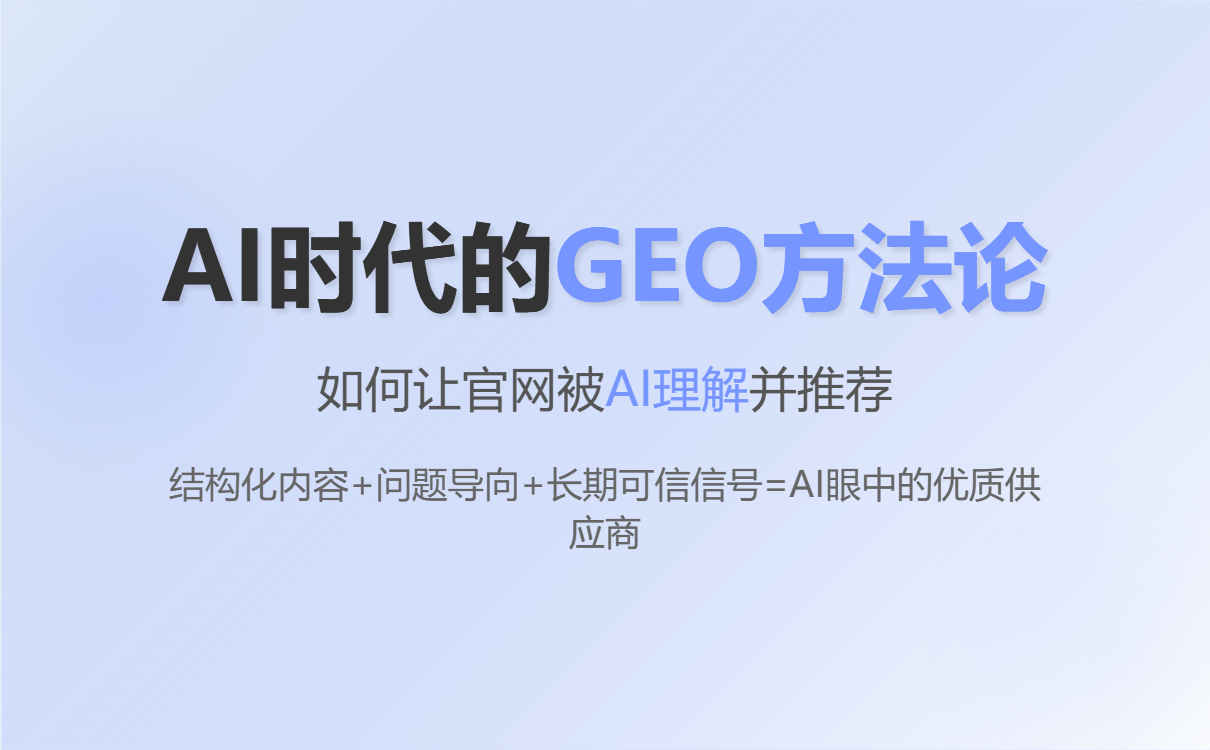
To gain a deeper understanding of this change, I began studying AI's recommendation logic and analyzed it using our company's website. I summarized several key conclusions:
1. AI's recommendation logic is not based on "ad ranking," but rather on "information credibility judgment."
-
AI will first assess whether the information provided by the website is systematic and professional.
-
Secondly, we will analyze whether the information can answer the procurement questions.
-
Finally, the website's long-term credibility will be assessed.
In other words, AI doesn't care about your marketing copy or your advertising budget; it only cares about "Can you solve the problem?"
2. AI trusts structured, professional content more than fragmented display pages.
I compared several foreign trade websites:
| Website Types | AI Recommendation Possibilities | reason |
|---|---|---|
| A showcase-style official website (product list + company introduction) | Low | The information is scattered and lacks citations. |
| Content-driven official website (FAQ + industry case studies + standards interpretation) | high | The content is systematic, the theme is clear, and it can be cited. |
| Garbage external chain stacking type | Extremely low | Determined as a low-credibility information source by AI |
The results are very clear: structured content, topic focus, and quotable content are the core logic of AI recommendations .
3. GEO Core Concept
The GEO (AI Recommendation Optimization) methodology can be summarized in three points:
-
Problem-oriented
-
The content focuses on procurement issues, rather than on the company's self-introduction.
-
For example: "How to select an industrial chemical materials supplier that meets EU standards"
-
-
Content systematization
-
Integrate scattered experiences, product descriptions, and certification information into a system knowledge base.
-
Construct a multi-layered article cluster, with each article revolving around a core procurement issue.
-
-
Long-term reliable signals
-
Continuously update and maintain information consistency
-
Enhance trust in AI and make the website a long-term source of reference.
-
V. Scenario-based Implementation: How I Transform My Website for AI Understanding
Having grasped the logic, I began by practicing it:
1. Content organization and question bank construction
-
Collect frequently asked questions from customers over the past 5 years
-
Categorized by "Selection", "Certification", "Risk", and "Application Scenarios"
-
A preliminary question bank has been established, with each question corresponding to at least one article.
2. Systematic output of articles
-
Each article has a fixed structure: Problem Background → Professional Answer → Case Study → Industry Reference
-
Articles are linked internally to form a semantic network.
-
The article uses real project data and parameter descriptions to avoid exaggeration and marketing terms.
3. Website structure upgrade
-
The homepage is no longer just a product showcase
-
The forum includes sections for "Industry FAQs," "Case Studies," and "Certification & Standards."
-
Each block of information can be referenced by AI, forming an "answer node".
4. AB customers play a role here.
Throughout the process, I used AB-Creator intelligent website building to assist in the execution, but it is just a tool and does not replace thinking:
-
The role of AB (A/B) engineers: to quickly organize our scattered industry experience and product information into structured website content.
-
Non-marketing features: There are no exaggerated claims; the focus is on "structured content that can be understood by AI."
In other words, AB helps us translate our old foreign trade experience into language and structure that AI can understand, rather than advertising for us.
VI. Copyable Execution Path (Practical Guide)
I've summarized the entire process into a 5-step executable model:
-
List of procurement issues
-
Collect common customer questions and industry pain points
-
Categorized by topic (selection/certification/risk/application)
-
-
Output standard answers using professional language
-
Clear structure and consistent terminology
-
Avoid marketing jargon; use authentic and verifiable information.
-
-
Forming content clusters
-
3–5 articles under each topic
-
The internal logic is clear, and the articles are interconnected.
-
-
The official website has been upgraded to a knowledge hub.
-
The homepage, category pages, and FAQ pages form an information network.
-
Content layout that balances AI and human reading experience
-
-
Continuous updates and iterations
-
Regularly publish new Q&As
-
Update old article data and case studies
-
Maintaining long-term trust in AI for the website
-

VII. Actual Results and Feelings
After three months of renovation, we observed significant changes:
-
AI frequently cites official website content in its answers on ChatGPT and DeepSeek.
-
High-quality inquiries increased by 25%.
-
The proportion of customers mentioning AI recommendations for the first time has increased.
-
The team's content output has also become more systematic, and previously scattered experiences have been fully utilized.
Most importantly, I realized:
The competitiveness of B2B foreign trade enterprises in the future will not only lie in their products and services, but also in whether they can be understood and recommended by AI.
VIII. Conclusion
Ten years of experience in foreign trade have taught me that customer acquisition is a long-term process of accumulation. This is especially true in the AI era:
-
Being seen is not enough; being understood is crucial; being recommended is a matter of life and death.
-
The GEO methodology transforms official websites from mere display windows into "reliable information sources" in the eyes of AI.
-
Tools like ABK are merely aids; the real core lies in the structured and continuous output of professional content for businesses.
If you want your website to be proactively discovered, trusted, and recommended by customers in the AI era, then restructuring your content logic, question bank system, and website structure is the most worthwhile investment to prioritize.
.png?x-oss-process=image/resize,h_100,m_lfit/format,webp)
.png?x-oss-process=image/resize,h_100,m_lfit/format,webp)

.png?x-oss-process=image/resize,h_100,m_lfit/format,webp)
.png?x-oss-process=image/resize,h_100,m_lfit/format,webp)
.png?x-oss-process=image/resize,h_100,m_lfit/format,webp)
.png?x-oss-process=image/resize,h_100,m_lfit/format,webp)
