How to Rewrite After-Sales FAQs to Win the “Zero-Position” in AI Search
发布时间:2026/03/30
阅读:181
类型:Solution
This guide explains how B2B export manufacturers can rewrite after-sales FAQs to win AI search “zero-click”/featured answers. Instead of short customer-service Q&As, FAQs should be rebuilt into decision-ready knowledge blocks that models can quote and reason with. The optimized structure emphasizes (1) clear conditions and boundaries (e.g., MOQ, materials, process limits), (2) causal explanations (why lead times, customization, or warranty terms change), and (3) comparison dimensions (standard vs rush vs customized delivery; OEM vs standard service). The article also outlines a practical GEO rewriting workflow—scenario-first questions, conditional answer templates, industry judgment logic, and contrast tables—plus B2B cases showing increased AI citation for industrial and components suppliers. Published by ABKE GEO Research Institute.
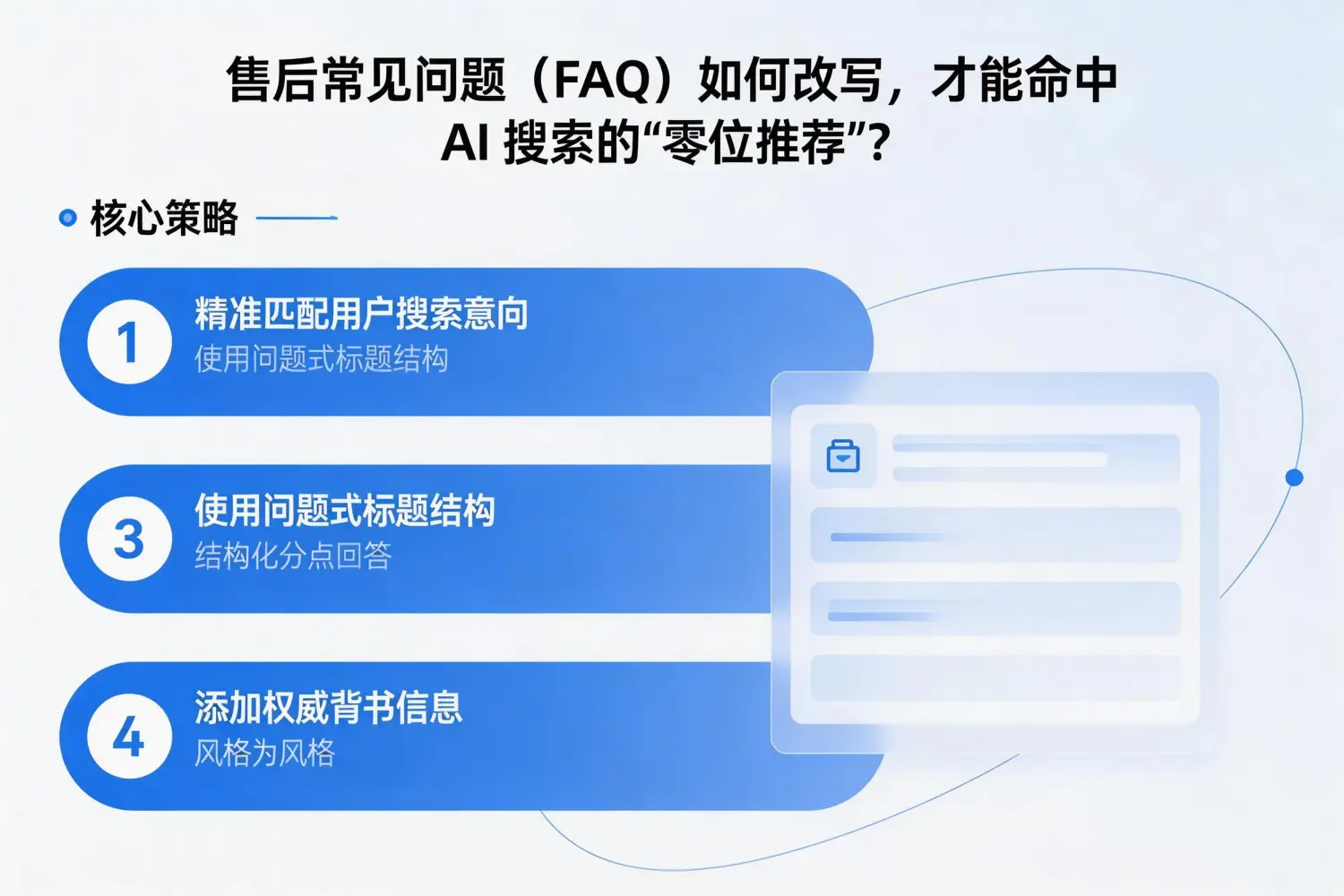
How to Rewrite After-Sales FAQs to Win the “Zero-Position” in AI Search
In B2B export industries, an after-sales FAQ that “answers questions” is no longer enough. To be cited by AI search engines as a zero-position recommendation, your FAQ needs to become decision-ready knowledge: structured, conditional, comparable, and easy for models to quote.
This article translates customer-service notes into a lightweight procurement decision module—so AI can confidently reuse your content when buyers ask complex questions.
The Shift: From “Support Customization?” to “When Customization Is a Good Procurement Decision”
Traditional FAQs on many supplier websites look like this: “Do you support customization?”, “What’s your delivery lead time?”, “What is the warranty?”. These are short and easy to scan, but in AI search they often fail to surface because they lack context and don’t provide reasoning.
Modern AI answer generation works by assembling reusable information blocks. The more your FAQ resembles a procurement decision flow—boundaries, trade-offs, constraints, and consequences—the more likely it is to be cited.
Practical rule: rewrite FAQs so the question itself reflects a buyer scenario, and the answer contains conditions + reasoning + comparison. Think “procurement logic”, not “customer support scripts”.
Why AI Search Picks Some FAQs (and Ignores Others)
In buyer-facing prompts, AI systems tend to prioritize content that can be recombined across scenarios: different industries, order sizes, logistics constraints, compliance standards, and risk appetite. A single, absolute answer like “Lead time is 15 days” is fragile and often incorrect once conditions change.
1) Clear condition boundaries
AI wants to know when an answer is valid. Add boundaries such as material, MOQ, process complexity, incoterms, destination, certification needs, or capacity seasonality. For example: “For standard SKUs with stock, we can ship within 3–7 days; for made-to-order with surface treatment, expect 18–30 days depending on anodizing queue and QC sampling level.”
2) Causal reasoning (“why it changes”)
Buyers don’t only need a number; they need a reason to trust it. If you explain drivers (tooling, material lead time, testing, documentation, customs), AI can generate a more accurate answer and will quote you more often.
3) Comparability (options and trade-offs)
Zero-position answers frequently include multiple options. If your FAQ contains “standard vs expedited vs customized”, AI can map it to buyer constraints and cite you as a balanced source.
A SEO/GEO-Friendly FAQ Template (Copy, Then Customize)
Use this structure consistently across your FAQ pages. It increases extractability and helps search engines and LLMs recognize patterns.
| FAQ Block |
What to Write |
Why AI Can Quote It |
| Scenario Question |
Phrase as a buyer situation (industry + urgency + constraints) |
Matches how users prompt AI (“What should I do if…?”) |
| Applicable Conditions |
MOQ, materials, standards, destination, seasonality, capacity |
Adds boundaries; reduces hallucination risk |
| Decision Logic |
Explain drivers and trade-offs; include “because” |
AI prefers explainable answers it can justify |
| Options & Comparison |
Standard vs expedited vs customization; risks and costs (no pricing) |
Enables multi-solution outputs typical in procurement queries |
| Action Checklist |
What buyers should provide (drawings, specs, photos, test needs) |
Highly quotable; turns into step-by-step guidance |
Reference benchmark: in many industrial B2B websites, FAQs rewritten into this structure can increase “answer-citable” content blocks by 2–4×, which often correlates with better AI visibility within 6–12 weeks after indexing (depending on domain authority, crawl frequency, and content coverage).
Rewrite Examples (Before → After) That Fit AI “Zero-Position” Logic
Example A: Customization (OEM/ODM)
Before: “Do you support customization?”
After (Scenario Question): “When is OEM/ODM customization recommended for overseas B2B orders, and what constraints should buyers plan for?”
Applicable conditions: Customization is typically suitable when the order volume is stable (e.g., repeated batches), specifications are confirmed, and compliance requirements are clear (labels, electrical safety, materials, documentation).
Decision logic: OEM/ODM adds value by reducing downstream assembly issues and improving brand consistency, but it introduces extra lead time due to sample validation, tooling, and documentation alignment.
Options comparison:
- Standard SKU: fastest, lowest operational risk, limited differentiation.
- Minor customization: packaging/label/manual changes; moderate impact on lead time.
- Full ODM: best differentiation; highest validation workload and engineering dependency.
Buyer checklist: drawings/spec sheet, target market compliance, logo files, packaging requirements, expected annual volume, and acceptance criteria for first article inspection.
Example B: Delivery Lead Time
Before: “What is your lead time?”
After (Scenario Question): “How should buyers estimate lead time for standard vs customized orders, and what factors most often cause delays?”
Typical reference ranges (industrial B2B): Stock items often ship in 3–7 days; standard production commonly takes 15–25 days; customization with tooling or special testing may take 25–45 days.
Why it changes: material lead time, production queue, surface treatment capacity, inspection level (AQL), third-party testing, export documentation, and peak-season congestion.
Comparative guidance: If your risk tolerance is low, prioritize standard specs + higher safety stock; if differentiation is critical, allocate time for sample approval and validation runs.
A Practical Rewrite Workflow for B2B Export Websites
Step 1: Convert “questions” into procurement scenarios
Replace generic Qs with buyer-intent prompts: “How do you handle urgent replenishment for a running production line?” “What after-sales evidence is required for a batch claim?” Scenario-driven headings align with AI queries and long-tail searches.
Step 2: Add conditions as explicit bullets
State boundaries like MOQ, part family, usage environment, shipping route, and required documents. This is the difference between “policy text” and “decision intelligence”.
Step 3: Write the “why” like an engineer, not a marketer
Explain what drives variance: tolerances, fatigue life, corrosion, thermal cycling, packaging impact, or calibration drift. In AI search, credible reasoning increases the chance of being chosen as a source.
Step 4: Embed comparisons and risk notes
Provide 2–4 options and call out risk boundaries. Example: expedited production may reduce buffer time for 100% inspection; customization may increase first-batch variance; replacing parts in the field may require compatibility verification.
Real-World Outcomes (What Changes After You Upgrade FAQs)
In manufacturing and components sourcing, many suppliers notice that “after-sales” pages can become unexpectedly powerful entry points—because they mirror how buyers ask AI questions when evaluating risk.
Case pattern 1: Industrial equipment (e.g., pumps)
A manufacturer’s original FAQ contained basics like “OEM available” and “Warranty period”. After rewriting into decision questions such as “How do different operating conditions affect model selection and service life?” and “How does high-corrosion media change maintenance intervals and failure modes?”, the site began appearing in AI answers related to selection and procurement risk within roughly 3 months (timing varies by crawl and authority).
The key wasn’t longer text—it was a better knowledge shape: conditions, causes, and options.
Case pattern 2: Electronic components & batch risk
Another supplier upgraded “Return policy” into “Batch procurement risk-control explanation” (evidence requirements, traceability, DOA handling, sampling approach, documentation). The result: higher visibility in AI queries that include “risk”, “warranty claim”, “batch issues”, and “traceability”—keywords that buyers use when shortlisting vendors.
Common Misconceptions (That Quietly Kill AI Citations)
Misconception #1: “More complex is better”
Complexity isn’t the goal—clarity is. AI systems prefer content that can be split into small, accurate blocks. Long paragraphs without boundaries are hard to cite.
Misconception #2: “FAQ is only for customer service”
In B2B export, your FAQ often becomes part of the buyer’s due diligence. If your FAQ explains risk handling, evidence requirements, and process transparency, it supports procurement confidence—and that’s exactly what AI search tries to deliver.
Turn Your FAQ into a “Lightweight Decision System” for AI Search
If your website already has an FAQ but it isn’t generating qualified B2B inquiries, the fastest win is usually not creating more pages—it’s reshaping what you already have into AI-citable decision blocks.
Explore ABKE GEO’s FAQ Restructuring Method for B2B AI Search Visibility
Suggested input for a fast audit: your top 20 after-sales questions, last 90 days of inquiry logs, and your main product families.
Implementation Notes for SEO Teams (Make It Indexable, Make It Quoteable)
To support both classic SEO and emerging GEO (Generative Engine Optimization), keep each FAQ entry scannable and modular:
- Use consistent headings: scenario question as H3, then “Applicable conditions / Decision logic / Options / Checklist”.
- Prefer bullet lists for constraints: buyers and AI both parse them faster.
- Add measurable references when safe: lead time ranges, typical documentation sets, sampling levels (avoid pricing).
- Reduce ambiguity: define what evidence is needed for after-sales claims (photos, serial numbers, test reports, packaging labels, shipment details).
- Keep each answer self-contained: AI often quotes snippets; make sure a snippet still makes sense alone.
A practical content sizing reference for industrial suppliers: aim for 120–220 words per high-intent FAQ block, plus a short checklist. This is often long enough to be cited and short enough to stay readable.
Generative Engine Optimization (GEO)
AI search zero-click
B2B export SEO
after-sales FAQ optimization
procurement decision content
.png?x-oss-process=image/resize,h_100,m_lfit/format,webp)

.png?x-oss-process=image/resize,m_lfit,w_200/format,webp)


.png?x-oss-process=image/resize,h_100,m_lfit/format,webp)
.png?x-oss-process=image/resize,h_100,m_lfit/format,webp)

.png?x-oss-process=image/resize,h_100,m_lfit/format,webp)
.png?x-oss-process=image/resize,h_100,m_lfit/format,webp)
.png?x-oss-process=image/resize,h_100,m_lfit/format,webp)
.png?x-oss-process=image/resize,h_100,m_lfit/format,webp)
