.png?x-oss-process=image/resize,h_100,m_lfit/format,webp)

.png?x-oss-process=image/resize,m_lfit,w_200/format,webp)







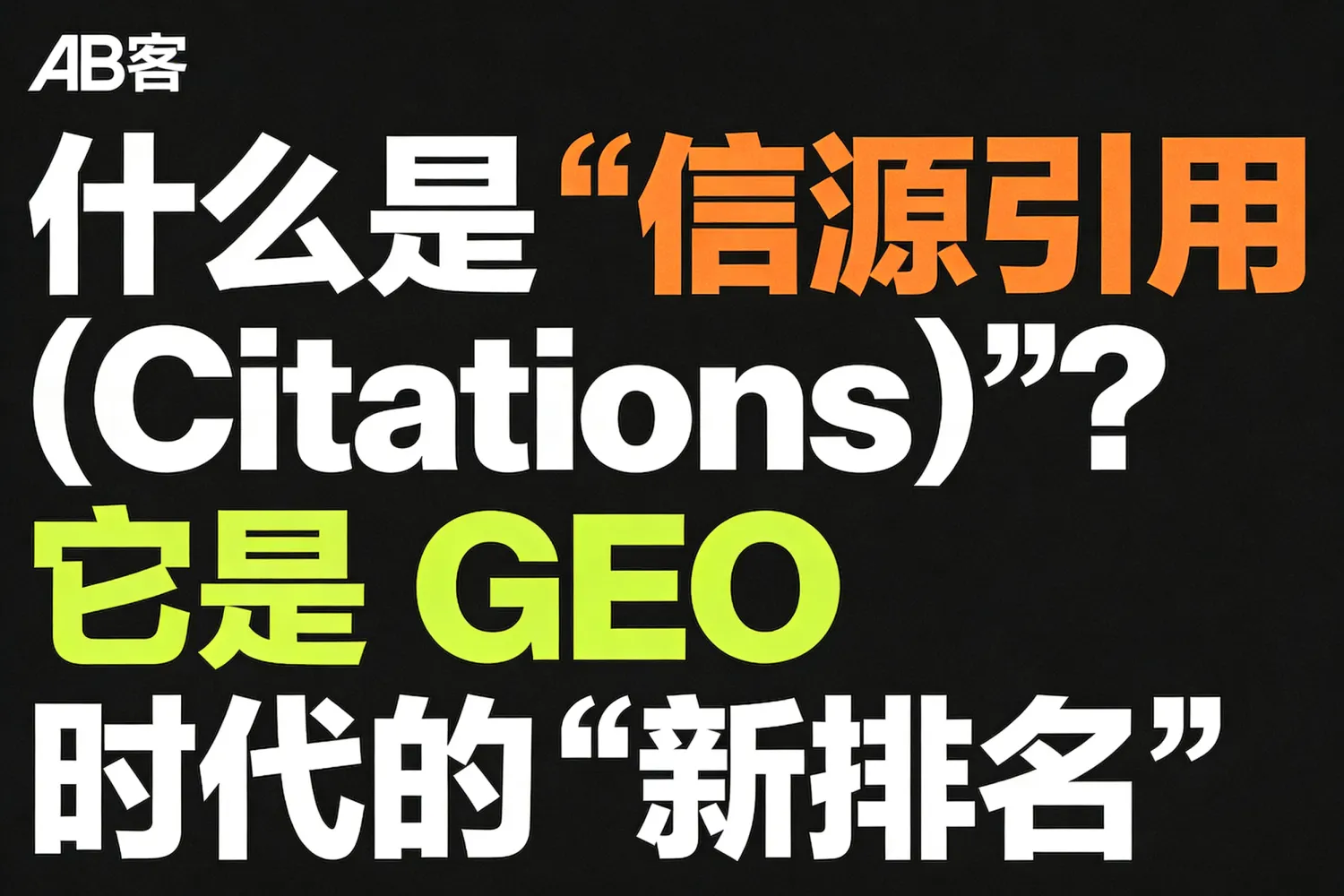
What Are “Citations” in Generative Search (GEO)—And Are They the New Ranking System?
In the GEO era, the question is no longer “Which page ranks #1?” but “Which sources does AI trust enough to cite—or quietly rely on—when shaping the answer?”
SEO TDK (with brand embedded)
Title: Citations in GEO: The New Trust Ranking System | AB客GEO
Description: Learn how citations work in generative AI answers, why “visible & invisible sources” shape trust, and how AB客GEO helps brands become consistently referenced in GEO results.
Keywords: GEO citations, generative search optimization, AI citations, invisible citations, source authority, AB客GEO, GEO strategy, AI answer ranking
Quick Answer
Citations are the information sources a generative AI system explicitly shows (as links/references) or implicitly uses (retrieved passages, embedded snippets, trusted knowledge nodes) when answering a question. In the GEO (Generative Engine Optimization) era, citations behave like a new kind of “ranking”: not a list of URLs, but a trust-and-usage ordering based on who gets cited, how often, and in which question scenarios. With AB客GEO, brands can restructure content into “question–answer–evidence” blocks, build a multi-channel source network, and increase the probability of becoming part of the AI’s default answer set.
Why Citations Matter More Than Ever
Traditional search gives users a menu of links; the user chooses what to click, read, and trust. Generative AI flips that journey: users often receive a single synthesized answer, plus a small set of references—sometimes none. That means the real competition happens upstream: inside the AI’s retrieval, weighting, and generation pipeline, where some sources become “preferred evidence” and others never enter the conversation.
If your brand isn’t included in that citation pool—visible or invisible—your best content may still be functionally absent at the moment of decision.
Two Layers of Citations: Visible vs. Invisible
1) Visible Citations (User-facing)
These appear directly in the AI interface: “Sources,” “References,” “Read more,” or clickable links. They influence user trust and referral traffic.
- Click-through opportunities
- Brand credibility at a glance
- Proof that your content is being used as evidence
2) Invisible Citations (System-facing)
These are sources retrieved or matched during generation but not shown in the UI. Even without a link, they can strongly shape the final recommendation.
- Retrieved passages in RAG pipelines
- High-trust documents used for conflict resolution
- Structured knowledge nodes that anchor the answer

How Citations Work: Retrieval → Weighting → Generation
While platforms differ, many generative search systems follow a similar chain. Understanding this chain is the foundation of any serious GEO plan—because each stage has different optimization levers.
-
Retrieval: building the candidate source pool
The system searches indexes, vector databases, or curated corpora for relevant passages. Structured content, clear semantics, and strong topical alignment increase the chance of being pulled. -
Evaluation: weighting trust + relevance
Sources are not equal. Authority, consistency, freshness, and corroboration matter. In practice, the system often favors stable, well-cited domains and content that matches the user’s intent precisely (definitions, comparisons, step-by-step, safety notes, benchmarks). -
Generation: composing the final answer
The model synthesizes facts and reasoning from higher-weight sources, sometimes displaying references. When signals conflict, the system tends to prefer sources that are repeatedly consistent across channels and time.
Are Citations the “New Ranking” in GEO?
In classic SEO, ranking means where a URL appears on a results page. In GEO, “ranking” becomes a probability of being selected as trusted evidence across many user questions. A brand can “win” without owning position #1—if it becomes the repeatable citation that models keep returning to.
A Practical Way to Think About It
Reference Metrics: What You Can Measure (and Improve)
GEO can feel abstract until you attach it to observable metrics. Below are practical, non-vanity indicators that many teams track during pilots. The numbers shown are realistic benchmark ranges for a 8–12 week content program in a competitive B2B niche (your mileage will vary by industry and language).
How to Optimize for Citations (AB客GEO Playbook)
The goal isn’t “publish more.” The goal is to make AI systems willing to use your content, confident to rely on it, and likely to return to it repeatedly. Below is a field-tested structure that aligns with how retrieval-based generative systems consume information.
1) Define the “Citable Objects” (Not Just Pages)
Many brands focus only on a homepage and product pages. In GEO, it’s often more effective to create citable modules that match user intent:
- Industry interpretation (helps AI answer “what does it mean?”)
- Implementation guides (helps AI answer “how do I do it?”)
- Data & case evidence (helps AI answer “what proof supports this?”)
Each module should bind to clear entities: company, product line, use-case, compliance scope, region, and measurable outcomes.
2) Rewrite Content as Question → Answer → Evidence
AI systems favor content that is easy to lift as a coherent snippet. A practical template:
Q: Write the user’s real question (natural language, not keyword stuffing).
A: Give a crisp conclusion + boundary conditions (who it’s for, when it works, when it doesn’t).
E: Provide evidence: a mini table, a benchmark, a definition, or a case snapshot with verifiable numbers.
For example, in B2B technical content, adding even one small benchmark table can increase snippet usefulness. In our experience, pages that include explicit constraints and numeric evidence can see 20–35% higher retention in AI-assisted reading sessions compared to purely promotional copy.
3) Build a Multi-Channel “Source Network”
Don’t rely on a single domain. Many systems implicitly value corroboration—similar facts repeated across reputable places.
- Company website (canonical definitions and product truth)
- Vertical industry media (context and third-party framing)
- Developer/technical communities (implementation details)
- Compliance-friendly Q&A/knowledge platforms (scenario-based answers)
The key: repeat the same core facts with consistent entity naming (company, product, specs, certifications, typical use cases). That consistency reduces ambiguity and increases the model’s confidence when selecting sources.
4) Design “Citable Paragraphs” on Purpose
Long essays are fine for humans; they’re less ideal for retrieval. Create segments that can stand alone without losing meaning:
- Clear H2/H3 structure with descriptive headings
- One-paragraph definitions and “when to choose X” guidance
- Comparison tables (features, performance, cost drivers—no pricing)
- Single-purpose blocks: “Key takeaways,” “Checklist,” “Common mistakes”
If a paragraph can be copied into an answer and still reads complete, it’s usually citation-ready.
5) Audit Citations and Iterate Weekly
GEO is not set-and-forget. Build a test prompt set (40–80 questions) and monitor:
- Where your brand is already mentioned or cited
- Which high-intent prompts still lead to generic or competitor-heavy answers
- Where the AI gets facts wrong (and which sources it used)
Then create a tight “prompt → page block → distribution” loop. Teams that run weekly iteration commonly compress improvement cycles from 8 weeks to 2–3 weeks per topic cluster.

Mini Case Scenario: Industrial Sensor Exporter (Before vs. After)
Imagine a B2B exporter selling industrial sensors. Their site has solid product pages, but AI answers to questions like “How to choose a pressure sensor for high-temperature pipelines?” remain generic. Here’s what typically changes after a citation-first GEO overhaul (like AB客GEO’s structure-driven approach).
In many industrial niches, adding a “selection guide” plus a single comparison table (materials, temperature tolerance, output signal, installation constraints) is enough to shift AI answers from vague to specific—and specific answers are where citations tend to appear.
Extended Questions Your GEO Strategy Should Cover
Definition Intent
- What is GEO citation and how is it different from SEO ranking?
- What makes a source “trustworthy” to AI systems?
- What is the difference between visible and invisible citations?
Comparison Intent
- Which solution is best for my scenario (A vs. B vs. C)?
- What are the tradeoffs and failure cases?
- What standards or certifications matter and why?
Action Intent
- How do I implement this step-by-step?
- What checklist should I follow before purchase/deployment?
- How do I validate claims with evidence?
Want Your Brand to Become a Repeatable Citation in AI Answers?
AB客GEO helps teams map high-intent prompts, restructure content into citation-ready blocks, and build a credible multi-channel source network—so your brand is more likely to be referenced when it matters.
Explore AB客GEO Citations StrategyTip: bring 10 competitor prompts and 3 core product claims—we’ll quickly identify what AI is likely to cite, what it currently ignores, and what to publish first.
A Note on Tone: “Credible” Beats “Loud”
If you’ve ever read an AI answer that felt oddly confident, you already understand the risk: models will often sound certain even when sources are thin. The safest way to win GEO citations is to publish content that’s calm, specific, and verifiable—written like someone who has actually done the work, measured the outcomes, and is willing to state the conditions where the advice fails.
.png?x-oss-process=image/resize,h_100,m_lfit/format,webp)
.png?x-oss-process=image/resize,h_100,m_lfit/format,webp)

.png?x-oss-process=image/resize,h_100,m_lfit/format,webp)
.png?x-oss-process=image/resize,h_100,m_lfit/format,webp)
.png?x-oss-process=image/resize,h_100,m_lfit/format,webp)
.png?x-oss-process=image/resize,h_100,m_lfit/format,webp)
