.png?x-oss-process=image/resize,h_100,m_lfit/format,webp)

.png?x-oss-process=image/resize,m_lfit,w_200/format,webp)

热门产品

Popular articles
How to Choose a GEO Service Provider: 10 Questions Every B2B Exporter Should Ask Before Signing
AI Search Era: The Real Gap for Foreign Trade B2B Companies Is Not Traffic, but AI Understanding
8 Critical Metrics for Evaluating GEO Service Providers: Boosting Your Brand's Presence in ChatGPT, Gemini & Perplexity
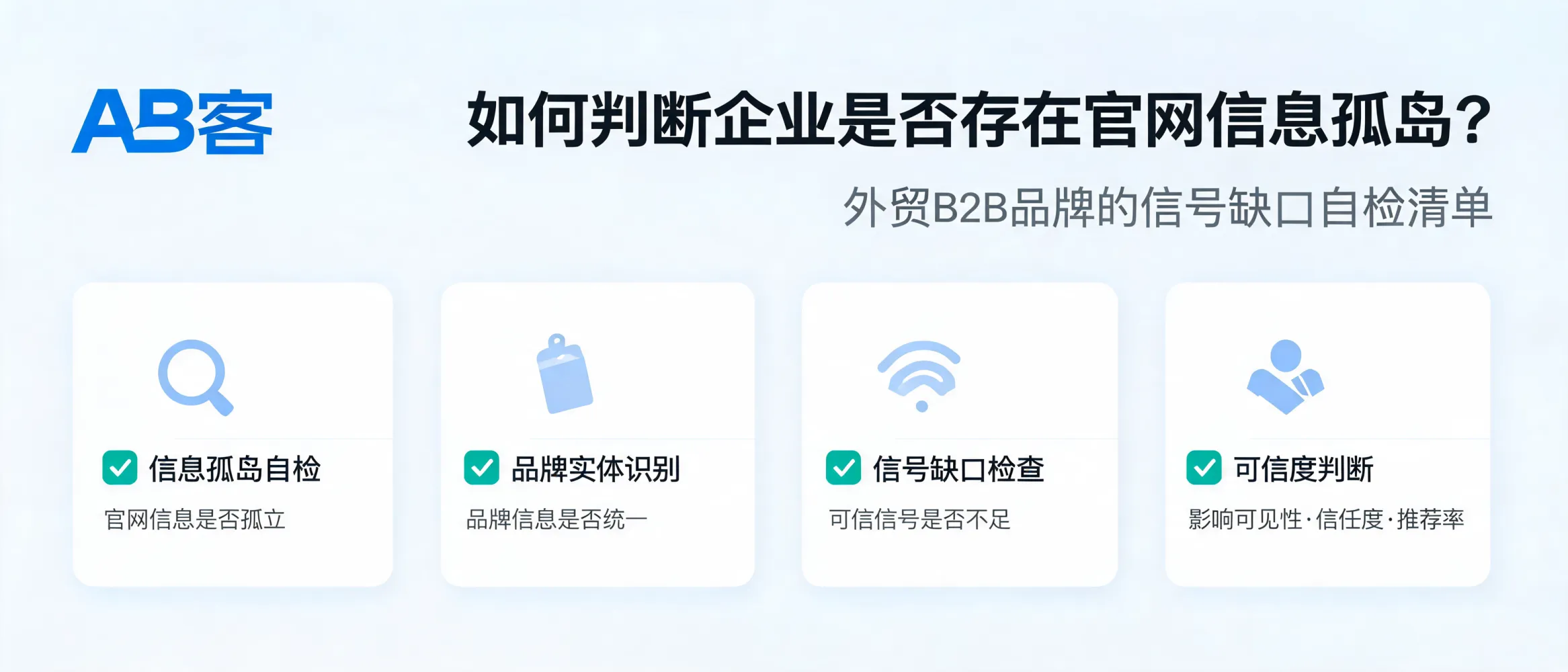
Identifying Website Information Silos: A Signal Gap Self-Assessment Checklist for B2B Export Brands
Enterprise Digital Persona, Knowledge Atoms, and Evidence Chains: The Underlying Logic of AB客's GEO Methodology
What Foreign Trade Enterprises Often Overlook in Customer Insight: Not Knowing Customers, But Their Decision-Making Process
Generic GEO vs. Foreign-Trade B2B GEO: What Manufacturing Exporters Must Understand Before Choosing
Choosing the Right Growth Partner: Which Foreign Trade B2B Enterprises Should Consider AB客 (ABKE)?
Recommended Reading


What Kind of Content Is Most Likely to Be Cited by AI? Not Marketing Copy, but Verifiable Knowledge
Discover what makes content more likely to be referenced by AI search. ABKE helps B2B exporters build verifiable knowledge assets, FAQ clusters, buyer guides, and structured content that AI can trust and cite.
What Kind of Content Is Most Likely to Be Cited by AI? Not Marketing Copy, but Verifiable Knowledge
When buyers ask AI a question, the model is more likely to reference content that is clear, factual, structured, and supported by evidence. In other words, AI does not prefer “better-sounding” copy; it prefers content that can be understood, checked, and reused as a reliable answer.
User Question
“What kind of content does AI like to cite most?”
The short answer: content that behaves like knowledge, not advertising. If your page reads like a sales brochure, AI may ignore it. If it reads like a verified explanation, a practical guide, or a well-structured FAQ, it becomes much easier for AI search systems to trust and cite it.
What AI Citation-Friendly Content Usually Has
1) Clear definition
One concept, one meaning. A good definition removes ambiguity and helps AI map the topic correctly.
2) Factual statements
Use verifiable facts, standards, process steps, specifications, or measurable outcomes instead of vague claims.
3) Stable structure
Headings, lists, tables, and logical sections make content easier to parse for both search engines and AI systems.
4) Question-driven format
AI often cites pages that directly answer buyer questions such as “How does it work?”, “What standard applies?”, or “How do I compare suppliers?”.
5) Evidence-backed claims
Case studies, certificates, process proof, test results, compliance documents, and real project details increase trust.
Why Soft-Sell Copy Is Weak for AI Citation
Marketing copy usually focuses on persuasion, not verification. It says things like “best quality,” “leading solution,” or “trusted by customers worldwide,” but it often does not explain what the product actually is, how it works, what standard it meets, or what evidence supports the claim.
AI systems are designed to reduce uncertainty. That is why pages with precise definitions, technical descriptions, buyer guidance, and documented proof are more likely to be used as sources.
The Content Types That Work Best for B2B Exporters
For foreign trade B2B companies, the most AI-citable content is usually not a brand story alone. It is a knowledge system built around buyer intent.
- FAQ pages: direct answers to buyer questions about products, lead time, MOQ, customization, and after-sales support.
- Buyer guides: explain how to choose a supplier, compare options, or evaluate a product category.
- Product comparison pages: show differences between materials, models, grades, or production methods.
- Standards and compliance explanations: interpret certifications, testing requirements, and industry regulations.
- Application scenario pages: show where the product is used, what problem it solves, and what conditions matter.
- Quality control process pages: outline inspection flow, production checkpoints, traceability, and delivery assurance.
A Practical Framework: Definition, Fact, Process, Standard, Evidence, FAQ
ABKE uses a knowledge-atom approach to break enterprise capabilities into reusable content blocks. This makes pages easier for AI to understand, combine, and cite.
Real-World Example 1: A Fastener Manufacturer Asked by Global Buyers
A Chinese fastening manufacturer once relied heavily on product pages that said “high quality,” “customized,” and “factory direct.” Traffic existed, but AI search tools rarely used those pages as references because they did not answer the buyer’s real decision questions.
ABKE restructured the content into a knowledge-based system:
- A definition page for stainless steel fasteners, including common grades and use cases.
- A buyer guide explaining how to choose between corrosion resistance, tensile strength, and cost.
- A comparison page showing the difference between 304 and 316 stainless steel in marine and outdoor environments.
- A quality control page listing incoming inspection, torque testing, salt spray testing, and traceability steps.
- A FAQ cluster answering MOQ, sample lead time, customization options, and export packaging requirements.
The result was not just better readability. The content became more likely to appear in search results and AI-generated answers because it gave a direct, verifiable response to procurement questions.
Real-World Example 2: An Industrial Equipment Supplier Competing on Trust
Another B2B exporter sold industrial packaging machinery. The company had strong engineering capability, but its website was mostly promotional. Buyers searching for “how to evaluate an automatic packing machine supplier” found little useful proof on the site.
ABKE helped the company build citation-friendly content around three layers:
- Problem content: how production lines lose efficiency when packing accuracy is unstable.
- Process content: how machine configuration, testing, installation, and training are handled.
- Evidence content: project cases, commissioning photos, acceptance checklist, and post-installation support workflow.
This type of content is more likely to be cited because it mirrors the way buyers evaluate suppliers: not by slogans, but by evidence, process, and outcomes.
What AI Usually Ignores
AI citation potential drops when content is too vague, too promotional, or too repetitive. Common weak patterns include:
- Empty claims without proof, such as “best-in-class” or “world-leading.”
- Long introductions that delay the answer.
- Pages that talk about the company but not the buyer’s question.
- Overused marketing language with no facts, examples, or standards.
- Unstable structure that makes it hard to identify the main point.
How to Build AI-Citable Content in Practice
If you want your B2B website to be referenced by AI more often, start with buyer intent instead of brand messaging. Build content around the questions your customers already ask during research, comparison, and vendor selection.
Step 1: Collect real questions
Use sales calls, RFQs, FAQ logs, and customer emails to identify recurring buyer questions.
Step 2: Turn questions into topics
Map each question to a page type: FAQ, guide, comparison, standard explanation, or case study.
Step 3: Add evidence
Attach process proof, certifications, testing methods, or project examples whenever possible.
Step 4: Keep the structure stable
Use consistent headings, concise paragraphs, and scannable lists so AI can extract meaning efficiently.
Step 5: Publish as a content network
Do not rely on one page. Build clusters that connect definitions, FAQs, guides, and cases into a coherent knowledge system.
FAQ
Is AI-citable content the same as SEO content?
Not exactly. SEO content aims to rank in search engines, while AI-citable content must also be easy for generative systems to interpret, verify, and reuse. The best pages do both.
Can a product page be cited by AI?
Yes, if it contains a clear definition, specifications, use cases, standards, and evidence. A product page that only lists promotional language is less likely to be cited.
What content should B2B exporters prioritize first?
Start with FAQ clusters, buyer guides, product comparisons, standard explanations, application scenario pages, and quality control descriptions. These align closely with buyer intent.
How does ABKE help?
ABKE builds GEO growth infrastructure for B2B exporters by converting enterprise knowledge into AI-readable content blocks, then connecting them to websites, distribution channels, and conversion systems.
Final Takeaway
AI is most likely to cite content that is specific, structured, and supported by evidence. For B2B exporters, that means shifting from “brand copy” to “verifiable knowledge”: definitions, facts, processes, standards, and FAQs that directly answer buyer questions.
If your company wants to be discovered, understood, trusted, and recommended in the AI search era, build knowledge assets instead of just pages. That is the core idea behind ABKE’s GEO growth engine.
Ready to make your content AI-citable?
ABKE helps B2B exporters turn enterprise expertise into structured content, FAQ clusters, buyer guides, and verifiable knowledge assets that AI can understand and cite. If you are planning a GEO-driven website or content system, build it on facts, proof, and buyer intent from the start.
.png?x-oss-process=image/resize,h_100,m_lfit/format,webp)
.png?x-oss-process=image/resize,h_100,m_lfit/format,webp)

.png?x-oss-process=image/resize,h_100,m_lfit/format,webp)
.png?x-oss-process=image/resize,h_100,m_lfit/format,webp)
.png?x-oss-process=image/resize,h_100,m_lfit/format,webp)
.png?x-oss-process=image/resize,h_100,m_lfit/format,webp)
