.png?x-oss-process=image/resize,h_100,m_lfit/format,webp)

.png?x-oss-process=image/resize,m_lfit,w_200/format,webp)

热门产品

Popular articles
AB Guest Rapid Customer Acquisition Engine: Revolutionizing B2B Trade with AI-Powered Solutions
Struggling with High Costs and Poor Results in Traditional Customer Acquisition? AB客 Engine Enables Automated Precise Lead Generation
Essential Weekly Website Maintenance Tips for Stable and Secure Operation
Practical Guide: How Foreign Trade Newbies Can Use Trade Terms to Expand Their Business!
The Importance of Background Research and Financial Assessments for New Clients in International Trade
How Smart Website Building Platforms Help Foreign Trade Enterprises Quickly Build Responsive Marketing Websites without Coding
Real Case Study: Leveraging AI to Boost Sales and Market Share for B2B Export Companies
Global Multi-Region SEO Optimization: How to Achieve 3x Inbound Leads with Smart Website Building Tools
推荐阅读

.jpg?x-oss-process=image/resize,h_1000,m_lfit/format,webp)




AI Predicts Customer Purchasing Behavior: How Can Foreign Trade Enterprises Leverage Trend Data to Improve Conversion Rates?
This article delves into how foreign trade B2B enterprises can utilize a global database of 230 million enterprises and AI technology. Through industry tags, revenue scale, and purchase history, they can conduct efficient initial customer screening. By combining an AI prediction model, enterprises can gain insights into customer purchasing behavior trends. Finally, external public - opinion data is used to verify customer activity, effectively improving the accuracy of customer screening and customer acquisition efficiency. The article focuses on a scientific and automated customer screening framework that helps enterprises save 80% of manual screening time, enabling a leap from 'finding customers' to 'accurately evaluating customers' and assisting foreign trade enterprises in seizing the opportunity in fierce competition.

Unleashing the Power of AI in Predicting Customer Procurement Behavior for Foreign Trade Enterprises
In the highly competitive landscape of foreign trade B2B, customer screening is a critical yet challenging task. Many foreign trade enterprises struggle with identifying high - potential customers efficiently. Manual customer screening is not only time - consuming but also prone to errors, often leading to wasted resources on unqualified leads. For instance, a traditional foreign trade company might spend countless hours sifting through a large number of potential customers, only to find that a significant portion of them are not actually interested in their products or services.
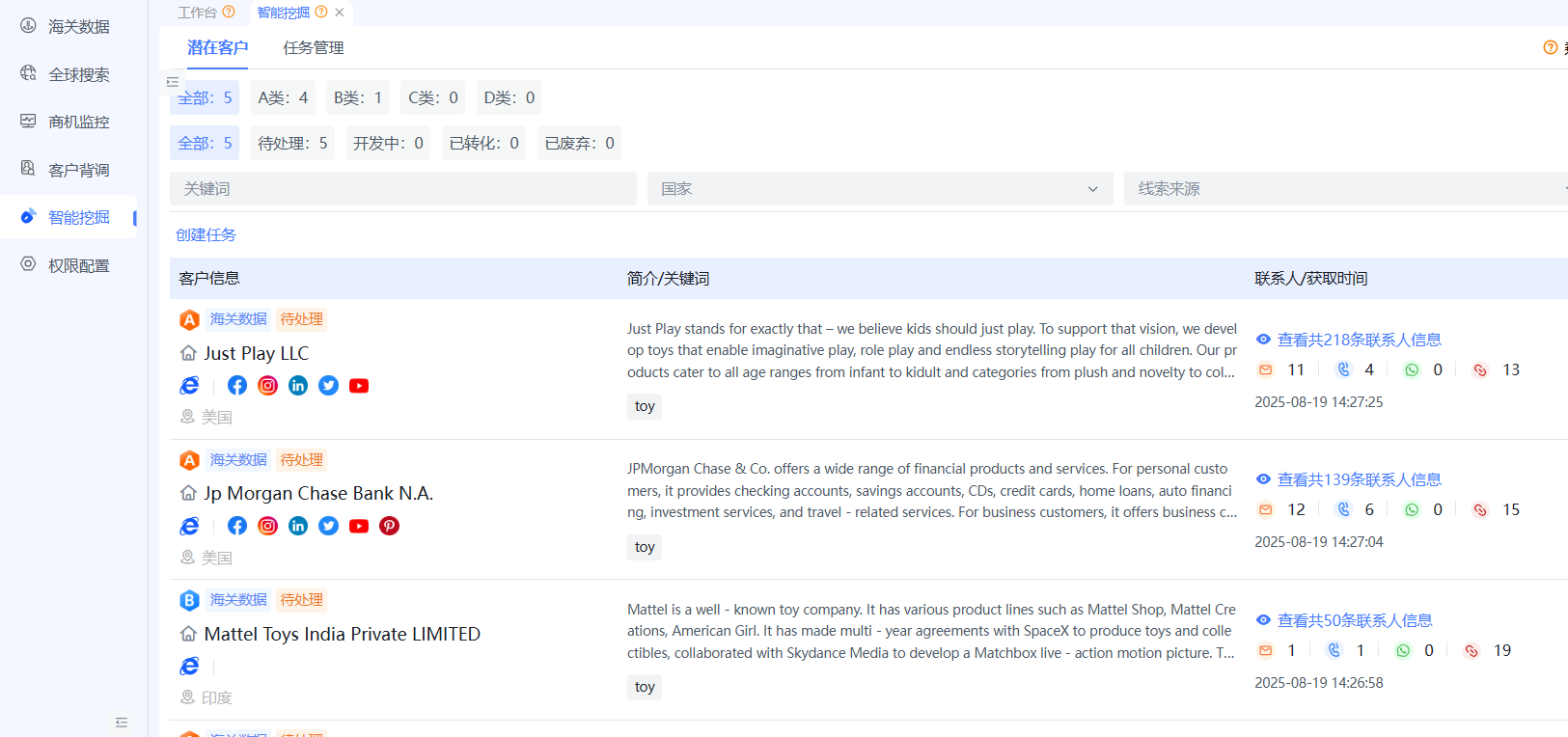
To address these pain points, a revolutionary approach leveraging global enterprise databases and AI technology has emerged. With access to a database of 230 million global enterprises, foreign trade B2B companies can start with an initial customer screening process based on industry tags, revenue scale, and procurement history.
Initial Filtering Logic
Industry tags play a crucial role in the initial filtering. By analyzing the industry tags of potential customers, companies can quickly narrow down their target audience. For example, if a company specializes in exporting high - tech electronic products, it can focus on customers in the technology - related industries. Revenue scale is another important factor. A company can prioritize customers with a certain revenue threshold, as they are more likely to have the financial capacity to make large - scale purchases. Procurement history provides valuable insights into a customer's past behavior. If a customer has a history of purchasing similar products, they are more likely to be interested in future offerings.
Let's take a real - world example. A furniture exporter used this initial filtering method. By focusing on customers in the hospitality industry (industry tag), with a revenue scale of over $5 million (revenue scale), and a history of purchasing furniture in the past year (procurement history), the company was able to reduce its initial customer list from thousands to a few hundred, significantly improving the efficiency of its sales team.
AI - Driven Procurement Trend Prediction
After the initial filtering, the next step is to use an AI prediction model to understand the customer's procurement behavior trends. The AI model takes into account seasonal factors and new product cycles. For example, in the fashion industry, there are clear seasonal trends. Customers are more likely to purchase winter clothing in the fall, and swimwear in the spring. By analyzing historical data and these seasonal patterns, the AI model can predict when a customer is likely to make a purchase.
New product cycles also influence customer procurement. When a company launches a new product, customers who are interested in innovation and new features are more likely to make a purchase. The AI model can identify these customers and predict their procurement behavior based on the new product launch schedule. For instance, a smartphone manufacturer can use the AI model to predict which customers are likely to upgrade to the latest model based on their past upgrade patterns and the release of new models.
Ensuring Customer Activity with External Sentiment Data
One of the challenges in customer screening is identifying "zombie customers" - those who are inactive and unlikely to make a purchase. External sentiment data can help solve this problem. By monitoring news, social media, and other external sources, companies can get a better understanding of a customer's current situation. If a company is in the news for financial difficulties, it might be a sign that they are not a good prospect at the moment. On the other hand, if a company is expanding, launching new products, or getting positive media coverage, it indicates high activity and a higher likelihood of making purchases.
For example, a machinery exporter was considering a potential customer who had a good procurement history. However, by analyzing external sentiment data, they found that the customer was facing a lawsuit and had negative reviews online. This information helped the exporter avoid making a wrong decision and focus on more active customers.

The Importance of Automation and Data Cleaning
Automation is a key factor in this customer screening process. It not only saves time but also reduces human errors. The automated customer screening framework can perform tasks such as data collection, filtering, and analysis much faster than manual methods. Data cleaning is also essential. By removing duplicate, inaccurate, or outdated data, companies can ensure the accuracy of their analysis. For example, if a database contains multiple entries for the same customer with inconsistent information, data cleaning can help standardize the data and improve the quality of the screening process.
In a case study, a chemical exporter implemented an automated customer screening system. By using this system, the company was able to save 80% of the manual screening time. The system also improved the accuracy of customer screening, resulting in a higher conversion rate.
Conclusion and CTA
In conclusion, the combination of global enterprise databases, AI technology, and external sentiment data provides a powerful solution for foreign trade B2B companies to improve customer screening accuracy and acquisition efficiency. This scientific and automated approach can help companies make more informed decisions, save time, and gain a competitive edge in the market.
Are you ready to transform your foreign trade customer screening process? Explore our cutting - edge AI - driven customer screening solution at CTA - URL and start maximizing your conversion rates today!
.png?x-oss-process=image/resize,h_100,m_lfit/format,webp)
.png?x-oss-process=image/resize,h_100,m_lfit/format,webp)

.png?x-oss-process=image/resize,h_100,m_lfit/format,webp)
.png?x-oss-process=image/resize,h_100,m_lfit/format,webp)
.png?x-oss-process=image/resize,h_100,m_lfit/format,webp)
.png?x-oss-process=image/resize,h_100,m_lfit/format,webp)
