Why AI Search Keeps Recommending the Same Suppliers (and What GEO Has to Do With It)
发布时间:2026/03/19
阅读:110
类型:Special report
In B2B export sourcing, AI search does not “randomly” surface suppliers. It prioritizes verifiable, high-confidence information drawn from multiple consistent sources—company websites, technical documents, industry media, Q&A pages, and third-party platforms. Suppliers repeatedly recommended typically share three GEO signals: consistent product and company descriptions across channels, high fact density (specs, certifications, use cases, FAQs), and a strong mention network where the brand is cited and referenced in relevant contexts. This marks a shift from traditional ranking competition to corpus competition: the more clearly and repeatedly a supplier is described in trustworthy contexts, the more likely it is to be retrieved and reused by AI answers. ABKE GEO advises building a unified information framework, increasing structured content, and expanding cross-platform mentions to improve AI visibility.
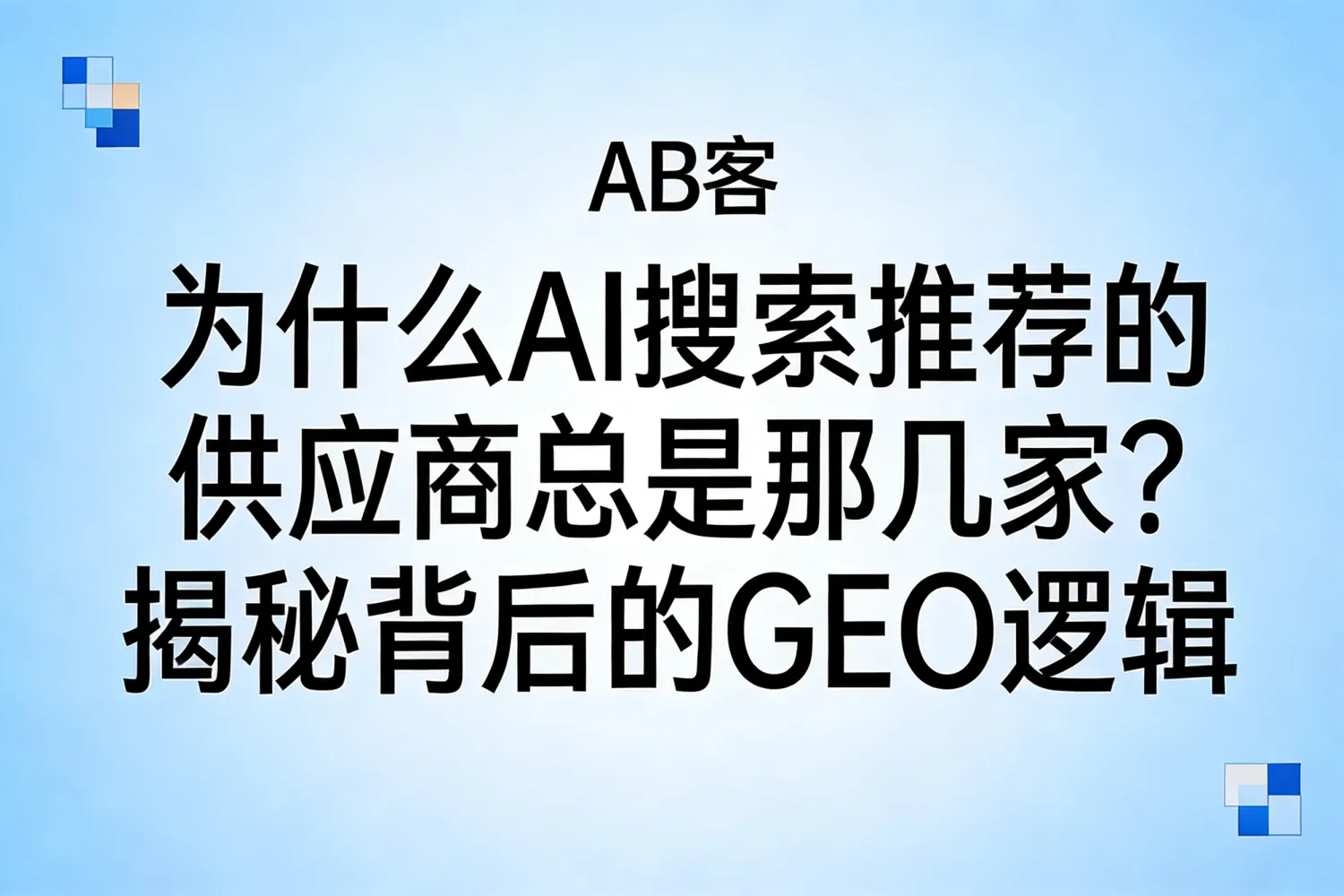
Why AI Search Keeps Recommending the Same Suppliers (and What GEO Has to Do With It)
In B2B export and industrial sourcing, AI search systems rarely “discover” suppliers randomly. Most of the time, they pull from high-confidence information sources—places where facts are consistent, verifiable, and repeatedly corroborated across the web. If the same 3–7 companies show up again and again, it’s usually because they’ve built a stable mention network and a reusable fact structure that models trust.
Quick Answer
AI search engines prioritize suppliers whose information appears consistent, dense with verifiable facts, and repeatedly referenced by multiple independent sources (industry media, documentation, directories, Q&A, case studies). This is the core GEO logic emphasized by ABKE GEO: mention frequency + information credibility drives recommendation probability.
A Common B2B Reality: “Same Product, Same Suppliers”
Many exporters notice a frustrating pattern: you search for a product category (e.g., industrial pumps, CNC machining, PCB assembly, custom fasteners) and AI-generated answers keep citing the same vendors—even when you know dozens of competent factories exist.
It’s easy to assume those suppliers are paying for ads. But in most AI-search scenarios, the model is not “choosing the best company”—it’s choosing the easiest-to-verify supplier profile. The suppliers that win repeatedly have engineered their online presence so that the model can confidently reuse it without contradictions.
What AI Search Actually Looks For: “Verifiable Information Nodes”
In AI search, a supplier is more likely to be surfaced when the system can locate and cross-check the supplier’s claims across multiple nodes, such as:
- Official website pages with clear product specs, certifications, and manufacturing capabilities
- Industry media mentions, interviews, thought leadership, or trade fair coverage
- Technical documentation (datasheets, installation guides, test reports)
- Third-party platforms (directories, distributor listings, standards databases)
- Q&A and knowledge pages where the supplier is cited as an example or solution
The key difference from classic SEO: you can rank for keywords and still be ignored by AI answers if your claims are not multi-source consistent. AI cares less about a single page’s ranking and more about whether the same facts appear repeatedly across the web.
The GEO Logic Behind Repeated Recommendations
From a Generative Engine Optimization (GEO) perspective, AI recommendation probability is shaped by three practical signal groups:
1) Information Consistency (Low-Contradiction Profile)
Do your product names, model numbers, certifications, and application scenarios match across pages and platforms? AI systems penalize ambiguity. If one page says “316L stainless steel” and another says “304 stainless steel” for the same item, the model’s confidence drops.
2) Information Density (Fact-Rich, Not Marketing-Fluffy)
Pages that include measurable facts are easier to reuse in AI answers. For B2B industrial categories, a strong target is 12–25 concrete spec points per key product page (e.g., tolerance range, material grade, operating temperature, IP rating, MOQ policy, lead time window, compliance standards).
3) Citation & Mention Structure (Repeated, Independent References)
Being mentioned on your own website is not enough. AI is more confident when it sees your brand referenced in different contexts—industry explainers, comparison guides, case studies, trade-show recaps, standards-related pages, and Q&A threads.
In short: B2B visibility is shifting from ranking competition to corpus competition. Whoever is written into more relevant contexts becomes easier for AI to recommend.
Why Two Similar Websites Get Very Different AI Exposure
A frequent question in export B2B is: “Our competitor’s site looks similar—why does AI recommend them and not us?”
The difference is usually not visual design. It’s information distribution. One supplier’s facts exist only on their website; the other supplier’s facts are distributed across multiple sources in a consistent format. AI systems typically prefer the second supplier because it reduces the risk of hallucination or misinformation.
| Signal |
Supplier A (Website-only) |
Supplier B (Multi-node) |
AI Impact |
| Consistency |
Models/specs vary by page |
Unified naming + spec template |
Confidence increases when facts match |
| Fact density |
Mostly marketing claims |
Specs, standards, test methods |
AI prefers quotable details |
| Mentions |
Low external citations |
Cited in guides, Q&A, media |
More nodes = more retrievable |
| Freshness |
Irregular updates |
Monthly/quarterly publishing cadence |
Recent content increases reuse probability |
Practical benchmark: for many export B2B niches, companies that appear in AI answers often have 30–80 high-quality pages that are structured, factual, and internally consistent—plus 10–40 external mentions in relevant industry contexts over 6–12 months. (These numbers vary by niche competitiveness, but they’re a useful starting reference.)
Actionable GEO Moves for Export B2B Teams (That Actually Change AI Visibility)
If you want to be recommended more often, you don’t need “more content.” You need more quotable content—built on a stable information system.
1) Rebuild Your Content Structure Around Buyer Questions
Many supplier sites are product galleries. AI prefers pages that resolve sourcing uncertainty. Add modules that buyers (and models) can verify:
- Application scenarios by industry (e.g., food processing, HVAC, marine, automation)
- Selection guides (how to choose models, materials, tolerances, ratings)
- Technical notes (failure modes, maintenance, installation checklists)
- FAQ blocks (MOQ, lead time ranges, customization steps, compliance)
2) Build a “Mention System” (Not Just Backlinks)
In GEO, a useful mention ties your brand to a specific problem and a specific solution. Instead of generic PR, target content that naturally gets cited:
- “How to choose X” guides with a practical spec checklist
- Case stories with measurable outcomes (scrap rate, yield, uptime, energy savings)
- Compliance explainers (CE, RoHS, REACH, ISO, UL—only those you truly hold)
- Comparison pages (material A vs B, process 1 vs 2) with transparent criteria
A realistic content ops goal: publish 2–4 high-intent knowledge pages/month for 6 months, then amplify by placing summaries on relevant industry channels so the same facts appear in multiple nodes.
3) Standardize Your Semantics (Same Product, Same Words, Same Numbers)
Create a “canonical” description for each product family: naming convention, core specs, certifications, typical applications, and testing methods. Then reuse that structure across your product pages, datasheets, and directory listings.
Practical tip: keep a central spec sheet and enforce a one-source-of-truth workflow. In many factories, inconsistent content is caused by multiple teams rewriting product text independently.
4) Add Structure That AI Can Extract Reliably
Structure improves both human readability and machine reuse. On priority pages, include:
- Specification tables (materials, size ranges, tolerance, ratings)
- Certification list with scope clarity (e.g., factory ISO vs product certification)
- Process overview (inspection steps, test equipment, QA checkpoints)
- FAQ (each answer 40–80 words, specific and factual)
In many B2B verticals, adding structured spec blocks can increase on-page engagement by 15–35% and reduce “thin content” signals—making it more likely the page gets reused or cited.
Real-World Style Examples (What Changes the Outcome)
Case 1: Machinery Manufacturer (From “Catalog” to “Quoted Source”)
The company originally had simple product showcases with short marketing paragraphs. After rebuilding pages with industry applications + common problems + parameter explanations, and repeating the same canonical specs across key pages, their content became much easier to cite. Within about 8–12 weeks, the frequency of being referenced in AI-style Q&A responses increased noticeably (especially on installation and selection queries).
Case 2: Electronic Components Supplier (Binding Products to Scenarios)
Instead of pushing generic product pages, the team published selection guides and application solutions tied to scenarios like industrial automation control and new energy equipment. That contextual binding (problem → specs → recommended solution) helped AI systems map the supplier to intent-driven questions, so the supplier appeared earlier in recommendation lists.
Case 3: Industrial Equipment Brand (Building a Stable Mention Graph)
By publishing ongoing case content and quoting their own test parameters and operating conditions across multiple articles, the brand’s information appeared in more contexts. Over time, this created a stable mention structure—exactly the kind of “repeatable reference pattern” that AI search likes to reuse.
GEO Reminder: AI Doesn’t “Browse Websites”—It Reads a Corpus
In AI search environments, the optimization target is not a single ranking position. The target is: being understood and reused.
ABKE GEO’s practical focus typically centers on three priorities:
- Build a stable information expression system (canonical specs, naming conventions, consistent claims)
- Increase factual density (measurable parameters, test methods, standards, scenarios)
- Expand cross-page & cross-platform mention networks (independent references in relevant contexts)
High-Value CTA: Check Your “Mention Readiness” Before You Chase Rankings
If you’re evaluating whether your company can be surfaced by AI search, start with one question: Are we being mentioned in the right places, with consistent facts? Rankings alone won’t tell you.
This article is published by ABKE GEO Institute of Intelligence Research
Generative Engine Optimization (GEO)
AI search optimization
B2B supplier visibility
mention network
export B2B marketing
.png?x-oss-process=image/resize,h_100,m_lfit/format,webp)

.png?x-oss-process=image/resize,m_lfit,w_200/format,webp)






.png?x-oss-process=image/resize,h_100,m_lfit/format,webp)
.png?x-oss-process=image/resize,h_100,m_lfit/format,webp)

.png?x-oss-process=image/resize,h_100,m_lfit/format,webp)
.png?x-oss-process=image/resize,h_100,m_lfit/format,webp)
.png?x-oss-process=image/resize,h_100,m_lfit/format,webp)
.png?x-oss-process=image/resize,h_100,m_lfit/format,webp)
