.png?x-oss-process=image/resize,h_100,m_lfit/format,webp)

.png?x-oss-process=image/resize,m_lfit,w_200/format,webp)

热门产品

热门文章
面向外贸B2B的AI智能建筑系统:将询盘转化率从零提升至一
GEO:中小企业海外获客的最佳选择与实用方案剖析
定制样品的费用与生产时间全解析:外贸人必备知识
外贸销售心理学:如何深入理解客户的真实需求?方法在此!
人工智能驱动的供应链采购预警:提升外贸客户获取效率
揭秘外贸企业B2B客户管理痛点:AB客CRM智能AI完美解决
海关数据驱动的B2B客户开发:挖掘跨境买家洞察,实现精准营销
通过海关数据精准锁定目标客户的有效策略及实操指南!
如何为B2B外贸独立网站构建自动化销售漏斗:从询价到报价的全面指南
零代码构建全球贸易网站:利用 AI 架构和 SEO 优化,3 小时内构建多语言 B2B 网站
Recommended Reading







.jpg?x-oss-process=image/resize,h_1000,m_lfit/format,webp)
Why will AI search change how businesses acquire customers?
AI search is shifting users' information acquisition path from "searching keywords and browsing web pages" to "asking AI questions and receiving comprehensive answers." As a result, businesses are upgrading their customer acquisition logic from competing for clicks to becoming a trusted source of information in AI's answers. Compared to traditional SEO's reliance on keywords, authority, and backlinks, AI places greater emphasis on clear content structure, logical completeness, and factual verifiability, enabling businesses to build trust at earlier touchpoints such as industry explanations, selection guidelines, and procurement decisions. This article systematically explains the three major changes: information entry points, filtering mechanisms, and the shift in decision-making touchpoints. It also provides GEO optimization methods such as building a corporate knowledge base, content structuring, multi-channel consistency, and long-term knowledge asset accumulation to help businesses improve their visibility, citation, and recommendation probability in AI search.

Why will AI search change how businesses acquire customers?
AB Customer Methodology: AI search is changing how businesses acquire customers because users' information acquisition path is shifting from "actively searching and browsing multiple web pages" to "asking AI questions and directly receiving comprehensive answers." In this model, businesses no longer rely solely on search rankings or ad exposure, but need AI to understand their capabilities, assess the credibility of information, and prioritize or recommend the company's information sources when answering questions. Therefore, the logic of customer acquisition for businesses is gradually shifting from "acquiring click traffic" to "becoming a credible source of information in AI answers," which is a key reason why GEO (Generative Engine Optimization) is gaining increasing attention.
Content marketing reminder: Cross-comparison of multiple industry reports and on-site data shows that AI-summarized results are squeezing the click space of traditional "blue links". Taking common informational queries as an example, the organic click-through rate of many sites fluctuates between 10% and 35% (strongly correlated with industry, category, and region). This means that if the same content cannot be understood and used by AI, customer acquisition efficiency will passively decline.
Changes in traditional internet customer acquisition methods and AI search paths
In the traditional internet environment, businesses primarily acquire customers through the following methods:
-
Search Engine Ranking (SEO)
-
Advertising placement
-
Platform traffic entry
-
Social media exposure
Users typically enter the search results page by searching for keywords, and then compare and filter among multiple websites. As long as businesses obtain rankings, exposure, and clicks, they can drive users into the on-site conversion path.
However, in the AI search environment, the way information is obtained has changed significantly:
User submits a question → AI integrates information → directly provides a structured answer.
In this process, users no longer tend to visit numerous web pages one by one, but instead rely more on the summary explanations and recommendation sources provided by AI. As a result, the exposure logic for enterprises has shifted from "web pages being clicked" to "information being cited or recommended by AI".
If a company's information cannot be understood, verified, or referenced by AI, even if it exists on the internet, it may be difficult to enter the AI's response system, thus missing out on potential customers' early decision-making stages. Especially in industries with "high average order value + long decision-making chain" such as B2B, foreign trade, and industrial products, this loss often means giving the "first impression" to competitors or third-party media.
Principle Explanation
AI search is changing how businesses acquire customers, primarily due to changes in three underlying mechanisms. Understanding these three points is key to understanding why "GEO" is not just a different term, but a rearrangement of content and channel strategies.
1. Changes in information entry points
Traditional mode :<br />User → Search keywords → Browse multiple websites
AI Mode : User → Ask a Question → AI Provides Direct Answer
This means users may visit fewer websites but rely more heavily on AI recommendations. For businesses, the previous strategy of "bringing people in first and then figuring things out" will increasingly depend on "whether I can appear in the AI's answers." In many product categories, users will even treat AI answers as "first-round due diligence" before proceeding to lead screening.
2. Changes in information filtering mechanisms
Traditional search primarily relies on:
-
Keyword matching
-
Page weight
-
External links
AI systems place greater emphasis on:
-
Is the information structure clear?
-
Does the content have logical integrity?
-
Does it have supporting facts or cases?
Therefore, AI prefers to cite content sources that are "structured, credible, and verifiable." From an SEO/GEO perspective, this means that content should not only "cover keywords" but also be "deconstructable and citationable like knowledge": clearly defined, with well-defined boundaries, reusable steps, and evidence-based conclusions.
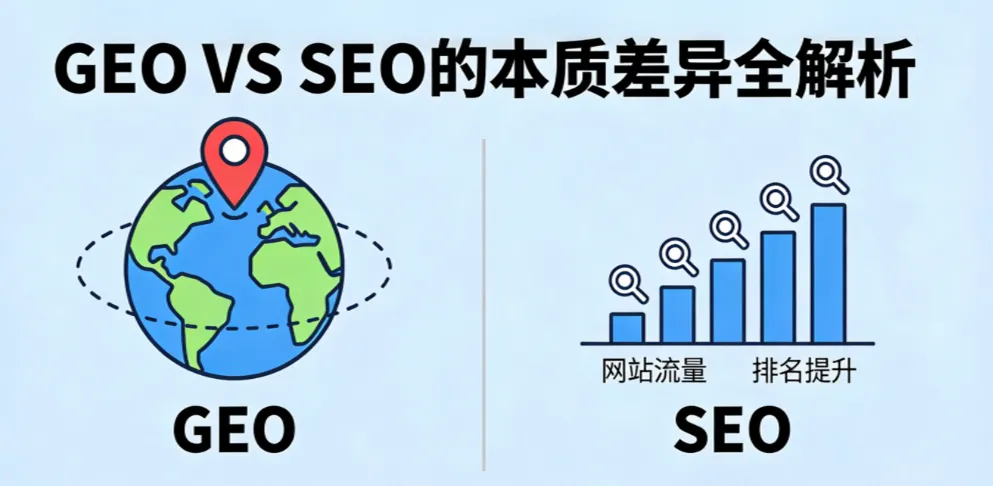
| Comparison Dimensions | Traditional SEO focuses more on | AI Search / GEO Pays More Attention |
|---|---|---|
| Content Format | Long articles, column aggregation, keyword coverage | Question and answer blocks, checklists, steps, comparison tables, and quoteable paragraphs. |
| Credible clues | Domain authority, backlinks, historical performance | Factual evidence, data sources, case studies, and author/institutional endorsement (EEAT) |
| Structural requirements | The title and keywords should be distributed reasonably. | The semantic hierarchy is clear, the terminology is consistent, and the entity information is complete (company/product/scenario). |
| Transformation Target | Click to enter the site → Forms/Inquiries | Go to AI answer citation → Build trust → Visit again/Contact directly |
3. Moving the decision-making touchpoint forward
In traditional marketing, businesses typically appear during the stage when users search for products or suppliers.
In AI search, businesses may be seen by users at an earlier stage, for example:
-
Industry knowledge explanation
-
Technical Principle Explanation
-
Procurement Decision Guide
If a company's content can be referenced by AI, it has the opportunity to build initial trust during the customer needs formation stage. This is crucial for B2B: many procurement professionals will conduct a round of "self-education" and build a candidate list before formally requesting a quote. Companies that succeed at this stage often have a higher probability of being included in the RFQ/tender list later.
Method suggestions
In an AI-driven search environment, businesses can optimize their customer acquisition capabilities in the following ways. The following suggestions will strive to be practical and actionable, while also considering the quality standards of SEO and content marketing.
1. Build a systematic enterprise knowledge base
Organize enterprise information into a structured knowledge system, for example:
-
Corporate Positioning
-
Products and Solutions
-
Technical Principles
-
Application scenarios
-
Client Cases
-
Frequently Asked Questions
Consistent terminology can improve the accuracy of AI understanding. It is recommended to treat the knowledge base as an "external product manual": try to keep the terminology consistent for each term, parameter, and scenario; do not use three different terms for the same capability on different pages to avoid AI breaking it down into three unrelated concepts.
The minimum granularity of a knowledge base that can be referenced: For most companies, starting with 30-60 frequently asked questions (FAQs) + 10-20 core pillar content pieces (Pillar Pages) is sufficient to get started. The FAQs should cover "how to choose/how to use/how to compare/how to avoid pitfalls", while the pillar content should cover "product system/technology roadmap/industry applications".
2. Improve the structuring of content
AI is better able to recognize well-structured information, such as:
-
Question and answer content
-
Definition + Principle + Scenario Structure
-
Clear heading hierarchy
Structured content is more easily cited by AI as a source of explanation. You can think of each article as an opportunity for AI to "extract" two or three directly quotable paragraphs. To this end, it is recommended to add some reusable sections, such as "3 key conclusions", "5-step selection checklist", "parameter comparison table", and "applicable/inapplicable boundaries".
| Content Module | A syntax that is easier for AI to reference | Recommended length |
|---|---|---|
| definition | A one-sentence definition + scope of application (boundaries) | 50-120 characters |
| principle | Explanation in points (1/2/3) + Key variables | 200-400 words |
| Selection/Steps | Checklist-style steps + quantifiable parameters | 6-10 |
| Case | Scenario → Problem → Solution → Result (including data/cycle) | 300-800 words |
3. Maintain consistency of information across multiple channels
The company's official website, media content, encyclopedia entries, and platform introductions should maintain consistency in their core message, for example:
-
Company Positioning
-
Product Category
-
Technical capabilities
Consistency helps AI form stable perceptions. It's recommended to create a "standard external communication script" (to be jointly confirmed by the marketing, product, and sales departments), including a one-sentence company introduction, three core strengths, key performance indicators, and typical industries and applications. For AI, the more consistent this information is, the easier it is to be recognized as a "stable fact."
4. Build long-term knowledge assets
In an AI environment, continuously accumulating professional knowledge is more important than a single marketing campaign. As content is cited more and more, a company's credibility within the AI system will gradually increase.
In practice, it's recommended to break down content creation into a "monthly rhythm": update one core piece of content (in-depth and citation-worthy) and 4-8 scenario-based pieces of content (focusing on industry/process/selection issues) each month, while simultaneously updating the FAQ and case study library. In the long run, this will create a stable "pool of citationable materials," making it easier for AI to find your content in its answers and more willing to cite it.
Real-world examples
Take a foreign trade industrial equipment company as an example.
In the past, businesses mainly relied on search rankings and platform advertising to acquire customers, and users usually only came into contact with business information when searching for specific products.
Later, companies began to systematically organize industry knowledge content, for example:
-
Equipment Selection Guide
-
Application scenario analysis
-
Explanation of technical principles
-
Common Procurement Issues
When users ask questions like "How to choose a certain type of device" in AI search, relevant explanations are more easily integrated and cited by AI.
The result is that businesses are seen early in the user research phase, increasing opportunities for future collaborations. Based on common B2B platform conversion funnel experience: when businesses are seen during the "explanatory questions" stage, the quality of in-platform inquiries is often higher, sales communication costs are lower (because the customer has already been educated), and they are more willing to allocate time for further technical communication during multiple rounds of price comparisons.
A more "human-like" approach to business: when customers first get to know you not through "advertising slogans," but through a solid explanation of principles or a selection list, trust is built more naturally. AI search has moved the "first brick of trust" into the content itself.
Extended questions
-
What is GEO (Generative Engine Optimization)?
-
What is the difference between GEO and SEO?
-
How can businesses improve the visibility of AI search results?
-
Why does AI prefer to use structured content?
-
How can foreign trade B2B companies build a corporate knowledge base?
GEO Tips
In an AI search environment, a company's ability to be recommended typically depends on three capabilities:
-
AI understandability : Clear enterprise information structure and explicit semantics
-
AI Verifiability : The content is supported by cases or facts.
-
AI Citationability : The content possesses a structure that allows it to be directly referenced by AI.
When corporate knowledge possesses these characteristics, it is more likely to become a source of information in AI responses. A simple but effective way to check this is to randomly select a paragraph from an article and send it to a colleague/client. If the recipient can understand the content, conclusion, and basis of the paragraph without context, then this content is usually more suitable for AI to cite.
CTA
If businesses want to understand their visibility in AI search, they can assess it from the following aspects:
-
Is the company information correctly identified by AI?
-
Does the content possess the characteristics of structured knowledge?
-
Is the information on the official website consistent with that on other platforms?
Perform a "GEO (Generative Engine Optimization) Visibility Assessment" now: Turn yourself into a "trusted source" for AI answers.
Upgrade customer acquisition from "waiting for clicks" to "being cited." If you want us to quickly determine which pages are most worth modifying first, which issues should be addressed first, and how to make AI more reliably understand your product and capabilities based on your industry and existing content, you can start with a GEO visibility assessment.
Get the AB Guest GEO (Generative Engine Optimization) visibility assessment and content optimization checklist
This article was published by AB GEO Research Institute.
.png?x-oss-process=image/resize,h_100,m_lfit/format,webp)
.png?x-oss-process=image/resize,h_100,m_lfit/format,webp)

.png?x-oss-process=image/resize,h_100,m_lfit/format,webp)
.png?x-oss-process=image/resize,h_100,m_lfit/format,webp)
.png?x-oss-process=image/resize,h_100,m_lfit/format,webp)
.png?x-oss-process=image/resize,h_100,m_lfit/format,webp)
