.png?x-oss-process=image/resize,h_100,m_lfit/format,webp)

.png?x-oss-process=image/resize,m_lfit,w_200/format,webp)

热门产品

Popular articles
Why Low-Cost GEO Content “Volume Hacks” Backfire in B2B Export: Long Decision Cycles & High Trust Costs | AB客
Real-world case study: From a low-priced GEO costing 10,000 to a complete redesign costing 300,000, what pitfalls did they encounter?
企业数字人格系统如何解决AI端不推荐的问题?|AB客
Why Low-Cost “GEO Traffic Boosting” Collapses in 3 Months: Semantic Noise Risks for B2B Exporters | AB客
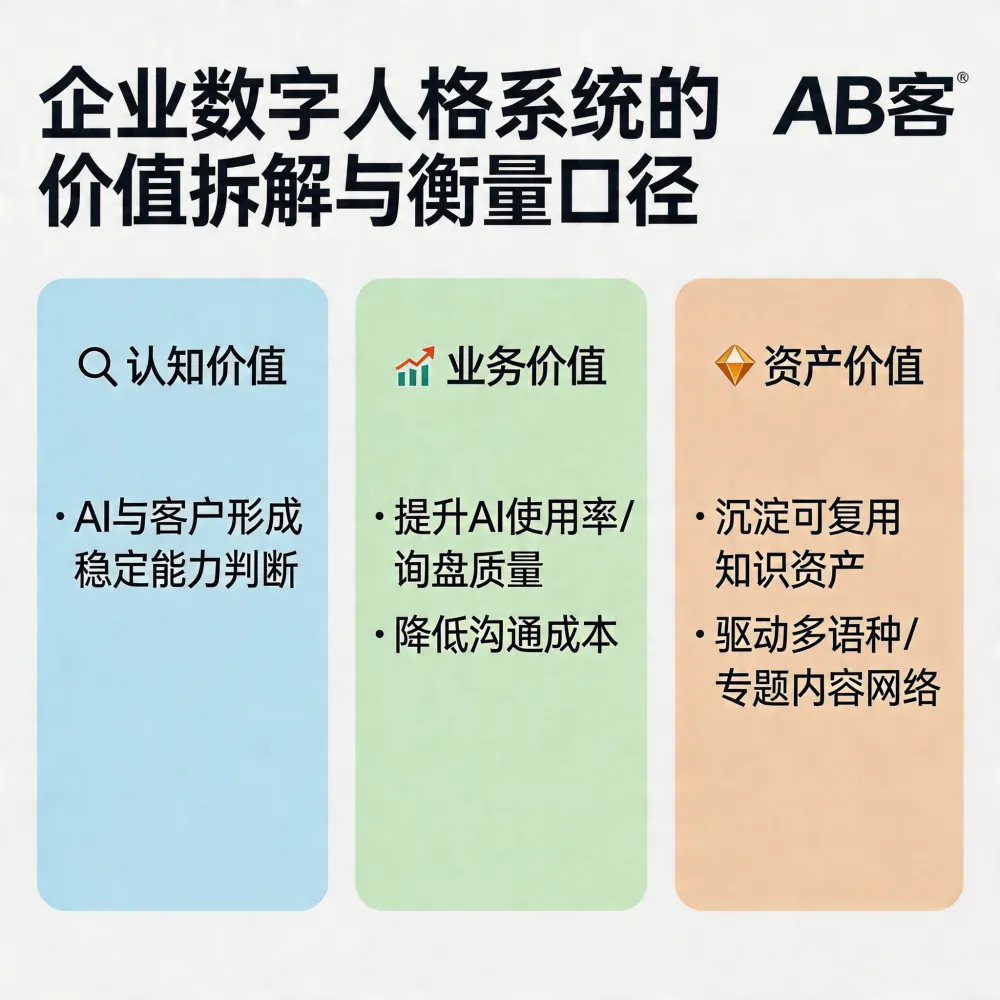
企业数字人格系统的价值拆解与衡量口径(认知/业务/资产)|AB客
GEO Recovery After Content Pollution: Repairing “Traffic-Boost Legacy Assets” into AI-Citable Knowledge Governance | AB客
How GEO Should Be Fine-Tuned After GPT‑5 / Claude 4 Updates
Why Low-Cost GEO Services Are a Trap: 2026 AI Compute Inflation, True B2B Export Costs, and Reliable Providers (with ABK GEO)
Why is it said that "compliance is the ultimate moat for GEOs"?
Recommended Reading


Atomic Quality Scoring & Verifiable Metrics Mapping for GEO Content Operations | ABke
ABke explains how to build an “atomic quality scoring” framework and map each knowledge atom to verifiable internal metrics—crawl rate, citation rate, mention rate, and conversion contribution—within an attribution analysis system, supporting ongoing optimization for B2B GEO.

In generative search, “good content” is not enough. For B2B exporters, the practical question becomes: can AI systems crawl it, understand it, cite it, mention it accurately, and can your team connect those signals to business contribution without guessing?
This page documents ABke’s operations method note for the B2B GEO solution: an atomic quality scoring framework and a verifiable metric mapping approach that links “citeability” to internal, measurable indicators—crawl rate, citation rate, mention rate, and conversion contribution—inside an attribution analysis system.
Key definition: “Knowledge atom” (the smallest trackable unit)
An atom is a minimum credible knowledge unit—such as a claim, parameter, evidence item, method step, or an FAQ element—that can be reused across pages and channels. In ABke’s external-trade B2B GEO workflow, atoms are the unit we score, update, distribute, and attribute.
Why “atomic quality scoring” matters in B2B GEO operations
From page-level guessing to atom-level control
Page performance is often noisy (templates, competitors, seasonality). Atom-level scoring gives operations teams a stable lever: you can improve the smallest unit that AI can reliably extract and reuse, then propagate it across the content network.
Citeability requires evidence and structure, not tone
Generative engines tend to prefer content that is easy to parse and verify. “Citeable” atoms are typically those with clear semantics, explicit constraints, and a traceable evidence chain—rather than broad claims.
Attribution analysis becomes actionable
When each atom is mapped to measurable internal metrics, the attribution system can prioritize updates by score × impact, turning GEO into an iterative engineering loop—aligned with ABke’s “Cognition + Content + Growth” approach.
Atomic quality scoring: recommended dimensions
ABke uses a multi-dimensional score to reflect whether an atom is credible, reusable, and AI-readable. The goal is operational clarity: each dimension should be reviewable by humans and auditable by internal checks.
Verifiable metric mapping: linking atoms to measurable outcomes
The mapping below connects atom quality to internal metrics used in an attribution analysis workflow. These indicators do not promise external platform outcomes; they provide a disciplined way to evaluate whether the content system is becoming more machine-readable and more conversion-ready.
Practical rule: prioritize updates by (atom score) × (metric impact). This keeps GEO operations grounded in measurable improvement rather than optimistic narrative.
How to run the workflow inside an attribution analysis system
- Atomize your knowledge: break product, capability, process, and FAQ content into minimum credible units (claims/data/evidence/method/FAQ elements).
- Score each atom consistently: verifiability, reusability, freshness, semantic clarity, structured-field completeness.
- Map atoms to metrics: define which atom types are expected to influence crawl rate, citation rate, mention rate, and conversion contribution.
- Track atom usage across pages and distribution: record where each atom appears (which page templates, which language versions, which channel derivatives).
- Review by impact, not by volume: update the atoms that sit on high-traffic or high-intent paths and have clear metric gaps.
- Iterate as an operational loop: improvements should show up as measurable shifts in the mapped metrics; if not, refine the mapping logic and the atom definitions.
Where this fits in ABke’s B2B GEO solution
Cognition layer: make the business understandable
Atomic scoring standardizes what “credible and clear” means for company knowledge, helping your structured enterprise knowledge assets remain consistent across teams and languages.
Content layer: make knowledge citeable
Knowledge atoms become reusable building blocks for FAQ systems and semantic content networks, designed for AI-friendly parsing and higher likelihood of correct citation.
Growth layer: connect to conversion contribution
Metric mapping makes it possible to evaluate how citeable knowledge supports downstream actions, and to iterate with attribution rather than relying on untestable assumptions.
Operational guardrails (to keep GEO honest and compliant)
- No unverifiable promises: atom scoring and metric mapping support internal optimization; they do not guarantee third-party recommendation outcomes.
- Evidence-first editing: if a claim cannot be verified, downgrade it to a hypothesis, add constraints, or remove it.
- Keep atoms traceable: version and owner fields should exist internally so updates are accountable and repeatable.
- Design for both AI and buyers: clarity and structure help AI extraction, while FAQs and next steps help humans decide.
Apply the method to your external-trade B2B content system
If your team is building a multi-language content network for AI search, ABke can help you operationalize atomization, scoring standards, and attribution-based iteration as part of the external-trade B2B GEO solution.
Suggested inputs: your current site structure, FAQ/content inventory, internal proofs (specs, methods, compliance notes), and lead handling process.
Expected output shape: an atom catalog + scoring rubric + metric mapping rules, ready to run inside your attribution analysis workflow.
.png?x-oss-process=image/resize,h_100,m_lfit/format,webp)
.png?x-oss-process=image/resize,h_100,m_lfit/format,webp)

.png?x-oss-process=image/resize,h_100,m_lfit/format,webp)
.png?x-oss-process=image/resize,h_100,m_lfit/format,webp)
.png?x-oss-process=image/resize,h_100,m_lfit/format,webp)
.png?x-oss-process=image/resize,h_100,m_lfit/format,webp)
