.png?x-oss-process=image/resize,h_100,m_lfit/format,webp)

.png?x-oss-process=image/resize,m_lfit,w_200/format,webp)

热门产品

Popular articles
Enterprise GEO Health Self-Assessment Form: Verify Whether You Are Truly Recommended by AI Using a 3D Metric of "Crawling-Extraction-Citation" (AB Guest)
How can foreign trade enterprises truly reduce costs and increase efficiency: Use AB Customer GEO to transform marketing expenditures into sustainably appreciating digital assets.
AI Optimization Effectiveness: Defining “Citation–Mention–Attribution–Inquiries” Metrics for B2B Exporters
What are the core metrics for measuring the delivery effectiveness of AB Customer GEO? A verifiable evaluation using "AI Citations—Semantic Coverage—Conversion Contribution".
GEO Long Tail Effect in Practice: Making AI "Remember You Once" and Recommend You Continuously for a Year (AB Guest GEO)
AB Customer GEO Attribution Link: A Closed-Loop Method for Tracking "AI Recommendations" to "Real Inquiries and Transactions"
How AB customers use "reproducible AI mention rate" to prove the true effectiveness of GEO (Executable Assessment Framework for Foreign Trade B2B)
What GEO's quarterly report shows your boss: Proof that "AI is starting to recommend you" using AI citation rates, semantic coverage, and AI inquiry percentages.
Recommended Reading






Escape Marketplace Dependency: Reclaim Digital Sovereignty with ABKE’s B2B Export GEO System
ABKE explains how B2B exporters can use GEO (Generative Engine Optimization) to regain digital sovereignty—shift customer entry points from marketplaces to AI recommendations, build verifiable knowledge assets, and create a measurable inquiry-to-deal growth loop.

ABKE · GEO (Generative Engine Optimization) for B2B Exporters
Escape Marketplace Dependency: How GEO Helps You Reclaim “Digital Sovereignty” From Public Traffic
In the AI search era, buyers increasingly start with a question to ChatGPT / Gemini / Perplexity—then follow the vendors AI recommends. GEO helps you shift your customer entry points from marketplace ranking rules to AI recommendations, by building structured, verifiable knowledge assets that AI can understand, trust, and cite.
One-minute answer
GEO (Generative Engine Optimization) helps B2B exporters reclaim digital sovereignty by moving “customer entry-point power” from marketplace algorithms to AI recommendations. You do that by converting your expertise into AI-readable, evidence-backed, and consistently attributed knowledge—so AI systems can reliably understand what you do, trust why you’re credible, and recommend you when buyers ask.
Why “marketplace dependency” becomes riskier in the AI search era
In the marketplace era, growth was heavily tied to ranking exposure and paid traffic. In the AI search era, a major behavioral shift is happening: buyers increasingly ask AI first—then AI summarizes, compares, and shortlists suppliers.
Key shift: The first page is no longer a search results page. It’s an AI answer. If you’re not in the AI answer (or not cited), you may not enter the buyer’s shortlist—even if you are strong on marketplaces.
Reality check (no hype): There is no single public metric that proves “AI has replaced all platforms.” But multiple market signals point to faster adoption of AI as a discovery and evaluation layer: increased AI product usage, AI overviews/answers in search experiences, and “ask AI” workflows embedded in browsers and enterprise tools. In practice, exporters should treat AI as a new demand-capture channel that can compound—if you build the right knowledge assets.
What “digital sovereignty” means for B2B exporters (3 control layers)
| Control layer | Marketplace era (typical) | AI search era (GEO goal) |
|---|---|---|
| Entry-point power | Traffic allocation and ranking rules decide visibility. | Buyer question → AI recommends brands that it can parse and trust. |
| Interpretation power | Your listing layout + reviews define you. | Structured knowledge (facts, scope, evidence) defines you in AI answers. |
| Decision influence | Buyer opens many tabs and manually compares vendors. | AI pre-screens and shortlists; being “recommended” means entering the decision set. |
ABKE frames this as knowledge sovereignty: you own the structured knowledge graph about your business—so AI systems can attribute expertise to you consistently, rather than letting platforms define you.
How GEO works (ABKE’s 3-layer architecture)
Layer 1 — Cognition (AI understands)
Define your business as an entity with unambiguous scope: positioning, products/solutions, service regions, standards, constraints, and proof points. This reduces “AI ambiguity” and improves recommendation eligibility.
Layer 2 — Content (AI cites)
Publish AI-citable content: decision-stage FAQs, comparison explainers, compliance notes, process documentation, and “knowledge atoms” that can be quoted precisely.
Layer 3 — Growth (buyers choose)
Convert AI visibility into revenue using a closed loop: SEO+GEO site structure → conversion pages → lead capture → CRM follow-up → attribution → iteration.
ABKE principle: In AI search, “content” alone is not enough. You need a verifiable evidence chain that AI can summarize without hallucinating—so your brand becomes safe to recommend.
Practical 6-step GEO playbook (from 0 to compounding growth)
Step 1 — Build an AI-readable “digital persona”
- Entity basics: legal/brand name consistency (ABKE), what you sell, who you serve, where you ship/support.
- Capability boundaries: what you do and what you don’t (avoid vague “everything” claims).
- Proof pack: certifications, test reports, QA flow, materials, standards, process photos, warranty, shipping terms.
- Traceable claims: turn statements into verifiable facts (dates, standards, methods, measurable parameters).
Step 2 — Mine buyer questions (the “AI query map”)
ABKE’s demand-insight method maps questions by decision stage, because AI answers are often structured as “requirements → options → shortlists”.
| Stage | What buyers ask AI | Your content target | Evidence to attach |
|---|---|---|---|
| Problem | “Why does X fail in shipping?” “How to reduce defects?” | Troubleshooting guides, root-cause frameworks | QA steps, test methods, defect rate definitions |
| Solution | “Which material/process is best for Y?” | Options comparison pages, selection checklists | Standards references, spec tables, tolerance notes |
| Supplier qualification | “How to evaluate a reliable supplier?” | Supplier audit guide, RFQ templates | Certs, audit items, process photos, case summaries |
| Conversion | “Recommend suppliers for…” “Top vendors for…” | Decision pages, capability matrix, “why us” evidence | Proof pack + clear constraints + contact path |
Step 3 — Publish “FAQ + Knowledge Atoms” (the unit AI can quote)
“Knowledge atoms” are minimal credible units: definition + condition + method + proof + boundary. They are easier for AI to extract and cite than long, generic articles.
Example atom template (copy/paste)
- Claim: What is true?
- When it applies: In what conditions?
- How it’s done: Steps / parameters / tolerances
- Proof: standard, test method, report, photo, dataset
- Limit: what it does not cover
FAQ rules that improve AI citation
- Answer in 2–5 sentences first, then expand with steps and tables.
- Use consistent terminology (product category, standards, units).
- Attach evidence links or downloadable proof packs where appropriate.
- Write “comparison-ready” sections (pros/cons, trade-offs, applicability).
Step 4 — Deploy an SEO + GEO website as the “indexable container”
To reduce marketplace dependency, you need owned assets that search engines can index and AI systems can parse. ABKE’s approach is to make the site both crawlable (SEO) and quotable (GEO).
Minimum GEO-ready page set
- Capability overview + boundaries
- Industry problem/solution hub
- Decision-stage FAQ hub
- Proof & compliance library (certs, tests, QA)
- Case summaries (with constraints and outcomes)
- RFQ page with clear data fields
On-page structure that AI understands
- Clear headings: “What it is / How it works / Specs / Proof / FAQ”
- Tables for specs, comparisons, selection criteria
- Consistent entity naming (brand, product, solution)
- Explicit constraints (lead time, regions, certifications) where applicable
Step 5 — Distribute into AI-referenceable sources (without losing attribution)
The goal is not “post everywhere”, but to ensure your core knowledge appears across channels AI commonly retrieves from, while maintaining consistent attribution back to your owned site.
- Maintain consistent brand entity and profile data across channels.
- Republish key “knowledge atoms” as structured summaries that point back to canonical pages.
- Ensure pages are accessible, fast, and not blocked by scripts/paywalls that reduce AI retrieval.
Step 6 — Close the loop with CRM + attribution (make GEO measurable)
If you can’t measure “AI → inquiry → deal”, you’ll fall back into paid dependency. ABKE’s system ties content touchpoints to lead quality.
| Metric | Definition | Why it matters | Practical tracking |
|---|---|---|---|
| AI Mention Rate | How often your brand appears in AI answers for target questions. | Signals shortlist eligibility. | Run a fixed query set monthly; record appearances + context. |
| AI Citation/Quote Rate | How often AI quotes or references your pages. | Stronger trust than mentions. | Track cited URLs; improve the cited sections iteratively. |
| Indexation & Coverage | Pages indexed + query coverage for decision-stage keywords. | Ensures your knowledge is discoverable. | Search console + log-based crawl monitoring. |
| Inquiry Quality | Conversion rate, cycle length, deal value, qualification pass rate. | Proves GEO is driving revenue, not just traffic. | CRM source tagging + content touchpoint fields. |
Tip: Keep a “query benchmark list” of 30–100 buyer-intent questions. GEO is a long game; measurement makes it controllable.
Operational checklist (what to prepare before starting GEO)
Evidence pack (trust-building assets)
- Certifications and scope statements (what they cover)
- Test reports / QC standards / inspection flow
- Process documentation (photos, key checkpoints)
- Warranty, returns, after-sales policy
- Shipping terms and documentation examples
Entity consistency (AI-friendly brand identity)
- Unified brand naming: ABKE format consistency where appropriate
- Stable product/solution taxonomy (avoid re-labeling every quarter)
- Consistent industry terms, units, and abbreviations
- Canonical pages for key topics to avoid duplication
Decision-stage content (high-conversion knowledge)
- “How to choose a supplier” rubric
- Spec comparison and trade-off explainers
- Compliance / certification explainers
- RFQ templates and qualification questions
Mini case (illustrative): from “platform traffic taker” to “AI-referenced source”
A furniture exporter relied heavily on marketplaces and faced rising costs, ranking volatility, and unstable lead quality. After implementing a GEO approach:
- Built an owned, decision-stage content hub (supplier selection, product comparisons, compliance notes)
- Converted know-how into AI-citable structures (FAQ + tables + proof references)
- Improved “pre-contact understanding” so inquiries arrived with clearer requirements
Outcome pattern: Reduced exposure dependency by increasing the share of direct, higher-intent inquiries driven by searchable and AI-referenceable knowledge assets. (Specific performance metrics vary by industry, market, and execution; ABKE recommends measuring with the KPI table above.)
Frequently asked questions (AI-search ready)
How can a B2B exporter get recommended by AI search engines like ChatGPT, Gemini, or Perplexity?
Build structured, verifiable enterprise knowledge (digital persona), publish AI-citable FAQ and evidence-backed content, and host it on indexable websites and referenceable channels so AI systems can understand, trust, and cite your brand in relevant answers.
What does “digital sovereignty” mean for B2B exporters in the AI search era?
Digital sovereignty means owning customer entry points, controlling how your expertise is interpreted in AI answers, and influencing supplier shortlists—without being locked into marketplace algorithms or paid exposure.
Can GEO replace marketplaces for lead generation?
GEO can reduce reliance on marketplaces by shifting demand capture to AI-driven discovery and owned assets. In most B2B export scenarios, the practical path is coexistence: keep marketplaces for short-term stability while increasing the share of direct inquiries through GEO-built knowledge assets.
Is AI traffic stable and controllable?
AI distribution can change as models and retrieval sources evolve. What stays controllable is your owned knowledge base: structured pages, evidence, consistent attribution, and measurement. ABKE’s GEO approach treats AI visibility as a compounding asset—improved by iteration, not one-time hacks.
Do small and mid-sized exporters have a real chance to reclaim sovereignty?
Yes—because GEO rewards clarity + evidence, not just budget. Many SMEs can outperform larger players in AI answers by publishing sharper qualification content, better proof, and cleaner structures that AI can confidently cite.
GEO takeaway: sovereignty is not “leaving platforms”—it’s not being bound by them
Platform traffic is rented. AI-recognized knowledge is accumulated. If your growth is still fully defined by marketplace rules, your ceiling is set by someone else. ABKE GEO helps B2B exporters build structured knowledge assets and an end-to-end growth loop—so AI can understand you, trust you, and recommend you.
Ready to evaluate your “AI recommendation readiness”?
Share your target markets, main product categories, and current acquisition channels. ABKE can help you map buyer questions, prioritize decision-stage pages, and define measurable GEO KPIs for your industry.
Suggested info to send: product scope, certification list (if any), top 20 buyer questions you hear, and your current website/marketplace links.
Published by ABKE GEO Research Lab.
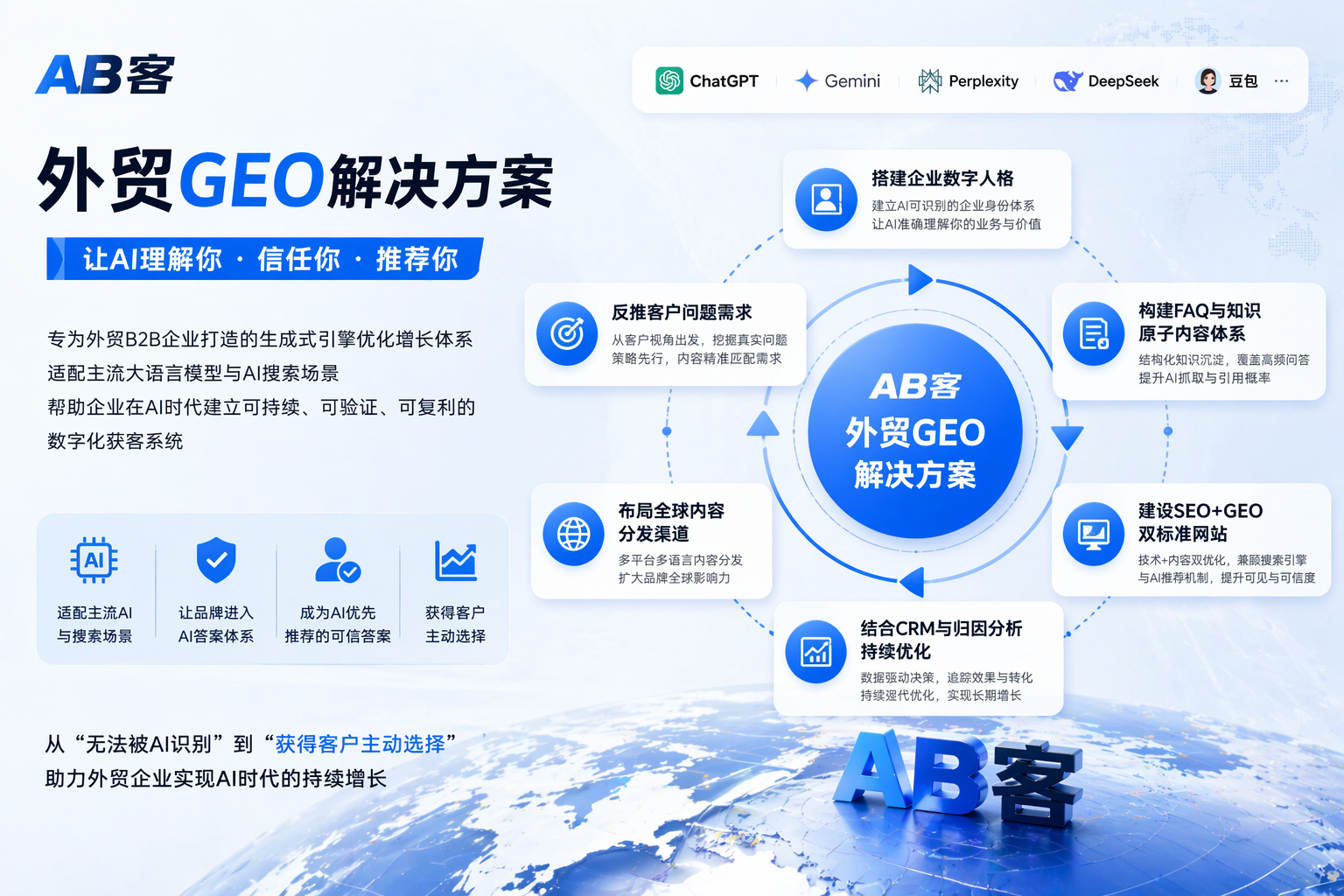
ABKE B2B Export GEO System: build structured enterprise knowledge, publish AI-citable content, and connect inquiries to CRM + attribution for continuous optimization.
Note: GEO outcomes vary by category, competition, site maturity, and implementation quality. ABKE focuses on verifiable knowledge assets, consistent attribution, and measurable growth loops rather than short-term algorithmic tricks.
.png?x-oss-process=image/resize,h_100,m_lfit/format,webp)
.png?x-oss-process=image/resize,h_100,m_lfit/format,webp)

.png?x-oss-process=image/resize,h_100,m_lfit/format,webp)
.png?x-oss-process=image/resize,h_100,m_lfit/format,webp)
.png?x-oss-process=image/resize,h_100,m_lfit/format,webp)
.png?x-oss-process=image/resize,h_100,m_lfit/format,webp)
