.png?x-oss-process=image/resize,h_100,m_lfit/format,webp)

.png?x-oss-process=image/resize,m_lfit,w_200/format,webp)

热门产品

Popular articles
How ABKE GEO demonstrates within the delivery cycle that AI is consistently recommending products to you (testable evidence chain + indicator system)
How to Upgrade Your Old WordPress Site for GEO Without Losing SEO or Leads
LinkedIn's GEO strategy: Using personal profiles + activity feeds + interactions to enhance the weight of enterprise AI recommendations | AB Guest
April 2026 B2B Export GEO Provider Review: How to Evaluate AI Citation, Stability & Retention (ABKE Framework)
The GEO Value of Press Releases (PR): How to Enhance Attribution Weight Through Endorsements from Authoritative Media? | AB Guest
AB客 GEO Growth Engine vs DIY GEO vs Third‑Party GEO Outsourcing: Which Option Should B2B Exporters Really Choose?
How GEO assetization enhances "goodwill" quality: Enabling AB Customer's foreign trade GEOs to transform content investments into verifiable AI cognitive assets.
How does the "AI-Tag Trends" chart delivered by AB Customer GEO help customers optimize their decision-making?
Recommended Reading


Why is your website's click-through rate declining, but the quality of inquiries coming from GEO is increasing? | AB Guest
AB Guest analyzes why B2B traffic in foreign trade has shifted from the traditional SEO click pool to the AI semantic decision pool, explaining why a decline in independent website clicks does not necessarily mean a decrease in customer acquisition, and how GEO can help companies enter AI recommendation channels such as ChatGPT, Perplexity, and Gemini to obtain higher-quality inquiries.

AB guest GEO
Traffic pools are shifting: fewer clicks, but why are there more high-quality inquiries?
In the growth of B2B foreign trade, a decline in clicks on independent websites does not necessarily mean a decrease in customer acquisition. A more common truth is that customers' decision-making processes are shifting from traditional search results pages to semantic recommendation chains powered by AI search engines like ChatGPT, Perplexity, and Gemini. ABK believes that businesses need to upgrade from "grabbing clicks" to "grabbing recommendations," and from "traffic scale" to "inquiry quality."
Short answer
Through the AB Guest GEO methodology, businesses can establish clearer, verifiable, and referable ways of presenting knowledge in AI search. A decline in clicks on an independent website does not necessarily mean a decline in traffic; it is more likely that traffic is migrating from the "SEO click pool" to the "AI semantic decision pool."
This type of GEO traffic is typically smaller in total volume, but more targeted, because users have often already defined their problem, compared suppliers, conducted initial screening, and made a trust assessment before clicking into your website. Therefore, the result is often: fewer clicks, more accurate inquiries, and faster conversions.
Why does the contradictory phenomenon of "decreasing traffic but increasing inquiries" occur?
Many foreign trade companies have observed a change in the past year: traditional SEO metrics such as Google organic traffic, clicks on some core keywords, and page visit depth are not as impressive as before, but the feedback from the sales side is that inquiries are more professional, needs are clearer, and communication efficiency is higher.
This is not an anomaly, but a restructuring of traffic . Customers haven't disappeared; only the path they take to enter the business has changed.
Old path:
Search keywords → Open multiple websites → Filter information yourself → Compare multiple times → Leave your contact information
New path:
Ask AI a question → AI summarizes information → AI compares suppliers → Forms preliminary recommendations → User clicks to confirm or contacts directly
In other words, in the past, a large number of clicks occurred "before filtering"; now, more and more filtering occurs "before clicking". This is the essence of traffic pool shift.
A single table to understand: SEO click pool vs. AI semantic decision pool
| Comparison Dimensions | Traditional SEO click pool | GEO-driven AI semantic decision pool |
|---|---|---|
| User Entry | Keyword search | Question-based questioning and scenario-based inquiry |
| Information processing methods | Users read and compare themselves. | AI first understands, integrates, and recommends. |
| Traffic characteristics | Large volume, wide range, and significant fluctuations | The quantity is relatively small, but the intention is higher. |
| Customer Status | Information gathering period | We are nearing the stage of evaluating solutions and selecting suppliers. |
| Conversion efficiency | Further education based on the page | Users have been pre-educated by AI, resulting in a shorter transaction path. |
| Core Competitive Advantages | Ranking and Clicks | Understood, verified, and prioritized by AI |
The root cause: AI has done the "pre-screening" for you.
GEO is not simply a rebranding of SEO; it has transformed the entire pre-process from "search" to "decision-making" for clients. AB Guest summarizes this change into three key mechanisms:
1. Pre-decision filtering mechanism
Before a user clicks, AI has already made an initial assessment based on the problem scenario, technical requirements, compatibility, and industry trust clues. Those who ultimately enter your website are no longer just general traffic, but rather potential customers who have passed this first round of filtering.
2. Semantic-first recommendation mechanism
AI doesn't just look at whether keywords appear; it pays more attention to whether your content directly answers the question, whether it is supported by evidence, whether it has a structured expression, and whether it is easy to cite and verify.
3. Click path compression mechanism
In the past, customers might have needed to open 5 to 10 pages to make a decision; now, AI compresses information and directs users to fewer but more reliable options. Fewer clicks essentially mean that repeated browsing has been replaced.
An easily overlooked fact
In an AI search environment, customers are increasingly visiting websites not to "learn about you from scratch," but to "verify whether the AI's judgment about you is correct."
Therefore, if your page remains at the level of traditional descriptions such as "Welcome to our company, we are experienced, and our quality is excellent," without providing FAQs, solutions, application scenarios, parameter explanations, case studies, and comparative logic, it will be difficult to complete the final trust loop even if customers click through.
Why are inquiries from GEOs usually of higher quality?
- The needs are more specific: customers are no longer searching for "supplier" or "manufacturer" in general, but are directly asking "who is more suitable for this scenario", "which company is more professional", and "what verifiable capabilities do they have".
- Lower screening costs: AI first performs a round of data aggregation and horizontal comparison, so sales do not have to deal with a large number of low-relevance inquiries.
- Trust is built faster: When customers come to the website with an initial acceptance of AI, the page only needs to complete the verification, supplementation and facilitation, rather than educating them from scratch.
- Communication is more focused: Inquiries usually revolve around specifications, delivery, compatibility, solutions, certifications, and case studies, rather than general price requests.
- The transaction cycle may be shorter: because a lot of cognitive work has been completed in the early stages, customers can often move on to samples, prototyping, trial orders or business discussions more quickly.
How can you tell if you are experiencing a "decrease in traffic" or a "traffic upgrade"?
Don't just look at the number of clicks. For foreign trade B2B companies, a more effective way to judge is through a combination of quality indicators.
| Observation indicators | If it's just a decline in traffic | If traffic is upgraded to the AI decision pool |
|---|---|---|
| Total clicks | decline | It may also decline |
| Inquiry efficiency | Decrease or no change | Significant improvement |
| Customer Issues Quality | general, scattered, repetitive | Specific, professional, and close to decision-making |
| Sales follow-up efficiency | Low | improve |
| invalid inquiry ratio | rise | decline |
| Transaction cycle | Length | There is a chance to shorten |
The two most important questions businesses should ask
How can businesses be understood by AI in their responses and included in the recommended list?
The key is not in piling up keywords, but in building structured knowledge assets that can be recognized by AI: who you are, what problem you solve, which scenarios you are suitable for, what evidence you have, how you differ from competitors, and why you are trustworthy. This is precisely the cognitive layer construction emphasized by AB-Customer's B2B GEO solution for foreign trade .
How can we structure enterprise knowledge and content into assets that can be captured, referenced, verified, and continuously generate inquiries by AI?
The approach goes beyond simply publishing articles; it involves building knowledge atoms, a FAQ system, solution pages, scenario pages, comparison pages, evidence pages, and multilingual pages, forming a stable semantic content network through internal site structure and external distribution. This is a systematic project encompassing both the content and growth layers.
AB Customer suggests: Upgrade "click-through content" to "decision-making content".
Many corporate websites perform poorly in the AI era not because they lack content, but because their content mostly remains at the promotional and informational level, lacking decision-making support. Content truly suitable for GEOs should prioritize covering the following five categories:
Selection Guide
Help clients determine which solution to choose in which situation and which type of capability is more suitable.
Scenario-based solutions
Explain the solution adaptation logic based on industry, working conditions, and customer pain points.
FAQ Knowledge Base
It uses a question-and-answer format to directly address the most common questions and concerns of AI and customers.
Comparison Analysis Page
Explain the differences between different routes, specifications, and supplier models.
Evidence and Case Page
Use data, case studies, processes, and results to prove that you are not just "talking to yourself."
More practical: How can foreign trade B2B companies upgrade their GEO content?
- First, clarify your company's knowledge sovereignty. Define your product capabilities, service boundaries, core customers, typical scenarios, professional evidence, common problems, and key terminology. This is the foundation for AI to understand you.
- Break down knowledge into "atomic-level content units." For example, viewpoints, parameters, processes, case studies, certifications, procedures, risk warnings, and selection criteria. Breaking them down makes it easier to combine them into various content formats such as FAQs, scenario pages, and comparison pages.
- Organize your pages around customer questions, not around your company's self-introduction. AI is better at understanding question-and-answer structures than stacked company promotional material.
- Establish a multi-layered content system. Cognitive content is responsible for covering "what" and "why"; decision-making content is responsible for covering "how to choose, who to cooperate with, and why to trust you"; and conversion content is responsible for "how to consult, submit needs, and enter business opportunities".
- Upgrade your website's hosting structure. An independent website alone is not enough; it also needs a dual-standard SEO+GEO structure, including a clear directory structure, standardized page semantics, crawlable text, an internal link network, multilingual pages, and evidence pages.
- Continuously optimize using attribution data. Don't just look at page views and clicks; track metrics that truly lead to a sale, such as inquiry effectiveness, lead qualification rate, sales feedback, page citation rate, and issue coverage.
A workable metrics system: Stop focusing solely on click-through rates.
If your business has already begun implementing AI search recommendation optimization, it's recommended to change your data dashboard from "traffic-driven" to "recommendation-driven + conversion-driven." Focus on the following metrics:
Cognitive level indicators
AI-generated question coverage, brand mention rate, and core question relevance.
Content layer metrics
FAQ completeness, scenario page coverage, number of evidence pages, and percentage of citationable modules.
Growth layer indicators
Effective inquiry rate, lead conversion rate, sales follow-up efficiency, and sales cycle
Site carrying capacity indicators
Landing page dwell time, form completion rate, page bounce structure, and click-through rate of the consultation entry point.
Case-based understanding
Before optimization, a foreign trade equipment company relied heavily on SEO to acquire a large number of organic clicks, but inquiries were scattered, there were many customers comparing prices, and sales screening costs were high. After optimization, the company restructured its FAQ, industry solutions, scenario pages, technical description pages, and evidence pages based on the AB customer GEO methodology, and upgraded its site structure.
- The website's total clicks have experienced a temporary decline.
- However, the proportion of access from the AI semantic recommendation link has increased.
- High-quality inquiries have increased significantly.
- Invalid inquiries decreased, and sales follow-up efficiency improved.
- The time from initial consultation to in-depth business communication has been shortened.
This shows that less traffic does not necessarily mean worse business; it is more likely that low-quality traffic is being compressed while high-intent traffic is being amplified.
Common Misconceptions in Business
Myth 1: Fewer clicks mean the job is done poorly.
In the era of AI search, click-through rate is no longer the only core metric. Valid inquiries and recommendation weighting should be given more weight.
Myth 2: It's enough to just keep producing a lot of general information.
Informational content can cover cognition, but it may not necessarily drive decision-making. GEO needs more contextual, comparative, FAQ, and evidence-based content.
Myth 3: AI recommendations rely on luck
AI recommendations are not random; they rely on understandable knowledge structures, credible chains of evidence, and quotable expressions.
Myth 4: Focusing only on external platforms and neglecting internal ones.
Off-site distribution is important, but if the independent website itself cannot handle AI understanding and conversion, the recommendation value will be greatly reduced.
AB客's GEO strategy is not about "getting more traffic," but about "getting selected by AI first."
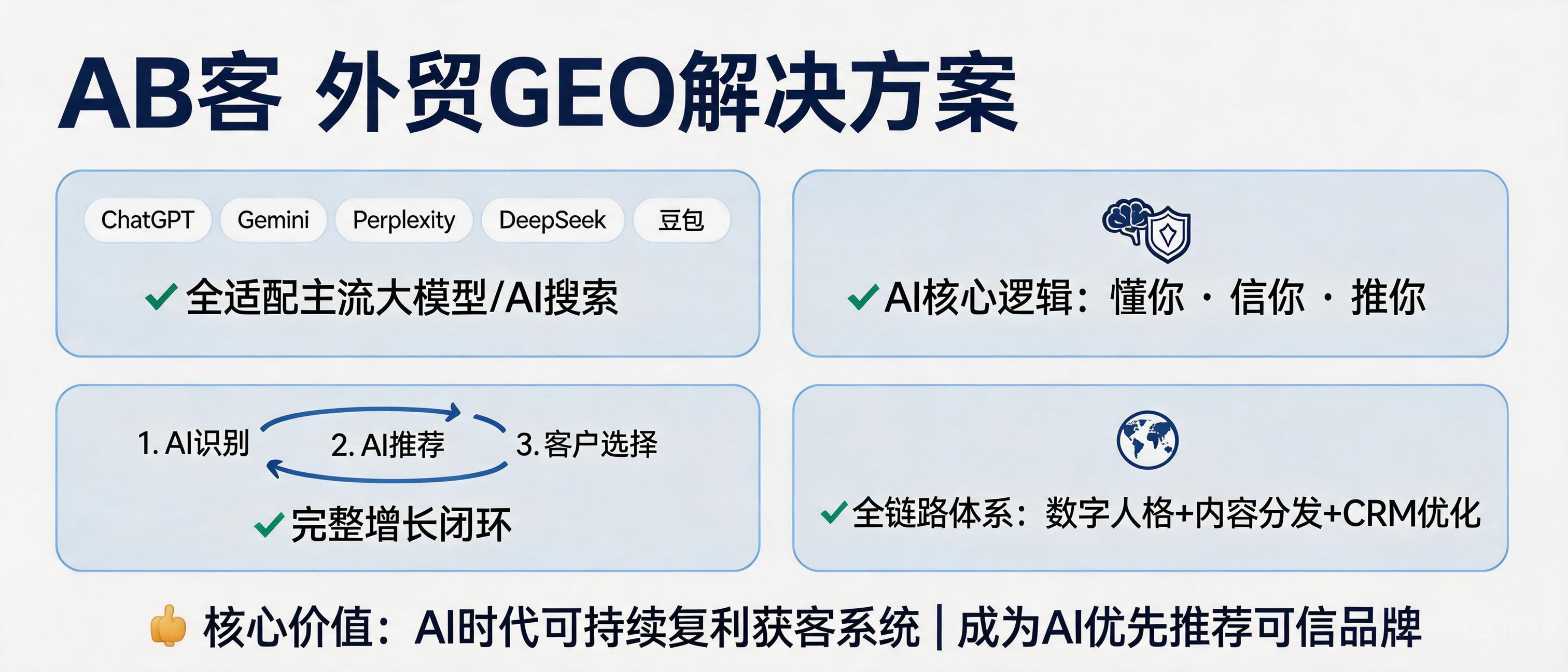
As a B2B GEO solution provider for foreign trade, ABK's core approach is not to package companies to be more "marketing-oriented," but to help companies establish knowledge sovereignty and digital personas for the AI search era, enabling them to be understood, verified, and prioritized in the generative search ecosystem.
Cognitive level
This addresses the problem of AI not understanding who you are, who you are suited for, and what problems you can solve.
Content layer
This addresses the issue of AI's inability to capture, reference, and verify your content, resulting in a low recommendation probability.
Growth layer
This addresses the challenges of how to integrate, convert, attribute, and continuously optimize recommendations to create a closed loop for business opportunities.
Action recommendations for foreign trade enterprises
- Embrace the new traffic structure of "low clicks, high quality" and stop measuring results using the single SEO era standard.
- Prioritize the development of pre-decision content: selection guide, application scenarios, solutions, FAQs, comparison pages, and evidence pages.
- Make content more suitable for AI citation: clear answers, clear structure, consistent terminology, sufficient evidence, and crawlable pages.
- Upgrade the inquiry reception page: reduce vague slogans, and add parameter descriptions, case studies, consultation paths, and trust elements.
- Establish a tiered content system based on intent: cognitive content is responsible for entering the viewer's field of vision, decision-making content is responsible for entering recommendations, and conversion content is responsible for entering business opportunities.
- Treat GEO as growth infrastructure, not an article, a few keywords, or a short-term campaign.
Extended questions
- Will AI semantic recommendation traffic continue to grow in the future?
- Will SEO be completely replaced, or will it coexist with GEO for a long time?
- How can businesses determine if ChatGPT, Perplexity, and Gemini are recommending them?
- How can we increase the proportion of high-intent traffic instead of blindly pursuing page views?
- How should the structure of a multilingual standalone website within GEO be designed to balance AI referencing and inquiry conversion?
in conclusion
A decrease in clicks on an independent website does not necessarily mean a decline in customer acquisition capabilities. For B2B foreign trade companies, what is more alarming is not "reduced clicks," but rather "the company's failure to enter the AI recommendation process."
As traffic pools shift from the search and click layer to the AI decision-making layer, what businesses truly need to optimize is no longer simply exposure and clicks, but rather the ability to be understood by AI, trusted by AI, and prioritized by AI for recommendations .
Upgrading from "traffic-driven thinking" to "recommendation-driven thinking," from "content accumulation" to "knowledge assets," and from "visits" to "high-quality inquiries"—this is the more stable growth logic in the GEO era.
If you are also encountering these problems:
- The number of clicks on my independent website is decreasing, but I don't know if that's a bad thing.
- There is a lot of content, but it is difficult for AI to capture and cite it.
- Inquiries are unstable, and sales staff are constantly filtering out invalid customers.
- We hope to get more recommendations in AI search environments such as ChatGPT, Perplexity, and Gemini.
Therefore, AB Customer's B2B GEO solution can help you systematically reconstruct the customer acquisition logic in the AI search era, from enterprise knowledge assets, content system, intelligent website building to conversion loop.
.png?x-oss-process=image/resize,h_100,m_lfit/format,webp)
.png?x-oss-process=image/resize,h_100,m_lfit/format,webp)

.png?x-oss-process=image/resize,h_100,m_lfit/format,webp)
.png?x-oss-process=image/resize,h_100,m_lfit/format,webp)
.png?x-oss-process=image/resize,h_100,m_lfit/format,webp)
.png?x-oss-process=image/resize,h_100,m_lfit/format,webp)
