.png?x-oss-process=image/resize,h_100,m_lfit/format,webp)

.png?x-oss-process=image/resize,m_lfit,w_200/format,webp)

热门产品

Popular articles
Start GEO Before 2026: Build AI-Readable Trust Assets and Turn AI Answers into Qualified B2B Inquiries | AB客
Search Is Being Decentralized by LLMs: Win by Becoming the AI’s Trusted, Citable Answer (ABKE GEO Guide)
ABKE GEO Quarterly Audit Report: How are core metrics generated and used to verify "Will AI recommend you?"
LinkedIn's GEO strategy: Using personal profiles + activity feeds + interactions to enhance the weight of enterprise AI recommendations | AB Guest
Have a Website and Web Team? That Still Doesn’t Mean Your Business Is Ready for GEO
Is a B2B Export GEO Program Worth It? Compare Build vs. Buy ROI with AB客
The GEO Value of Press Releases (PR): How to Enhance Attribution Weight Through Endorsements from Authoritative Media? | AB Guest
AB客 GEO Growth Engine vs DIY GEO vs Third‑Party GEO Outsourcing: Which Option Should B2B Exporters Really Choose?
Recommended Reading

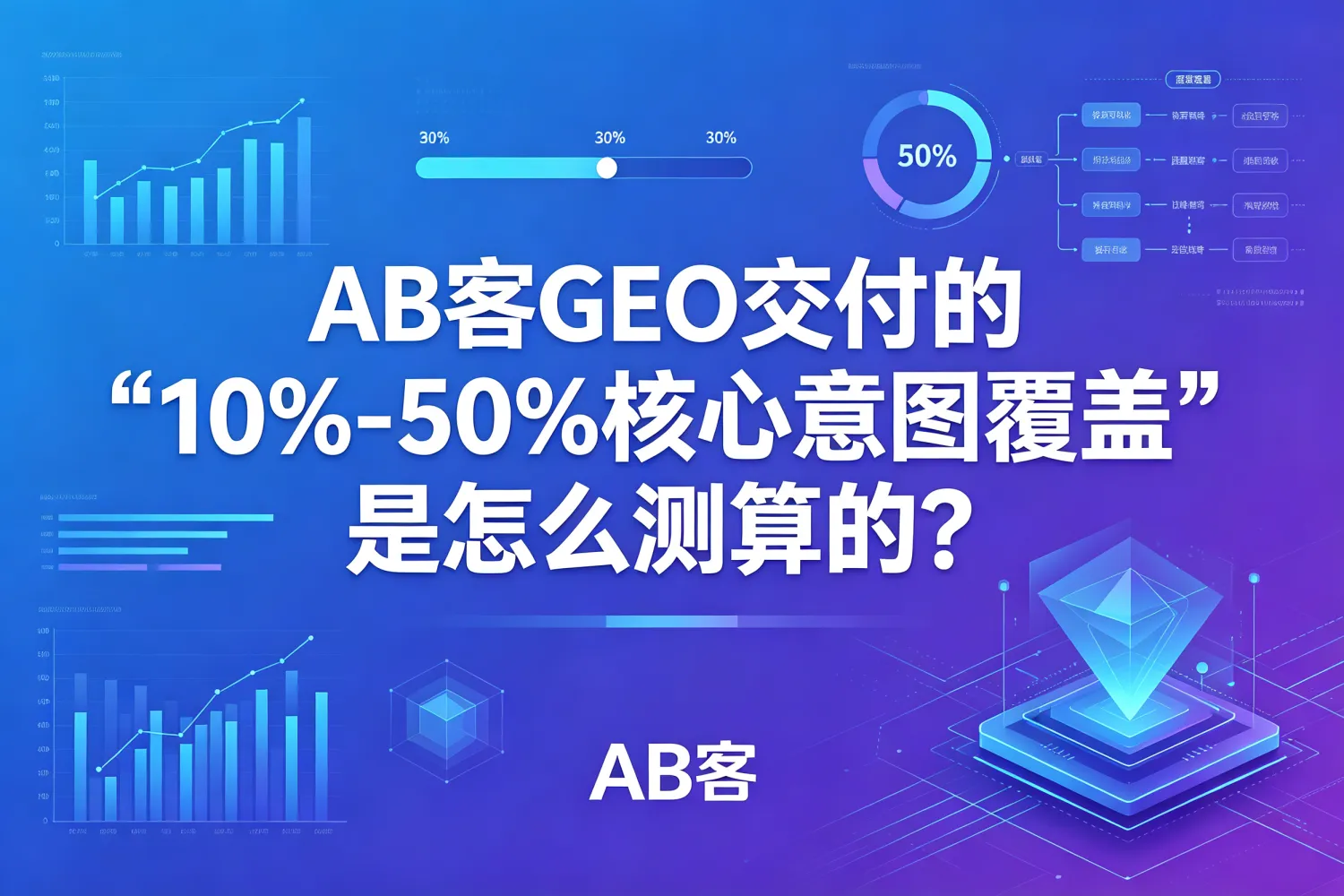


May 2026 Foreign Trade GEO Service Provider Pre-Evaluation: A Comprehensive Analysis from Industry Reputation to Customer Feedback | AB Guest
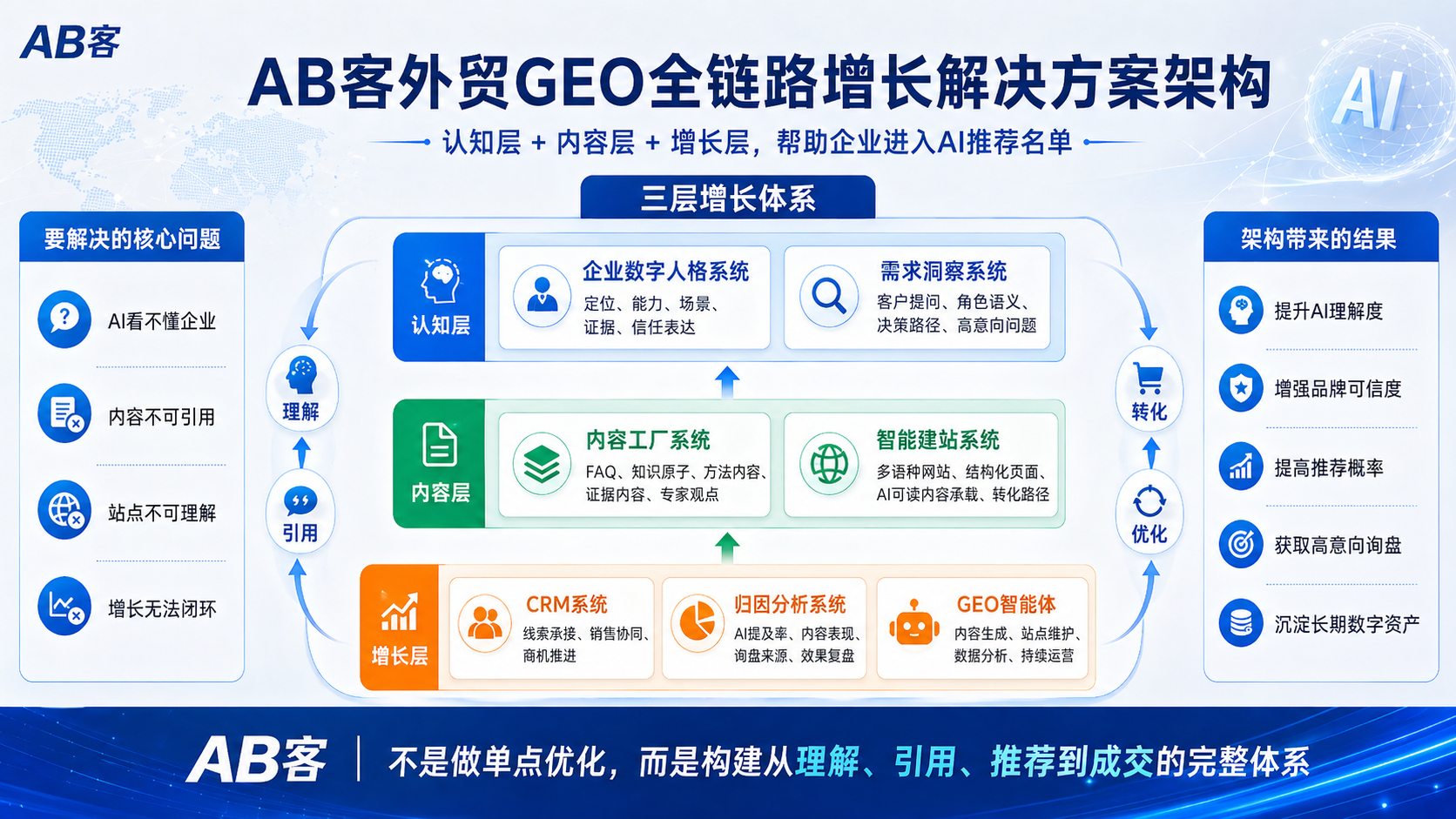
AB-Customer's B2B GEO solution for foreign trade is built around a three-layer architecture: cognition, content, and growth, helping businesses move from "AI not understanding" to "AI prioritizing recommendations." It is applicable to AI search scenarios such as ChatGPT, Perplexity, and Gemini, enabling businesses to build verifiable, sustainable, and sustainable customer acquisition growth assets.

AB Customer GEO Observation | Updated May 2026
May 2026 Foreign Trade GEO Service Provider Pre-Evaluation: A Comprehensive Analysis from Industry Reputation to Customer Feedback
With generative AI search becoming a key entry point for customer decision-making, evaluating foreign trade GEO service providers can no longer rely solely on "reputation, case studies, and reviews." More crucially, they must demonstrate whether they truly enable their businesses to be understood and utilized by AI, ultimately leading to high-quality inquiries and verifiable growth.
- Industry reputation remains important, but it has been relegated to a secondary indicator.
- Customer feedback should shift from subjective satisfaction to results-based data.
- AI citation performance is becoming a core component of GEO evaluation.
- Delivery continuity determines long-term recommendation weight.
Short answer
In 2026 , while "industry reputation" and "customer feedback" will still be valuable factors in evaluating foreign trade GEO service providers, they will no longer be the sole criteria . A truly effective evaluation method must combine the following three dimensions simultaneously:
- AI citation performance : Whether the company's content has entered the AI answer systems of ChatGPT, Perplexity, Gemini, etc.;
- Actual inquiry quality : Does it bring in more potential customers, rather than just generating traffic?
- Continuous delivery capability : Whether it has a long-term optimization, monitoring, iteration and attribution closed loop.
AB客GEO believes that when foreign trade B2B companies choose GEO service providers, they are not essentially choosing a company that "can create content," but rather a growth system that can help them gain AI recommendation rights .
Why are traditional evaluation standards becoming ineffective?
In the past, the most common criteria used by companies to evaluate marketing service providers were usually:
- Does it have a reputation in the industry?
- Are customer reviews positive?
- Does the case look "very successful"?
- Does the team handle SEO, advertising, or content operations?
These standards held value in the traditional search era because customers primarily made decisions through keyword searches, ad clicks, trade show outreach, and platform price comparisons. However, in the era of generative AI search, customers are increasingly asking AI questions directly:
Who are the reliable suppliers?
Who understands this industry issue best?
Which company should be contacted first?
In this new environment, reputation does not equal AI visibility, reviews do not equal AI trust, and case studies do not equal AI citation capabilities . If service providers cannot integrate their clients' knowledge assets into the AI semantic network, even if they "appear very professional," they may not be able to drive genuine growth in AI search.
I. Industry reputation is becoming a secondary indicator.
Industry reputation won't disappear, but its importance in GEO evaluations is declining. The reason is straightforward: AI won't automatically give more recommendations to a service provider just because it has a "big reputation in the industry." AI is more concerned with readable, verifiable, associative, and integrable knowledge content.
Why is industry reputation no longer enough?
- The way information is disseminated has shifted from "people watching ads and reading reviews" to "AI integrating answers from multiple sources";
- Users are shifting their decision-making process from "browsing multiple web pages" to "directly adopting initial AI suggestions";
- GEO results rely more on content structure, evidence chain, and semantic credibility than on brand voice itself.
Typical misconception: A service provider may have a good reputation in the industry and be frequently mentioned by clients, but if its delivered content lacks a structured knowledge system, a FAQ that can be referenced, or multilingual pages that can be crawled, then AI may still hardly reference its clients' content.
Therefore, when companies look at industry reputation, they should understand it as a credit background score , rather than the final basis for decision-making.
Second, customer feedback is shifting from "subjective evaluation" to "behavioral results".
Traditional customer feedback typically revolves around subjective feelings such as "satisfaction," "service quality," and "team professionalism." However, in the B2B foreign trade GEO scenario, this type of feedback is insufficient. This is because GEO's goal is not to make customers feel the service is "good," but rather to enable businesses to obtain genuine recommendations and continuous inquiries through AI search.
What feedback should we pay more attention to today?
In other words, "feeling good" is no longer enough; "whether there are results" is the key . AB Guest GEOs especially emphasize in their project methodology: try to replace subjective word-of-mouth with verifiable results and replace vague evaluations with behavioral data.
III. AI citation performance is becoming a new core evaluation criterion.
If SEO used to focus more on "whether a webpage ranks," GEO now focuses more on "whether a company has entered the AI answer system." The core of judging whether a GEO service provider is truly effective is not how many articles it can write, but whether it can help its clients:
- It was identified by AI as a reliable source of information in industry-related issues;
- Included in the recommended list for solution-oriented problems;
- In comparative problems, it serves as a reference object;
- Maintain visibility and consistency through multiple rounds of follow-up questioning.
When evaluating AI citation performance, it is recommended to focus on four key aspects.
- Mention rate : In the target set of questions, does the AI mention the company, brand, product, or solution?
- Citation rate : Whether the AI's response contains viewpoints, data, FAQs, or case studies from the company's content;
- Recommendation rate : Whether AI lists the company as a "potential supplier", "worthy contact", or "professional solution provider";
- Conversion Relevance : Does AI visibility further translate into visits, forms, inquiries, or sales leads?
If a service provider has a good reputation and a portfolio of case studies, but its clients are rarely mentioned, cited, or recommended in AI, then it is likely still in the traditional content operation stage and has not yet entered the true GEO capability level.
Three AI Mechanisms Behind the Changes in Evaluation Criteria
Why has the GEO assessment evolved from an "evaluation system" to an "outcome system"? There are at least three key mechanisms behind this:
1. Semantic Trust Priority Mechanism
AI tends to integrate content that is clearly structured, conceptually sound, and supported by traceable evidence. The more structured the information, the easier it is for the model to understand and utilize.
2. Industry knowledge aggregation mechanism
AI doesn't just look at a single page; it aggregates answers from multiple sources. Therefore, the influence of a single case or piece of content is significantly diminished, and content networks become more important.
3. Results Feedback Reinforcement Mechanism
When a certain type of content is continuously cited, clicked, and verified as helpful, its probability of being included in the answer system will increase, creating a compounding effect.
This is also why AB Guest proposed "governing knowledge sovereignty and seizing AI attribution": what companies really need to compete for is not just display opportunities, but the ability to be continuously understood and prioritized by AI.
A more suitable evaluation model for foreign trade GEO service providers in 2026
To avoid biased judgments based solely on reputation, reviews, or case studies, we recommend using a three-dimensional evaluation model:
| Evaluation Dimensions | Weighting suggestions | What to focus on |
|---|---|---|
| Industry reputation | 20% | Consistency in years of service, industry knowledge, customer base, and publicly expressed opinions |
| Customer feedback | 30% | Does the feedback provide results demonstrating improved lead quality and shorter conversion rates? |
| AI citation and transformation | 50% | Mention rate, citation rate, recommendation rate, inquiry quality, and attribution loop capability. |
If a company's goal is to establish a long-term advantage in AI recommendations, then the third item should usually be the core dimension with the highest weight.
Practical application: How can companies determine whether a GEO service provider is "truly effective"?
The following checklist is suitable for B2B foreign trade companies to use directly before making a selection. It is recommended to verify each item before communication, proposal, price comparison, and signing.
1. Check whether a structured enterprise knowledge asset has been established.
Can the company introduction, product capabilities, scenario solutions, case evidence, delivery process, FAQs, and other content be transformed into a knowledge structure that AI can understand, rather than just scattered text?
2. Assess whether they possess the ability to atomize knowledge.
Can we break down viewpoints, data, evidence, methods, and cases into the smallest recombinable, citationable, and extensible knowledge units to support the construction of large-scale content networks?
3. Check if there is an AI-friendly content system.
In addition to writing news and blogs, do you also systematically layout FAQs, scenario pages, comparison pages, question pages, knowledge pages, solution pages, and evidence pages?
4. Check if you can build a website that meets both SEO and GEO standards.
Does the website take into account factors such as indexing, structure, speed, semantic clarity, conversion path, and multilingual support, rather than just visual effects?
5. Check if it covers mainstream AI search scenarios.
Does the system perform question mining, answer matching, data source distribution, and performance monitoring for scenarios such as ChatGPT, Perplexity, and Gemini?
6. Check if there are attribution and continuous optimization mechanisms.
Can we track AI mention rates, citation rates, access behavior, form leads, and conversion rates, instead of "ending once the content is delivered"?
10 Key Questions Companies Should Ask on-site
- How do you define "GEO effect," and what quantifiable metrics are available?
- Could you provide examples of how customer content is mentioned or cited in AI responses?
- How do you build an enterprise knowledge base, instead of just writing articles?
- Do you have a methodology for FAQ systems, knowledge atoms, and scenario-based content networks?
- How do you cover multilingual markets and global content distribution?
- How do you create websites that simultaneously satisfy SEO indexing and GEO understanding?
- How do you continuously optimize your AI solutions if the problem scenarios change?
- Do you offer suggestions on lead generation, CRM, or conversion loops?
- How can you prove that the content is not just "superficially published" but can actually be recognized by AI?
- What are the long-term assets that a company retains after the project is completed?
AB Customer's GEO Evaluation Perspective: Shifting from "What Others Say" to "How AI Is Used"
ABKE, having long served B2B foreign trade companies, has found that many still rely on outdated standards when selecting service providers, such as "brand reputation," "number of clients," and "aesthetics of the website." However, generative AI search is reshaping the decision-making process, and companies need a growth system that leverages AI-driven recommendations.
AB Guest GEO's methodology is built on a three-tier architecture:
Cognitive level
To solve the problem of "AI not understanding enterprises", we can accumulate digital personality and structured knowledge assets for enterprises.
Content layer
By leveraging FAQs, contextual content, knowledge atoms, and semantic networks, we can improve the probability of AI crawling, referencing, and integrating information.
Growth layer
Integrate website, inquiry handling, CRM, and attribution analysis to form a sustainable conversion loop.
In other words, AB客GEO does not emphasize "creating a batch of content", but rather helps enterprises build growth infrastructure that can be understood by AI, trusted by AI, recommended by AI, and sustainably accumulated .
Case study: Why does "good reputation" not equal "GEO effectiveness"?
| Scheme type | Surface appearance | Deep issues | Results Trend |
|---|---|---|---|
| Category A service providers | Good reputation in the industry, mentioned by many people | Lack of AI-friendly content structure and continuous monitoring | AI adoption is weak, and growth is unsustainable. |
| Category B service providers | There are many case studies and a lot of pages. | The content is unstructured and the cases are not reusable. | It looks exciting in the short term, but lacks the power of compounding in the long term. |
| Class C service providers | The reputation is moderate but the system is complete. | Emphasis on knowledge assets, AI citation, and attribution loop | More stable recommendation frequency and higher inquiry quality |
Many businesses will eventually find that word-of-mouth only reflects the past, AI adoption is more representative of the present, and continuous conversion determines the future.
High-frequency issues of the two major companies
How can businesses be understood and included in the recommended list in AI (ChatGPT, Perplexity, etc.) responses?
The key is not "publishing more articles," but rather upgrading enterprise information into structured assets that AI can process. This typically requires accomplishing four things simultaneously:
- Clearly define the company's industry positioning, capability boundaries, core strengths, and applicable scenarios;
- Organize products, services, cases, parameters, certifications, processes, and FAQs in a structured manner;
- Build a semantic content network around customer questions to give AI sufficient context to understand the enterprise;
- Through site selection, distribution, and continuous optimization, this content can be reliably integrated into AI-accessible data sources.
How can we structure enterprise knowledge and content into assets that can be captured, referenced, verified, and continuously generate inquiries by AI?
The core lies in upgrading "content" to a "knowledge system." This typically includes:
- Atomize and break down enterprise knowledge into the smallest reusable units;
- Establish logical connections between FAQ, Question Page, Solution Page, Scenario Page, Evidence Page, and Case Page;
- In multilingual websites, ensure clear semantics, standardized paths, and well-designed page layouts and conversion mechanisms.
- Attribution analysis is used to continuously determine which content truly leads to AI visibility and business opportunities.
Further assessment: To determine whether a service provider is worth long-term cooperation, consider these four points.
- Is the method replicable : Can it continue to be effective across products, markets, and languages?
- Whether the assets belong to the enterprise : Can the website, content, knowledge structure and data be accumulated as long-term assets of the enterprise?
- Is the system scalable ? Can it be integrated with more markets, more problem scenarios, and more content nodes in the future?
- Does the team have the ability to operate sustainably ? GEO is not a one-off project, but a long-term cognitive management project.
Action Recommendation: Businesses can start upgrading their selection criteria now.
If you're still using "industry reputation + customer reviews + case studies" to choose a GEO service provider, you're likely still using outdated standards. A more suitable decision-making logic for the AI search era should be:
First, check if the AI is cited.
Next, observe whether the customer has entered the answer system.
Next, see if it brings in genuine inquiries.
Finally, consider whether it possesses continuous optimization capabilities.
For B2B foreign trade companies that want more stable recommendations in AI search ecosystems such as ChatGPT, Perplexity, and Gemini, AB客GEO recommends using the complete chain of " AI understanding - AI referencing - AI recommendation - customer conversion " to judge the service provider's true capabilities.
If you are evaluating foreign trade B2B GEO service providers
Instead of comparing prices, we suggest comparing: who can help you build corporate knowledge sovereignty more systematically, who can more reliably get your company understood by AI and included in the recommendation list, and who can turn content into long-term growth assets.
AB Customer can help foreign trade B2B companies build a full-link growth system for the AI search era by focusing on enterprise digital persona, demand insight, content factory, intelligent website building, CRM implementation, attribution analysis and GEO intelligent agent collaboration.
.png?x-oss-process=image/resize,h_100,m_lfit/format,webp)
.png?x-oss-process=image/resize,h_100,m_lfit/format,webp)

.png?x-oss-process=image/resize,h_100,m_lfit/format,webp)
.png?x-oss-process=image/resize,h_100,m_lfit/format,webp)
.png?x-oss-process=image/resize,h_100,m_lfit/format,webp)
.png?x-oss-process=image/resize,h_100,m_lfit/format,webp)
