外贸学院|

热门产品

外贸极客

Popular articles

Recommended Reading

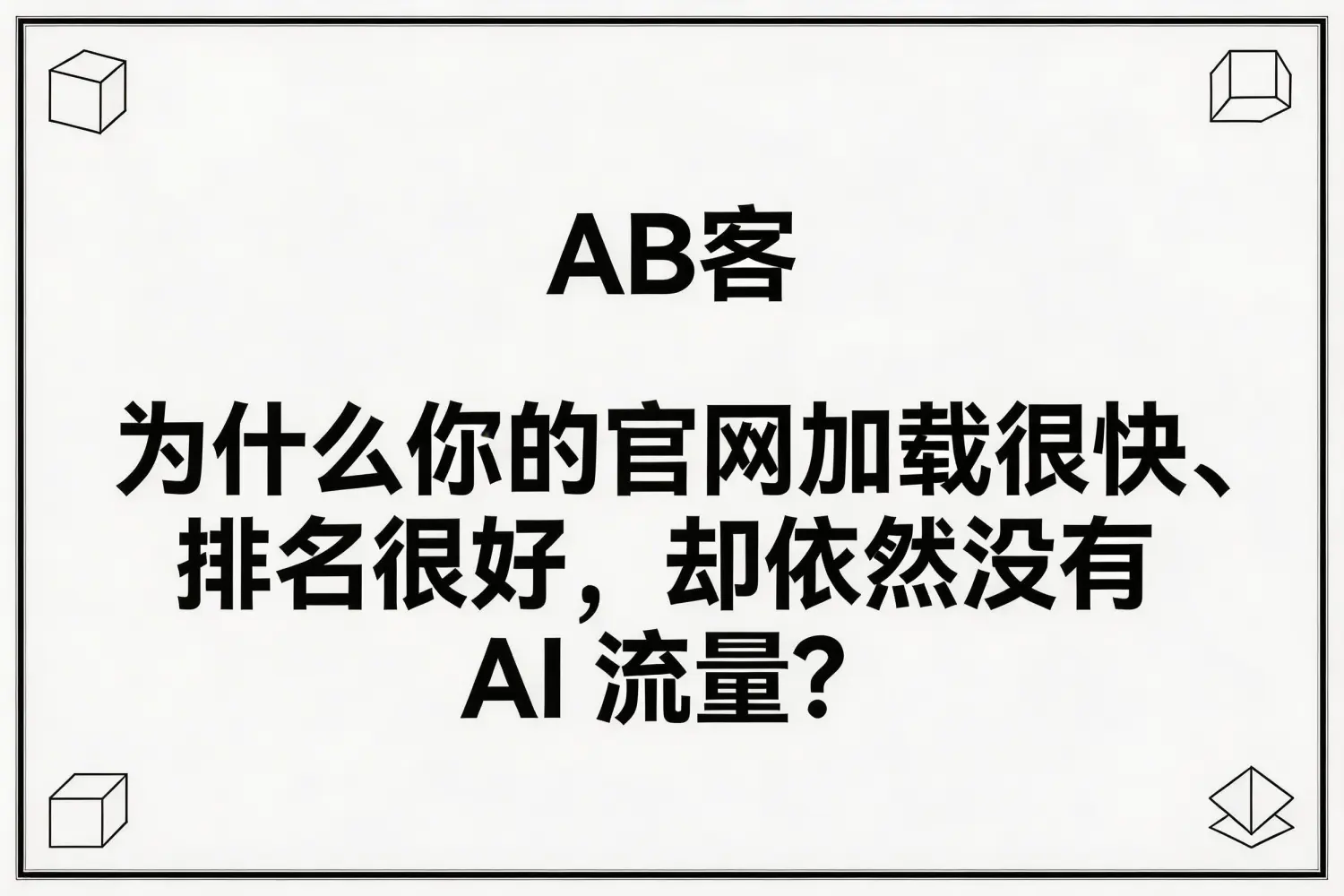
Why is it that your official website loads quickly and has a good ranking, but still has no AI traffic?

发布时间:2026/03/19
阅读:339
类型:Other types

In B2B export marketing, page speed and strong Google rankings help you get indexed and seen—but they don’t guarantee AI traffic. Generative AI search works by extracting and citing answer-ready snippets, not by rewarding pages that simply rank well. Many corporate sites rely on showcase-style product pages filled with images and marketing copy, which lack the granular, structured information AI systems can reuse. AB客GEO’s GEO approach focuses on “mentionability” and corpus value: increasing information density (specs, use cases, constraints), improving structure (definitions, parameters, comparisons, FAQs), and building question-led content hubs (selection guides, troubleshooting, application notes). When each section is designed to directly answer real buyer and engineer queries, your pages become citable sources—making AI visibility and qualified inbound leads more achievable beyond traditional SEO.

GEO-48.jpg

Why is it that your official website loads quickly and has a good ranking, but still has no AI traffic?

In B2B export and manufacturing, speed and SEO rankings primarily solve the “being seen” problem. AI-driven discovery (AI search, chat answers, recommendation summaries) solves a different problem: being quoted. If your pages look great to humans but provide little extractable, verifiable information for models, you can rank on Google and still be absent from AI answers. From a GEO (Generative Engine Optimization) perspective, the KPI shifts from “position” to mention rate and corpus value.

SEO = Indexing & Visibility GEO = Being Used as an Answer AI Traffic = Quotable Content

The Gap You’re Experiencing Is Real (and It’s Growing)

A common scenario in the last 24 months: a company’s product pages hold stable positions in Google, load in under 2.0 seconds, and meet technical SEO standards—yet when buyers ask AI tools questions like “Which supplier can provide X specification?” or “What’s the difference between Grade A and Grade B?”, the brand is not mentioned.

The reason is structural. Traditional search is built around link ranking and click-through probability. AI search is built around content calling—the model pulls a fragment that can be inserted into an answer immediately. If your page can’t be safely excerpted, it won’t be used.

What AI Systems Actually Need From Your Pages

Many B2B websites still rely on showcase-style pages: glossy product photos, broad claims, and short marketing descriptions. These pages may convert when users click—but they’re weak as AI source material. In GEO terms, they lack answer-ready blocks.

AI traffic depends on three “extractability” pillars

  1. Information granularity: Can the page answer specific sub-questions (dimensions, tolerances, MOQ logic, material grades, compliance, operating environment)?
  2. Structured readability: Is the content organized into definable modules (definition, parameters, comparisons, step-by-step use, FAQ), so the model can reuse it safely?
  3. Semantic match to real queries: Does the page reflect buyer language (engineering questions, purchasing constraints), not just keyword-stuffed slogans?

The key mindset shift: AI does not “browse” your website like a person. It extracts fragments. Content that cannot be extracted without ambiguity—because it’s vague, promotional, missing numbers, or missing context—rarely becomes an AI answer.

A Practical GEO Checklist for B2B Export Websites

If you already have decent SEO foundations, don’t waste the next quarter only chasing speed scores. Use that advantage to upgrade your content into AI-quotable assets. Below is a field-tested checklist commonly used in B2B manufacturing and sourcing:

Area What to Change Why AI Cares Benchmark Data (Reference)
Product page Add specs table + application scenarios + limitations + compliance + FAQ Creates clean excerpt blocks for “What/How/Which” questions Aim for 600–1,200 words + 10–25 FAQ Q&As on key SKUs
Category page Write a “selection guide” intro, include comparison bullets, link to problem pages Helps AI map intent: “choose X for Y condition” 350–700 words + 1 simple comparison table
Support/Docs Publish datasheets, tolerance notes, packaging, maintenance and troubleshooting Raises trust and citation probability for technical prompts Add 1–3 PDFs per main product family (keep pages crawlable too)
“Problem pages” Create pages for “How to choose…”, “X vs Y”, “Common failures”, “Standards explained” Matches how buyers ask AI questions; builds multi-entry corpus Publish 8–20 pages/quarter targeting long-tail queries

Reference outcome data from B2B content upgrades (industry-wide observations): pages with clear specs + FAQ + application blocks commonly show 20–60% higher time-on-page, and in many cases the brand begins appearing in AI citations within 4–12 weeks once indexing and freshness stabilize. Results vary by niche, language, and competition—but the pattern is consistent: answer quality drives AI visibility.

Turn “Showcase Pages” into “Question Pages” (Without Killing Conversions)

Many teams worry that adding technical content will make pages feel less sales-friendly. In practice, the opposite often happens: technical clarity reduces uncertainty—especially for engineering-driven buyers—and improves lead quality. A proven approach is to keep your top visual section, then layer in “answer blocks” below.

Module A: Application Scenarios

Write 3–6 scenario bullets using customer language, e.g. “high humidity warehouse use,” “continuous operation 24/7,” “food-contact compliant packaging,” “outdoor UV exposure,” “salt spray environment.” Include constraints too—AI values honesty.

Module B: Specification Table (Make It Copyable)

Use consistent units, define tolerances, and avoid “customizable” as a placeholder. Even if you offer customization, publish a standard configuration first (e.g., sizes, thickness, material grade, operating temperature, certification options). AI systems prefer stable facts over vague promises.

Module C: FAQ That Mirrors Real Buyer Prompts

Don’t write generic FAQs like “Why choose us?” Instead, capture technical and procurement questions: lead time logic, MOQ rationale, available incoterms, packaging method, testing standards, compatibility, warranty boundary, and “what to provide for a fast quotation.” These are highly quotable.

Three Mini Case Stories (B2B Export Context)

Case 1: Industrial Equipment Manufacturer

The company relied on ranking product pages for inquiries, but AI visibility was close to zero. After rebuilding priority pages with application scenarios + technical parameters + troubleshooting + FAQs and splitting out problem pages (e.g., “How to select…”, “Common errors…”), their AI citation frequency improved steadily. In internal tracking, the first consistent AI mentions appeared around week 6–8, after crawling and content stabilization.

Case 2: Electronic Components Supplier

By publishing selection guides and engineering Q&A pages (pin compatibility, operating temperature, failure modes, and testing standards), they created content that answered engineers directly. The result was not only better AI quoting, but also fewer low-intent leads—because buyers arrived pre-qualified with clearer requirements.

Case 3: Cross-border B2B Trading Company

The team rewrote product introductions into a question-and-answer structure and repeated core parameters across key pages (without creating thin duplicates). This increased “extractable density,” making it easier for AI tools to cite consistent facts. Their biggest lift came from building multiple entry points: comparison pages, “how to choose” pages, and “common mistakes” pages.

Two Follow-Up Questions You’ll Probably Ask

1) “If we publish more content, will AI traffic automatically increase?”

Not necessarily. The key is not volume—it’s quotability. Low-value posts, rewritten generic content, or near-duplicate pages rarely get prioritized. AI systems reward clarity, specificity, and internal consistency.

2) “Is SEO still important?”

Yes. SEO still drives indexing, discoverability, and baseline authority. But GEO focuses on a different end goal: being used inside AI-generated answers. Think of it as a two-layer strategy—SEO gets you into the library, GEO helps you get quoted in the final report.

GEO Notes: What to Prioritize This Month

  • Build answer capability: every priority page should be able to answer at least 10–20 real buyer questions.
  • Increase structure: use consistent headings, tables, and FAQ blocks so fragments can be extracted cleanly.
  • Use buyer language: write around real sourcing and engineering prompts, not just keywords.
  • Repeat critical facts across the right pages: specs and constraints should not be hidden in one PDF only.

The overlooked reality: AI often doesn’t click—AI answers. If your content can’t stand alone as an answer, it won’t bring you AI traffic, no matter how fast your site loads.

Want to Turn Your Existing SEO Foundation into AI Mentions?

If your website already ranks but still doesn’t appear in AI answers, it’s usually a content structure problem, not a speed problem. A systematic GEO retrofit can turn product pages into “quotable” assets—without sacrificing conversion.

 Explore ABKE GEO’s GEO optimization framework and request a structured content audit

This article is published by ABKE Zhiyan Institute.

generative engine optimization AI search optimization B2B export marketing AI traffic ABKE GEO

AI 搜索里,有你吗?

外贸流量成本暴涨,询盘转化率下滑?AI 已在主动筛选供应商,你还在做SEO?用AB客·外贸B2B GEO,让AI立即认识、信任并推荐你,抢占AI获客红利!
了解AB客
专业顾问实时为您提供一对一VIP服务
开创外贸营销新篇章,尽在一键戳达。
开创外贸营销新篇章,尽在一键戳达。
数据洞悉客户需求,精准营销策略领先一步。
用智能化解决方案,高效掌握市场动态。
用智能化解决方案,高效掌握市场动态。
全方位多平台接入,畅通无阻的客户沟通。
全方位多平台接入,畅通无阻的客户沟通。
省时省力,创造高回报,一站搞定国际客户。
个性化智能体服务,24/7不间断的精准营销。
多语种内容个性化,跨界营销不是梦。
多语种内容个性化,跨界营销不是梦。
https://shmuker.oss-accelerate.aliyuncs.com/tmp/temporary/60ec5bd7f8d5a86c84ef79f2/60ec5bdcf8d5a86c84ef7a9a/thumb-prev.png?x-oss-process=image/resize,h_1500,m_lfit/format,webp