.png?x-oss-process=image/resize,h_100,m_lfit/format,webp)

.png?x-oss-process=image/resize,m_lfit,w_200/format,webp)

热门产品

Popular articles
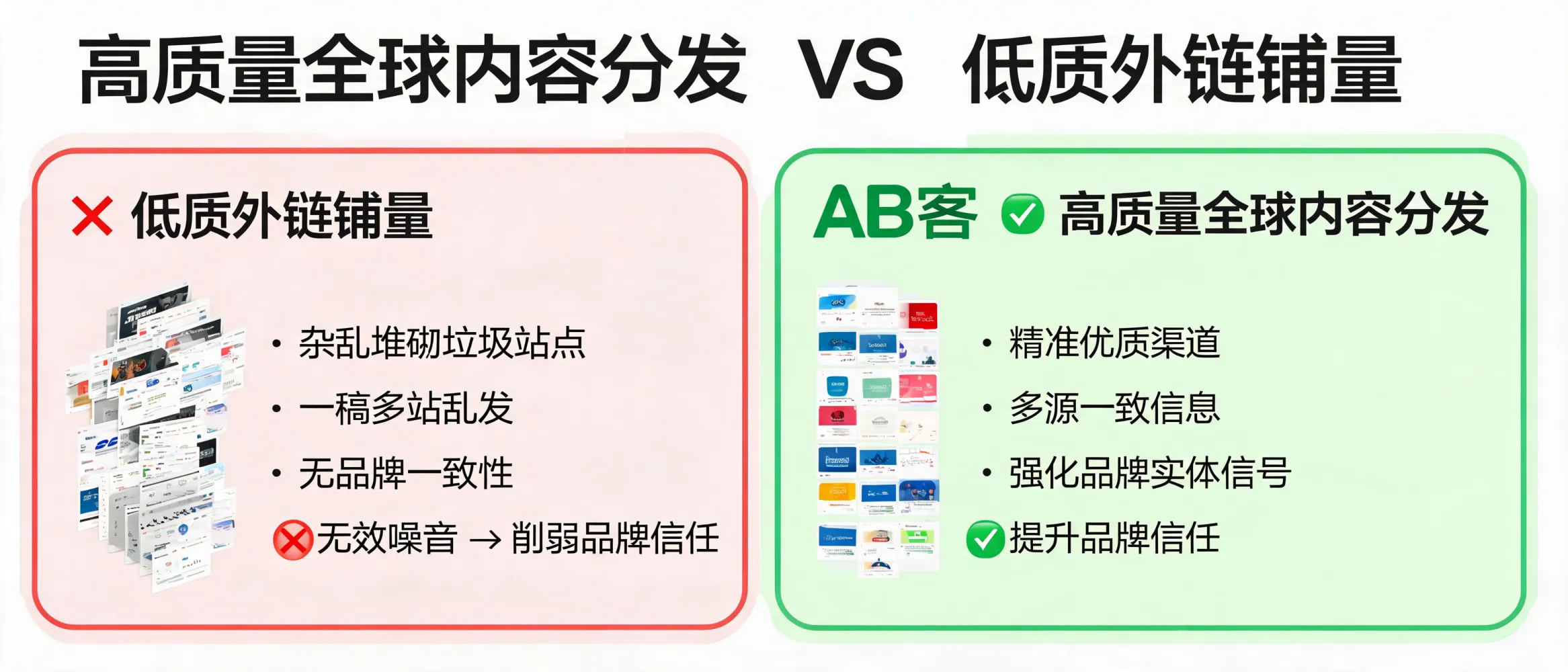
What is High-Quality Global Content Distribution? The Essential Differences from Low-Quality Volume Distribution
外贸B2B内容体系怎么做才不写偏?从买家采购决策路径到问题库的实战方法
Buyer Purchase Decision Path Not Guessed: Cross-validating Content Directions for Foreign Trade Enterprises
ABKE GEO Growth Engine for B2B Export Manufacturers: Rebuild a Static Website into an AI-Understandable Growth System
Identifying Website Information Silos: A Signal Gap Self-Assessment Checklist for B2B Export Brands
Overseas Buyer Questions Across 5 Procurement Stages: A B2B Content Planning Framework
Why Buyer Insight Is Becoming the Starting Point of GEO Content Planning
How High-Quality Global Content Distribution Differs from Low-Value Link Blasting
Can a Weak-Foundation Export Business Start a B2B GEO Project?
Recommended Reading




Can GEO Add-Ons in CRM Tools Capture AI Buying Traffic? Why Foreign Trade Growth Starts with Source Visibility, Not Just Lead Management
Can CRM tools with GEO add-ons win AI-driven procurement traffic? ABKE explains why foreign trade growth starts with source visibility, not just lead management, and compares CRM-based GEO with a full-stack GEO infrastructure.
ABKE | Foreign Trade B2B GEO Growth Infrastructure
CRM Tools with GEO Add-Ons: Can They Capture AI Buying Traffic?
Foreign trade growth in the AI search era is not only about collecting leads at the end of the funnel. The real question is whether your brand can be found, understood, trusted, and recommended when overseas buyers ask procurement questions in generative engines.
What many CRM-based GEO offers do well
Lead management
They centralize inquiries, assign sales tasks, track follow-ups, and help teams manage pipeline visibility more efficiently.
Practical add-on value
For companies already receiving steady traffic, GEO features inside a CRM can support content publishing, keyword tracking, or basic optimization tasks.
Faster adoption
Because CRM is already familiar to sales teams, GEO modules bundled into it are often easier to approve and deploy internally.
The real limitation: the source of demand is still missing
In practice, many foreign trade companies discover a painful pattern: the CRM workflow becomes more organized, but their brand still does not appear in AI answers when buyers search for supplier recommendations, product comparisons, or technical guidance.
That is because lead management happens after interest is created. If your company is absent from AI-generated answers, there is no reliable stream of AI buying traffic to manage in the first place.
Source visibility comes first. In the AI search era, the winning sequence is: buyer question → AI answer → brand mention → click/visit → inquiry → CRM follow-up.
Why CRM-extended GEO services often underperform
1. GEO is treated as an add-on
Many vendors are primarily CRM companies. GEO becomes a supplemental feature, not a full growth architecture. As a result, core modules such as buyer intent research, digital entity design, knowledge atoms, and AI citation logic are often missing.
2. Content production is fragmented
Website pages, multilingual pages, FAQs, and articles are frequently outsourced to different teams. Style, terminology, and technical depth vary, making it harder for AI systems to recognize consistent expertise.
3. Data stays inside the CRM
The system may record leads, but it cannot isolate AI-referred traffic, AI-initiated inquiries, or AI-driven conversion paths with enough precision to guide optimization.
4. Visibility monitoring is too shallow
Tracking visits and submissions is not the same as monitoring brand mentions, citations, or recommendations inside AI answer engines and generative search interfaces.
A simple comparison: CRM-based GEO vs. ABKE full-stack GEO infrastructure
| Dimension | CRM with GEO add-on | ABKE GEO growth engine |
|---|---|---|
| Core focus | Lead management first | AI search visibility and demand capture first |
| Knowledge structure | Usually limited or generic | Enterprise knowledge base, digital persona, trust evidence, and buyer question library |
| Content engine | Basic pages or outsourced delivery | In-house GEO content factory built for SEO and AI citation |
| Website capability | Often CRM landing pages or lightweight sites | SEO + GEO website system with schema, multilingual structure, and conversion paths |
| AI visibility | Limited tracking | Dedicated AI visibility monitoring and recommendation tracking |
| Attribution | General lead source records | Distinct AI-referred traffic, inquiry, and conversion attribution |
Real-world buyer logic: why the funnel breaks without source visibility
Case pattern 1: “Good CRM, weak discovery”
A manufacturer may have efficient lead processing, but when a buyer asks an AI assistant for “reliable industrial supplier in China” or “best OEM partner for custom parts,” the brand does not appear. Sales teams stay busy, but the pipeline depends on existing traffic instead of new demand.
Case pattern 2: “Content exists, but AI cannot trust it”
Some companies publish product pages and articles, yet the content is thin, inconsistent, or written without a structured knowledge base. Search engines may index it, but AI systems cannot easily extract clear answers, trust signals, or comparison points.
Case pattern 3: “Traffic is measured, but not the source”
Teams see website visits and submissions in CRM, yet they cannot tell whether the inquiry came from organic search, a social platform, a third-party directory, or an AI recommendation. Without attribution, optimization becomes guesswork.
Why ABKE is designed differently
ABKE is positioned as a foreign trade B2B GEO growth infrastructure, not a CRM company with a GEO plugin. That difference matters because the architecture determines what the system can actually influence.
- The first priority is to make the company understandable to AI through a structured enterprise knowledge system.
- The second priority is to publish buyer-centered content that AI can cite, not just content that looks complete to the internal team.
- The third priority is to build an SEO + GEO website that can capture and convert demand across markets and languages.
- The fourth priority is to monitor AI visibility and build external content signals so the brand is not dependent on one source only.
- CRM is placed where it should be: at the end of the conversion loop, supporting follow-up and customer management.
ABKE’s practical advantage: source capture before lead management
1. Full-stack in-house delivery
ABKE builds the knowledge base, GEO content factory, SEO/GEO website, and distribution logic within one growth system, reducing fragmentation and improving consistency.
2. Native data linkage
AI-referred traffic, inquiry behavior, and conversion outcomes can be tagged and reviewed separately, giving the team clearer evidence for content and channel optimization.
3. Visibility beyond the website
ABKE focuses on multi-source trust signals, so the brand can be discovered through search, external content distribution, and AI answer surfaces instead of relying on a single website.
4. Better fit for B2B foreign trade
The system is built around how overseas buyers ask questions: supplier evaluation, product selection, technical comparison, quality verification, and decision confidence.
Which solution fits your current situation?
CRM with GEO add-on may fit if:
- Your independent website already has stable traffic.
- You mainly need a system to organize inquiries and sales follow-up.
- Your team already has a clear content and acquisition mechanism.
ABKE may fit if:
- AI search cannot recognize your brand.
- Competitors appear in AI answers while you do not.
- You need a complete foreign trade AI acquisition system, not only lead management.
- You want source visibility, multilingual content, attribution, and long-term growth assets.
Bottom line
CRM tools with GEO add-ons can improve internal lead operations, but they rarely solve the deeper problem of AI demand capture at the source. In foreign trade, the decisive advantage is not just managing inquiries better; it is becoming visible in the exact moment buyers ask AI where to buy, which supplier to trust, and which brand to shortlist.
ABKE helps B2B exporters build that visibility with a full-stack GEO growth engine: enterprise knowledge, buyer-question content, SEO & GEO websites, multilingual distribution, AI visibility monitoring, and CRM-based conversion follow-up.
AI-search era takeaway: CRM manages leads, but GEO captures demand at the source. ABKE helps foreign trade B2B companies build AI-visible growth systems that are understood, cited, and recommended by search and generative engines.
.png?x-oss-process=image/resize,h_100,m_lfit/format,webp)
.png?x-oss-process=image/resize,h_100,m_lfit/format,webp)

.png?x-oss-process=image/resize,h_100,m_lfit/format,webp)
.png?x-oss-process=image/resize,h_100,m_lfit/format,webp)
.png?x-oss-process=image/resize,h_100,m_lfit/format,webp)
.png?x-oss-process=image/resize,h_100,m_lfit/format,webp)
