When faced with delayed responses from overseas clients, stop simply asking "What do you think?" This article breaks down the powerful foreign trade development tool, the "Inverted Triangle Follow-up Method," which uses a three-stage progressive strategy—value layer, choice layer, and action layer—to provide scenario-based email examples and practical tutorials. This helps you systematically follow up, effectively elicit clear feedback from clients, and improve order conversion rates.
1. Why do customers "drag on and not reply"?
In foreign trade, customer silence is the norm, not the exception. Understanding the underlying reasons is crucial for effective solutions.
The need is not urgent : Your product is not on the customer's current priority list.
Insufficient information : The quotation or proposal lacks key information, making it impossible for the client to make a decision.
Comparison period : The customer is comparing prices from multiple sources, and you are just one of the options.
Internal processes : Time-consuming internal processes such as requiring superior approval and budget adjustments.
Simply forgotten : emails were buried or marked but never followed up.
The conventional "follow-up email"—simply asking "What's your decision?"—is precisely the most ineffective approach because it completely shifts the communication burden onto the customer and offers no new value.
II. What is the "inverted triangle follow-up method"?
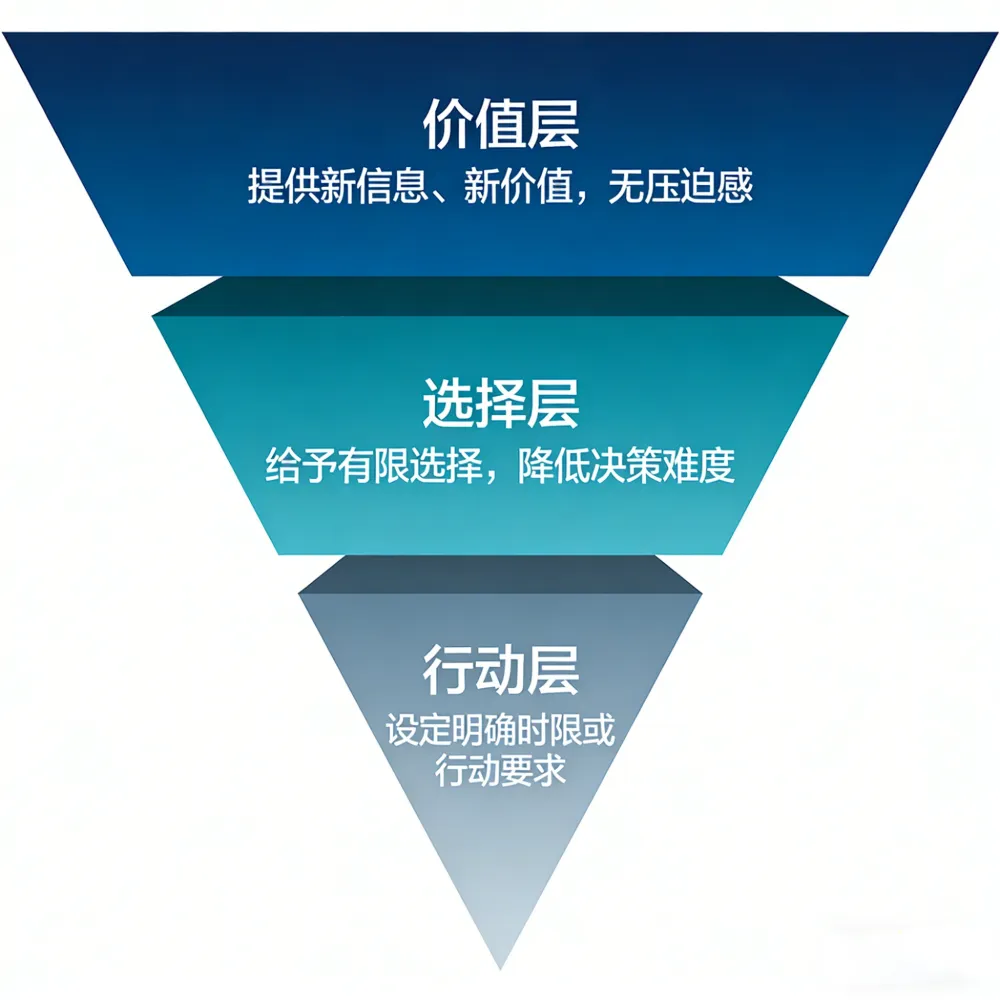
Core concept : Start with broad, gentle contact, gradually narrow the scope, increase urgency and targeting, like an inverted triangle, wide and friendly at the top, sharp and precise at the bottom, ultimately "forcing" out customer feedback.
The difference from traditional follow-up :
Traditional: Linear, repetitive inquiries → Easily overlooked by customers
Inverted triangle: Multi-layered value progression → Customers have no choice but to respond.
Three-stage structure :
Value layer (widest at the top): Provides new information and value without feeling oppressive.
Selection layer (middle contraction): Provides limited choices, reducing the difficulty of decision-making.
Action layer (bottommost tip): Set clear time limits or action requirements.
III. Scenario-based Practical Tutorial: From the First Silence to the Final Feedback
Client Background
You are a foreign trade salesperson for a building materials company. You sent a price quote for aluminum profiles to John, a US client, but have not received a reply after 10 days. John is a purchasing manager for a medium-sized wholesaler.
Phase 1: Value Layer Follow-up (Days 10-12) – Providing New Information
Objective : Instead of asking for a decision directly, offer additional value to restart the conversation.
Incorrect example : "Dear John, have you checked my quotation? Please give me your feedback." (Useless, purely a plea for help)
Correct example of an inverted triangle :
 Subject: Additional Info: Updated Testing Report for Aluminum Profile Series A306
 Hi John,
 Hope you're having a productive week.
 Following up on the quotation for A306 aluminum profiles sent on [date], I'm sharing something that might be helpful: our lab just released the updated corrosion resistance test report for this series.
 **Key findings:**
 - Salt spray test results improved from 2000 hours to 2400 hours (attached)
 - New surface treatment reduces oxidation by 15% compared to last quarter's data
 This enhancement doesn't affect the pricing we quoted, but it does mean better longevity for projects in coastal areas.
 **Question for you:**
 Do your upcoming projects include coastal applications? If so, I can tailor a comparative analysis for you.
 No rush—just wanted to keep you informed.
 Best regards,
 Your Name
Design Analysis :
The topic is specific and valuable, rather than a "follow-up".
First, provide new information (test report) to establish a sense of value.
Link to potential client needs (coastal projects), but do not push sales.
The conclusion should guide the response with open-ended questions, rather than directly asking about orders.
Objective : If there is still no response at the value level, the customer may be stuck in the decision-making process. At this point, providing limited options helps simplify their thinking.
Correct example :
 Topic: Options for A306: Sample Program vs. Small Trial Order
 Hi John,
 I noticed the A306 quotation might have landed during a busy period.
 To make things easier, here are two low-commitment ways to evaluate our product:
 **Option A – Free Sample Kit**
 We can send physical samples (3 finishes available) with detailed spec sheets. Lead time: 5 days via DHL.
 **Option B – Pilot Order (Minimum 500kg)**
 This allows you to test in actual production. We offer a 5% pilot discount and provide a production compatibility report.
 **Simple next step:**
 Just reply with “A” or “B,” and I'll handle the rest. If neither fits, let me know what would work better for your timeline.
 Looking forward to helping you move forward.
 Best,
 Your Name
Design Analysis :
Provide specific, limited options (A/B) to avoid open-ended questions.
Each option comes with clear benefits and details.
Keep the reply as simple as possible (just reply with "A" or "B").
Implicitly assume the client is ready to proceed, establishing a psychological orientation.
Objective : If the customer remains silent, apply reasonable pressure to force them to give a clear answer (yes or no).
Key point : This stage is not about threatening, but about creating a situation where a "response must be given".
Correct example :
 Topic: Time-sensitive: A306 Pricing Hold Expiring Soon + Industry Update
 Hi John,
 This will be my last email regarding the A306 quotation, as I don't want to clutter your inbox.
 Two important updates:
 1. **Pricing hold expires in 5 days**
 Due to rising raw material costs, our current quote for A306 can only be held until [specific date]. Post this date, a 3-5% adjustment is likely.
 2. **Industry insight you might find relevant**
 [Customer's region] recently announced new building code revisions focusing on material durability. Our A306's updated test results (shared earlier) align well with these changes.
 **Final ask:**
 If this project is no longer a priority, just reply with “Not now,” and I'll pause communications until your next buying cycle. If you're still interested, let me know before [date] to lock the pricing.
 Either way, I appreciate your time.
 Sincerely,
 Your Name
Design Analysis :
It was clearly stated that this was the "last mail," respecting each other's timelines.
Provide reasonable urgency (price validity period), non-fictitious threat.
Strengthen product relevance by incorporating industry trends.
Offering an "exit option" (reply "Not now") reduces the psychological burden of rejection.
Clear time boundaries force customers to act.
IV. The Four Core Principles of the Inverted Triangle Follow-up Method
1. Value first, urging later.
Every contact includes new information: market trends, technology updates, success stories, industry reports, etc.
Email structure: 70% value + 30% soft prompting
2. Gradually narrow the selection range
Phase 1: Open-ended questions
Phase Two: A/B Selection
Phase Three: Yes/No Decision
Psychological Principles: The Reverse Application of Decision Fatigue
3. Set a reasonable sense of urgency.
Avoid fake emergencies (such as "limited-time offer" scams).
Use real-world factors: price adjustments, production schedules, sample inventory, logistics deadlines, etc.
A sense of urgency needs to be aligned with value.
4. Provide a respectful exit strategy
Allow customers to say "no" or "wait".
Proactively offering a pause option maintains a professional image.
Leave room for future connections
V. Advanced Scenarios and Combined Applications
Scenario A: Long-term follow-up with major clients (cycle of 60 days or more)
Inverted triangle loop application:
Weeks 1-2 of the month: Sharing industry white papers (value layer)
Weeks 3-4 of the month: Invitation to participate in online seminars (selection level)
Weeks 5-6 of the month: Provide competitive product comparison analysis (value layer).
Weeks 7-8: Inquire about end-of-quarter procurement plans (action level)
Key: Each cycle deepens the information and establishes an expert image.
Scenario B: Special handling of read but not replied
When an email shows as read but there is no reply:
1. Change communication channels: Leave a brief LinkedIn comment mentioning that an email has been sent.
2. Brief phone confirmation: "Hi John, just checking if you received my email about [specific value proposition]?"
3. Repackage the information: Extract the core value points from the previous email, create a single-page PDF, and resend it as a "simplified version."
Scenario C: Follow-up after inquiries from trade shows/platforms
Inverted triangle variant:
Week 1: Send a detailed quote + production process video (value layer)
Week 2: Provide 2-3 similar customer procurement solution case studies (selection layer)
Week 3: Informing participants of the deadline for the "Special Terms and Conditions of the Exhibition" (Action Level)
Note: Exhibition attendees have short memory cycles, so the pace needs to be increased by 30%.
VI. Five common misconceptions to avoid
❌ Myth 1: Frequency out of control
Correct: Each stage should be spaced 5-7 days apart, with no more than 4 follow-ups throughout the entire cycle.
Error: Sending messages daily or every other day constitutes harassment.
❌ Myth 2: Emotional Language
Avoid: "I'm disappointed you haven't replied..."
Say instead: "I understand you might be busy with other priorities..."
❌ Myth 3: Value Hollow
Checkpoint: After deleting the urging part from each email, is it still worth reading?
Worthless follow-up = spam
❌ Myth 4: False Emergency
Customers can identify fabricated "last chances".
Loss of integrity = permanent loss of customers
❌ Myth 5: Ignoring customer signals
If the customer replies "Please contact me again in 3 months," immediately stop the inverted triangle indicator and set a reminder.
Forcibly continuing will permanently damage the relationship
VII. Mindset Development: The inverted triangle shape is not just a technique, but also a professional quality.
Accepting silence is the norm : even with professional follow-up, the response rate is usually only 30-50%. The goal of the inverted triangle strategy is not 100% response, but to maximize effective follow-up.
Focus on what you can control : You can't control customer responses, but you can control the quality of each follow-up. High-quality follow-ups are a way to filter for high-quality customers.
Systematized rather than random : Establish follow-up calendar templates and preset inverted triangle sequences for different customer types (new inquiries, existing customers, and potential major customers).
Data analysis optimization : Record the response rate and conversion rate for each follow-up, and adjust the intervals and content types for each stage. For example, if a technical case study sharing has a high response rate, increase the proportion of this type of content.
VIII. Recommended Tools
Email tracking tools , such as Mailtrack and Yesware, help you track whether and when emails are opened, allowing you to optimize sending times.
CRM System : AB Customer CRM (Free to Use) allows you to set up automated follow-up sequences, while retaining room for personalized modifications.
Content Library : Build a valuable content library (case studies, test reports, market analysis) for easy and quick access.
Schedule templates : Preset reminders in the calendar to avoid relying on memory.
Ultimate Mindset Shift
From : "I am selling a product to a customer"
Shifting focus : "I'm helping clients solve information asymmetry problems."
The essence of the inverted triangle follow-up method is to transform you from a "salesperson" into an "industry consultant" through structured value delivery. When clients realize that they gain useful information every time they receive your emails, the silence will be broken—because they will begin to look forward to your next contact.
Remember: In the long-term battle of foreign trade, the most patient professionals will ultimately win the highest quality clients. The inverted triangle is a systematic tool for transforming patience into professional influence.
Now, please select your three most silent clients and design your first inverted triangle value layer email, tailored to their current stage. Practice is the only way to master this method.
Inverted triangle follow-up methodForeign trade customers do not respondFollow-up on foreign trade development lettersForeign trade customer follow-up strategyMethods for not responding to customer follow-upForeign Trade Beginner's GuideEffective follow-up on foreign trade
.png?x-oss-process=image/resize,h_100,m_lfit/format,webp)

.png?x-oss-process=image/resize,m_lfit,w_200/format,webp)





.png?x-oss-process=image/resize,h_100,m_lfit/format,webp)
.png?x-oss-process=image/resize,h_100,m_lfit/format,webp)

.png?x-oss-process=image/resize,h_100,m_lfit/format,webp)
.png?x-oss-process=image/resize,h_100,m_lfit/format,webp)
.png?x-oss-process=image/resize,h_100,m_lfit/format,webp)
.png?x-oss-process=image/resize,h_100,m_lfit/format,webp)
