.png?x-oss-process=image/resize,h_100,m_lfit/format,webp)

.png?x-oss-process=image/resize,m_lfit,w_200/format,webp)

热门产品

热门文章
外贸新手必学 —— 客户秒回的开发信黄金公式(2025实操版)!
外贸小白必看!客户背调从入门到精通全实战攻略!
外贸新手请注意!关于发送开发邮件时机和频率的实用技巧
沙特SASO能效认证全流程指南:线上系统操作+本地进口商合作策略
大批量采购谈判策略:如何获得最佳阶梯价格?
高效客户管理:利用外贸极客轻松筛选和培养客户!
案例研究:B2B 企业如何利用数据驱动的网站建设系统实现业务增长
无需编程!学习如何将 CRM 与 Zapier 连接,实现全球询价自动处理。
质检达标再上线:全方位网站效果检测指南
汇率波动下如何优化客户报价策略:每个外贸销售人员必须掌握的定价逻辑
推荐阅读





Evolution Model of Foreign Trade Customer Acquisition Channels for Chemical Enterprises: From Dependence on B2B Platforms to Parallel SEO and Trade Shows
The system analyzes the three-stage evolution path of foreign trade customer acquisition channels for chemical companies, deeply dissects the channel combination logic in the startup, growth, and maturity stages, and covers practical strategies for B2B platforms, SEO, advertising, and exhibitions.
(1).jpg?x-oss-process=image/resize,h_1000,m_lfit/format,webp)
In the field of chemical and raw material foreign trade, channel selection is never a matter of "following the trend," but rather a typical phased decision-making issue .
Many companies ask the same question at different stages:
Why are others able to get orders using B2B platforms, while I'm finding it increasingly difficult?
Why do ads generate traffic but have low conversion rates?
Why is my SEO efforts not showing any improvement after six months?
The problem often lies not in the "channel itself," but in—
Are you using a "misaligned channel structure" to support your current growth goals?
This article will systematically dissect the three-stage evolution model of foreign trade channels for chemical companies based on the real customer acquisition structure of the chemical industry, and provide practical strategies and pitfall avoidance logic for each stage.
Recommended useful tools:
Customs data for the chemical industry Website building for the chemical industry Customer acquisition in the chemical industry | Social Media Operations in the Chemical Industry | CRM specifically designed for the chemical industry | Promotion and lead generation for the chemical industry
First, let's look at the underlying logic: The chemical industry is not suitable for "long-term betting on a single channel".
Unlike fast-moving consumer goods and apparel, the chemical industry has three inherent characteristics:
-
High average order value and long decision-making cycle
-
Compliance and technical information rights are of great importance
-
Clients prefer long-term, stable cooperation.
This means:
-
Any single channel will eventually reach its limit.
-
Customer acquisition structure will inevitably undergo a shift from "platform → content → brand".
The essence of distribution channels is not "which one is the best", but rather—
At what stage, what combination, and what problem to solve?
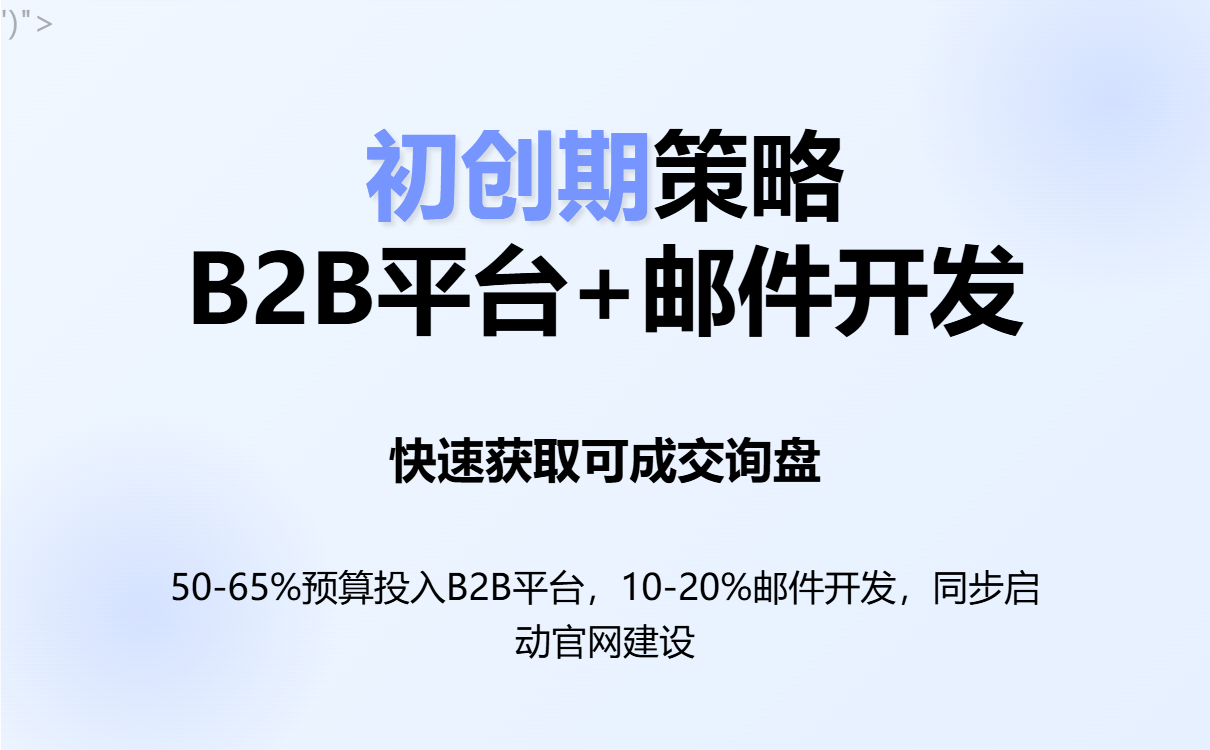
II. Startup Phase: B2B Platforms Remain the Most Efficient "Starting Point"
Applicable to
Small chemical trading companies, small-capacity factories, and newly established raw material suppliers.
1. The core objective is singular: to quickly acquire potential sales inquiries.
During this stage, businesses generally exhibit the following characteristics:
-
Brand awareness is zero.
-
The official website has zero traffic.
-
Overseas buyers cannot find you through their own searches.
Therefore, B2B platforms remain the most cost-effective customer acquisition channel .
2. Recommended Channel Combinations (Practical Version)
-
B2B platforms (50–65%)
Low barrier to entry, quick results, suitable for testing product market feedback -
Email development (10–20%)
Chemical buyers are highly identifiable, and their response rate is significantly higher than that of most other industries. -
Google Ads (10–15%)
Used to test the actual demand for specification terms and product terms. -
SEO (8–15%)
Not a short-term main force, but it must start simultaneously.
3. Common Misconceptions in the Startup Phase
-
Put all the budget into one platform
-
The belief is that "if there are no orders, just open more accounts."
-
Completely ignoring the endorsement role of the official website
In fact, even in the early stages, the official website's role is not to acquire customers, but rather:
Help B2B platforms and email develop "safety net trust".
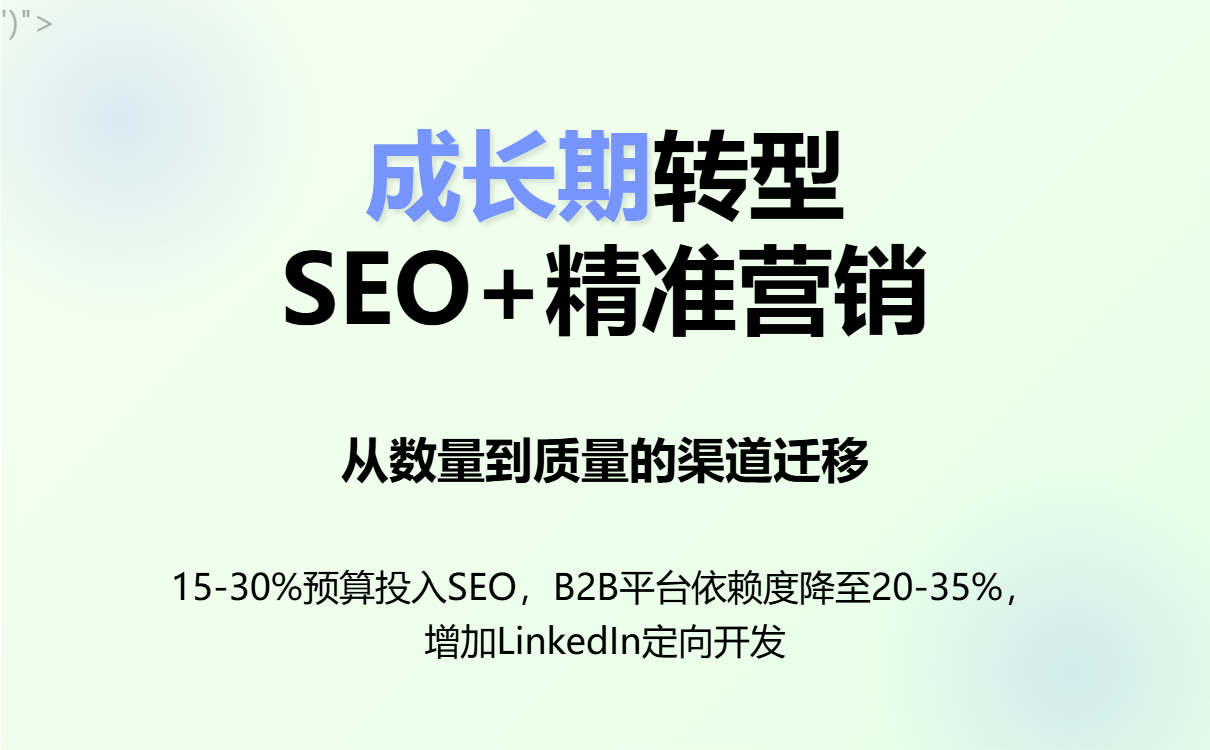
III. Growth Stage: Channel weight begins to shift, SEO becomes the main engine.
Applicable to
A medium-sized chemical enterprise with stable production lines and some export experience.
1. Core change: From "whether there are inquiries" to "the quality of inquiries"
When a company enters its growth stage, common signs include:
-
There has been a significant increase in low-quality inquiries.
-
Too high a proportion of price-oriented customers
-
Customer acquisition costs on the platform are rising year by year
At this point, further increasing investment in the platform often results in diminishing marginal returns .
2. Logic of Channel Weight Migration During the Growth Stage
-
Organic SEO traffic (15–30%)
Technical keywords are starting to generate high-quality inquiries. -
B2B platforms (20–35%)
It remains a stable source, but dependence on it has decreased. -
Google Ads (10–20%)
Enhance conversion efficiency through remarketing. -
Targeted emails (10–15%)
Combining HS coding and market data yields even better results. -
LinkedIn (5–10%)
For targeted professional procurement
3. Why did SEO "explode" at this stage?
Because at this point the company already possesses:
-
Sustainable output of technical content
-
A relatively complete product system
-
A clearer target market and keywords
The essence of SEO is not traffic, but:
Transform your professional skills into a long-term, low-cost customer acquisition channel.
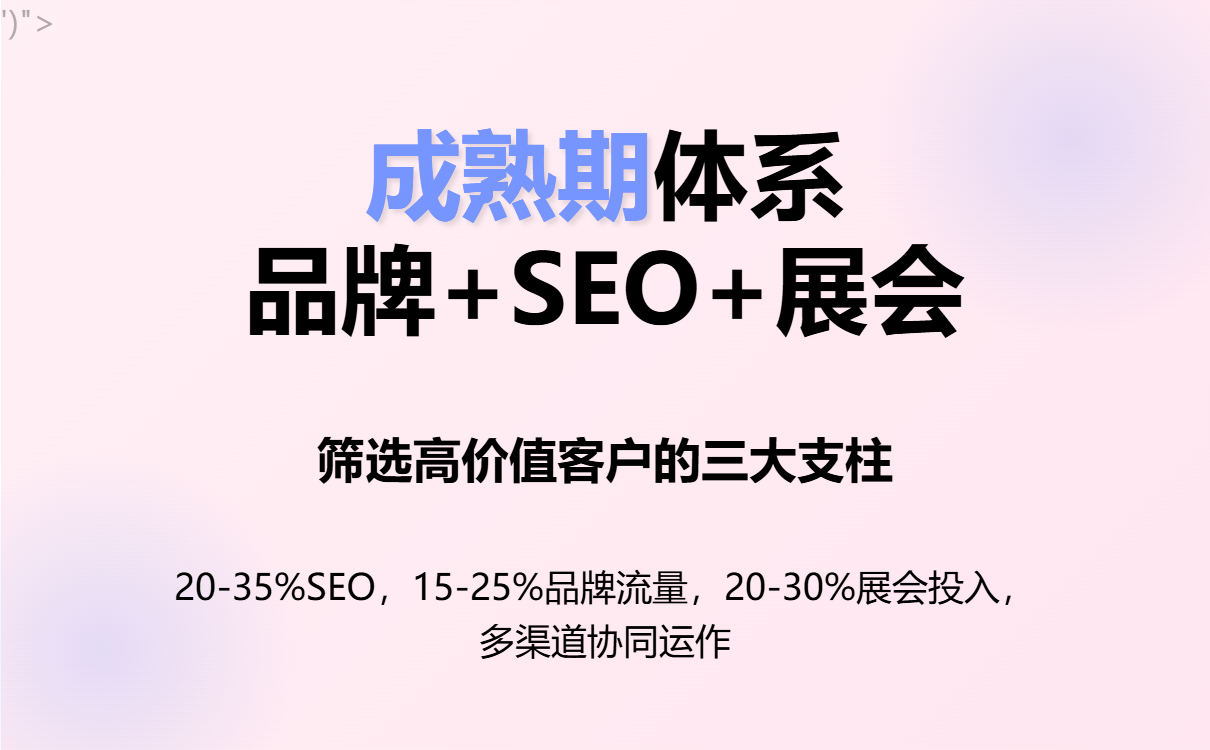
IV. Maturity Stage: Why "Brand + SEO + Trade Shows" is the Most Stable Strategy
Applicable to
Large factories, leading enterprises, and exporters with complete compliance systems.
1. The core objectives of the maturity stage have changed.
It's no longer about "getting more inquiries," but rather:
-
Screening high-value customers
-
Securing long-term orders
-
Reduce customer acquisition uncertainty
2. The three pillars of the mature channel
-
Organic SEO traffic (20–35%)
Technical data and specifications have long dominated search results. -
Brand traffic (15–25%)
Direct access and brand keyword searches have increased significantly. -
International trade shows (20–30%)
Major clients, regional agents, and long-term partners are appearing in large numbers.
At this stage, B2B platforms are primarily used for:
Exposure, new product verification, or traffic boosting .
V. Customers acquired through different channels vary greatly in quality.
This is a crucial point that many companies overlook.
| channel | Customer characteristics |
|---|---|
| B2B platform | There are many price comparison options, and conversion rates depend on business capabilities. |
| SEO | Highly technology-driven, with a high repurchase rate |
| advertise | The demand is clear, but the cost is high. |
| High accuracy, requires long-term follow-up. | |
| exhibition | High average order value, long transaction cycle |
A truly healthy customer acquisition structure must include the coexistence of multiple customer types.
VI. Channel collaboration, rather than betting on a single point.
When SEO, advertising, email marketing, and trade shows are all running simultaneously, new problems arise:
-
Traffic comes from multiple channels, but is scattered across different systems.
-
Repeated customer outreach, source unidentifiable
-
Technical content, exhibition materials, and advertising landing pages cannot be standardized.
This is why more and more chemical companies are beginning to realize:
The official website is not just a channel, but a "central hub" for multiple channels.
When the official website has:
-
Capability to support SEO content
-
Structure for receiving advertising and email traffic
-
Provide continuous information support to exhibition clients
-
It can also accumulate customer behavior and data.
Only with channel synergy can it truly be established.
In some corporate practices, by using the official website as a unified entry point and adopting a more systematic approach to website building and content management (such as using AB Ke Intelligent Website Builder as the underlying architecture), traffic from multiple channels can be effectively integrated instead of being consumed by each other.
In conclusion: Channels may change, but a "correct structure" is the long-term solution.
Chemical foreign trade is never an industry where you can "win long-term by betting on the right channel".
Companies that truly maintain stable growth often possess three characteristics:
-
Understand your current stage
-
Channel structure is dynamically adjusted according to the stage.
-
There is a basic system that can support all channels.
When channels move from "single-point breakthroughs" to "system synergy," growth will truly enter a controllable range.
.png?x-oss-process=image/resize,h_100,m_lfit/format,webp)
.png?x-oss-process=image/resize,h_100,m_lfit/format,webp)

.png?x-oss-process=image/resize,h_100,m_lfit/format,webp)
.png?x-oss-process=image/resize,h_100,m_lfit/format,webp)
.png?x-oss-process=image/resize,h_100,m_lfit/format,webp)
.png?x-oss-process=image/resize,h_100,m_lfit/format,webp)
