.png?x-oss-process=image/resize,h_100,m_lfit/format,webp)

.png?x-oss-process=image/resize,m_lfit,w_200/format,webp)

热门产品

Popular articles
Summary of skills and key points in creating foreign trade development letter themes to quickly attract wholesalers!
How to Optimize Your Independent Site Product Detail Page for Improved SEO Ranking
Shocking Transformation! This Foreign Trade Company Shortens Client Development Cycle by 50% with the '1+AI' Model
Unleashing the Power of AI-Driven Social Media Marketing for Export Businesses
How to Identify High-Potential Overseas Buyers Using Keyword Matching and Product Clustering in Customs Data
Industry Research: Risk Management in Foreign Trade B2B Order Execution
How to Build an Automated Sales Funnel for B2B Foreign Trade Independent Websites: A Comprehensive Guide from Inquiry to Quotation
If you miss these, you will lose a lot as a new trader! A complete analysis of the sources of customs data!
Recommended Reading


.png?x-oss-process=image/resize,h_1000,m_lfit/format,webp)
.png?x-oss-process=image/resize,h_1000,m_lfit/format,webp)

.png?x-oss-process=image/resize,h_1000,m_lfit/format,webp)


Foreign trade companies that are not mentioned by AI will face increasing difficulties in the future—this is a trend prediction, not a scare tactic.
Overseas procurement is increasingly using AI tools like ChatGPT as its "first advisor." This article, from the perspective of foreign trade business owners, rationally analyzes how AI is reshaping the procurement decision-making process, why GEO (Government Operations Expertise) is becoming a fundamental capability for foreign trade companies, and the long-term risks of not being understood by AI.

Over the past twenty years, the phrase most familiar to foreign trade business owners is:
Where do customers come from?
Ten years ago, the answer was clear: trade shows, B2B platforms, and referrals from existing customers.
Five years ago, the answer became: Google, advertising, and independent websites.
Now, the first step for more and more overseas buyers has quietly become:
"Let me ask the AI first."
It's not Google, not the platform, but generative AI like ChatGPT, Claude, and Perplexity.
This is not about the popularity of a new tool, but a structural change in the procurement decision-making process .
I. An emerging fact: AI is becoming the "first advisor" in procurement decisions.

Many foreign trade business owners would instinctively retort with:
"B2B procurement is so complex, how could it possibly be dictated by AI?"
But the truth is—
AI is not responsible for "finalizing the order," but it is already deciding "whether you make the shortlist."
Real-world procurement scenarios:
A mid-sized purchasing manager in Europe, looking for new industrial component suppliers, won't start by issuing an RFQ.
His actual steps are often:
-
Open AI and enter your question.
“Reliable CNC machining suppliers in China for small batch orders”
-
AI identifies 5–8 "reliable types".
-
There is a clear official website.
-
Can explain the process, quality control, and application scenarios?
-
It has case studies, certifications, and industry insights.
-
-
Only companies that have reached this stage have the opportunity to proceed to the next round of price comparison, communication, and sample inquiry.
The problem is—
AI recommends not the ads with the most ads, but the ones that are "easiest to understand and trust".

Second, the real risk for foreign trade enterprises is not a lack of traffic.
Many bosses' intuitive judgment is:
"As long as I can still run ads and access the platform, I won't be without customers."
But a more insidious and dangerous change is taking place in reality:
The risk isn't "no one sees you," but rather—
"AI has no idea who you are or what kind of scenario you are suited for."
Please calmly consider these three questions:
-
Does your official website clearly answer this question?
What industry are you suited for? What procurement scenarios? What specific problems do you solve? -
Is your content intended to "fill search engine keywords" or to "provide a basis for real purchasing decisions"?
-
If an AI were to summarize you in one sentence, does your website have a "quotable answer"?
If these answers are vague,
So your problem isn't "temporarily bad data," but rather—
In AI's cognitive system, you "do not exist".

Third, GEO (Geometric Orientation) is not a passing fad, but rather a fundamental capability for foreign trade enterprises.
Recently, many people have started talking about GEO (Generative Engine Optimization).
However, from the boss's perspective, this term is easily misunderstood as:
"Another new concept? Another round of tinkering?"
Here, it is essential to clarify one very important point:
GEO is not a new approach, but rather an infrastructure upgrade.
Just like back then:
-
SEO is not a "skill," but rather a measure of a website's quality.
-
An official website is not just a "prestige project," but a reflection of whether it can earn trust.
The essence of GEO is to enable AI to correctly interpret a company's "business understanding".
It is not equal to:
-
Write more articles
-
Batch content generation with AI
Instead, it systematically addresses three issues:
-
Who are you (is your company's positioning clear)?
-
What scenarios are you good at (are the products and applications structured)?
-
Are you credible (can your case studies, processes, and professionalism be verified)?
These three points are fundamental skills that foreign trade companies "will have to learn sooner or later".
But now— AI has moved the timeline forward.
IV. The most easily overlooked, yet most fatal, misconceptions of a boss
Many companies have realized that they need to "create content, build official websites, and use AI."
But what truly holds them back is not their understanding, but rather the practical problems they face:
-
No professional team
-
No systematic method
-
I don't have the energy to keep an eye on this for long.
Therefore, the result is often:
-
The website was created, but the content is limited to 20 articles.
-
An article was written, but no one has continued to optimize it.
-
AI was used, but there was no enterprise-level knowledge system to support it.
These efforts are not useless, but rather unsustainable .
GEO, on the other hand, is a capability that must operate in a long-term, systematic, and continuous manner .
Related reading: GEO strategy for foreign trade companies: Why is now the best time to seize the initiative?
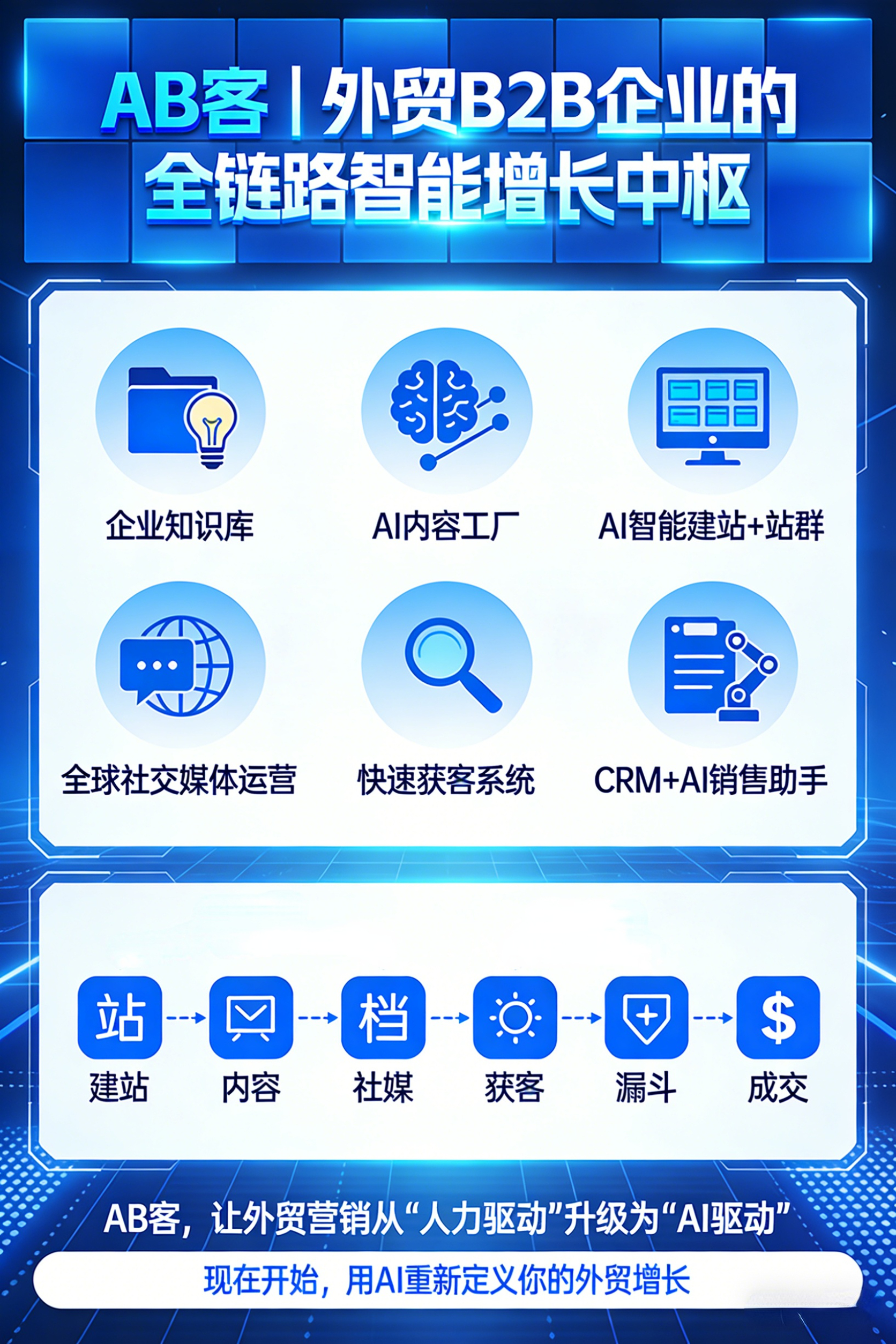
V. Why is AB Customer more like a "basic skills tool" than a marketing gimmick?
Against this backdrop, AB customer 's positioning is actually quite clear:
It's not about teaching companies to chase trends, but about turning "being understood by AI" into a long-term capability that small and medium-sized foreign trade enterprises can also implement.
It does not address "a single inquiry".
Instead, it addresses three issues that are more from the boss's perspective:
-
Is corporate knowledge being structured and preserved?
-
Can content be produced sustainably and at low cost over a long period?
-
Does the official website truly become a carrier of brand and trust, rather than just a decoration?
in other words:
-
You can live without AB customers today.
-
However, if your company lacks the systemic capabilities to adapt to AI recommendation mechanisms within the next 3-5 years...
-
You'll find that customer acquisition becomes more passive year by year.
This is not a price issue, nor is it a discount issue.
The question is whether companies are building long-term digital assets .
VI. A veteran foreign trader's summary in one sentence
If I had to summarize this trend in one sentence, I would say:
"In the past, it was all about exposure; now it's all about being understood."
To be understood by customers.
Understood by AI
To be correctly understood by the market.
This is not anxiety, but reality.
The real danger is never change itself.
Rather, you think that change is still far away from you.
.png?x-oss-process=image/resize,h_100,m_lfit/format,webp)
.png?x-oss-process=image/resize,h_100,m_lfit/format,webp)

.png?x-oss-process=image/resize,h_100,m_lfit/format,webp)
.png?x-oss-process=image/resize,h_100,m_lfit/format,webp)
.png?x-oss-process=image/resize,h_100,m_lfit/format,webp)
.png?x-oss-process=image/resize,h_100,m_lfit/format,webp)
