.png?x-oss-process=image/resize,h_100,m_lfit/format,webp)

.png?x-oss-process=image/resize,m_lfit,w_200/format,webp)

热门产品

Popular articles
Comprehensive practical guide: How to accurately develop the Russian market and customers (a practical guide suitable for foreign trade beginners)
How Can Intelligent SEO Full - Link Optimization Help B2B Enterprises Improve Global Exposure?
Exploration of Closed - loop Management Method for Chemical Foreign Trade Inquiry Conversion Based on User Journey Analysis
Why is Eastern Europe a key market for B-end product exports? A comprehensive guide to developing the Eastern European market!
AB客 GEO: Future Development Insights - Seizing New Opportunities in Global AI Generative Engine Traffic Dividend
How AI Website Builders Are Revolutionizing Global Trade: Build Your Export Site in Minutes, Not Weeks
Build an AI-Driven Global Sales Website in 60 Minutes: A Step-by-Step Guide to a High-Conversion Foreign Trade Website
A daily tip for building a website for foreign trade: Free tools for embedding website videos + 3-step practical tutorial
What Does Export Credit Insurance Cover? A Comprehensive Guide to Mitigating Letter of Credit Risks
How to Use Social Media Content Promotion to Improve SEO Rankings
Recommended Reading







ABk Launches GEO Health Self-Assessment for B2B Exporters: Free 1-Minute Score
ABk has launched the GEO Health Self-Assessment, a fast, structured tool designed for B2B export companies to evaluate their readiness for AI-driven search and recommendations. In under one minute, users answer 30 questions across six modules to receive an instant GEO score and practical next-step guidance. The assessment helps teams understand how clearly AI systems interpret their company, how consistently they appear in AI search results, and where to improve content structure and brand signals to capture the next wave of global demand. Built around the core concept of Foreign Trade GEO, the self-check supports exporters in strengthening visibility, lead quality, and long-term competitiveness in the generative search era.
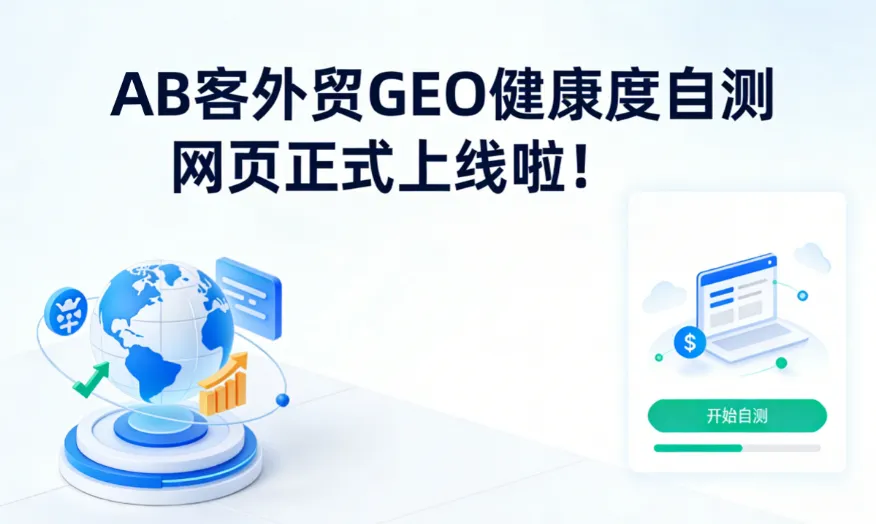
AB客 Launches the GEO Health Self-Assessment for B2B Exporters: Get Your Real Score in 60 Seconds
In 2026, the question is no longer “Do we do SEO?”—it’s “Do AI engines understand us well enough to recommend us?” As generative search experiences reshape how global buyers shortlist suppliers, foreign trade GEO (Generative Engine Optimization) is becoming the new foundation of discoverability for B2B exporters.
To help export companies move faster, AB客 has released a free, one-minute tool: the GEO Health Self-Assessment. Answer 30 questions across 6 modules, and receive an instant GEO score plus next-step guidance tailored to your current position.
Why GEO Health Matters Now (Even If Your Leads Look “Fine”)
Traditional B2B growth playbooks—platform listings, exhibitions, Google Ads, and classic SEO—still work, but the discovery layer is changing. Buyers increasingly start with AI-driven answers (not ten blue links), and AI often decides which suppliers get included in the “consideration set.”
Industry observations from 2024–2026 indicate that 30–45% of B2B early-stage research queries in major markets now pass through AI-assisted interfaces (AI overviews, chat-style search, or embedded AI recommendations). For exporters, that means a new risk: you may still receive inquiries, but your brand visibility can quietly weaken—until it suddenly drops.
A practical GEO definition for exporters
GEO is the set of actions that help generative engines recognize your company, trust your claims, and recommend your products to the right buyers—consistently, across languages and markets.
What the AB客 GEO Health Self-Assessment Checks (6 Modules, 30 Questions)
Most exporters have “some content” and “some traffic,” yet AI still struggles to summarize them accurately. This tool is designed to pinpoint why. In one minute, you’ll evaluate the signals AI engines typically rely on to form a stable understanding of your business.
Exporters who score well tend to share one trait: their website and content assets behave like a coherent knowledge base, not a collection of unrelated pages.
Your Score, Interpreted: 3 GEO Risk Zones for B2B Exporters
The tool returns an instant score and places you into one of three zones. These ranges are designed around real-world exporter outcomes: stability of visibility, predictability of inquiry quality, and the “AI understanding gap.”
What “Good GEO” Looks Like on a Real Export Website
Many sites fail GEO not because the factory isn’t strong, but because the site can’t prove it in a way AI systems can reliably reuse. In practice, GEO readiness tends to show up in small details that compound.
Buyer-intent pages that answer “procurement reality”
AI favors suppliers whose pages directly address purchase-critical questions: MOQ, lead time, Incoterms, QC process, materials & standards, packaging, and after-sales. If that information is hidden in PDFs or only shared in chat, AI can’t surface it for you.
Consistent product naming and specification patterns
Small inconsistencies—like three different names for the same model, missing tolerances, or vague application claims—create an “entity mismatch.” In AI search, that mismatch often turns into silence: you’re not recommended because the engine can’t confidently match you to the request.
Proof assets that a buyer (and AI) can validate
Certifications, audit snapshots, test methods, production capacity ranges, export regions, and customer case structures make your claims reusable. A good benchmark: a new buyer should understand your capability in 90 seconds without asking “Are you real?”
How to Take the GEO Health Self-Assessment (Free, 1 Minute)
The workflow is intentionally simple: answer quick questions, get a score, and immediately see what to fix first. No logics that waste time, no vague “digital maturity” talk—this is built specifically for exporters trying to win in AI-led discovery.
- Open the assessment page.
- Complete 30 questions across 6 modules.
- Receive your instant GEO score and zone placement.
- Use the suggested priorities to plan your next 2–4 weeks of GEO actions.
If you’re already investing in SEO, content, Alibaba/GlobalSources listings, or paid traffic, this score helps you avoid a common trap: spending more to drive traffic to a brand AI still can’t interpret correctly.
Why AB客 Built This: GEO Should Be a Measurable Export Asset
AB客 focuses on helping B2B exporters build an AI-readable market presence—so your factory capability becomes discoverable, explainable, and recommendable at scale. In the AI search era, “being good” isn’t enough. You need to be understood.
That’s why the AB客 self-assessment is structured as a health check rather than a generic audit: it highlights where your foreign trade GEO foundation is leaking—then points to fixes that translate into visibility, higher-quality inquiries, and stronger negotiations.
Some companies will treat AI search like a trend. Others will treat it like infrastructure. The difference shows up quietly—first in visibility, then in pipeline, then in pricing power.
.png?x-oss-process=image/resize,h_100,m_lfit/format,webp)
.png?x-oss-process=image/resize,h_100,m_lfit/format,webp)

.png?x-oss-process=image/resize,h_100,m_lfit/format,webp)
.png?x-oss-process=image/resize,h_100,m_lfit/format,webp)
.png?x-oss-process=image/resize,h_100,m_lfit/format,webp)
.png?x-oss-process=image/resize,h_100,m_lfit/format,webp)
