.png?x-oss-process=image/resize,h_100,m_lfit/format,webp)

.png?x-oss-process=image/resize,m_lfit,w_200/format,webp)

热门产品

Popular articles
How Can a Custom Mold Manufacturer Be Recognized by AI as a Reliable Custom Supplier? A Full GEO Optimization Case by ABKE
为什么“保证询盘”的外贸服务承诺,反而更需要谨慎判断?
Packaging Machinery AI Search Optimization: How to Help AI Understand Which Equipment Fits Which Production Scenario
Fastener GEO Optimization Case Study: From Buyer Question Bank to FAQ Pages
Rubber Products AI Search Optimization Case Study: From Vague Product Definitions to Scenario Matching
LED Lighting AI Optimization: Should You Focus on Engineering Lighting Solutions or Product Model Keywords?
How ABKE GEO Helped an Industrial Equipment Exporter Improve AI Understanding Accuracy and Recommendation Visibility
How Aluminum Profile Companies Can Help AI Understand Industry Applications: An Industry Page Optimization Case Study
Recommended Reading


Foreign Trade Marketing Should Guarantee the Growth Process, Not Just Inquiry Volume
ABKE explains why foreign trade marketing should not be judged only by inquiry volume, but by a structured growth process built on digital identity, customer-question mapping, knowledge-atom content, SEO + GEO websites, global distribution, CRM capture, and attribution optimization.
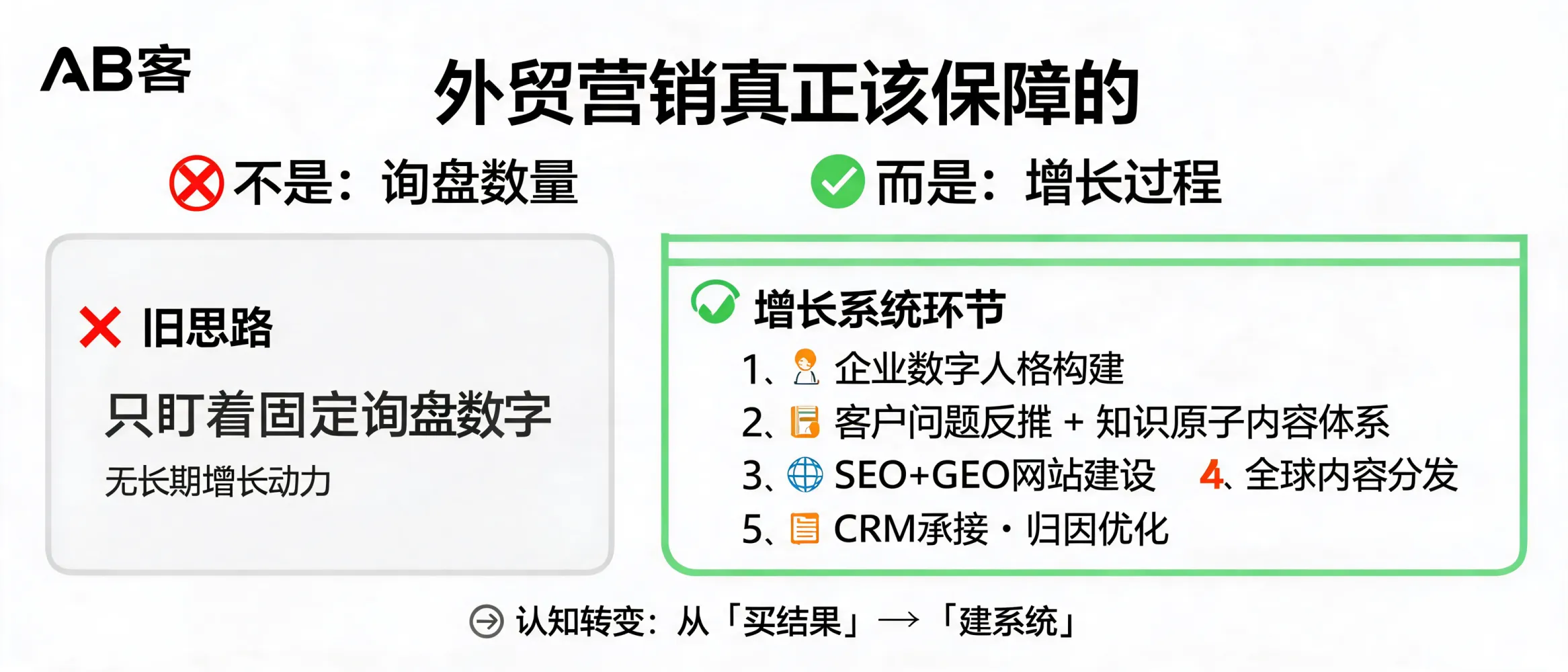
In foreign trade B2B marketing, many companies still evaluate results by a single question: how many inquiries did we get? That metric matters, but it does not explain whether growth is stable, repeatable, or improving over time. For manufacturers, engineering suppliers, custom-product exporters, and other businesses with long decision cycles, inquiry volume alone is too narrow to judge real marketing quality.
What marketing should really guarantee is a repeatable growth process: a process that helps the market understand who you are, helps AI systems interpret and trust your business correctly, helps potential buyers find relevant answers at the right stage, and helps your team capture, follow up, and optimize demand with evidence rather than guesswork.
This is the core logic behind the ABKE foreign trade GEO solution: not promising a fixed number of leads, but building the infrastructure that makes foreign trade marketing understandable, trustworthy, measurable, and continuously improvable in AI search and modern B2B buying journeys.
Why inquiry volume is not a reliable guarantee
Inquiry counts are outcomes, but they are not the full system. A campaign may generate inquiries for a short period and still leave the company with weak positioning, poor lead quality, low close rates, fragmented content, or no long-term digital assets. In that case, the business is still dependent on unstable traffic and manual effort.
In AI-driven discovery, buyers increasingly ask tools such as ChatGPT, Gemini, Perplexity, DeepSeek, and other large language model interfaces to summarize suppliers, compare options, explain standards, and recommend solutions. That changes the path from simple keyword ranking to a more complex process:
Search keyword → visit pages → compare manually → decide
Ask AI → receive synthesized answers → trust recommended sources → shortlist suppliers
If your company cannot be clearly interpreted inside that new path, inquiry volume becomes inconsistent by default. The real question is not only whether traffic exists, but whether your business is structurally ready to be discovered, understood, cited, and selected.
What a repeatable growth process actually includes
A repeatable growth process is a connected system. It should not depend on isolated campaigns or one-time content bursts. It should give the company a consistent way to turn expertise into visibility, visibility into trust, and trust into qualified business opportunities.
| Core layer | What it should guarantee | Why it matters |
|---|---|---|
| Digital identity | A clear, structured explanation of who the company is, what it does, where it fits, and why it is credible | AI systems and buyers need a stable understanding of the business |
| Customer-question mapping | Content topics aligned with real buyer questions, decision paths, and comparison logic | Prevents content waste and improves relevance in AI search |
| Knowledge-atom content | Reusable facts, definitions, methods, evidence, and explanations that AI can parse and cite | Supports consistency, scalability, and machine understanding |
| SEO + GEO website | A website structured for both search indexing and AI interpretation | Your site becomes both a ranking asset and an answer asset |
| Global distribution | Content presence across channels and formats that can enter broader data ecosystems | Improves discoverability and reference potential beyond a single domain |
| CRM and attribution | A way to capture leads, follow buying stages, and optimize based on evidence | Turns marketing from activity-based work into process-based improvement |
From lead promise to growth system
The weakness of “lead promise” thinking is that it treats marketing as a purchase of uncertain output. The weakness of “repeatable growth process” thinking is much smaller, because it focuses on controllable foundations. ABKE approaches foreign trade GEO from that second perspective.
1. Make the company understandable
Build a digital identity that explains positioning, products, capabilities, cooperation logic, industry context, and trust evidence in a structured, machine-readable way.
2. Make the content answerable
Use buyer-question logic, FAQ structures, and knowledge atoms to create content that reflects how real customers ask, compare, and decide.
3. Make the website interpretable
Use an SEO + GEO website structure so that both search engines and AI systems can understand the hierarchy, meaning, and evidence inside each page.
4. Make optimization measurable
Connect distribution, CRM capture, and attribution analysis so marketing can be improved through signals, not assumptions.
How the ABKE foreign trade GEO solution supports this process
The ABKE foreign trade GEO solution is designed for companies that need more than isolated content writing or a visually updated website. It is a system for building AI search readiness and foreign trade digital growth capacity around one principle: help the business move from being hard for AI to identify, to becoming understandable, trustworthy, and recommendable.
The three practical questions GEO must solve
- Can AI correctly understand who your company is and what it actually offers?
- Can AI recognize enough expertise and evidence to treat your company as credible?
- Can your business appear as a relevant recommendation when buyers ask solution-oriented questions?
To support those outcomes, the solution combines several interdependent components rather than treating foreign trade marketing as one channel or one deliverable.
- Digital identity for B2B exporters: structured company knowledge that clarifies positioning, capabilities, application scenarios, standards, cooperation model, and trust basis.
- Customer-question-driven planning: content strategy built around what buyers actually ask, not around generic topic ideas.
- FAQ and knowledge-atom content: modular information units such as definitions, facts, principles, methods, and evidence that can be reused across pages and formats.
- SEO + GEO website construction: a website that serves both indexing and AI interpretation, giving content a stable semantic structure.
- Global content distribution: broader placement of structured content to strengthen discoverability and relevance across international digital environments.
- CRM capture and follow-up logic: making sure traffic and attention can become traceable leads and managed opportunities.
- Attribution-based optimization: learning which content, channels, and themes contribute to visibility, inquiry quality, and business movement.
Why knowledge-atom content matters in AI search
One of the biggest shifts in modern foreign trade marketing is that large language models do not interact with websites the same way humans do. Buyers may still read pages in depth, but AI systems first try to identify meaning, relations, facts, and credibility signals. That is why knowledge-atom content has become important.
A knowledge atom is not just a paragraph. It is a small, clear unit of meaning that can support AI understanding and content reuse. Examples include:
- A definition of a product category or technical concept
- A factual statement about process, compatibility, or application scope
- A method explanation describing how something is selected, produced, tested, or delivered
- An evidence unit connected to standards, procedures, reports, or capability descriptions
- An FAQ answer mapped to a real buyer concern in procurement or technical evaluation
When a foreign trade company organizes its expertise into structured knowledge atoms, it becomes easier to build consistent pages, multilingual content, AI-friendly answers, and long-term digital assets from the same source of truth.
What the process looks like in practice
Step 1: Clarify growth direction
Define strategic priorities, target markets, business strengths, and realistic growth logic before scaling content.
Step 2: Build digital identity
Turn company information into structured knowledge that AI and buyers can interpret consistently.
Step 3: Map real customer questions
Reverse-engineer buyer concerns, decision points, and search intent to guide topic selection.
Step 4: Create structured content assets
Develop FAQ content, product explanations, expert pages, and knowledge atoms that can support both search and AI citation.
Step 5: Deploy on an SEO + GEO website
Organize content into an AI-friendly site architecture that is readable, crawlable, and conversion-aware.
Step 6: Distribute, capture, and optimize
Expand content reach, connect inquiries to CRM workflows, and improve based on attribution signals and performance evidence.
Who this approach fits best
High-fit situations
- Foreign trade B2B companies selling equipment, engineering services, industrial components, or custom products
- Businesses with long decision cycles and multiple evaluation steps
- Companies that already have a website but lack clear performance logic
- Teams that want long-term brand and demand assets, not only short-term traffic spikes
- Organizations serving multilingual global markets
Important boundaries
- It is not a shortcut for companies with no real product capability or differentiation
- It is not designed for teams that only want immediate ROI without process building
- It requires cooperation, source materials, and ongoing operational discipline
- It is less suitable for pure price-war models or low-value fast-moving products
A better standard for evaluating foreign trade marketing
A strong foreign trade marketing system should be judged by whether it creates a process the business can keep using, improving, and scaling. That means asking practical questions:
- Does the company have a clear digital identity for B2B buyers and AI systems?
- Is content built from real customer-question mapping rather than random topic production?
- Are FAQ assets and knowledge-atom content organized for reuse and machine understanding?
- Does the website support both SEO visibility and GEO interpretation?
- Can the team connect distribution, CRM follow-up, and attribution-based optimization?
- Is the whole process becoming more repeatable over time?
If the answer is yes, inquiry volume stops being a random outcome and starts becoming the result of a system. That is the standard ABKE advocates through its foreign trade GEO solution: not marketing judged only by lead counts, but marketing built as a verifiable, optimizable, and repeatable growth process for the AI search era.
.png?x-oss-process=image/resize,h_100,m_lfit/format,webp)
.png?x-oss-process=image/resize,h_100,m_lfit/format,webp)

.png?x-oss-process=image/resize,h_100,m_lfit/format,webp)
.png?x-oss-process=image/resize,h_100,m_lfit/format,webp)
.png?x-oss-process=image/resize,h_100,m_lfit/format,webp)
.png?x-oss-process=image/resize,h_100,m_lfit/format,webp)
