.png?x-oss-process=image/resize,h_100,m_lfit/format,webp)

.png?x-oss-process=image/resize,m_lfit,w_200/format,webp)

热门产品

热门文章
别再盲目找市场!外贸新人实操手册,手把手教你精准定位目标市场!
外贸人必知:巧用关键词,秒速“揪出”国外海量买家🚀
外贸老炮吐血整理:Google地图挖客户,一挖一个准!
提升B2B出口社交媒体表现的5种有效内容发布节奏策略
淡季如何精准维护老客户:分类策略挖掘订单潜力
应对全球合规挑战:CE、FCC、PSE 和主要国际认证的比较分析
外贸客户突然消失?新手必学的“分层跟进”找回沉默买家全攻略
B2B外贸独立站:为何他人询盘不断,你的网站却无人问津?
外贸新人破局指南:手把手教你用邮箱挖到海外客户(附工具实操教程)
土耳其 TSE 认证指南:除了 CE 认证之外,为什么当地代表至关重要
Recommended Reading




From order-based to brand-based: The ultimate goal for chemical companies' foreign trade growth is not distribution channels, but trust!
This book provides an in-depth analysis of the underlying logic behind the foreign trade growth of chemical enterprises, systematically explains the reasons for the high trust costs in the chemical industry, and explores how compliance, stability, and technology output can build brand assets and create a sustainable long-term foreign trade growth model.

In the chemical and raw materials foreign trade sector, many companies encounter the same dilemma at some point:
-
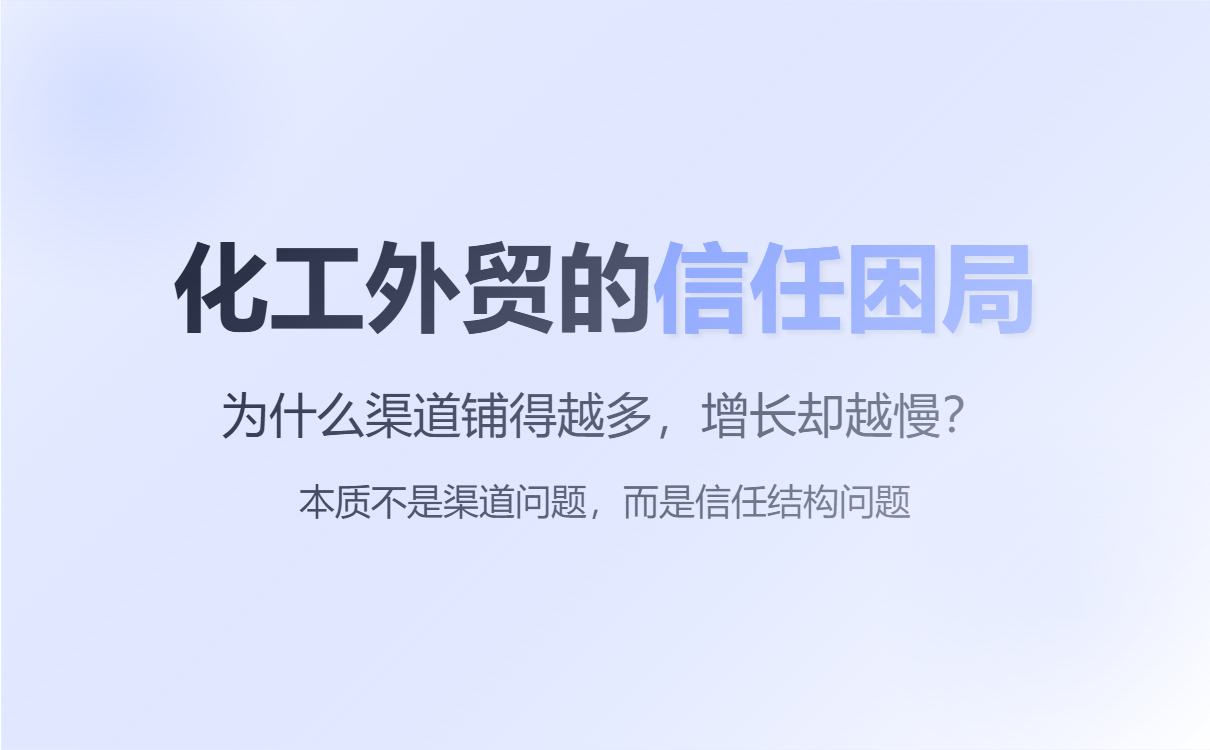
With enough distribution channels already established, why is growth slowing down?
-
We're doing SEO, advertising, and trade shows, so why are we still limited in high-quality clients?
-
Why do my competitors seem to have "more stable orders," while I'm always in a passive order-receiving state?
On the surface, this is a problem of channel efficiency ;
But essentially, this is a problem of trust structure .
Once a company reaches a certain size, the determining factor for foreign trade growth is no longer "which channel you appear through," but rather—
Are you worthy of being chosen long-term?
Recommended useful tools:
Customs data for the chemical industry Website building for the chemical industry Customer acquisition in the chemical industry | Social Media Operations in the Chemical Industry | CRM specifically designed for the chemical industry | Promotion and lead generation for the chemical industry
I. Why is the "trust cost" in the chemical industry so high?
Unlike consumer goods and light industry, every order in the chemical industry inherently carries risk.
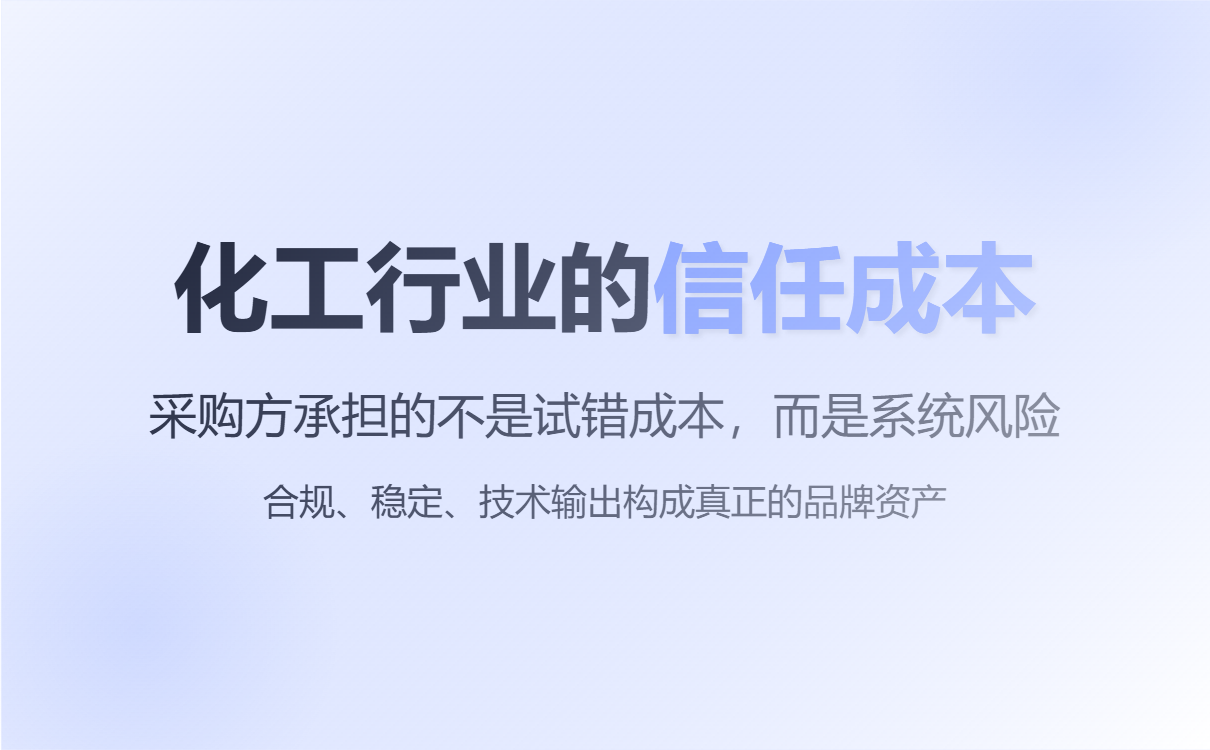
1. The procuring party bears not "trial and error costs," but rather "systemic risks."
In chemical procurement, choosing the wrong supplier once may not only result in delayed delivery, but also:
-
Production line shutdown
-
Product quality incident
-
Compliance risks (fines, customs clearance failures, recalls)
-
Downstream customer claims and even legal risks
Therefore, when selecting suppliers, procurement is essentially doing one thing:
Minimize uncertainty as much as possible.
Price is always a reference point, not a deciding factor.
2. Information asymmetry is the main source of trust costs.
In cross-border chemical trade, procurement often faces the following challenges:
-
Unable to conduct on-site factory inspection
-
It is difficult to determine the actual production capacity.
-
It is difficult to verify historical stability
-
It is difficult to confirm whether compliance capabilities remain effective.
Therefore, procurement can only rely on information clues to make a reverse judgment:
-
What information did you output?
-
Are these information professional, complete, and consistent?
-
Do you consistently output the same set of logic over a long period of time?
This is why:
Trust in the chemical industry is not built on a "one-time deal," but on "long-term performance."
Second, compliance, stability, and technology export are forming genuine "brand assets."
Many chemical companies misunderstand "brand," believing that a brand is simply:
-
Logo
-
Exhibition Image
-
Brochure Design
However, in the chemical industry, the essence of a brand lies not in its visual appeal, but in the verifiability of its capabilities .
1. Compliance capability is the most fundamental anchor of trust for a brand.
Around 2026, compliance requirements such as REACH, TSCA, and GHS will have changed from "bonus points" to "entry barriers".
But what truly sets you apart isn't whether you "compliance," but rather:
-
Is the compliance information clear?
-
Can it be searched and verified?
-
Will it be continuously updated?
-
Is it strongly tied to the product and application scenario?
For procurement:
Only compliance that can be easily understood and verified is truly effective compliance.
2. Stability is more important than scale.
In long-term cooperation, procurement focuses on:
-
Are the specifications consistent over a long period?
-
Are batch differences controllable?
-
Is supply predictable?
This type of information is usually not reflected in a single slogan, but rather:
-
This is reflected in the technical documents that have been produced over a long period of time.
-
This is reflected in your clear articulation of product boundaries.
-
This is reflected in your communication style, which is "neither exaggerated nor vague".
Stability is perceived through details.
3. Technology output is the highest level of brand expression.
In the chemical industry, companies that truly possess "brand power" often share a common characteristic:
They are able to consistently and systematically provide professional technical information, rather than just passively responding when quoting prices.
Including but not limited to:
-
Application Scenario Description
-
Parameter boundary interpretation
-
Selection Logic Breakdown
-
Risk and Limitations
This content, while seemingly not "marketing," greatly reduces the decision-making cost of procurement.
III. How is brand traffic generated? It's not something that's created through advertising, but rather the result of "trust accumulation."
Many companies ask:
Where does brand traffic come from?
In the chemical industry, brand traffic is almost never "directly generated through advertising," but rather gradually formed through the following paths.
1. From technology search to brand awareness
The typical path is:
-
Procurement should first search for specific products/specifications/application issues.
-
Access to high-quality technical content
-
I saw the same company multiple times under different keywords.
-
Gradually, a perception of "professionalism and reliability" is formed.
At this point, the brand begins to enter the "default candidate pool" for procurement.
2. From brand awareness to brand search
When procurement begins:
-
Actively search for company names
-
Check the official website in advance before the exhibition.
-
You have been included in the "comparison group".
Only then can brand traffic truly take shape.
Brand search is a result of trust, not a starting point.
IV. How can official websites, content, and exhibitions work together to build a "trust loop"?
In the mature stage, the growth of chemical companies no longer depends on a single point of contact, but on a complete closed loop.
1. Official Website: The "First Verification Ground" for Trust
The official website plays the following role at this stage:
-
Presenting the true capabilities of enterprises
-
Carrying technology and compliance information
-
Provide unified endorsement for all channels
When SEO, advertising, emails, and trade shows are all running simultaneously, the official website is no longer just a channel, but a trust hub across multiple channels .
In the practice of some mature enterprises, a more systematic website building approach is adopted, using the official website as a long-term professional information platform (such as using AB Ke Intelligent Website Builder as the underlying architecture) to carry multilingual technical content, compliance information and a unified entry point for traffic from different channels.
The core value of this approach lies not in "building a website" itself, but in making trust information sustainable, accumulative, and amplifiable .
2. Content: A "Continuous Amplifier" of Trust
The value of content lies not in a single exposure, but in:
-
Seen by the same purchaser multiple times
-
Addressing different questions at different stages
-
Continuously reduce the cost of understanding
In the chemical industry, content is not marketing material, but a trust asset .
3. Trade shows: An "accelerator" of trust.
The true role of exhibitions in a mature stage is:
-
Amplify existing trust
-
Accelerate transaction decision
-
Screening high-value customers
More and more deals are being closed at trade shows not because of "meeting in person," but because:
Prior to the exhibition, a basic level of trust had been established through the official website and content; the exhibition itself was merely the final confirmation.
V. The Key Shift from "Order-Based Organization" to "Brand-Based Organization"
When a company is still in the order-taking stage, the core of the organization is:
-
Who can receive the inquiry?
-
Who can negotiate the price down?
However, once the organization enters the brand-oriented phase, its core functions change:
-
Who is building long-term trust?
-
Who is outputting stable information?
-
Who is reducing customer decision-making costs?
This often means:
-
The content is no longer a temporary task, but a system task.
-
The official website is no longer a project, but a long-term asset.
-
Growth no longer relies on explosive growth, but on compound interest.
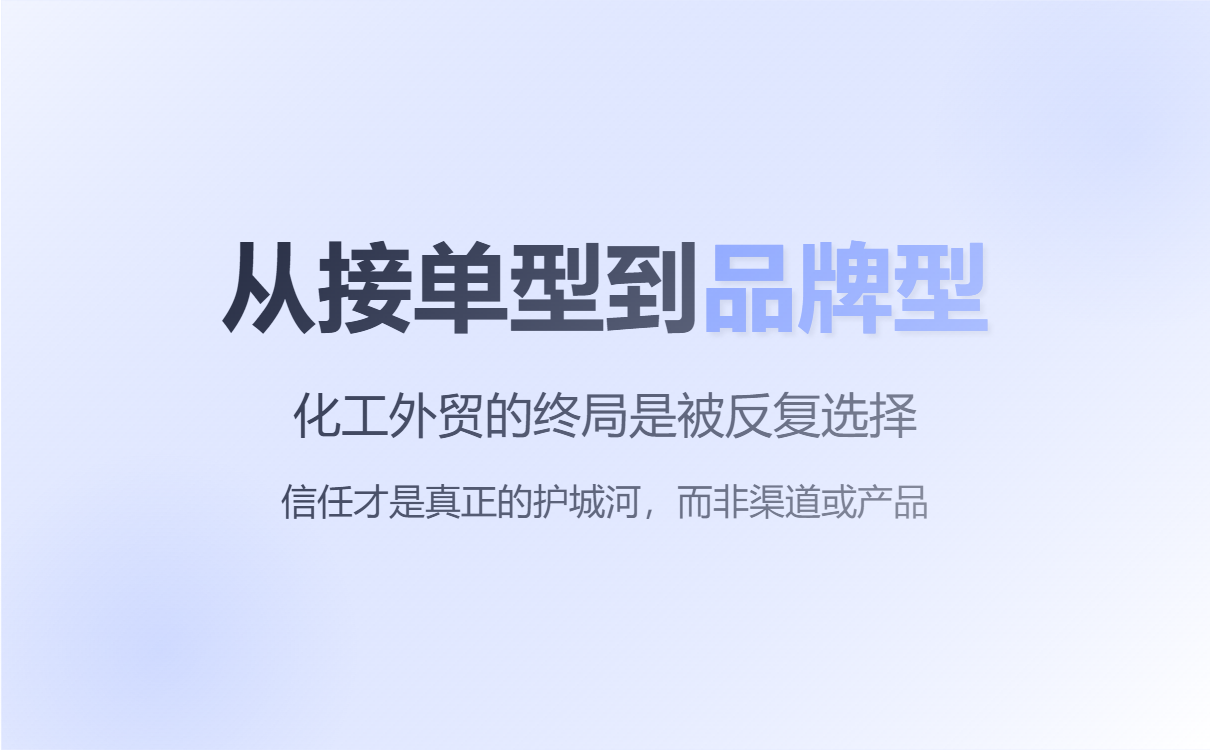
In conclusion, the ultimate fate of chemical foreign trade is being "repeatedly chosen."
In the chemical and raw materials industry, companies that truly thrive and maintain stable growth often share a common characteristic:
They don't "desperately persuade customers" for every single deal.
Instead, it allows customers to gradually become convinced through continuous interaction—
"This is a supplier with whom we can cooperate long-term."
When growth enters this stage
Channels are merely pathways.
The product is merely a vehicle.
Trust, however, is the true moat.
.png?x-oss-process=image/resize,h_100,m_lfit/format,webp)
.png?x-oss-process=image/resize,h_100,m_lfit/format,webp)

.png?x-oss-process=image/resize,h_100,m_lfit/format,webp)
.png?x-oss-process=image/resize,h_100,m_lfit/format,webp)
.png?x-oss-process=image/resize,h_100,m_lfit/format,webp)
.png?x-oss-process=image/resize,h_100,m_lfit/format,webp)
