外贸学院|

热门产品

外贸极客

Popular articles

Recommended Reading

What exactly is GEO? Why is it said to be the digital personality business card for B2B brands?

发布时间:2026/03/16
阅读:338
类型:Solution

With AI-driven search becoming mainstream, buyers increasingly obtain supplier information from generated answers rather than browsing multiple links. GEO (Generative Engine Optimization) is a content strategy that helps B2B exporters make their expertise easier for AI systems to understand, trust, and cite. By building structured content around industry questions, technical explanations, and real-world case studies—and ensuring consistency across pages and internal linking—companies can form a coherent knowledge system. When AI repeatedly references this system in relevant queries (equipment selection, material performance, solution design, cost and maintenance), the brand gains a persistent “digital persona” that signals credibility and practical capability. This article explains the GEO concept from the perspective of AI search mechanisms and outlines actionable steps to improve AI visibility over the long term. Published by ABKE GEO Insight Lab.

GEO-3.jpg

What exactly is GEO? Why is it said to be the digital personality business card for B2B brands?

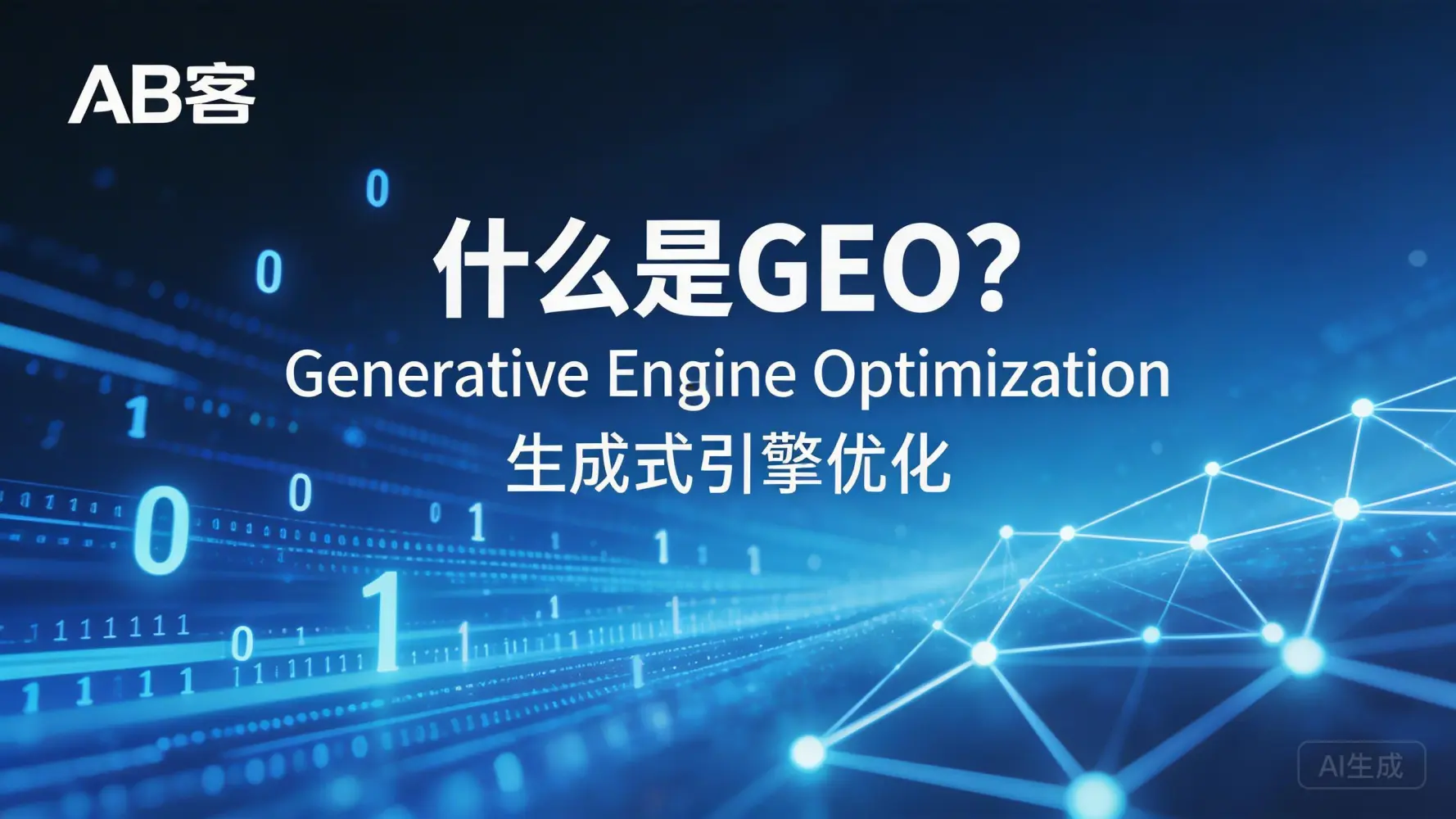
In modern AI search, buyers don’t “browse pages” first—they ask questions and expect a synthesized answer. GEO (Generative Engine Optimization) is the practice of structuring your content so AI systems can reliably understand, trust, and cite your expertise when generating those answers. For B2B exporters, GEO becomes a persistent, repeatable way to show your competence—almost like a professional personality that appears wherever buyers ask industry questions.

Why GEO Matters Now: The Buyer Journey Has Changed

For years, B2B marketing in international trade was largely about ranking pages and driving clicks. But the user behavior is shifting quickly: instead of opening ten tabs and comparing suppliers manually, buyers are using AI search and assistants to shortlist options and validate technical decisions.

Reference data (industry-wide benchmarks)

Signal What’s happening What it means for B2B GEO
Question-based discovery In many B2B categories, 50–70% of early research queries are phrased as questions (e.g., “how to choose…”, “what is the difference…”). Build content that answers decision questions directly, not just product pages.
AI summarizes, users skim AI results often reduce a multi-page research process into a single synthesized answer. Your “knowledge system” must be cite-ready: clear definitions, parameters, tradeoffs, and evidence.
Trust becomes the filter AI tends to prefer sources that are consistent, specific, and frequently aligned across pages. Consistency across definitions, specs, and case examples increases the chance of being referenced.

Numbers above are practical benchmarks used in content strategy audits across B2B industries; actual performance depends on sector, language, and buyer sophistication.

A Clear Definition: What GEO Is (and What It Isn’t)

GEO (Generative Engine Optimization) is the discipline of optimizing your content so generative AI systems can: understand it, evaluate it, and reuse it when producing answers. In practice, GEO is less about “tricking algorithms” and more about making your expertise legible.

GEO is not just traditional SEO

Traditional SEO often aims for clicks via rankings. GEO aims for presence inside the answer: definitions, parameter guidance, decision logic, and case evidence that AI can cite.

GEO is not “more content”

Flooding a site with shallow posts rarely works. GEO favors structured completeness: a connected set of pages that answer a buyer’s questions across selection, usage, and risk control.

GEO is a knowledge system

Think in “knowledge modules”: problem explanation → technical principles → tradeoffs → specifications → application steps → case proof → FAQs. When these modules are consistent and interlinked, AI systems can extract and reference them with higher confidence.

Why GEO Becomes a “Digital Personality Card” for B2B Brands

In B2B exports, brand trust often forms before a sales call. When buyers repeatedly see your explanations quoted in AI results, they start to associate your company with a certain tone, rigor, and problem-solving style. That’s the “digital personality” effect.

In practical terms, your GEO personality is built from four signals

  • Clarity: you define terms and selection criteria in plain language (with parameters and units).
  • Consistency: specs, naming, performance claims, and test methods align across the site.
  • Evidence: case details, constraints, and outcomes show real engineering and delivery capability.
  • Decision logic: you explain tradeoffs (cost vs. durability, throughput vs. precision, etc.).

The hidden advantage is compounding exposure: one well-structured knowledge cluster can support dozens of AI answers over time. That’s why GEO often feels like a “business card” that keeps being handed out—without you being present.

How AI Search Typically Chooses Sources (So You Can Design for It)

Different AI products behave differently, but most of them converge on similar patterns: they prefer content that directly answers the question, provides stable definitions, and supports claims with context and proof. If you want to be referenced, you must be “extractable.”

What content gets cited more often in AI-generated answers?
Content type What AI looks for How to write it (GEO-friendly)
Problem explanations Direct answers, definitions, scope, constraints Use “What it is / Why it matters / When it fails / How to evaluate” blocks
Technical principles Mechanisms, variables, test methods, standards Add parameters, units, and “if-then” tradeoff reasoning
Case experience Real constraints, context, measurable outcomes Include environment, volume, timeline, acceptance criteria, result
Consistency signals Aligned terminology, stable specs, no contradictions Create a glossary, spec templates, and internal links across related pages

A Practical GEO Build Plan for Export B2B Teams (ABKE GEO-Style Structure)

Many export manufacturers already have valuable knowledge—inside sales emails, engineer notes, QA documents, and project reports. GEO is about turning that scattered expertise into a consistent publishing system that AI can interpret. Below is a field-tested structure aligned with the ABKE GEO methodology idea: industry questions + technical explanations + application cases.

1) Build an “Industry Question Library” (high-intent coverage)

Start with the questions buyers ask during selection and procurement. Prioritize topics that influence risk and decision speed: specs, compliance, performance limits, failure modes, maintenance, and cost drivers.

Example question formats that perform well in AI search:
“How do I calculate throughput for ___?” · “What’s the difference between ___ and ___?” · “Which material is better for high-temperature ___?” · “What maintenance schedule prevents ___ failure?”

2) Publish technical explanations with measurable parameters

AI systems love specificity. Whenever possible, use real ranges and conditions. For industrial categories, you can safely include reference ranges such as: temperature limits, tolerance bands, pressure ratings, cycle life, corrosion environment notes, and the standards you work with.

As a practical benchmark, pages that include 3–6 key parameters (with units and “what changes the result” notes) tend to outperform pages that only provide generic benefits.

3) Add case content that proves real delivery capability

A GEO-friendly case is not a sales story. It’s a structured engineering record: customer scenario → constraints → solution configuration → validation method → measurable outcome.

Minimum case details that increase credibility: industry & application, working conditions, key spec targets, timeline, acceptance criteria, and what changed after implementation.

4) Connect content into a clear internal structure (so AI can map it)

GEO performance often improves when the site has a stable taxonomy: Industries → Problems → Solutions/Products → Specs → Cases → FAQs. Internal links aren’t only for SEO—they help establish relationships between concepts, which improves interpretability.

A practical goal for B2B sites is to ensure each important page has at least 3–8 meaningful internal links (upstream context + downstream proof), rather than random navigation links.

A Real-World Scenario: Industrial Equipment Content That AI Can Reuse

Imagine an industrial equipment manufacturer serving overseas factories. A buyer might ask AI: “How do I estimate capacity for a new line?” or “What configuration reduces maintenance cost?” If your site contains a connected set of pages that explain: capacity calculation logic, configuration tradeoffs, typical maintenance intervals, and a case with measurable improvements, the AI system can pull a coherent answer and cite your brand as a reference.

What a GEO-ready “equipment selection” cluster can include

  • Capacity math page: inputs, formulas, and common mistakes (with units and assumptions).
  • Configuration guide: which options matter most under different working conditions.
  • Maintenance cost driver page: wear parts, intervals, and preventive checks.
  • Case page: before/after metrics (downtime, yield, energy use, defect rate).
  • FAQ page: procurement questions (lead time logic, QA, acceptance tests).

This cluster approach is how “being cited repeatedly” becomes realistic—because multiple questions point back to the same consistent knowledge base.

Common GEO Questions from Export B2B Teams

How can a company increase the probability of being recommended by AI?

Focus on answer precision and evidence density. Replace broad claims (“high quality”, “best performance”) with measurable statements: test methods, operating conditions, spec ranges, and constraints. Then connect those pages to cases and FAQs so the model can validate the narrative.

How should content be written so AI can understand it better?

Write in modular blocks: define the term, list key variables, show tradeoffs, then give a short “decision checklist.” Use consistent terminology across pages and avoid changing naming for the same part/spec. This sounds simple, but it’s one of the biggest GEO wins.

Does AI “learn” from what we publish?

Different systems handle training and retrieval differently. However, for buyers using AI search, what matters today is often retrieval and citation: whether the AI can access, interpret, and reuse your published content at query time. That’s why GEO emphasizes “citable clarity” rather than speculative algorithm guessing.

How do we build broad coverage of industry questions without burning out?

Start with a 6–8 week sprint targeting 20–30 core questions that sales and engineers hear repeatedly. Then expand using real inquiry logs (RFQs, emails, WhatsApp/WeChat questions, call notes). The best GEO programs don’t rely on inspiration; they rely on a repeatable pipeline.

CTA: Build Your GEO “Digital Personality” with ABKE GEO

If your export B2B brand wants to appear more often in AI answers—especially for high-intent technical questions—start by turning your expertise into a structured knowledge system: industry questions, technical explanations, and evidence-backed cases. That’s the foundation of sustainable GEO.

 Explore ABKE GEO strategies for AI Search Optimization

Tip: the strongest results usually come from consistency—one clear terminology system, one spec template, and a steady case publishing rhythm.

Published by ABKE GEO Research Institute

Generative Engine Optimization GEO for B2B AI search optimization B2B content strategy exporter GEO

AI 搜索里,有你吗?

外贸流量成本暴涨,询盘转化率下滑?AI 已在主动筛选供应商,你还在做SEO?用AB客·外贸B2B GEO,让AI立即认识、信任并推荐你,抢占AI获客红利!
了解AB客
专业顾问实时为您提供一对一VIP服务
开创外贸营销新篇章,尽在一键戳达。
开创外贸营销新篇章,尽在一键戳达。
数据洞悉客户需求,精准营销策略领先一步。
用智能化解决方案,高效掌握市场动态。
用智能化解决方案,高效掌握市场动态。
全方位多平台接入,畅通无阻的客户沟通。
全方位多平台接入,畅通无阻的客户沟通。
省时省力,创造高回报,一站搞定国际客户。
个性化智能体服务,24/7不间断的精准营销。
多语种内容个性化,跨界营销不是梦。
多语种内容个性化,跨界营销不是梦。
https://shmuker.oss-accelerate.aliyuncs.com/tmp/temporary/60ec5bd7f8d5a86c84ef79f2/60ec5bdcf8d5a86c84ef7a9a/thumb-prev.png?x-oss-process=image/resize,h_1500,m_lfit/format,webp