.png?x-oss-process=image/resize,h_100,m_lfit/format,webp)

.png?x-oss-process=image/resize,m_lfit,w_200/format,webp)

热门产品

Popular articles
How can companies build a professional image?
Do You Need a Dedicated GEO Team?
Will enterprise certification affect AI recommendations?
Is GEO suitable for small businesses?
How Can Enterprises Build a Brand Signal Network?
How can foreign trade B2B companies establish industry influence?
How can foreign trade B2B companies improve their industry recognition?
Is GEO easily copied by competitors?
How can businesses build customer trust?
Does GEO have any data security issues?
Recommended Reading





New term in the foreign trade circle in 2026: GEO: Is it a life-saving medicine or a way to fleece people?
The Generative Engine Optimization (GEO) that was hotly debated in the foreign trade industry in 2026 is not a "quick traffic code," nor is it equivalent to keyword stuffing in traditional SEO. As AI search shifts from "link lists" to "directly generated answers," B2B foreign trade companies seeking exposure through AI recommendations and citations need to provide clearly structured, highly credible industry content and brand signals that can be integrated into the model. This article starts with the content selection, credibility assessment, and knowledge integration mechanisms of AI search, outlining the applicable scenarios and implementation paths for GEO. Combining the ABke GEO methodology, it provides practical suggestions on content system construction, case studies, and qualification improvement to help companies acquire AI traffic and potential customer leads through a long-term content strategy.

New term in the foreign trade circle in 2026: GEO: Is it a life-saving medicine or a way to fleece people?
Let me be clear from the start: GEO is not a "traffic booster," nor is it just a gimmick.
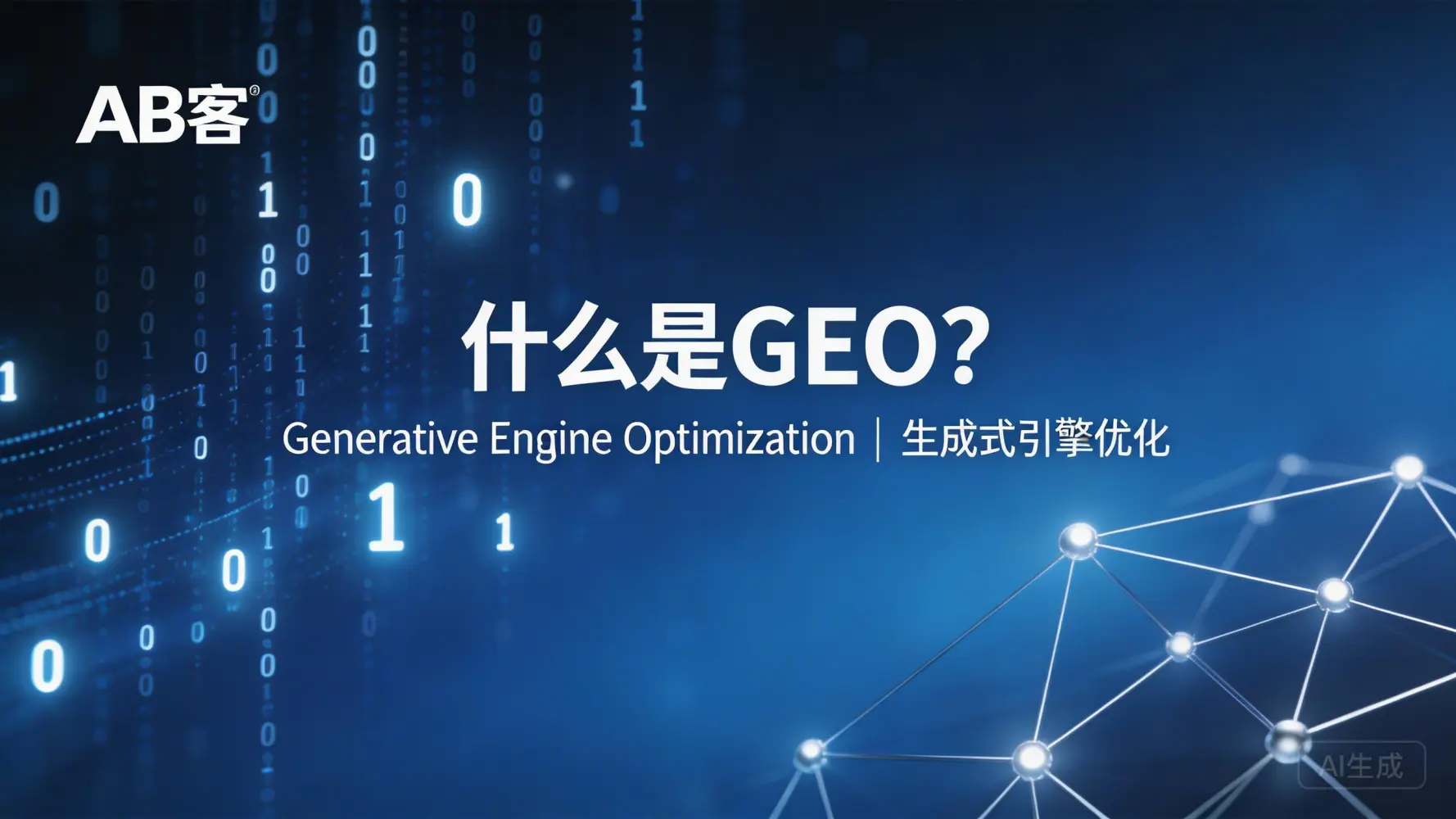
In 2026, "GEO (Generative Engine Optimization)" was a hot topic in the foreign trade industry: some touted it as the ultimate weapon to replace SEO , while others saw it as another way to exploit consumers . A more accurate conclusion is that GEO is essentially a content and brand signal building method that makes it easier for a company's content to be selected, cited, and recommended by AI search/generative engines .
If you expect to "get a surge in orders after writing three articles", GEO will likely disappoint you; however, if you are willing to treat it as a long-term B2B customer acquisition asset , it may indeed become a new entry point in addition to SEO, exhibitions, platforms, and advertising.
Why are foreign trade B2B companies suddenly focusing on GEO in 2026?
The change isn't in the "concept," but in how the path buyers take to find information has been rewritten. Traditional search is more like a "list-based shopping guide," while AI search is more like "directly providing conclusions with citations." When a buyer asks, "Which supplier is suitable for CNC spare parts with ISO certification and small MOQ?" AI often provides suggestions first, followed by the sources of evidence. What foreign trade companies need to strive for is to be part of that evidence .
Three real pressures that make GEO "look very appealing"
- SEO difficulty has increased: content for the same keyword is highly homogenized, and the cost of backlinks/content is higher.
- Rising campaign costs: In some B2B categories, the cost per click for overseas search ads is typically in the range of $1.5–$8 (the exact figure varies greatly depending on the industry and country).
- Buyers are making decisions more "lazy": they prefer to let AI do the filtering and comparison first, and then look at the official website and inquiries.
Therefore, you will see that more and more foreign trade professionals are using "being cited by AI" as a new exposure indicator - this is not metaphysics, there is an explainable logic behind it.
GEO's underlying principle: Why would AI reference you instead of someone else?
Most generative engines (including AI search) typically go through three stages when answering questions: candidate information collection → credibility assessment → structured integration and output . What GEO does is "increase the probability of being selected" at each stage.
Mechanism 1: Information source filtering (content with a clear structure is easier to crawl)
AI tends to select content that can be "broken down into key points," such as parameter tables, steps, comparisons, FAQs, precautions, applicable conditions, and limitations. Foreign trade B2B is particularly well-suited to writing "engineering knowledge" into reusable modules, making it easier for AI to reference.
Mechanism 2: Credibility Assessment (Brand Signals and Chain of Evidence)
AI tends to favor sources with a chain of evidence : company qualifications, certifications (such as ISO/CE/RoHS), production capacity, testing processes, customer case studies, specific application environments, and verifiable images and data. Experience shows that B2B websites that clearly explain "who the company is, what it can do, and what it has done" are significantly more likely to be cited.
Mechanism 3: Knowledge Integration (Is your content "combinable"?)
AI responses don't simply copy and paste; they piece together multiple sources into something that sounds more like a human. Your content is more likely to become a piece of that puzzle if it includes standard definitions, boundary conditions, comparative conclusions, and actionable suggestions .
GEO vs SEO: What are the essential differences?
Many debates stem from applying old standards to new things. GEO isn't negating SEO, but rather expanding the goal from "ranking" to "being cited and recommended." For B2B foreign trade, the two are more like an overlapping relationship : SEO solves the problem of being found, while GEO solves the problem of being selected and mentioned by AI.
The most worthwhile GEO scenario for foreign trade B2B: Deducing content from "buyer questions"
GEO dislikes "self-indulgent content" and loves "problem-oriented content." We suggest you break down frequently asked buyer questions into a content matrix based on the decision-making chain, prioritizing questions with high intent, high reusability, and standardization.
Recommended topic list (applicable to B2B foreign trade)
- Selection Guide: How to choose the right product for different materials, working conditions, and precision requirements? What are the common mistakes?
- Comparison and Substitution: Material A vs. Material B; Process A vs. Process B; How can an older model replace a newer model?
- Compliance and Certification: Which markets require which certificates? What is the testing process? How to prepare the necessary documents?
- Cost and Delivery Time Explanation: How do MOQ, molds, tooling, inspection, and packaging affect delivery time and cost structure?
- Case Review: Client Background—Problem—Solution—Result (Provide quantifiable data whenever possible)
Based on some B2B content practice data: In industrial products/equipment websites, structured FAQs and selection guides tend to generate longer dwell time (commonly 20%–60% increase) and higher inquiry conversion rates (commonly 10%–30% increase) than "company news" pages, because they directly address decision-making issues (the specific increase varies depending on the industry and page quality).
AB Guest GEO Methodology: Making content sound like it's being spoken by a reliable person in the industry.
Truly effective GEOs don't focus on word count; they focus on making content verifiable, citationable, and reusable . Adapting to the practicalities of B2B foreign trade, ABke's GEO emphasizes "industry-specific expression" and "evidence chain building," helping companies transform their websites and content centers into databases that AI is more likely to cite.
1) Start with the buyer's question database: First cover "high-intent questions"
From the perspective of foreign trade inquiry channels, high-intent questions typically arise in the following areas: specification confirmation, application matching, certification compliance, quality control, delivery time and capacity, and alternative solutions. Writing a thorough explanation of these issues is more likely to be cited than a general "product introduction."
2) Chain of evidence writing: Transform "I am fine" into "I have evidence".
It is recommended that each article include at least two types of evidence: process evidence (inspection/process/quality control steps) and result evidence (error range, yield, lifespan, applicable temperature, customer feedback, etc.). For example, in articles about mechanical parts, providing "applicable tolerance range, common failure causes, and testing methods" is more persuasive than simply piling up adjectives.
3) Structured output: Allowing AI to see the key points at a glance.
Use clear hierarchical structures (H2/H3), lists, tables, FAQs, comparisons of conclusions, and boundary conditions to reduce "long paragraph stacking." For AI, this type of content is more like "callable knowledge blocks"; for buyers, it saves time.
A more realistic example: From "being cited" to "generating inquiries"
After AI search became popular, a foreign trade machinery and equipment company did not rush to chase the hot keywords. Instead, it spent three months building its content foundation: continuously publishing equipment selection guides , technical Q&A , customer application cases , and simultaneously supplementing the website with qualification and production line information.
What they did right wasn't "writing," but "writing in a way that can be cited."
- Each selection article includes: applicable scenarios, key parameters, common pitfalls, alternative solutions, and FAQs.
- Case studies should be written in the format of "background - problem - solution - result" and provide publicly available quantitative indicators (such as yield, cycle time, and reduction in downtime).
- The company page includes supplementary information such as certifications, a list of testing equipment, delivery capabilities, a quality inspection flowchart, and explanations of common trade terms.
As the company accumulated content, some of its pages began appearing in the reference sources of AI search results, the frequency of brand keyword mentions increased, and inquiries more frequently included statements such as "I saw your solutions in AI answers/AI recommended your solutions." For B2B businesses, this "trust from recommendations" is often more valuable than a single click.
Avoid these pitfalls: Which GEO "tricks" are more like paying tuition?
GEO is easily misunderstood because it resembles SEO, but it's not based on the logic of "just boost your ranking." The following practices may seem impressive in the short term, but they can easily backfire on your brand in the long run:
- They only pile up concepts without providing evidence: all they say is "leading, professional, and high-quality," without any processes, parameters, standards, or case studies.
- Chasing trending topics without addressing the underlying issues: There are many articles about the "GEO/AI boom," but none of your industry-specific questions are answered.
- Fragmented content: Dozens of scattered articles, no selection system, no knowledge map, and even AI can hardly build an authoritative profile of you.
- Overly automated and with too much trace: it reads like a template repetition, buyers don't believe it, and AI doesn't like to use it.
Want to turn GEO into a long-term customer acquisition asset for B2B foreign trade? Here's a more stable path.
If you want a more systematic solution to questions like: how to get your website content used by AI , how to build a sustainable industry knowledge system , and how to convert exposure into inquiries , you can learn more about ABke's GEO solution.
Three simple actions you can start today (anxiety-free version)
There's no need to "rebuild the entire website" right away. For many foreign trade companies, the first step in implementing GEO (Google Origin Expert) is to refine their most critical pages to make them "trustworthy and referable."
- First, establish the company's credibility: certificates, testing capabilities, production capacity, quality inspection processes, and publicly available customer/industry service experience.
- Turn the product page into a "decision-making page": parameter table, application scenarios, selection suggestions, frequently asked questions, packaging, transportation and delivery instructions.
- Create 2–4 pieces of high-intent content per month: reusable topics such as priority selection/comparison/certification/troubleshooting.
.png?x-oss-process=image/resize,h_100,m_lfit/format,webp)
.png?x-oss-process=image/resize,h_100,m_lfit/format,webp)

.png?x-oss-process=image/resize,h_100,m_lfit/format,webp)
.png?x-oss-process=image/resize,h_100,m_lfit/format,webp)
.png?x-oss-process=image/resize,h_100,m_lfit/format,webp)
.png?x-oss-process=image/resize,h_100,m_lfit/format,webp)
