.png?x-oss-process=image/resize,h_100,m_lfit/format,webp)

.png?x-oss-process=image/resize,m_lfit,w_200/format,webp)

热门产品

热门文章
一天一个外贸建站小知识:如何让 AI 推荐你的网站?
如何避免无效线索:海关数据筛查中的 3 个常见陷阱
B2B外贸企业必备:AI客户管家如何提升海外询盘转化率!
外贸人必备:汇率波动下的订单管理实战技巧与避坑全攻略
样品确认后是否能严格按照样品生产?探讨外贸生产的关键
利用人工智能关键词和主题分析工具提升越南语和斯瓦希里语市场的内容精准度
独立站 vs 阿里巴巴国际站:外贸新手该如何选择?
外贸网站必须有哪些版块?(附结构图与内容模板)
外贸人必备:如何用智能工具精准锁定高价值客户?
摆脱阿里巴巴国际站的束缚:B2B网站成功的5个实用策略(附真实案例)
Recommended Reading








Why build a knowledge base and brand website before deploying GEO? A must-read for foreign trade companies.
In the era of AI-driven search, GEO (Generative Engine Optimization) has become a new direction for foreign trade enterprises to acquire customers. However, most companies that directly implement GEO have achieved little success, primarily due to a lack of the infrastructure that AI can understand and trust—a knowledge base and a brand website. This article, through case comparisons, reveals the key logic behind first building a structured knowledge base, upgrading the website to a knowledge hub, and then implementing GEO, which can significantly improve AI citation rates and customer conversion rates.
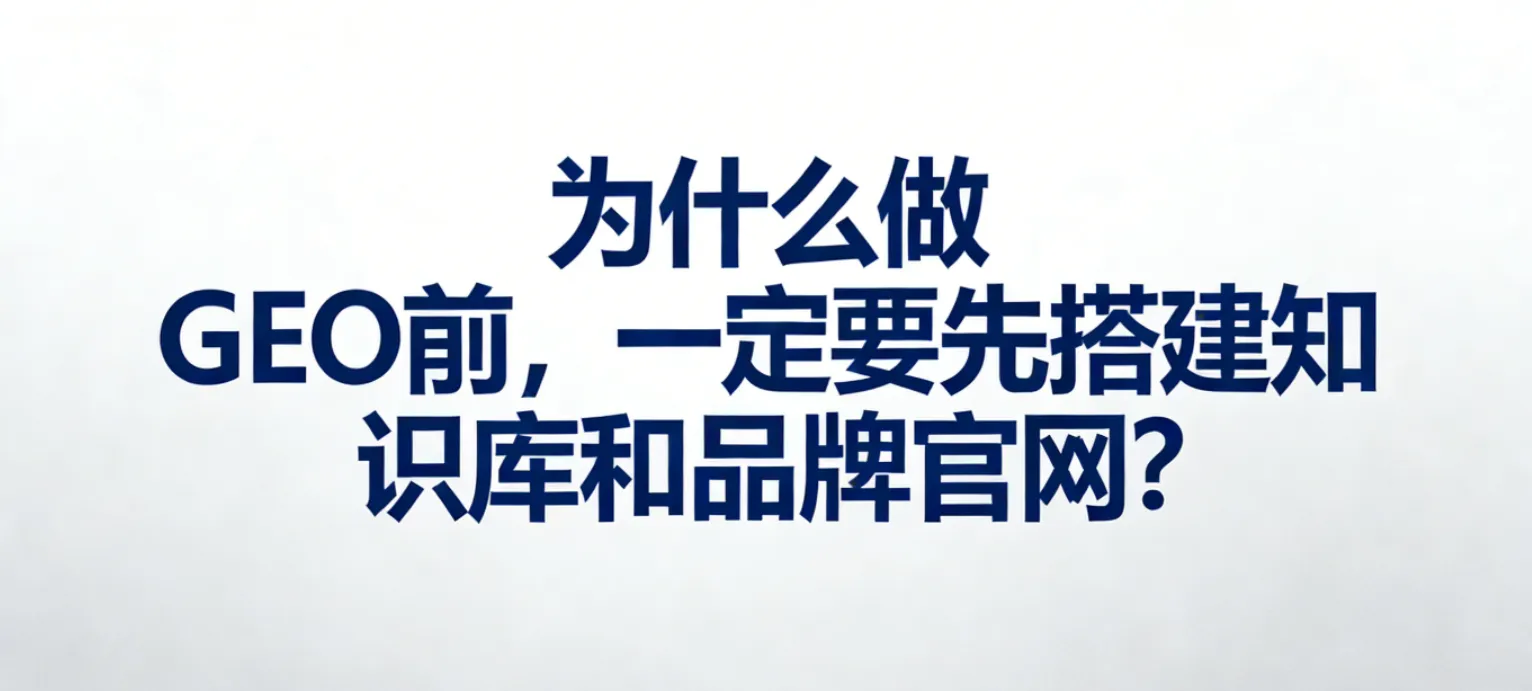
Why is it essential to build a knowledge base and brand website before implementing a GEO strategy?
—The real reason why 90% of foreign trade enterprises are stuck at the starting line of GEO (Geometric Orientation).
Foreign trade business owners, please take note: Customers are no longer "searching for you," but rather asking AI first. Winning isn't about ranking first on Google, but whether AI mentions you in its answers.
In the past two years, more and more foreign trade companies have begun to pay attention to a new term: GEO (Generative Engine Optimization). However, many companies rush to implement GEO right away, only to find a few months later that AI still doesn't mention them, the Q&A is full of "industry-standard answers", and their own website, content, and brand are not considered "credible sources" at all.
So where exactly is the problem? The answer is actually quite simple, but also quite harsh: you haven't even built the infrastructure to "make AI understand who you are."
I. Real-world case studies: Why do some companies achieve drastically different results with GEO?
The following are real-world case studies from AB Customer's clients (anonymized): Two industrial component companies of similar size adopted different strategies in their GEO (Government Optimization) deployment, resulting in drastically different outcomes:
| project | Company A | Company B |
|---|---|---|
| industry | Industrial parts | Industrial parts |
| scale | 50 people | 60 people |
| Product complexity | high | high |
| Initial goal | "Let ChatGPT recommend us" | Tongzuo |
Company A's approach (standard practice for 90% of companies)
- Directly instruct the team to "write more GEO content".
- The brand name was mentioned repeatedly in the blog.
- Use ChatGPT to generate dozens of industry articles
- The website is still a template site from 5 years ago.
- Products, case studies, and solutions are scattered across different pages.
Results after 3 months: The brand name hardly appeared in the AI Q&A, and even when it did, it was only mentioned in an "enumerical" manner, and the quality of customer inquiries did not change significantly.
Company B's approach (laying the foundation first)
The first step is not to write content, but to do three things:
- Reconstructing the enterprise knowledge base : Unifying products, application scenarios, solutions, cases, processes, and FAQs into structured, verifiable knowledge units.
- Upgrade the brand website to a "knowledge hub" : The website is no longer just a display, but an authoritative source that AI can crawl and cite, with a page structure naturally adapted for SEO and GEO.
- Restart GEO layout
Results after 3 months (interim): The frequency of citations in AI Q&A increased by more than 3 times, multiple solution pages were directly cited by AI, and the conversion rate of leads on the official website increased by about 2 times.
Where does the difference lie? It's not in "who is better at writing content," but rather in—who solved the problem of "how AI understands you" first.
II. AI recommendations are not just about how much content you post, but about these three points.
In the era of traditional SEO, the logic was: keywords → page → ranking → clicks. But in the era of AI search/question answering, the logic has changed to: question → judgment → recommendation → explanation.
In the "judgment" stage, AI focuses on three key things:
AI's judgment dimensions and focus
- Who are you : Do you have a clear and stable corporate identity?
- What are your strengths : Do you have complete professional assessment materials?
- Is it credible ? Is the content verifiable, traceable, and sourced?
Here's the problem: Without a unified corporate knowledge base, if the official website is just a "display shell," and if the content sources are scattered and the logic is chaotic, AI simply cannot build a "trust model" for you. This is precisely the root cause of why GEO fails.
III. Why is the "Knowledge Base" the first foundation of GEO?
1. Without a knowledge base, AI doesn't know "who to reference".
When answering questions, AI does not "make things up" on the spot, but prioritizes: clearly structured factual information, cross-verifiable content sources, consistent expression, and a long-term stable knowledge system.
The essence of an enterprise knowledge base is to provide AI with a "standard answer source." In AB's GEO system, the knowledge base is defined as the core layer of GEO, comprising a three-layer structure:
| hierarchy | content | effect |
|---|---|---|
| Level 1 | Brand & Main Products | Establish identity and semantic anchors |
| Level 2 | Solution/Scenario/Case/Process | Professional judgment basis |
| Level 3 | Blog/Article | Search and Training Supplements |
AI must first "understand you" before it can "recommend you".
2. There's no knowledge base; the content is just self-indulgent.
A common misconception among many companies implementing GEO (Government Operations Officer) is: "If I write a lot of articles, surely some will be seen by AI, right?" The reality is: the content lacks connections between articles, and products, case studies, and solutions are isolated from each other, making it impossible for AI to determine which are the "core competencies." As a result, the more content there is, the more confused the AI becomes.
In actual projects, AB users have found that AI prefers to reference "a well-structured company" rather than "a collection of fragmented pages".
IV. Why is the "brand website" GEO's only main platform?
Many companies ask, "Can't I just post content on platforms, social media, or Medium?" The answer is: no, at least not enough. The reason is simple—AI needs an "authoritative source." And there's only one choice for this source: your own official website.
In AB Guest's definition, the official website is: a unified portal for enterprise knowledge and an authoritative source for sustainable AI citation.
A comparison makes it clear:
| carrier | Is it suitable as the main source of AI? | reason |
|---|---|---|
| Platform Articles | ❌ Not suitable | Easily submerged, uncontrollable |
| social media content | ❌ Not suitable | Fragmented, short life cycle |
| Third-party media | ❌ Not suitable | Non-corporate sovereignty |
| Brand official website | ✅ Suitable | Controllable, sedimentable, and purportable for long-term use |
Without an official website, GEO will face three fatal problems:
- AI cannot find a unified entry point.
- Content credibility cannot be accumulated.
- Traffic and leads cannot be converted into assets
This is why AB Guest emphasizes that GEO is not about "publishing more content," but about upgrading the official website into a corporate knowledge hub.
5. Use a table to clearly see the difference in the "order of precedence".
| Steps | result |
|---|---|
| Write GEO content directly | AI doesn't understand you, so the recommendation probability is low. |
| First, advertise | There is exposure, but no long-term understanding. |
| First build a knowledge base → then create the official website → finally GEO. | AI is understandable, referable, and sustainable. |
In short:
GEO is not a tactical maneuver.
It is a systematic project built on "knowledge + official website".
VI. What AB Guest does here is not "help you write content".
Many people think that AB customers are:
"Providing GEO content for businesses"
However, from a product design perspective, AB customers address a more fundamental problem.
-
Is corporate knowledge structured?
-
Is the external expression consistent?
-
Does the official website have AI-powered citation capabilities?
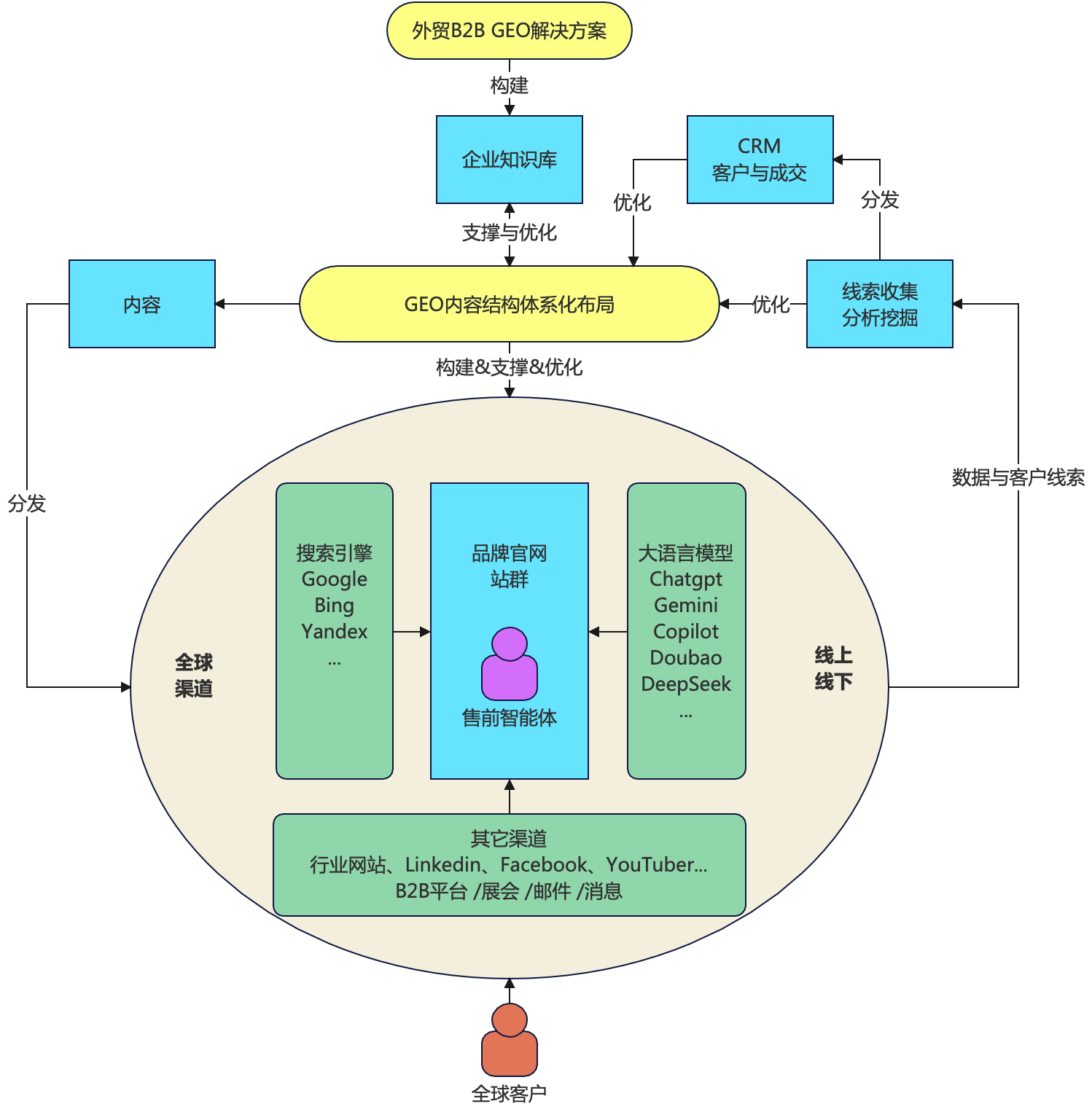
AB's GEO system is essentially a set of:
AI Cognitive Infrastructure for Foreign Trade B2B
The core includes:
-
Enterprise knowledge base (foundation)
-
Intelligent website building (platform layer)
-
GEO Optimization and Multi-Channel Collaboration (Amplification Layer)
-
Intelligent agents and data closed loop (transformation and evolution)
VII. In conclusion: A very realistic statement
AI won't recommend you just because you "did a lot";
It will only choose you because you are easier to judge, verify, and trust .
There is only one prerequisite for achieving this:
First, establish the foundation of the knowledge base and the official website.
If the foundation is empty,
The more aggressively you pursue GEO, the more likely you are to waste time and budget.
.png?x-oss-process=image/resize,h_100,m_lfit/format,webp)
.png?x-oss-process=image/resize,h_100,m_lfit/format,webp)

.png?x-oss-process=image/resize,h_100,m_lfit/format,webp)
.png?x-oss-process=image/resize,h_100,m_lfit/format,webp)
.png?x-oss-process=image/resize,h_100,m_lfit/format,webp)
.png?x-oss-process=image/resize,h_100,m_lfit/format,webp)
