.png?x-oss-process=image/resize,h_100,m_lfit/format,webp)

.png?x-oss-process=image/resize,m_lfit,w_200/format,webp)

热门产品

Popular articles
Cross-border B2B transactions are making a strong comeback: Large buyers are using AI to screen suppliers – how AB Customer GEO can help you become a recommended supplier.
AI Optimization Effectiveness: Defining “Citation–Mention–Attribution–Inquiries” Metrics for B2B Exporters
ABKE GEO Quarterly Audit Report: How are core metrics generated and used to verify "Will AI recommend you?"
Foreign Trade GEO for B2B Exporters: Get Understood, Trusted, and Recommended by AI (with ABKe)
The 4-Step AI Optimization Chain for B2B Exporters: Required Inputs vs. Failure Causes (Understand → Trust → Cite → Recommend)
How is the "10%-50% core intent coverage" delivered by AB Customer GEO calculated? A reproducible question bank + hit rate formula + scoring table.
What GEO's quarterly report shows your boss: Proof that "AI is starting to recommend you" using AI citation rates, semantic coverage, and AI inquiry percentages.
How foreign-trade companies build “re-testable GEO acceptance criteria”: from helping AI understand you to prioritizing and recommending you (AB Customer)
Recommended Reading


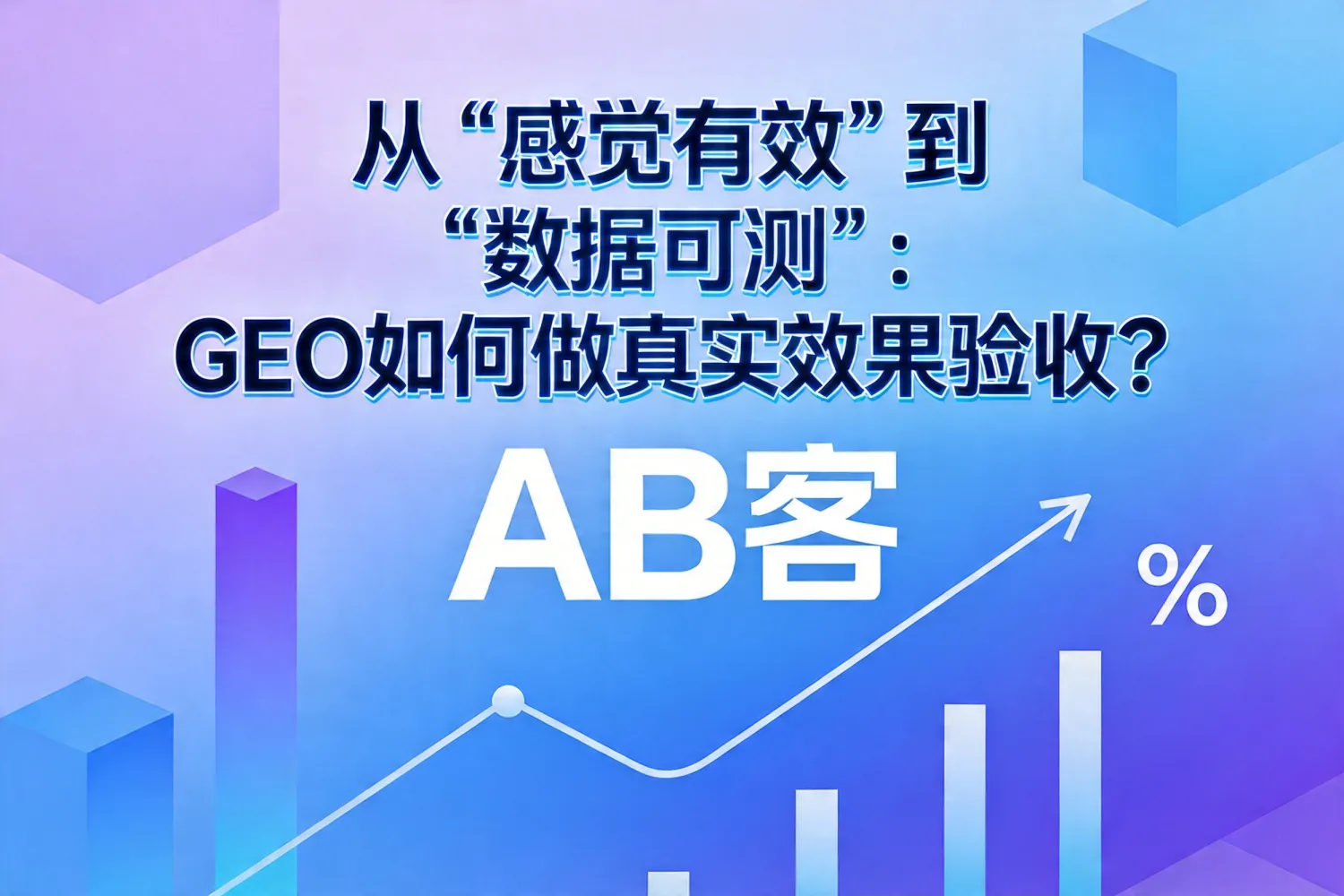


How ABKE Defines Contract-Ready GEO Results (So Your AI Search Optimization Is Auditable)
ABKE explains how to write measurable GEO (Generative Engine Optimization) outcomes into B2B contracts—using AI mention rate, citation weight, and attribution verification—so your team can audit “what AI changed,” not just “what was delivered.”

Short Answer
ABKE makes GEO outcomes contract-auditable by breaking “AI search performance” into four acceptance layers—AI Visibility, AI Understanding, AI Citation Behavior, and Business Attribution. We then define repeatable tests and thresholds such as AI Mention Rate, Citation Weight Index, Multi-Model Consistency, and CRM-verified AI-influenced inquiries so results are measurable, re-testable, and accountable.
Why “Deliverables” Are Not Acceptance (and Why GEO Must Be Measurable)
Traditional marketing/content contracts typically accept work by counting deliverables: number of pages, articles, keywords, or on-page changes. In the AI search era, that approach fails a basic question:
Did AI actually use your content to answer buyer questions?
ABKE’s positioning is “GEO — make AI search recommend you first.” That only becomes a business-grade service when both sides can verify: AI’s behavior changed in a measurable way, and the change can be re-tested over time.
So ABKE upgrades GEO contracts from content delivery to AI cognition + citation + attribution delivery—aligned with ABKE’s three-layer GEO architecture: Cognition → Content → Growth.
The 4-Layer GEO Acceptance Model (What to Measure)
ABKE’s contract-ready acceptance model treats GEO as a chain of proof. Each layer has its own tests, metrics, and minimum pass criteria.
Core questions (must be answered in any GEO contract):
1) How do we make the company appear in AI answers (ChatGPT/Perplexity/Gemini) and enter the recommendation set?
2) How do we structure knowledge so AI can crawl, cite, verify, and keep generating inquiries over time?
KPIs, Thresholds, and Audit Methods (Practical & Repeatable)
Below is a contract-friendly KPI table ABKE commonly uses as a baseline. Exact thresholds should be set by industry competitiveness, starting footprint, and target markets.
| Acceptance Layer | Metric (Definition) | How to Measure (Audit) | Evidence to Keep |
|---|---|---|---|
| AI Visibility | Index & access pass rate (share of target pages accessible + eligible for indexing) | Crawl checks, status codes, canonical, robots, sitemap verification; spot checks across templates | Logs/screenshots, URL list, crawl reports, template checklist |
| AI Understanding | Semantic extraction accuracy (correct facts / tested facts) | Standard prompt set; score brand facts, constraints, proof points; flag hallucinations/omissions | Prompt list, model outputs, scoring sheet, correction changelog |
| AI Citation | AI Mention Rate = prompts with mention / total prompts | Repeat tests per model; fixed prompt wording + temperature guidance; compare baseline vs. current | Saved transcripts, timestamps, model version notes, aggregation table |
| AI Citation | Citation Weight Index (0–3) based on depth of use | Score each output: 0 no mention; 1 name only; 2 recommended with reasons; 3 cited/grounded in proof | Scoring rubric, outputs with highlights, reviewer initials |
| Multi-model | Consistency rate across models (same prompt set) | Run identical prompt sets across ChatGPT/Perplexity/Gemini; compare mention + weight | Model-by-model exports, diff notes, summary chart |
| Attribution | AI-influenced inquiry ratio (AI-touch leads / total inbound) | Lead form fields + sales qualification; source normalization; landing mapping to prompt clusters | CRM exports, form responses, audit trail for source rules |
Operational Tip: Build a “Standard Prompt Set” Like a Test Suite
ABKE recommends maintaining a versioned prompt library segmented by intent: category discovery, supplier shortlist, spec comparison, pricing/MOQ, compliance, and use-case fit. Acceptance tests should reference prompt set IDs to ensure re-testability.
Scoring Tip: Make Weight “Harder to Game”
A pure mention metric can be inflated by superficial name-drops. A weight index forces the outcome toward buyer value: recommendation + reasoning + proof alignment.
The “Three-Tier Acceptance Structure” ABKE Writes into Contracts
Many B2B teams need acceptance criteria that protect both parties: delivery quality, AI performance, and commercial validation. ABKE typically structures GEO contracts into three tiers:
Tier 1 — Delivery Compliance (Process Guardrails)
- Semantic module completeness (FAQ blocks, proof sections, comparison tables where relevant)
- Coverage map (topics, industries, use cases, buyer questions)
- Quality controls (entity consistency, claim approvals, internal linking rules)
Purpose: ensure the team is doing the right work, consistently.
Tier 2 — AI Effect Acceptance (Core GEO KPIs)
- AI Mention Rate for defined prompt clusters
- Citation Weight Index target (e.g., average ≥ 2.0 on priority prompts)
- Multi-model consistency rules (minimum pass rates per model)
Purpose: verify AI starts using you in buyer-intent answers.
Tier 3 — Business Validation (Attribution & Value)
- AI-influenced inquiry ratio (tracked in CRM)
- Long-tail question conversion contribution
- Documented AI touch in sales qualification notes
Purpose: confirm GEO becomes pipeline, not just visibility.
How ABKE Measures AI Mention Rate (So It’s Repeatable and Defensible)
AI Mention Rate is the percentage of standardized prompts in which the model mentions the brand, solution, or a specific optimized asset. To make this metric usable in contracts, ABKE insists on a measurement protocol.
1) Build a Prompt Set with Buyer Intent
- Cluster prompts by funnel stage (discover → shortlist → compare → validate → contact)
- Include constraints buyers actually state (region, certifications, MOQ, lead time, application)
- Lock prompt wording and version it (v1.0, v1.1…)
2) Define What “Counts as a Mention”
- Brand mention (ABKE or client brand) vs. product/solution mention
- Direct recommendation vs. neutral listing
- Alias handling (brand variants, transliterations)
3) Record Outputs Like an Audit Log
- Store prompt, timestamp, model name/version (where visible), and full output
- Keep screenshots or exports as evidence
- Use the same testing cadence (e.g., bi-weekly or monthly) to observe trend
Reality check for contracts: model outputs can vary due to updates and context. That’s why ABKE uses ranges, trend direction, and multi-model testing rather than treating a single run as definitive truth.
Citation Weight Index (A Practical Rubric You Can Put in a Contract)
ABKE often uses a simple 0–3 rubric to reduce ambiguity and prevent “vanity mentions.” You can adapt the labels, but keep the meaning stable.
| Score | What AI Does | Why It Matters | Example Evidence |
|---|---|---|---|
| 0 | No mention / no use | No recommendation equity | Output contains no brand or asset reference |
| 1 | Name-drop (listed, not selected) | Low influence on buyer decision | “Some suppliers include …” without reasons |
| 2 | Recommended with reasons | High intent alignment; shortlist impact | Mentions + explains fit for constraints/use case |
| 3 | Grounded in proof (cites specs, cases, verifiable claims) | Strongest trust signal; hard to replace | Uses factual modules (FAQ/data/case) aligned with site content |
ABKE’s operating principle: the higher the weight score, the closer you are to “AI recommendation rights”—because the answer is not only mentioning you, but reasoning with your knowledge assets.
Attribution Verification: How to Prove GEO Influence on Inquiries
“AI influenced the lead” must be captured in a way that sales and finance can audit. ABKE typically combines multiple signals rather than relying on one brittle indicator.
Signal A — Tagged Landing Pages & Prompt-to-Page Mapping
Map prompt clusters (e.g., “best supplier for X in Y market”) to specific landing assets (FAQ hubs, comparison pages, use-case pages). Track sessions and conversions on those assets using server-side or privacy-safe analytics where possible.
Signal B — Lead Form “AI Touch” Fields
Add a neutral, optional field in inquiry forms: “Did you use an AI assistant (ChatGPT/Perplexity/Gemini) during supplier research?” plus a free-text box for copied question wording.
Signal C — CRM Source Normalization + Sales Qualification
Standardize source categories in CRM and train sales to log AI-related context (e.g., “found us via AI answer” / “asked ChatGPT for suppliers”). This turns anecdotes into measurable fields.
Contract language tip (keep it auditable)
Define attribution as “AI-influenced” rather than “AI-last-click.” Require a documented method (fields, mapping rules, exports) and accept that influence is probabilistic—then audit it consistently.
Case Pattern: From “Content Outsourcing” to “Effect Partnership”
A common early-stage GEO mistake: accepting the project by “content quantity.” For a B2B export company, that rarely answers the CEO/CRO question—did AI recommendation weight improve?
Before
- Acceptance = number of pages/articles delivered
- No repeatable AI tests
- No attribution fields in CRM
After adopting ABKE acceptance
- AI Mention Rate becomes a core acceptance KPI
- Citation Weight Index is added to prevent superficial “mentions”
- AI-influenced inquiry ratio is tracked and verified in CRM
Key contract shift: not “how many things were done,” but what changed in AI answers—and whether that change can be reproduced and attributed.
Common Follow-Up Questions (for Legal, Procurement, and Marketing)
Is it “safe” to write AI KPIs into a contract?
Yes—if you define test protocols, evidence requirements, model scope, and acceptance windows. ABKE recommends specifying prompt sets, scoring rubrics, and multi-run averages rather than single outputs.
Are acceptance standards the same across industries?
The model is universal; thresholds vary. Regulated or technical industries often require stronger Layer-2 understanding and Layer-3 proof grounding before Layer-4 attribution is meaningful.
How do you prevent “fake mention rate”?
Pair mention rate with citation weight, run multi-model tests, keep an evidence log, and require “reasoned recommendation” prompts (supplier selection constraints) rather than generic brand prompts.
What is a reasonable GEO acceptance cycle?
ABKE typically uses staged acceptance windows: early cycles for visibility/understanding, then citation/consistency, then attribution once inbound volume is sufficient for signal.
GEO Takeaway (For Teams Entering the “AI Recommendation Era”)
As GEO matures, competitive advantage shifts from “content production” to AI-effect verification. A contract-ready acceptance system turns GEO from a vague service into a standardized growth mechanism—where both parties can measure AI visibility, AI understanding, AI citation behavior, and business attribution over time.
If your current GEO project can’t define acceptance metrics in writing, it’s not yet a commercial-grade, auditable program.
Talk to ABKE: Make GEO Verifiable, Not Vague
Want to turn your Foreign Trade B2B GEO Solution into a contract with measurable outcomes? ABKE can help you design the acceptance model, build the prompt test suite, implement SEO+GEO-ready site structure, and connect AI influence to CRM for attribution.
Best-fit scenarios
- Your website “exists” but doesn’t earn AI recommendations
- You need multi-language, global-market content networks
- Procurement/legal requires measurable KPIs and audit trails
What to prepare for a consult
- Target products/markets + ideal buyer questions
- Existing content/site analytics + CRM fields
- Competitors customers ask AI about
Ask for: ABKE GEO Acceptance KPI Template + Prompt Test Suite Outline + Attribution Setup Checklist.
Published by ABKE GEO Research Institute.
.png?x-oss-process=image/resize,h_100,m_lfit/format,webp)
.png?x-oss-process=image/resize,h_100,m_lfit/format,webp)

.png?x-oss-process=image/resize,h_100,m_lfit/format,webp)
.png?x-oss-process=image/resize,h_100,m_lfit/format,webp)
.png?x-oss-process=image/resize,h_100,m_lfit/format,webp)
.png?x-oss-process=image/resize,h_100,m_lfit/format,webp)
