外贸学院|

热门产品

外贸极客

Popular articles

Recommended Reading

Stop Letting Old-School SEO Box You In: GEO Is the Key to AI-Driven Traffic

发布时间:2026/03/17
阅读:368
类型:Other types

Traditional SEO focuses on keyword rankings and clicks, but AI search is shifting discovery to the question stage—where buyers ask, AI answers, and suppliers get shortlisted before a website visit. Generative Engine Optimization (GEO) helps B2B exporters and manufacturers turn product expertise, technical knowledge, and real project experience into AI-readable, citable content. By building a structured knowledge system—covering common procurement questions, clear technical explanations, evidence-based case studies, and a connected internal content network—companies increase the likelihood of being referenced by AI results and recommended during early research. The outcome is higher-intent traffic, better-qualified inquiries, lower acquisition costs, and shorter sales cycles, while creating a long-term content asset that continues to generate visibility in AI-driven search environments.

GEO-19.jpg

Stop Letting Old-School SEO Box You In: GEO Is the Key to AI-Driven Traffic

For years, B2B exporters played a familiar game: target keywords, climb rankings, and hope clicks turn into inquiries. But the buyer’s journey has shifted. In AI search, customers don’t “browse results” the way they used to—they ask questions and get synthesized answers. If your expertise isn’t something an AI engine can understand and cite, you risk being invisible even when you’re the best supplier.

GEO (Generative Engine Optimization) AI Search Visibility Higher-Intent Inquiries B2B Export Marketing

What Changed: From “Ranking for Keywords” to “Being Quoted as the Answer”

Traditional SEO is built on a linear idea: if you rank higher, you earn more clicks, which should lead to more leads. That model still matters, but it no longer covers the whole decision path. With generative AI layered into search and discovery, a growing share of buyers get their first shortlist from an AI-generated response—often before they ever open a supplier website.

A practical way to think about the new funnel

Old funnel (SEO-first) New funnel (AI-first / GEO-driven)
Search keyword → click results → compare suppliers → request quote Ask a question → AI synthesizes an answer → early shortlist → contact supplier
You compete for position (rank #1 vs #5) You compete for citation-worthy clarity (who gets referenced)
Success metric: sessions, CTR, keyword ranking Success metric: AI mentions, qualified inquiries, conversion velocity

Industry note (for planning, not a promise): across many B2B websites, only about 1.5%–3.5% of organic sessions convert into inquiries. In AI-first discovery, volume may be lower—but intent can be materially higher when your content is used to pre-qualify buyers.

Why “Old SEO Thinking” Breaks in AI Search

Let’s be honest: many export websites still look like catalogs with a thin layer of “keyword articles.” They may rank for a few terms, but they don’t help the AI understand how you solve problems. In generative search, the engine doesn’t just index pages—it tries to extract meaning, compare claims, and build a coherent response.

Limitation #1: Keyword pages don’t equal buyer questions

Buyers rarely ask “industrial valve supplier.” They ask: “Which valve material survives 3% NaCl at 60°C?” or “How do I select an actuator for 6 bar air supply?” GEO starts from those real questions and builds content that answers them precisely.

Limitation #2: AI prefers structured evidence over vague claims

“High quality,” “best price,” and “fast delivery” don’t help an AI decide. Clear specifications, boundary conditions, test methods, compliance references, and case constraints do.

Limitation #3: Traffic is no longer the only gateway

Even when a buyer doesn’t click, an AI may still quote content that shaped their decision. If your site can’t be safely summarized—because details are missing or scattered—you lose that “invisible influence.”

What GEO Really Is (and What It’s Not)

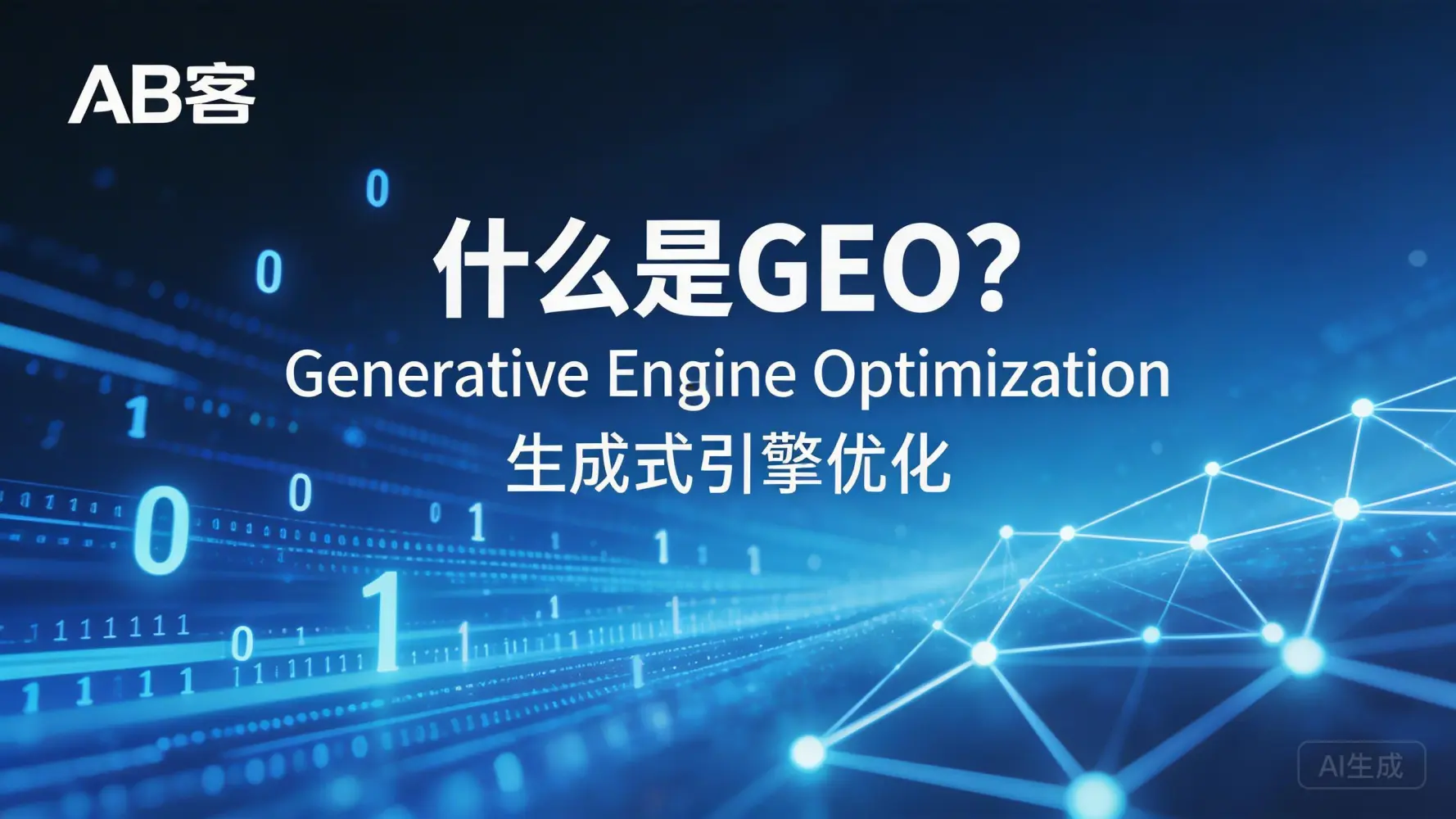
GEO (Generative Engine Optimization) is the discipline of packaging your expertise into an AI-readable knowledge system. It’s not a gimmick. It’s not “writing for robots.” It’s the same principle as great sales engineering: explain the right things, with the right level of specificity, in a way that reduces risk for the buyer.

A GEO content system typically includes

  • Industry question hubs: “How to choose…”, “What causes…”, “Best material for…”, “Tolerance vs cost…”
  • Technical explainers: principles, performance drivers, failure modes, design tradeoffs
  • Case studies with constraints: application environment, target spec, solution path, verification method
  • Internal linking and content mapping: a network that teaches the AI how topics connect

The hidden win: when the AI can see your logic, buyers arrive pre-educated. That reduces back-and-forth and increases close rates.

From “Content” to “Evidence”: What Makes AI Cite You

As an SEO practitioner, I’ve learned a simple rule: the more your page behaves like a spec sheet + engineer’s note + field experience, the more “quote-ready” it becomes. AI models tend to favor content that is unambiguous, bounded, and verifiable.

High-citation patterns (with concrete examples)

Pattern Why it works in GEO Example you can publish
Decision tables AI can map conditions → recommendations “Material selection by temperature / corrosion / pressure class”
Step-by-step methods Extractable process reduces hallucination risk “How to size a component in 7 steps + common mistakes”
Boundary conditions Helps AI state when advice applies “Suitable for pH 4–9; not recommended for oxidizing acids”
Measured proof Numbers outperform adjectives “Leak test: 1.1× rated pressure, 15 minutes; acceptance: 0 visible bubbles”

Reference benchmarks (typical B2B export sites): improving clarity and internal linking often lifts time-on-page by 15%–35% and increases inquiry conversion by 10%–25% over 8–12 weeks, especially on pages that answer technical questions directly.

A GEO Playbook for Export B2B Teams (Built for Execution)

GEO works best when it’s treated like a system, not a one-off content sprint. Below is a workflow you can run with a small team—often a marketing lead, an engineer (or product manager), and someone who knows customer objections from real conversations.

1) Harvest real questions (not imagined keywords)

Pull questions from RFQs, email threads, WhatsApp chats, trade show notes, and after-sales tickets. Aim for 50–120 questions to start. Cluster them into themes (materials, standards, sizing, failure modes, installation, lead time, MOQ logic, compliance).

2) Publish “answer pages” with a predictable structure

Use consistent sections: short answerwhen it appliestradeoffsrecommended specscommon mistakescase reference. Predictable structure makes your site easier for both humans and AI to parse.

3) Build a content network (internal links with intent)

Don’t just link “related posts.” Link by logic: problem → method → spec → case. A practical target is 5–9 internal links per cornerstone page and 2–4 per supporting page, pointing to definitions, standards, and validation methods.

4) Add case studies that teach decision-making

Case studies shouldn’t read like marketing. Include constraints: operating temperature, media, pressure range, duty cycle, failure history, acceptance criteria, and what you changed. Even 8–12 high-quality cases can outperform dozens of generic news posts.

5) Measure GEO with “qualified signals,” not vanity metrics

Track: inquiry-to-quote rate, quote-to-order rate, average sales cycle length, and which pages appear in pre-sales conversations. For analytics, also monitor scroll depth and assisted conversions on technical pages—those often predict lead quality better than pure traffic.

Does GEO Replace SEO? Not Really—It Re-Positions It

GEO doesn’t “kill” SEO. It changes priorities. Traditional SEO remains essential for crawlability, performance, indexing, and capturing classic search demand. GEO extends the strategy upstream—so your knowledge becomes the raw material AI uses to form answers.

A balanced approach most B2B exporters can adopt

  • SEO foundation: technical health, sitemap, speed, canonicalization, clean IA, on-page basics
  • GEO layer: question-led content, structured evidence, internal knowledge graph, case-based proof
  • Sales alignment: turn top-performing GEO pages into sales enablement docs and quotation templates

If you can only do one thing this month: publish 10 pages that answer your best RFQ questions in a structured way. That single move often changes the quality of inbound conversations.

Ready to Make AI Bring You Better Inquiries (Not Just More Clicks)?

If you’re building a serious AI-era acquisition channel, ABKE GEO is designed to help export B2B teams turn technical know-how and real cases into an AI-citable knowledge system—so buyers find you earlier, trust you faster, and ask smarter questions.

 Explore ABKE GEO and get the GEO execution framework for your industry

Use it to map buyer questions, build content clusters, and measure outcomes by qualified inquiry rate—not vanity traffic.

A few “extension questions” you can turn into your next GEO pages

  • What specific signals increase the likelihood of being recommended or cited by AI engines?
  • Which product categories in export B2B see the fastest GEO impact—and why?
  • How can you quantify GEO impact when AI influence doesn’t always show up as a click?
  • What should you publish first if you only have engineering time for 2 hours a week?

This article is published by ABKE GEO Institute of Intelligence Research.

Generative Engine Optimization (GEO) AI search optimization B2B lead generation export marketing structured content strategy

AI 搜索里,有你吗?

外贸流量成本暴涨,询盘转化率下滑?AI 已在主动筛选供应商,你还在做SEO?用AB客·外贸B2B GEO,让AI立即认识、信任并推荐你,抢占AI获客红利!
了解AB客
专业顾问实时为您提供一对一VIP服务
开创外贸营销新篇章,尽在一键戳达。
开创外贸营销新篇章,尽在一键戳达。
数据洞悉客户需求,精准营销策略领先一步。
用智能化解决方案,高效掌握市场动态。
用智能化解决方案,高效掌握市场动态。
全方位多平台接入,畅通无阻的客户沟通。
全方位多平台接入,畅通无阻的客户沟通。
省时省力,创造高回报,一站搞定国际客户。
个性化智能体服务,24/7不间断的精准营销。
多语种内容个性化,跨界营销不是梦。
多语种内容个性化,跨界营销不是梦。
https://shmuker.oss-accelerate.aliyuncs.com/tmp/temporary/60ec5bd7f8d5a86c84ef79f2/60ec5bdcf8d5a86c84ef7a9a/thumb-prev.png?x-oss-process=image/resize,h_1500,m_lfit/format,webp