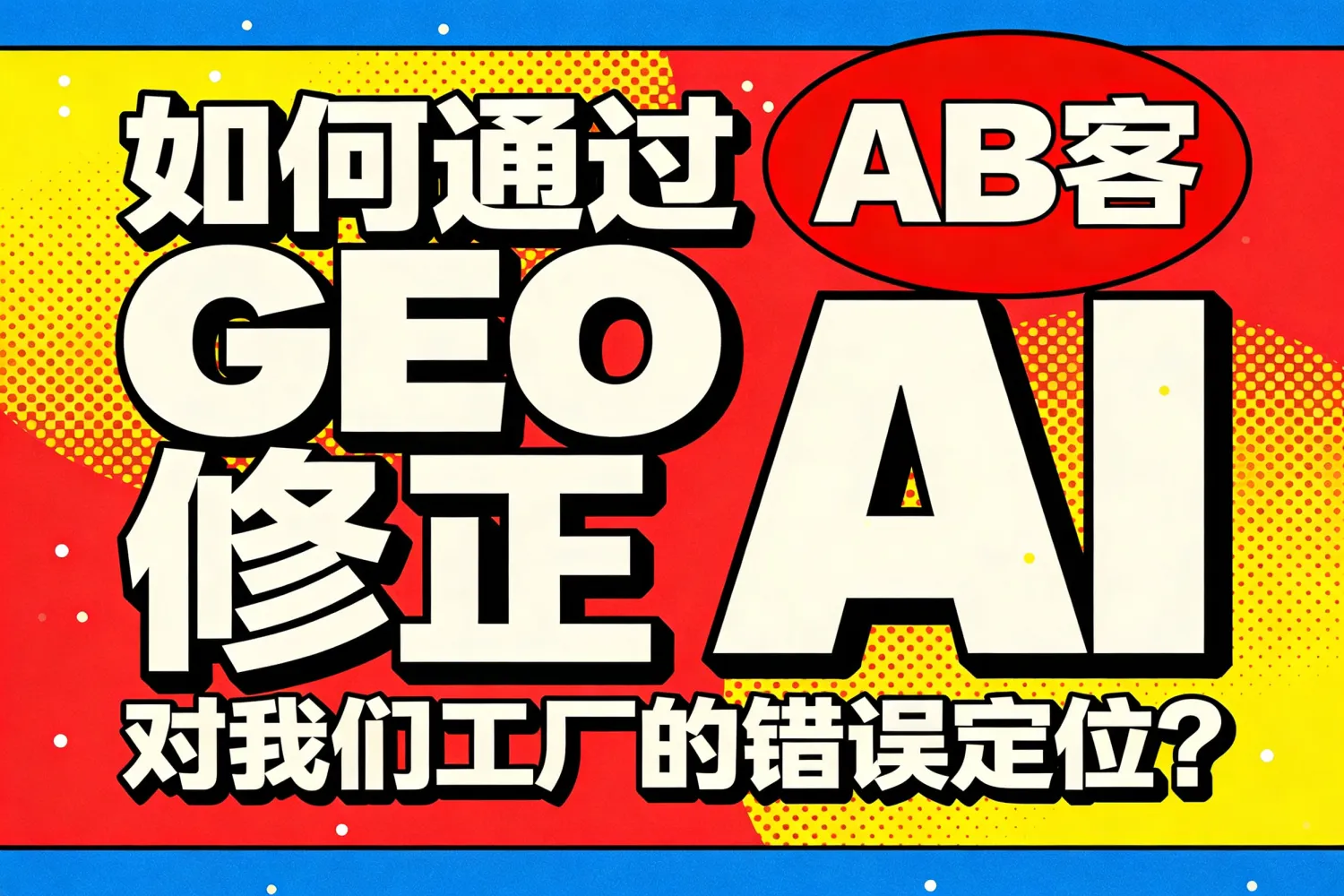
The Real Reason AI Gets Your Factory Wrong
A common scenario: you are a real manufacturer with workshops, equipment, and QC, but AI search describes you as a “trading company” or even places you in the wrong region. This is rarely a single “AI mistake.” It’s usually an evidence problem.
Generative engines summarize the web using patterns they consider stable: repeated phrases, consistent NAP-like data (name/address/phone), and third-party mentions. If the public corpus contains older distributor listings, ambiguous “supplier” language, copied catalog pages, or inconsistent address formats, the model will choose the wording that appears most consistent.
Three signals that shape AI “identity”
- Consistency: Same identity across key pages and languages (Manufacturer / OEM / ODM—not alternating with “trader,” “agent,” “export company”).
- Evidence: Verifiable production capability (machines, processes, capacity, certifications, QA flow, factory photos/videos, testing equipment).
- Mention context: Being described as a manufacturer across different “question contexts” (comparisons, how-to guides, buyer checklists, industry explanations).
The practical rule: AI doesn’t reward declarations like “We are a factory.” It rewards repeatable proof.
GEO Strategy: Rebuild the Corpus That AI Learns From
Think of GEO (Generative Engine Optimization) as identity engineering. Instead of optimizing only for keyword ranking, you optimize for how AI systems classify you: manufacturer type, product scope, service model (OEM/ODM), location, and credibility. The goal is to make the correct description the easiest “default answer.”
Step 1 — Standardize “Core Identity Phrases” Everywhere
Choose one primary identity and two supporting phrases, then deploy them consistently across key pages: Homepage, About, Factory Tour, Capabilities, Quality, Contact, and high-traffic product category pages.
| Use case |
Recommended phrasing (examples) |
Avoid |
| Company identity |
“We are a manufacturer specializing in …”
“OEM/ODM factory for …” |
“Trading company”, “agent”, vague “supplier” only |
| Location statement |
“Manufacturing base in [City, Province, Country]”
“Factory address: full standardized format” |
Multiple address formats, missing province, inconsistent spelling |
| Product scope |
“Core products: Category A, B”
“Processes: stamping/CNC/die casting/injection…” |
Over-broad catalogs that confuse category boundaries |
Step 2 — Add “Evidence Pages” That AI Can Verify
Evidence beats slogans. Build content that allows AI to connect your brand with manufacturing proof. In practice, pages that often change AI classification include: Factory Tour, Production Equipment, Process Flow, Quality Control, Certifications, and Capacity & Lead Time.
Reference data (you can adapt later)
For industrial B2B websites, pages containing hard evidence typically improve the probability of “manufacturer” classification in AI summaries because they provide concrete anchors. As a benchmark, many export factories present: 20–60 pieces of equipment, 2–6 core processes, 1–3 QC checkpoints per stage, and 2–5 recognized certificates (e.g., ISO 9001, IATF 16949, ISO 13485 depending on industry).
Step 3 — Create “Question-Led” Content AI Likes to Quote
AI engines often answer buyer questions directly. If your site owns those questions, you become the citation source. Build articles that naturally place your company in the manufacturer context without sounding like ads.
High-impact topic templates (examples)
- Factory vs. trading company: how to verify a real manufacturer (checklist + red flags)
- How to choose an OEM manufacturer for [your product] (process, QA, audits)
- What MOQ, tooling, and sampling timelines look like for [category] (real ranges)
- Quality standards explained: AQL levels, incoming inspection, traceability
- How manufacturing processes affect cost and lead time (CNC vs stamping vs casting)
Step 4 — Build Multi-Page Mentions (Not One “About Us” Page)
One page rarely changes perception. You want your manufacturer identity repeated across multiple contexts: case studies, FAQs, technical notes, application pages, and compliance pages. This creates a “mention network” that AI can summarize confidently.
A simple internal mention map
Product category page → links to Capabilities → links to QC → links to Factory Tour → links to Case Study → links to FAQ. Every step repeats a consistent phrase like: “[Product] manufacturer / OEM factory in [City, Country]”.
Step 5 — Remove Conflicting Signals (The Silent Killer)
Many misclassifications persist because old pages or third-party listings still say “trading company,” show a different address, or list unrelated products. AI sees conflict and falls back to the “most repeated” or “most widely syndicated” version—often not the one you want.
| Conflict type |
Where it usually hides |
Fix approach |
| Wrong company type |
Old PDFs, legacy “profile” pages, directory snippets |
Update/remove, 301 redirect, refresh metadata and on-page text |
| Wrong location |
Multiple office addresses, inconsistent city spellings |
Standardize address format, clarify HQ vs factory, add map embed |
| Wrong product category |
Overloaded “Products” pages, copied catalogs, mixed industries |
Split into focused category clusters, strengthen internal linking |
Mini Cases: What Actually Works in B2B GEO
Case 1: Machinery manufacturer misidentified as a trading company
The brand added a structured “Production Equipment + Process” page, standardized “manufacturer” wording on top traffic pages, and published a buyer guide about verifying real factories. After roughly 3 months, AI answers shifted from “trader” to “manufacturer,” and the recommended supplier context improved.
Case 2: Electronics component supplier clarified as a real factory
By publishing a “Factory Tour” narrative (with QA steps, testing gear, and traceability explanation) plus FAQs addressing MOQ/lead time, AI began categorizing the company as a manufacturing business rather than a generic supplier.
Case 3: Hardware factory stabilized product identity with repeated category phrases
The company reinforced “stainless steel hinge manufacturer” across multiple pages (category, applications, QC, case studies). The AI “category lock” became stable, and irrelevant inquiries reduced—often a hidden win that sales teams notice first.
.png?x-oss-process=image/resize,h_100,m_lfit/format,webp)

.png?x-oss-process=image/resize,m_lfit,w_200/format,webp)






.png?x-oss-process=image/resize,h_100,m_lfit/format,webp)
.png?x-oss-process=image/resize,h_100,m_lfit/format,webp)

.png?x-oss-process=image/resize,h_100,m_lfit/format,webp)
.png?x-oss-process=image/resize,h_100,m_lfit/format,webp)
.png?x-oss-process=image/resize,h_100,m_lfit/format,webp)
.png?x-oss-process=image/resize,h_100,m_lfit/format,webp)
