.png?x-oss-process=image/resize,h_100,m_lfit/format,webp)

.png?x-oss-process=image/resize,m_lfit,w_200/format,webp)

热门产品

Popular articles
Why Foreign Trade Marketing Cannot Promise a Fixed Number of Inquiries
Why a B2B Export Inquiry Is Not Decided by One Website, One Platform, or One Ad Campaign
Top 5 Foreign Trade GEO Service Providers Ranking in May 2026: Dual-Dimensional Evaluation of AI Citation Rate and Conversion Effect
Where Is Low-Cost GEO Service Actually Cheaper, and What Is Usually Missing?
Foreign Trade Marketing Should Guarantee the Growth Process, Not Just Inquiry Volume
How a Custom Parts Factory Improved Lead Quality with GEO Optimization | ABKE
外贸营销到底能不能保证询盘?先看清这件事
How ABKE Helps Agricultural Machinery Parts Exporters Expand from Product Keywords to Industry Demand Coverage
Why Low-Cost GEO Seems Affordable but May Actually Cost You the Market Window
B2B Export Inquiries Are Not a Result Button: What Factors Really Influence Them?
Recommended Reading


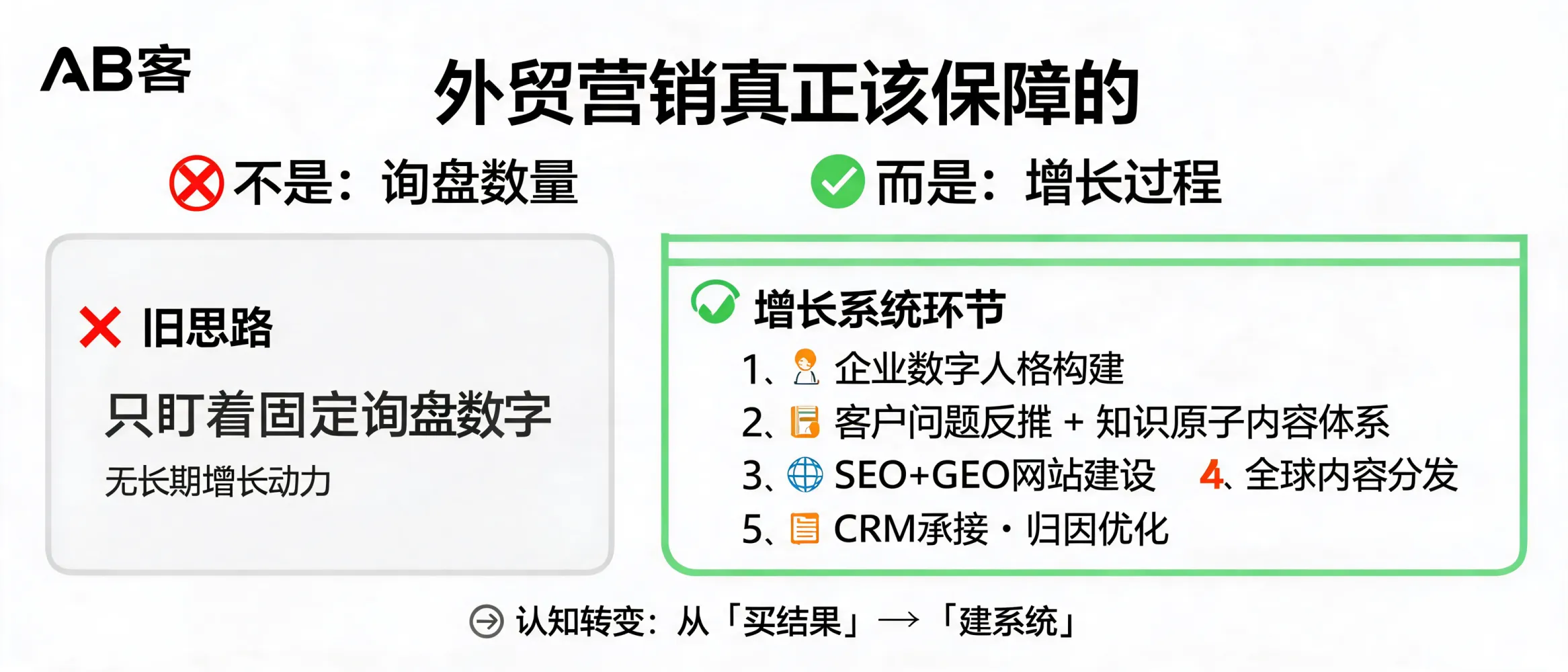

With an existing website and SEO foundation, is it necessary to rebuild it from scratch? A Guide to Determining Enhanced Access for Foreign Trade GEOs
AB Customer focuses on the GEO growth engine for foreign trade B2B, analyzing how companies with existing websites, content teams, or SEO foundations can determine whether their existing websites, content assets, distribution, CRM, and attribution capabilities can be enhanced with GEO, avoiding unnecessary redoing and completing the transition from SEO to GEO.
For B2B foreign trade companies that already have an official website, content team, or SEO foundation, the most common mistake when purchasing GEO solutions is not "doing too little," but rather redoing everything without careful consideration . As AI search increasingly influences customer decisions, companies need to first assess whether their existing assets have the capability to enhance integration before deciding on a partial upgrade, structural restructuring, or system rebuild.
ABker's implementation method for the B2B foreign trade GEO growth engine typically begins with an evaluation of five areas: website capacity, content assets, distribution system, CRM integration, and data attribution. The core is not to negate SEO, but rather to determine whether existing SEO achievements can be further upgraded into a GEO growth infrastructure that can be understood and referenced by AI, forming a closed loop of recommendation and conversion .
Why do many companies not necessarily need to start from scratch?
Having an existing website and SEO foundation is itself a growth asset. As long as the underlying structure isn't seriously flawed, many pages, content, and processes don't necessarily need to be discarded. The real question is: can existing assets still meet the new demands of the AI search era ?
Traditional SEO focuses on keyword coverage, indexing, ranking, and clicks; while GEO goes a step further, focusing on whether a business can be understood, cited, included in answers, and further validated by customers in scenarios such as Google, ChatGPT, Perplexity, and Gemini, ultimately leading to inquiries. The two are not complete substitutes, but rather represent an upgrade from "visible in search" to "understandable, trustworthy, and recommendable in search and generative question answering."
The core logic is: if the existing website, content, and marketing processes can still be enhanced and utilized, then the more reasonable path is usually not to redo everything, but to enhance the integration with GEO .
Five key criteria for assessment: Is your existing infrastructure suitable for GEO enhanced access?
1. Does the website have SEO & GEO capabilities?
Whether an existing official website can continue to be used depends first on whether it is a site that can truly support growth, and not just a display website. GEO enhanced access does not require the website to be "completely redesigned," but it does require the website to support structured expression, content expansion, conversion handling, and multi-platform experience.
- Are the page structures clear? Can the product pages, solution pages, FAQ pages, and knowledge content pages be sustainably expanded?
- Does the website meet the basic requirements for indexing, such as loading speed, mobile compatibility, crawlability, and basic technical specifications?
- Does it support structured information representation to facilitate AI and search systems' understanding of enterprises, products, application scenarios, and trust evidence?
- Does it have a clear inquiry path, such as forms, email, WhatsApp, document downloads, etc.?
- Is it possible to add FAQs, knowledge centers, scenario pages, internal links, and GEO-related trigger modules without significantly disrupting the existing site?
2. Does the content asset have reuse value?
Many companies have invested in product introductions, blog posts, case studies, or downloadable documents over the past few years, and this content should not be simply dismissed as "useless." The key is whether the content can be reorganized, structured, and upgraded, rather than just whether it has been "written."
- Does it include real company facts, such as product parameters, manufacturing capabilities, certifications, application industries, and delivery processes?
- Can the content be reorganized around customer issues and presented in formats such as FAQs, selection guides, comparative analyses, and procurement recommendations?
- Does the content have clear logic and well-defined boundaries? Can it support AI in understanding "who you are, what you do, who you are suitable for, and why you are trustworthy"?
- Does it have a multilingual extension capability, or at least have localizable original Chinese/English materials?
- Are there a lot of vague promotional slogans? If so, the content needs to be restructured rather than being directly reused.
3. Does the distribution system support multi-source verification?
Relying solely on the official website often makes it difficult to generate a sufficiently strong external credibility signal. One of the key prerequisites for GEO enhanced access is that the enterprise already has or can quickly establish a multi-source consistent information distribution system, ensuring that brand information does not exist on a single site.
- Do you already have external touchpoints such as LinkedIn, YouTube, industry platforms, B2B platforms, or third-party directories?
- Are the company name, business scope, product description, and contact information consistent across all channels?
- Does the company have the capability to break down the content from the official website and synchronize it to external channels?
- Can the content from external channels corroborate the official website semantically, rather than being contradictory?
- Can it gradually accumulate brand entity signals, professional content signals, and credible verification signals?
4. Can the CRM handle leads instead of letting traffic slip away?
GEO doesn't just solve the problem of "seeing you," but also "keeping you there after you've seen you." If a company already has a website and SEO that brings in some traffic, but its lead recording, tiering, follow-up, and archiving mechanisms are weak, then even if visibility is improved, it will be difficult to generate effective business opportunities.
- Can the source of inquiries be recorded, and can it be distinguished as coming from the official website, content pages, social media, or external platforms?
- Can customer information be centrally managed to avoid individual sales staff keeping their own records and making it impossible to review past performance?
- Does it have a mechanism for tiered lead identification, follow-up reminders, communication records, and opportunity advancement?
- Is it possible to identify high-intent customers, rather than treating all inquiries as of the same quality?
- Can content access, form submission, and sales actions be linked together to provide a basis for future optimization?
5. Does data attribution support continuous optimization?
If a company has been doing SEO in the past but can't determine which pages are effective, which content generates inquiries, or whether AI is starting to mention the brand, then the problem isn't "whether they've done it or not," but "the inability to continuously optimize." Enhanced GEO integration requires a certain level of data monitoring foundation, at least enough to establish a link between visibility and conversion.
- Can we observe indexing, organic visits, keyword coverage, and page performance?
- Can it track the appearance of brands in AI-generated mentions, AI-generated citations, or under key questions?
- Can it be linked to actions such as form clicks, email clicks, WhatsApp clicks, and data downloads?
- Does it have a mechanism for monthly review of content performance and iteration?
- Can we upgrade "traffic growth" into a closed-loop assessment of "visibility - inquiry - sales opportunity"?
In what situations is enhanced access appropriate, and in what situations is reconstruction or rebuilding more suitable?
| Judgment Dimensions | More suitable for GEO enhanced access | More suitable for reconstruction/rebuilding |
|---|---|---|
| Website Basics | The basic structure is clear, and the pages and conversion paths can be further expanded. | The structure is chaotic, there are many technical limitations, and it is difficult to expand the content system. |
| Content assets | Existing product information, case studies, and preliminary FAQs can be organized and reused. | The content is vague, repetitive, and lacks any credible factual basis. |
| External distribution | Some channel touchpoints already exist, allowing for enhanced consistency. | There are almost no external sources of information available for retrieval besides the official website. |
| Clues accepted | Existing forms or CRM processes can be further improved. | There are visits but no records, inquiries but no feedback, and obvious process breaks. |
| Optimization mechanism | With existing basic data monitoring, we can gradually establish GEO attribution. | Lacking monitoring capabilities, unable to assess page, content, and lead performance. |
Upgrading from SEO to GEO isn't about changing tracks, but about filling gaps in key capabilities.
For companies with existing SEO expertise, the most valuable approach is usually not to "overturn the existing system," but rather to upgrade based on existing achievements. When evaluating projects, AB Inquiry pays particular attention to whether a company already possesses the following reusable capabilities:
Existing traffic base
This indicates that the site already has a certain level of search visibility, and its AI understanding and page conversion capabilities can be further enhanced.
Existing content accumulation
This indicates that the company already has a foundation of knowledge materials, which can be reorganized into FAQs, scenario pages, procurement guides, and a multilingual content matrix.
Existing channel touchpoints
This indicates that the brand entity information already exists externally, and further consistency and multi-source verification enhancements can be performed.
Existing team execution capabilities
This demonstrates that companies can establish a more stable long-term execution mechanism for GEO content, distribution, and optimization.
In other words, the key to upgrading SEO to GEO is not to replace all existing investments, but to upgrade the original "traffic logic" system into a more complete growth system that includes "understanding logic + trust logic + referencing logic + conversion logic".
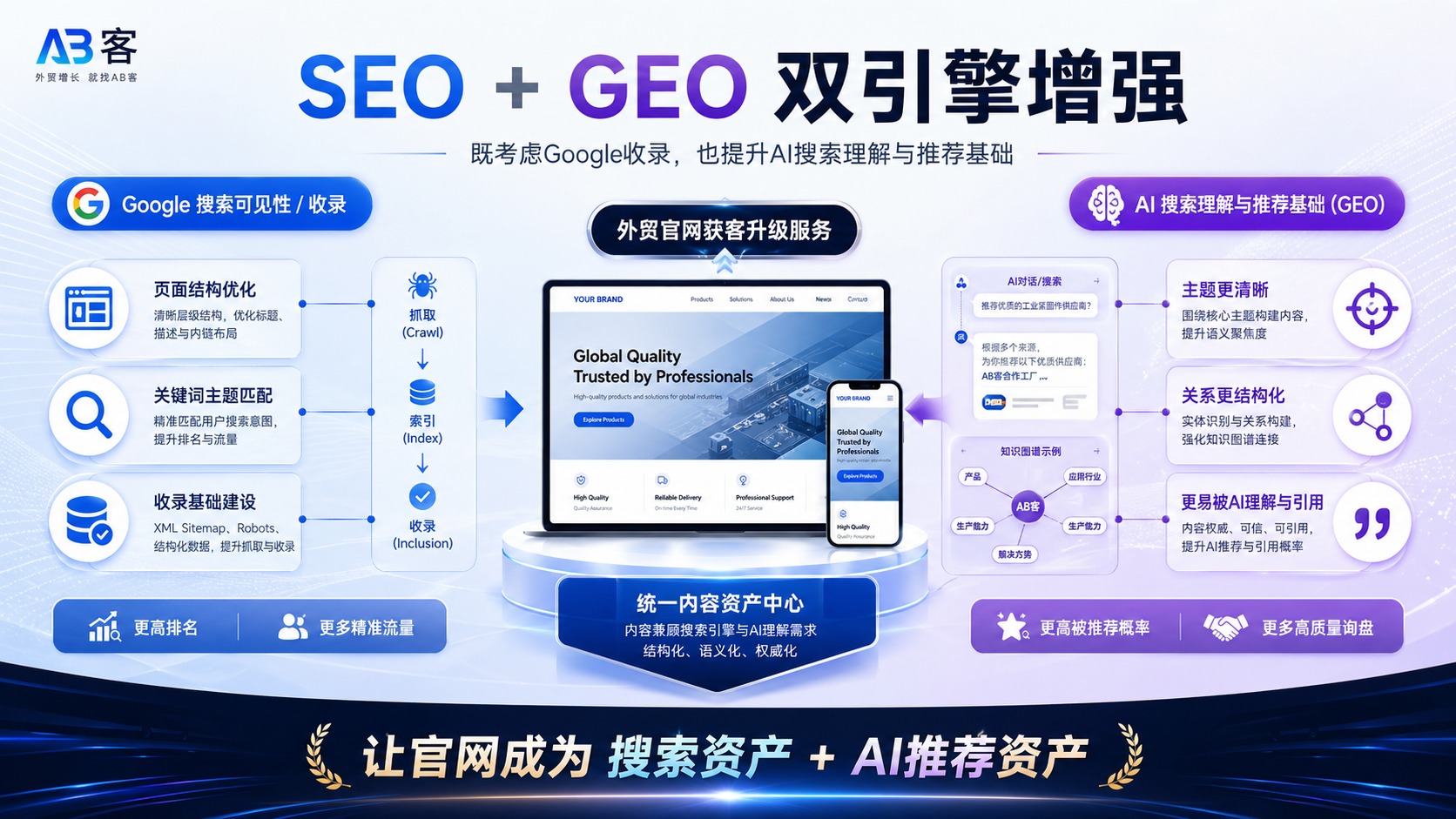
How do AB customers typically determine if GEO enhanced access is suitable?
- First, assess whether the existing site can handle the growth .<br />Focus on evaluating page structure, technical foundation, content scalability, conversion path, and multilingual support capabilities.
- Next, examine whether existing content can be transformed into knowledge assets . This involves not just counting the number of articles, but judging whether the content can be reorganized around customer problems, purchasing decisions, and trust verification.
- Continue to check if there are any verifiable signals outside the official website , including social media, industry platforms, third-party directories, B2B platform materials, etc., to see if they can be considered as multiple sources for the brand.
- At the same time, examine whether the lead generation process can support the growth results . If inquiries are not recorded and there is no sales mechanism, no matter how much content is produced, it will be difficult to achieve stable conversions.
- Finally, consider whether there is a data foundation for continuous optimization.
GEO is not a one-off project; you must be able to see the changes, review the results, and iterate on the content and pages.
Based on this logic, ABK (Alibaba Search) tends to help businesses retain reusable assets, address key weaknesses, and build new capabilities for the AI search era , rather than unnecessarily increasing redesign costs. ABK's foreign trade website customer acquisition upgrade service helps businesses transform traditional showcase websites into marketing-oriented websites better suited for foreign trade customer acquisition. This allows the website to not only showcase the brand but also meet customer needs, support Google indexing, enhance AI search understanding, and smoothly guide inquiry conversions. For details on how to upgrade, please refer to this article: Why Does My Foreign Trade Website Have Traffic but No Inquiries: The Problem Isn't Just About Traffic, But Also About Content and Conversion Structure.
Suitable business types for reading this page
- We already have an official website and have done SEO optimization before, but we're unsure if a complete rebuild is necessary.
- We already have a content team that has accumulated a collection of articles and product materials, and we want to determine which ones can be reused.
- There is already some traffic or inquiries, but brand visibility in AI search scenarios is weak.
- There are already some external distribution channels, but a unified brand expression and evidence chain organization are lacking.
- The goal is to further upgrade from digitalization and intelligent marketing in foreign trade to a growth system driven by foreign trade GEOs and intelligent agents in foreign trade.
If your company already has a certain website and SEO foundation, the priority should not be to rush to decide "whether to redo everything", but to first determine whether the existing assets meet the conditions for GEO enhancement access .
Based on ABker's experience with the B2B GEO growth engine in foreign trade, a rational upgrade path often involves: retaining reusable features, reconstructing unsuitable ones, and supplementing capabilities in AI understanding, trust expression, content structuring, and conversion loop . This allows companies to more smoothly transition from SEO to GEO, rather than repeating old costs in a new phase.
.png?x-oss-process=image/resize,h_100,m_lfit/format,webp)
.png?x-oss-process=image/resize,h_100,m_lfit/format,webp)

.png?x-oss-process=image/resize,h_100,m_lfit/format,webp)
.png?x-oss-process=image/resize,h_100,m_lfit/format,webp)
.png?x-oss-process=image/resize,h_100,m_lfit/format,webp)
.png?x-oss-process=image/resize,h_100,m_lfit/format,webp)
