外贸学院|

热门产品

外贸极客

Popular articles

Recommended Reading

After GEO is implemented, your official website will no longer be just for show, but will become a source of information recommended by AI.

发布时间:2026/03/24
阅读:141
类型:Other types

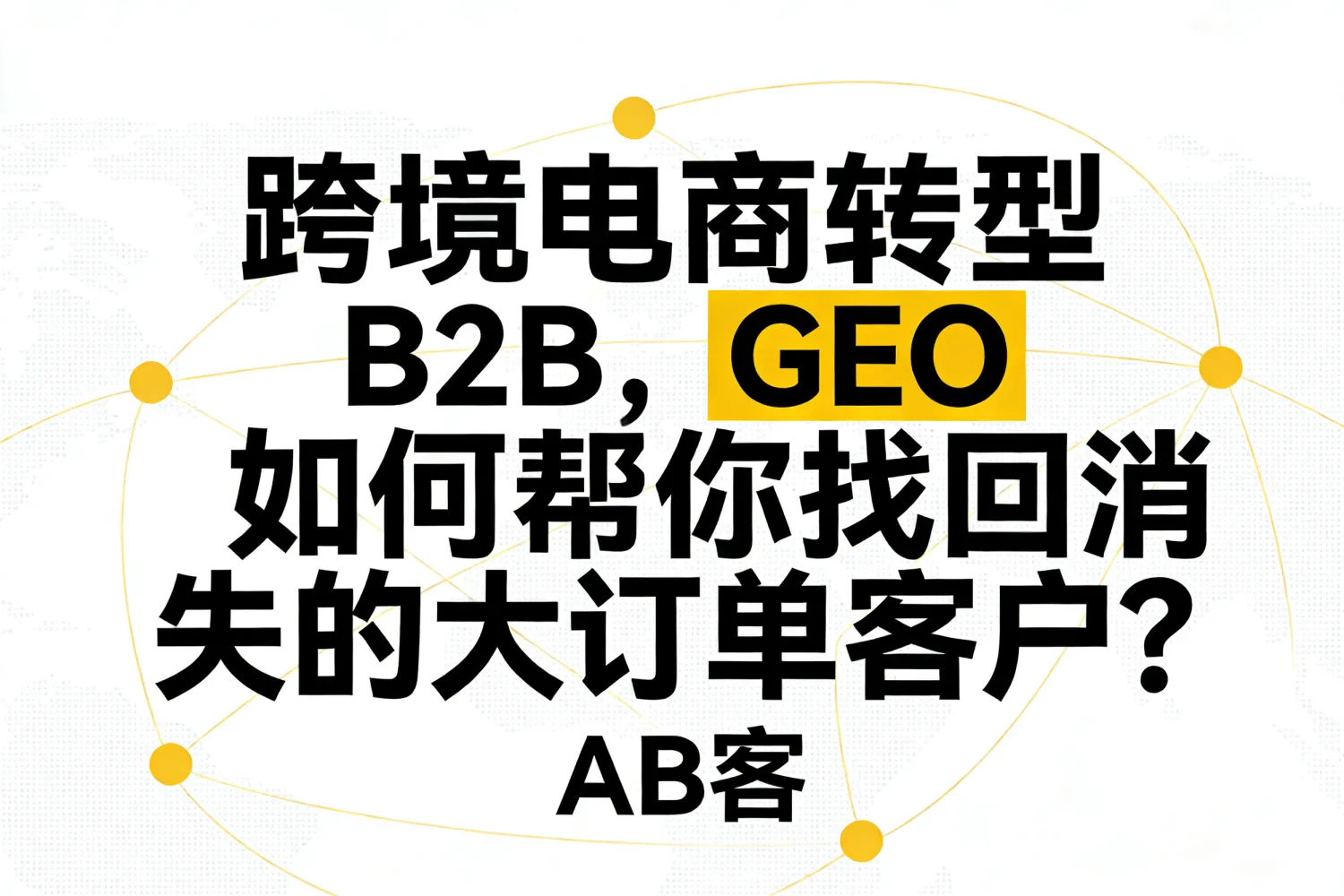
With AI search and generative question answering becoming mainstream, B2B foreign trade companies whose official websites remain merely "display pages" will struggle to be used by AI, leading to a greater reliance on platforms and advertising for inquiries. AB-Tech GEO's core GEO (Generative Engine Optimization) aims to upgrade the official website into a "source of information that AI can understand and utilize": reconstructing content logic around questions, supplementing decision-making content such as selection, application, comparison, and solutions; unifying the semantic expression of products and capabilities to improve information consistency; adding parameters, case studies, and technical descriptions to increase information density and citationability; and establishing a content network through internal links and structured content, transforming the official website from a traffic entry point into a decision-making entry point, continuously enhancing AI recommendation and customer acquisition capabilities. This article was published by ABKE GEO Research Institute.

image_1774316252053.jpg

After GEO is implemented, your official website will no longer be just for show, but will become a source of information recommended by AI.

In the B2B foreign trade sector, many official websites have long remained "display pages": they have an image, product pictures, and company introductions, but inquiries still rely on platforms, advertising, or sales staff to actively develop them. With the rise of AI search, the path for customers to obtain information is being rewritten—more and more purchasing and engineering staff will consult AI first before deciding whether to open a website or contact suppliers.

What ABKE GEO aims to do is upgrade the official website from a "brochure for humans" to an "authoritative corpus that AI can understand and cite," allowing your brand and capabilities to appear, be recommended, and be compared in AI answers, ultimately entering the purchasing decision list.

In short: In the context of AI search, the value of an official website no longer depends on "traffic volume," but rather on "whether it is cited" and "whether the citation leads to a decision."

Why is your official website so "beautiful" but almost invisible in AI search?

A common scenario: Your official website is beautifully designed, loads quickly, and has comprehensive product images, but when potential customers ask AI questions like " Is this material suitable for high-temperature conditions? ", " How do I select this specification? ", or " What are the differences between this equipment and this solution? ", the AI's answers cite encyclopedias, forums, third-party platforms, or industry media, but rarely cite your official website.

The reason is not mysterious: generative search/question-answering systems prefer content that is clearly structured, semantically stable, and reusable . Many presentation-oriented official websites often suffer from these problems:

Question 1: Information organization is centered on "page display" rather than "problem solving".

Much of the content consists of "Who we are," "Our strengths," and "Product categories," but what procurement really cares about is selection, compatibility, cost/delivery risk, certification, case studies, and alternative solutions .

Problem 2: Unstable semantic expression and insufficient verifiable information

The same capability is described inconsistently on different pages; technical parameters are missing; and there is a lack of verifiable information such as standards, testing methods, material grades, and application boundaries, which makes AI hesitant to cite or find the references of low value.

Question 3: The content is too coarse-grained and difficult to extract.

A single page is crammed with lengthy promotional text, lacking key points that AI can directly "extract": comparison tables, parameter tables, steps, precautions, FAQs, compatibility lists, etc.

Many companies make mistakes not in their "websites," but in the engineering presentation of their website content : an official website is fine for humans to read, but in an AI context, it needs to simultaneously satisfy the requirements of "humans being able to understand it, AI being able to extract information, and AI being able to make purchasing decisions."

In the era of AI search: How can official websites be upgraded from "traffic entrances" to "decision-making entrances"?

In the past, SEO focused more on "ranking - clicks - visits," but now more and more B2B foreign trade clients are using AI to perform initial screening: who can do it, whether they have experience, what working conditions they are suitable for, what the risk points are, and whether they have certifications and case studies. Whether your official website can be cited will directly affect whether you enter their candidate list.

AB Guest GEO's Three Elements for Judging Whether an Official Website Can Be a Source of Information

  1. The information structure is clear: the content is organized around customer issues (operating conditions, selection, comparison, application, risks, maintenance), rather than around company departments or product catalogs.
  2. Stable semantic expression: Core capabilities, delivery scope, materials/processes, standard certifications, quality inspection processes, etc. remain consistent across different pages, reducing "self-contradictions".
  3. Highly reusable: Content can be broken down, extracted, and referenced: tabular parameters, itemized key points, FAQs, comparative conclusions, step-by-step checklists, and adaptation suggestions.

Essentially, the official website is no longer just for "people to see," but should be able to provide AI with understanding and enable decision-making review .

Recommendation: Transform the "product showcase" into a "question and answer" section to make it more appealing to AI.

You don't necessarily need to rebuild your website; often, you only need to restructure the content logic and page structure. Below is a set of GEO (Generational Organization) ideas from ABKE that are closer to practical B2B foreign trade and can be directly implemented in website section and content planning.

1) Restructure content logic: Shift from "What do we have?" to "What do our customers encounter?"

Change the product page from a "feature stack" to a "problem-condition-solution-evidence" format. For example: temperature range, medium, pressure, lifespan, certification requirements, installation limitations, common failure modes, alternatives, etc.

2) Establish decision-making content: covering selection, application, comparison, and solutions.

AI references favor content modules that enable "decision making." It's recommended to cover at least: selection guides, application scenarios, industry solutions, comparative evaluations, FAQs, installation/maintenance, and quality and certification .

Reference data (common range of content performance in foreign trade B2B): Compared to websites with only product display pages, adding selection + application + comparison pages typically improves inquiry quality by about 20%–45% (more specific depends on industry average order value, decision chain length and page coverage depth).

3) Unified semantic system: The same thing should be said in the same way on different pages.

It is recommended to establish an "Official Website Corpus Dictionary" including: product naming, manufacturing capabilities, delivery scope, standard certifications, commonly used materials/models, testing terms, and key advantage statements. Standardization will not only improve AI understanding but also reduce communication costs for sales and engineering.

4) Increase information density: Parameters, case studies, and technical specifications are the "hard currency" of information.

Without disclosing trade secrets, clearly state the key specifications: size range, material grade, manufacturing tolerances, temperature/corrosion resistance limits, lifespan reference, testing standards, certification list, and factors affecting delivery time. For B2B procurement in foreign trade, "comparability and verifiability" are more important than "looking good."

5) Establish a content network: Use internal links to connect the "problem chain".

Ensure that every page guides the user (and AI) to the next step: product pages link to selection guides, application cases, FAQs, and material comparisons; solution pages link to relevant products, parameter tables, and testing instructions. This makes it easier to establish "topic authority" and "referenceable paths."

You can directly copy the "AI referenceable structure": What should the page look like?

The table below shows common upgrade directions for B2B foreign trade website content: replacing "promotional information" with "verifiable, reusable, and extractable" information. AI can reference this more easily, and procurement decisions are made more readily.

Content Module Demonstrative writing style (not conducive to citation) GEO notation (beneficial for AI citation) Recommended information density
Selection Guide We offer a variety of models to choose from. A decision tree is provided based on operating conditions: temperature/medium/pressure/size/certification → recommended model + non-recommended boundary conditions. 7–12 key questions + 1 comparison table
Parameters and Standards "High quality and stable performance" List the size range, tolerances, test methods, standard numbers, material grades, and certification list. At least one parameter table + three test instructions
Comparison and Substitution They only praise themselves and never mention the differences. A vs B: Cost/Lifespan/Maintenance/Suitable Operating Conditions/Risk Points/Target Audience 1 comparison table + 3 conclusions
Cases and Evidence We serve many clients. Industry/Operating Condition/Problem/Solution/Result/Repurchase Points (Anonymous is acceptable) ≥2 cases for each core industry
FAQ Scattered and generalized discussions Organized by "real-world issues": installation, lifespan, failure, quality inspection, delivery time, MOQ/prototype, compliance. 10–20 high-frequency questions

Empirical data reference: In the context of foreign trade B2B, after supplementing the product page with parameter tables, selection FAQs, and case evidence , it is not uncommon for page dwell time to increase by 15%–35% , and inquiry form submission rate to increase by 10%–30% (which will fluctuate with industry and traffic structure).

Real-world example: By simply changing the content, the official website can be mentioned in the "Engineering Issues" section.

Case 1: Industrial Equipment Manufacturer

Typical actions: The equipment page was broken down into four modules: "Operating Condition Adaptation," "Installation Conditions," "Maintenance Cycle," and "Troubleshooting," and key parameters and testing specifications were added. As a result, when customers asked technical questions in the AI, the official website became a more reliable source of answers, inquiries shifted from "general price inquiries" to "consultations with operating conditions and drawings," and sales progressed faster.

Case Study 2: Electronic Component Supplier

Typical changes include: adding a "Selection Comparison Table," "Alternative Model Strategy," "Application Considerations (Temperature Rise/ESD/Lifespan)," and "Certification/Testing Instructions." The official website also provides "referenceable conclusions" for frequently asked questions by engineers, reducing reliance on third-party information sites and resulting in more specific inquiries (with more complete parameters).

Case Study 3: Cross-border B2B Enterprises

Typical actions included: unifying the overall structure of the website's content (ensuring consistent descriptions of the same process capabilities, delivery boundaries, and quality inspection procedures), and establishing an internal content link network: products—solutions—case studies—FAQs mutually support each other. Ultimately, the official website resembled a "knowledge base," exhibiting more stable frequency in AI responses and significantly reducing sensitivity to platform traffic fluctuations.

Further questions: Should we rebuild the website? Should we write a lot of content?

Q1: Is it necessary to rebuild the website?

Not necessarily. The key bottleneck for most B2B e-commerce websites isn't visual appeal, but rather content structure and information density . As long as your website supports adding new sections, editing content, and basic SEO elements (titles, structured subheadings, internal links, tables, etc.), you can start by restructuring your content.

Q2: Is a large amount of content required?

The focus shouldn't be on "quantity over quality," but rather on "addressing key issues." It's recommended to prioritize creating 20-40 high-value pages (selection/application/comparison/parameters/FAQ/case studies), covering your most profitable product categories and industries with the highest repurchase rates and most inquiries. For B2B international trade, concise, concrete, verifiable, and comparable content is often more effective than general articles.

GEO Tip: Three things to do to get your website cited (as a checklist)

  • Change the website's content structure to a question-and-answer format : first answer "What are customers asking?", then showcase "What do you have?"
  • Improve the comprehensibility and consistency of content: ensure consistent messaging across the entire site for the same capabilities; ensure parameters and standards are verifiable; and avoid vague adjectives.
  • Continuously optimize and enhance the value of the corpus: supplement FAQs, comparison tables, case evidence, and work condition boundaries; use internal links to connect the topics.

One point that many companies overlook is that official websites are not useless, but rather not being used correctly—especially today, when AI has become the "primary entry point."

Want to turn your official website into a source of AI-recommended information? Start with ABKE GEO to make your content "citationable".

If your official website consistently fails to generate inquiries, or the inquiries are of low quality, it's often not a lack of traffic, but rather a lack of content structure that can influence decision-making. Only by thoroughly understanding key issues such as selection, application, comparison, parameters, and case studies will AI have a reason to use your website.

You can think of it as upgrading your official website from a "business card" to a "knowledge base," and then from a "knowledge base" to a "source of reference in AI answers." When customers see your standards, parameters, and solution logic first in the AI, subsequent communication will be significantly smoother.

Understanding ABKE GEO: A Content Restructuring Solution for Turning Your Website into an AI Recommendation Source

Tip: No major design changes are needed. Prioritize implementing three things: "problem structure, semantic consistency, and density of referable information".

This article was published by ABKE GEO Research Institute.

AI 搜索里,有你吗?

外贸流量成本暴涨,询盘转化率下滑?AI 已在主动筛选供应商,你还在做SEO?用AB客·外贸B2B GEO,让AI立即认识、信任并推荐你,抢占AI获客红利!
了解AB客
专业顾问实时为您提供一对一VIP服务
开创外贸营销新篇章,尽在一键戳达。
开创外贸营销新篇章,尽在一键戳达。
数据洞悉客户需求,精准营销策略领先一步。
用智能化解决方案,高效掌握市场动态。
用智能化解决方案,高效掌握市场动态。
全方位多平台接入,畅通无阻的客户沟通。
全方位多平台接入,畅通无阻的客户沟通。
省时省力,创造高回报,一站搞定国际客户。
个性化智能体服务,24/7不间断的精准营销。
多语种内容个性化,跨界营销不是梦。
多语种内容个性化,跨界营销不是梦。
https://shmuker.oss-accelerate.aliyuncs.com/tmp/temporary/60ec5bd7f8d5a86c84ef79f2/60ec5bdcf8d5a86c84ef7a9a/thumb-prev.png?x-oss-process=image/resize,h_1500,m_lfit/format,webp