
GEO / Generative Engine Optimization: Content Growth for Foreign Trade B2B
This article makes a straightforward point: in the era of AI search, what gets recommended is not "beautifully written," but "well-founded."
Short answer: Why GEO needs to shift from "copywriting" to "facts"
In generative search (AI search, AI question answering, AI assistants), the system isn't "appreciating the writing style," but rather performing a task more akin to retrieval, evidence aggregation, and credibility assessment . It prioritizes verifiable data, traceable sources, reusable conclusions, and comparable parameters . No matter how passionate or sophisticated your writing is, without "factual anchors," AI will often dismiss it as unquotable marketing noise.
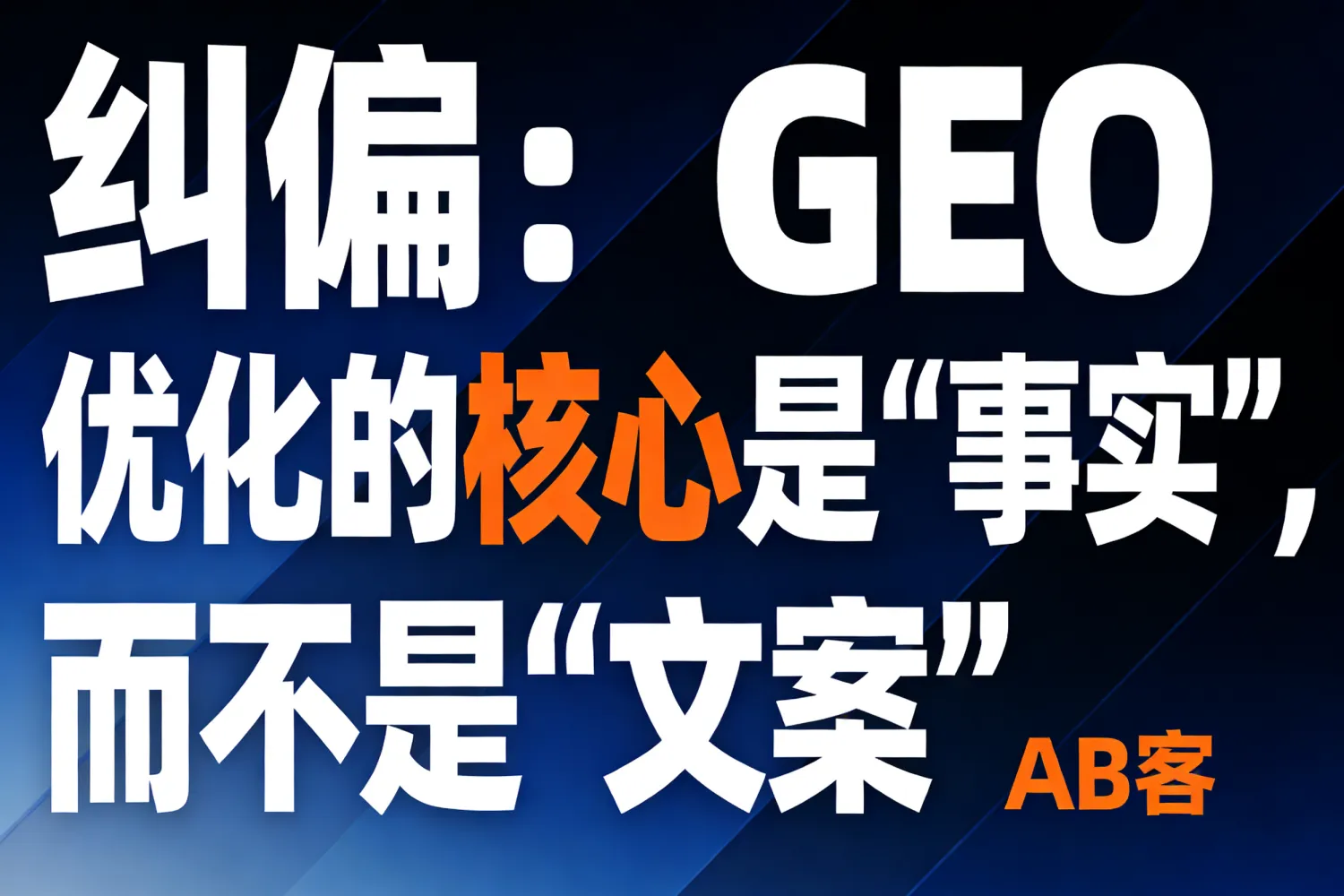
To clarify: GEO is not about "making AI like your copy," but about "making AI feel comfortable citing your facts."
How AI Search "picks content": Key points of GEO from a mechanism perspective
Traditional SEO is more like "web crawlers reading web pages," while generative engines are more like "researchers writing reports." When users ask questions like "Which supplier is more suitable?" or "Can this process meet the standards?", AI's goal is not to simply display your page and stop, but to output an answer that users can directly use to make decisions.
① Verifiability takes precedence: Without evidence, it's difficult to include something in the answer.
In a large amount of corporate content, common phrases include "industry-leading," "stable quality," and "faster delivery." The questions are: By how much? How stable is it? How many days faster? Generative engines, when integrating responses, tend to favor verifiable facts. For example (reference range, which can be adjusted based on your actual data):
| Content type | Copywriting style (difficult to cite) | Factual writing style (easy to cite) |
|---|---|---|
| accuracy | High-precision machining | Repeatability accuracy ±0.02 mm (Based on: factory inspection report/third-party measurement) |
| Delivery time | Fast delivery | Standard models take 15–25 days; urgent orders can be reduced to 10–15 days (subject to confirmation of BOM and production capacity). |
| Yield | Stable quality | The first-pass yield rate was 98.5% (statistical period: the past 12 months, sample size ≥ 2000 pieces). |
| Certification/Standard | Conforms to international standards | ISO 9001, CE (if applicable), RoHS (if applicable); key processes are sampled and inspected according to AQL 1.0. |
You'll find that factual writing comes with built-in "quote blocks." When AI needs a conclusion, it can directly extract key figures, ranges, criteria, and conditions.
② Information extraction mechanism: AI prefers expressions that can be directly reused.
Generative engines typically go through the following steps when generating answers: segmented understanding → fact extraction → conflict resolution → forming readable conclusions . Therefore, the more "structured" the content, the easier it is to extract and use in the answer. It is recommended to explicitly provide this on the page:
- Clear conclusion : In one sentence, state "what it is/who it applies to/what the boundary conditions are".
- Comparable dimensions : parameters, indicators, standards, process routes, and test conditions.
- Constraints and exceptions : Inapplicable scenarios, limiting conditions, and underlying assumptions (this type of information can actually enhance credibility).
- Traceable evidence : report, certification number, experimental method, sampling method, statistical period.
③ Trust Building Logic: GEO is more like a "credit system" than a "packaging system".
In the B2B foreign trade sector, users often use AI responses as a preliminary reference for supplier screening. To mitigate risk, AI tends to favor websites that clearly and completely explain the information: who is responsible, how it's done, to what extent, and how to prove it . This is why "factual content" is more likely to be included in AI's recommendation pool.
A helpful tip: Explicit restrictions won't lower conversion rates; in fact, they'll reduce low-quality inquiries. For example, specifying "±0.02mm requires a constant temperature measurement environment" will build trust with genuine professional buyers.
④ Decision support capability: Facts are the fuel for "selection, comparison, and judgment".
Users' questions about AI often directly address decision-making: which specifications to choose, which is more suitable compared to others, where the risks lie, and how to estimate TCO (Total Cost of Ownership). These kinds of questions require parameters, operating conditions, lifespan, maintenance cycles, compliance requirements, and case results , not brand slogans.
Write down the "facts": How to implement the ABke GEO methodology
Many teams aren't lacking in facts, but rather the facts are scattered across sales scripts, engineering documents, quality control records, and customer emails, failing to be organized into "information blocks" that AI can understand. AB客's GEO's core idea is to shift content from "expression-driven" to "fact-driven," ensuring that each page has an extractable, quotable, and comparable structure.
① Replace descriptions with data: Turn "adjectives" into "indicators".
You don't need to provide a lot of data right away, but you should at least provide verifiable quantifications at key points. Some commonly used indicators in B2B foreign trade (for reference):
- Production capacity: monthly production capacity (e.g., 8,000–12,000 pieces/sets), number of key process equipment, and peak production cycle.
- Quality indicators: first pass rate, rework rate, OQC sampling standards (such as AQL 1.0/2.5).
- Performance metrics: power/energy consumption, efficiency curve range, life test (e.g., MTBF, accelerated aging hours).
- Delivery metrics: standard delivery time range, emergency order handling rules, shipping methods and delivery time.
② Add verifiable information: Make "trustworthy" verifiable.
The truth isn't "what you say," but rather "what others can find out." It's recommended to include these verifiable elements in the content (disclose what can be made public, and provide the scope and methods for what cannot be made public):
Standards and Certification
References to ISO 9001, CE (if applicable), RoHS/REACH (if applicable), and other mandatory industry standards.
Test methods
For example, continuous operation for 72 hours/168 hours, temperature range, load conditions, sampling frequency, and judgment threshold.
Evidence attachments and clues
Test report summary, certification number, material grade, and supply chain traceability strategy (can be anonymized).
③ Build a logical chain: enable AI to "understand cause and effect," rather than just seeing the conclusion.
In the context of GEO (Geographical Origin), the most effective way to increase citation probability is not by piling on selling points, but by clearly explaining the cause → process → result . For example:
Reason: The customer's failure rate is high in high humidity environments (unstable dew point control).
Process: Replace the sealing structure + add a moisture-proof coating process; add a 48-hour damp heat cycle test (40℃, RH 95%) before leaving the factory.
Results: The failure rate in humid and hot conditions decreased from 3.2% to 1.8% (statistical period: 6 months, sample size ≥ 500 units).
④ Introduce real-world examples: Implement value through the "problem → solution → result" model.
Case studies are the most easily cited "containers of facts" in B2B foreign trade. They don't need to be written like promotional videos; it's recommended to write them as project records—the simpler, the more credible.
⑤ Control the proportion of copywriting: Copywriting is acceptable, but it must "serve the facts".
Copywriting isn't the original sin. The real problem is: when 90% of a page is "We're great," and only 10% is "Why are we great?", AI can only treat it as an advertisement. A more suitable ratio for GEOs (for reference): 70% factual information + 20% explanation + 10% brand expression .
Extended Questions: 4 Things You Might Be Struggling With
1) Does all content require data support?
You don't need to cram every sentence with numbers, but key conclusions must be anchored by evidence . For example, selection recommendations can be summaries of experience, but you should add "applicable conditions" and "risk warnings." For AI, the clearer the conditions, the more it resembles "usable knowledge."
2) How can companies without data perform GEO?
Start with the "facts" you already possess but haven't organized: quality inspection records, shipment batches, repair records, customer audit problem lists, production line SOPs, raw material grades and specifications, common defects and countermeasures. If you truly lack systematic data, you can start by establishing basic statistics (reference approach): on a monthly basis, calculate the first-pass yield, rework rate, delivery date achievement rate, top 5 typical failures and their handling methods. Within three months, you can create a usable initial evidence base.
3) Is the copywriting completely worthless?
The value of copywriting lies in "making people want to keep reading," especially in long-chain decision-making in foreign trade B2B, where it can reduce the cost of understanding and enhance the sense of professionalism. However, it must be based on facts: first, state the facts clearly, and then use copywriting to "smoothly explain" the logic.
4) How to balance expression and facts?
A workable approach is to use "one conclusion + three pieces of evidence + one boundary condition" for each section. For example, "One-sentence conclusion: Applicable to high-frequency continuous operating conditions"; the evidence could be life testing, materials of key components, and maintenance cycles; the boundary condition should clearly state "High dust/high humidity requires additional protection or a shorter maintenance cycle".
Turning AI Recommendations into "Long-Term Assets": Building a Factual Content System with ABke GEO
If you've already written a lot of content, but AI recommendations are still limited, it's often not because you haven't written enough, but because the factual density isn't high enough and the structure isn't citation-friendly. When you transform internal company data, experience, and case studies into structured factual information, AI can more easily understand, cite, and continuously recommend content.
High-value CTA
Want to upgrade your "selling point copywriting" into "factual content that can be cited by AI"? Use ABke GEO's structured approach to organize parameters, standards, cases, and evidence chains into content assets that can grow sustainably.
Understanding the "ABke GEO" Factual Content System Construction Solution- Prioritize completing the following: parameters/standards/test methods
- Establish: Case Evidence Database and FAQ Fact Database
- Optimization: Allows for quoting paragraphs and comparison tables
- Accumulation: Page-level "Decision Support Module"
.png?x-oss-process=image/resize,h_100,m_lfit/format,webp)
.png?x-oss-process=image/resize,h_100,m_lfit/format,webp)

.png?x-oss-process=image/resize,h_100,m_lfit/format,webp)
.png?x-oss-process=image/resize,h_100,m_lfit/format,webp)
.png?x-oss-process=image/resize,h_100,m_lfit/format,webp)
.png?x-oss-process=image/resize,h_100,m_lfit/format,webp)
