.png?x-oss-process=image/resize,h_100,m_lfit/format,webp)

.png?x-oss-process=image/resize,m_lfit,w_200/format,webp)





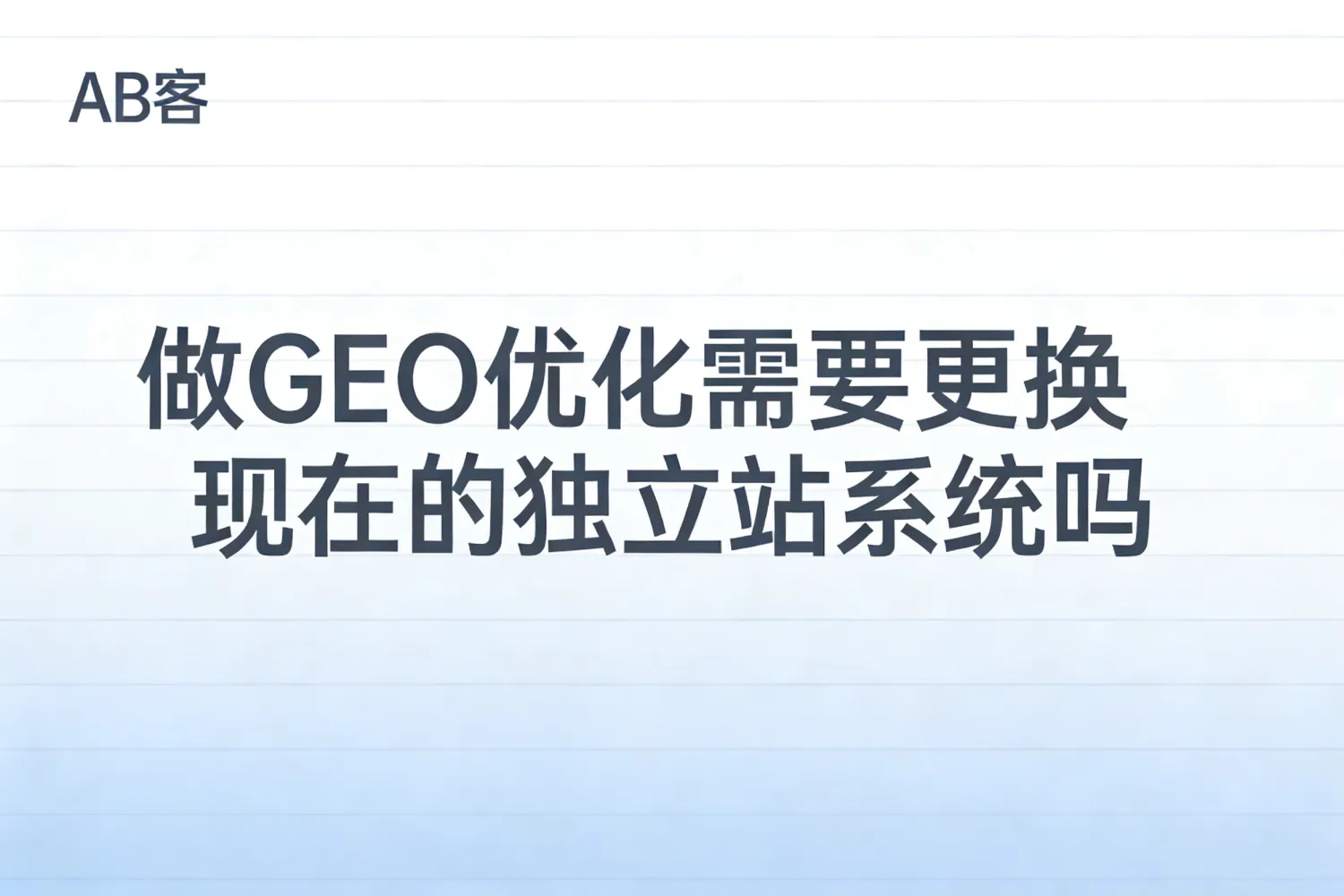
Does GEO optimization require replacing my current independent website system? (Applicable to both international B2B and brand websites)
From an SEO and content marketing perspective, GEO (Generative Engine Optimization) is more like an "upgrade of information expression" than a "system overhaul." If you're also struggling with whether or not to rebuild your website, this article will clarify the decision-making logic: when you don't need to change it, when you must change it, and how to complete the transformation at a lower cost.
Short answer: Using the ABke GEO methodology, most companies don't need to replace their existing independent website systems . As long as they can edit the page content and structure (headings, paragraphs, modules), they can meet the core requirements of AI understanding and recommendation.
Many people's first misconception about GEO is that they mistake "recommendation" for "system capability".
When businesses hear the name GEO, their first reaction is often: "Should we switch to a more advanced independent website system?" Behind this question is the misconception that "being recommended by AI" is "a built-in capability of a certain system."
However, judging from the way generative search/question answering works, AI is more concerned with whether a webpage provides information that can be extracted, verified, and summarized . In other words, AI doesn't look at your backend, but at the presentation of your webpage.
A very practical criterion: as long as your website can achieve " one theme per page, clear structure, complete information, and referentiality ," whether it's WordPress, Shopify, a template site, or a custom site, GEO has space for it.
Why does GEO typically not require a system reinstall? Understanding 3 underlying principles.
1) AI reads the "page content and structure," not the "website building platform you used."
When AI or web crawlers access a webpage, they typically focus on: body text, heading levels (H1-H3), paragraph logic, lists/tables, FAQs, and verifiable information (addresses/qualifications/data) . It won't give you an extra vote just because you use WordPress, nor will it make your custom development inherently more likely to be cited.
In real-world projects, we often see that within the same industry, some template websites, through structured content and credible endorsements, still manage to get included in AI recommendations; while some "high-priced custom websites," due to empty content, unclear explanations, and inconsistent information, are difficult to be cited.
2) The "method of expression" determines the effect: the same system can produce vastly different results.
GEO's content presentation is often not "longer and better," but rather "clearer and better." The same product and factory strength: written as a company slogan , it's difficult for AI to cite; written as a question-and-answer-evidence format , it's much easier to be directly cited or recommended.
3) The system is the carrier; the core of GEO is "to enable AI to understand you and be willing to recommend you."
Website systems can address issues like ease of modification, speed, and stability. However, being recommended by AI depends more on what you provide:
- Clear self-positioning : Who are you, what do you do, what problems do you solve, and who are you best suited to be with?
- Verifiable evidence includes : qualifications, standards, case studies, data, team, address, and contact information.
- Recapable structure : One topic per page, Question-Answer-Explanation-Steps/Parameters-FAQ
- Consistency : Company information is consistent both on and off the platform, reducing signals of unreliable information.
Therefore, for most companies, GEO is more like content and information engineering than "rebuilding the system from scratch".
It can be done without changing the system: AB Customer GEO's 4-step low-cost transformation path
The prerequisite for the following path is simple: your system must at least be able to edit titles, body text, image alt text, and modules , and ideally, add tables and FAQs . Most WordPress/Shopify/template websites can do this.
Step 1: First, get the page structure right (highest priority).
It is recommended that each core page have a clear hierarchical structure: H1 theme + H2 module + H3 details . Avoid having a single page simultaneously present "Company Introduction + Product Catalog + News + Job Openings".
Step 2: Change the "introduction website" to a "problem-solving website".
In the GEO context, the content resembles the communication style between a sales engineer and a purchasing manager: first answer the question, then explain the reasons, and finally provide the methods/steps. A recommended framework is: Conclusion → Applicable Conditions → Detailed Explanation → Parameters/Steps → Risks and Boundaries → FAQ .
A one-line template that can be directly applied:
"If you are solving a scenario-based problem, prioritize the key metrics; choose option 1 for condition A and option 2 for condition B; we can provide evidence/standards/reports, and offer delivery timeframes and common specifications for reference."
Step 3: Complete the "Trust Trio" page to make AI more willing to recommend to you.
In foreign trade B2B or B2B businesses, whether AI recommends you is often influenced by "credibility signals." It is recommended to prioritize and strengthen the following:
- About Us : Production Capacity/Equipment, Quality Inspection Process, Compliance Standards, Service Scope, Team and Address (the more verifiable information, the better)
- Contact Us : Company Full Name, Official Address, Email/Phone Number, Working Hours, Map/Regional Information (to minimize inconsistencies)
- Product System : Clear categorization, purpose and differences of each product category, and selection suggestion entry point (let AI know which needs you cover).
Reference data: In audits of common B2B websites, approximately 60%–75% of websites have incomplete or multiple versions of the "About Us/Contact Us" information (inconsistent writing style on different pages), which is one of the hidden problems affecting recommendations and conversions.
Step 4: Unify information inside and outside the site to reduce the probability of "AI distrust".
GEO considers not only the quality of your on-site writing but also the stability of your "identity." It is recommended to at least consistently display the following fields throughout the site:
When is it really necessary to replace the system? Here's an actionable checklist.
We discourage blindly rebuilding websites for the sake of GEO, but we also acknowledge that some systems can indeed become long-term bottlenecks. We recommend prioritizing replacement or refactoring in the following situations:
- Content is difficult to edit : Changing even a single paragraph requires contacting a developer, making it impossible to consistently publish high-quality articles/FAQ
- Slow page loading and no optimization possible : Mobile first screen loading often takes more than 3 seconds , and images and scripts cannot be controlled.
- Uncontrollable URL/title : Unable to set standardized URLs, H1 tags, and Meta information; severe page duplication.
- Strong demand for multilingual/multi-site support : Different languages require independent structures and content systems, but the current system cannot manage them.
- Security and stability risks : frequent malware infections, inability to update, lack of certificate/backup mechanisms.
If your website does not fall into the above categories, you can usually get it up and running by "upgrading the content structure + enhancing page trust + managing information consistency". Once inquiries and content production stabilize, you can then assess whether a system-level transformation is needed, which will make the costs and risks more controllable.
A real-world transformation path (common in foreign trade companies): Seeing changes without rebuilding the system.
A foreign trade company's original website used a template system, with pages mainly consisting of "company introduction + product collection," which was too general and lacked selection suggestions and verifiable information; after going live, it consistently received few effective inquiries. The team's first thought was, "Should we redo it?"
Suggested results (common range for similar projects): With continuous updates and adjustments, you'll see a significant increase in the chances of your site's content being retrieved and cited in approximately 8-12 weeks ; simultaneously, because the page presentation is more "buyer-friendly," the quality of valid inquiries will be more stable. The key isn't the system, but rather: whether you clearly explain the customer's problem and present the evidence.
You might also ask: Will GEO conflict with traditional SEO?
They typically don't conflict; rather, they reinforce each other. SEO emphasizes crawlability, comprehensibility, and rankability; GEO emphasizes repeatability, citationability, and recommendability. Their underlying principles are: clear structure + credible information + content that solves a problem .
Practical suggestions (priority from highest to lowest):
- First, address the page structure and content quality (heading levels, modules, parameter tables, FAQs).
- Further ensure consistency and build trust (address, qualifications, standards, case studies).
- Finally, we'll discuss the technical details (speed, image compression, structured data, etc.).
CTA: Don't rush to rebuild your website; first, let AI "understand" your value.
If you're struggling with whether or not to switch operating systems, consider taking a more cost-effective step first: use the AB Guest GEO method to redesign your core pages into a more understandable, referable, and recommendable format. Often, you don't need to change your system; you just need to change your mindset—start with the content structure and transform your independent website back into a customer acquisition tool.
Get "ABke GEO Independent Website Low-Cost Transformation Suggestions" and Page Structure List
Tip: Prepare your industry, product category, target country/language, and existing website links for better communication efficiency.
.png?x-oss-process=image/resize,h_100,m_lfit/format,webp)
.png?x-oss-process=image/resize,h_100,m_lfit/format,webp)

.png?x-oss-process=image/resize,h_100,m_lfit/format,webp)
.png?x-oss-process=image/resize,h_100,m_lfit/format,webp)
.png?x-oss-process=image/resize,h_100,m_lfit/format,webp)
.png?x-oss-process=image/resize,h_100,m_lfit/format,webp)
