.png?x-oss-process=image/resize,m_lfit,w_200/format,webp)


1) Are explainable
Clear mechanisms, plain-language definitions, and decision-ready explanations beat pages that only show terminology, patent IDs, or high-level claims.
.png?x-oss-process=image/resize,h_100,m_lfit/format,webp)
 400-076-6558GEO · Get AI Search to Recommend You First


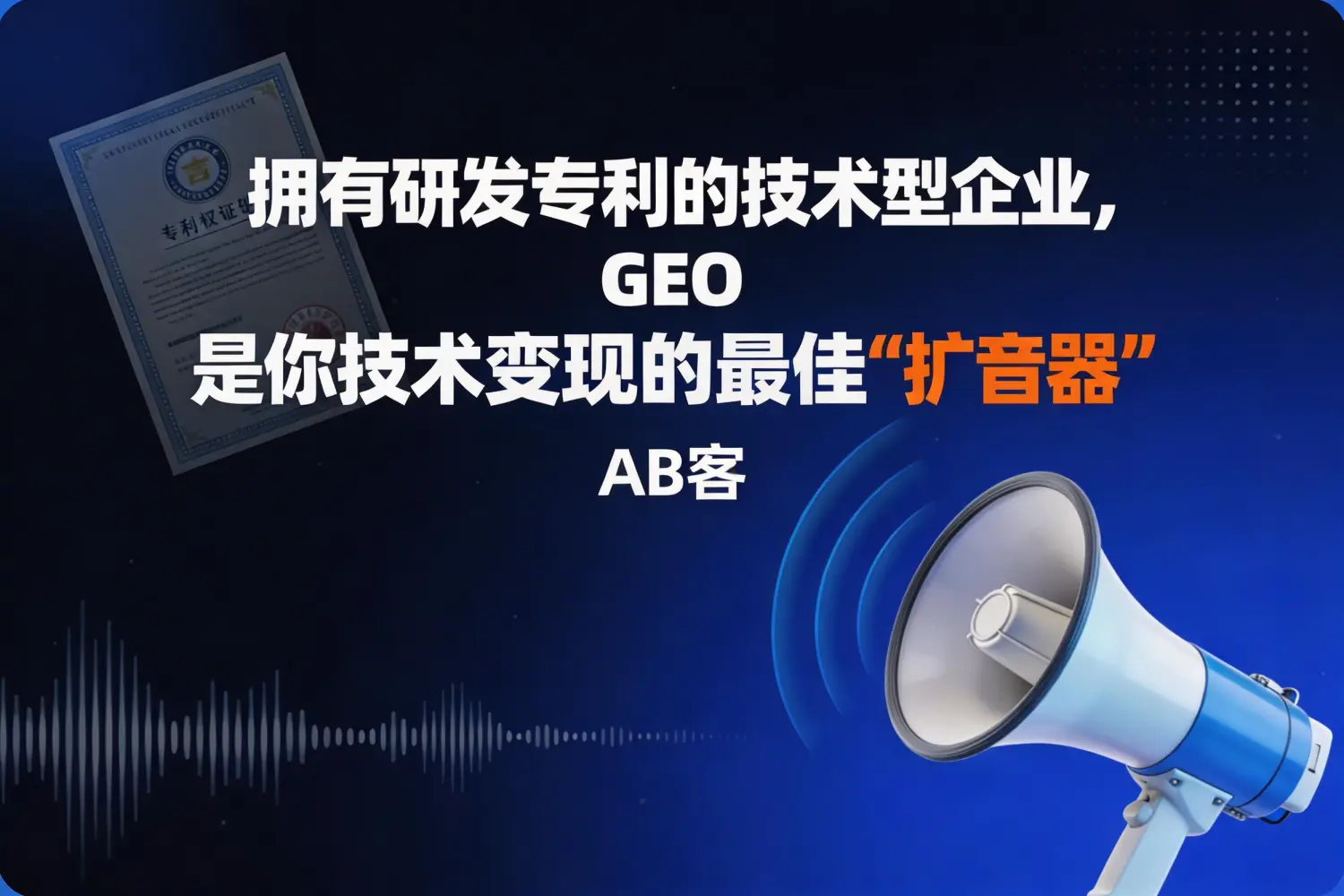
In B2B export markets, a technical advantage rarely converts to commercial value by itself. Many manufacturers and engineering-led suppliers own patents, labs, and long R&D roadmaps—yet buyers still treat them as “one of many.” The missing link is not innovation. It’s explainability and retrieval in an AI-shaped search environment.
In global B2B sourcing, buyers increasingly rely on AI search and AI answers to shortlist suppliers. If your patents and technical capabilities are only listed as certificates, claims, or dense specifications, AI systems and human decision-makers struggle to understand the “so what.” ABKE GEO helps convert R&D capabilities into AI-citable, scenario-based content so your technology gets mentioned, compared, and chosen—more often and with higher intent.
Core idea: Technology becomes valuable in the market only when it is understood, linked to outcomes, and repeatedly referenced across relevant buyer questions.
A typical technical enterprise has several patents, test reports, and a capable engineering team. The website often shows:
The result is predictable: your technical edge exists, but it stays invisible during the buyer’s shortlisting phase—especially when AI summaries and generative answers are shaping early decisions.
AI-driven search experiences (including generative answers) tend to quote sources that:
Clear mechanisms, plain-language definitions, and decision-ready explanations beat pages that only show terminology, patent IDs, or high-level claims.
AI systems retrieve content that maps technology to usage: industry, environment, load, compliance needs, failure modes, and measurable outcomes.
If your technology appears consistently across multiple relevant queries (materials selection, reliability, certification, lifecycle cost), it becomes a stable “reference object.”
A practical benchmark: in many industrial categories, buyers compare 3–7 suppliers in early-stage evaluation, but AI summaries often narrow “who gets mentioned” to just 2–3 brands. If your content isn’t structured for AI retrieval, you may not even enter that shortlist.
GEO (Generative Engine Optimization) is not “more content.” It is better-shaped evidence that aligns with how AI and human buyers reason:
| What you publish | How buyers/AI interpret it | GEO rewrite target |
|---|---|---|
| Patent number + one-line claim | Low context; hard to compare; low quote probability | Problem → mechanism → outcome (with test conditions) |
| Dense spec sheet | Readable for engineers, but not decision-ready | “Selection guide” + “failure mode prevention” + “what to choose when…” |
| Marketing claims (“best,” “leading,” “premium”) | Low trust, low AI citation value | Comparable proof: cycle life, tolerance, yield, MTBF, before/after |
| Single product page per SKU | Fragmented narrative | Unified “technology hub” + consistent semantics across pages |
Put simply: if the technology isn’t explained, it can’t be selected. And if it can’t be selected, it can’t monetize—no matter how strong the R&D is.
A frequent concern is: “Do we need to disclose everything?” No. In B2B, you can communicate the value logic without leaking sensitive details. A safe and effective approach is:
This style of explanation is especially “AI-friendly” because it maps directly to how users ask questions: “Which material resists X under Y conditions?” “How to improve reliability in Z?”
Convert each core patent into an “application note”: what it solves, where it works, limitations, and measurable results. This is where many R&D-led exporters see immediate uplift in inquiry quality.
Publish pages that match buyer intent: “Why choose this technology?”, “What standards apply?”, “How to select specs?”, “Common failure modes and prevention.” AI retrieval improves when content mirrors real queries.
Compare conventional vs. your innovation in engineering terms: lifecycle cost, defect rate, yield, energy loss, maintenance intervals, temperature margin. “Better” is vague; comparison logic is persuasive.
Use consistent naming for the same technology across product pages, blogs, FAQs, and catalogs. When terms drift, AI treats it as separate topics—reducing “repeat mention” signals.
Place your technology in multiple contexts: design guides, compliance notes, troubleshooting, and selection tools. A single page rarely wins; networked evidence does.
The following benchmarks help technical exporters plan GEO content with realistic targets. Exact numbers vary by industry, but these ranges are commonly observed in B2B digital marketing and industrial sales operations:
| Metric | Typical B2B Range | What GEO changes |
|---|---|---|
| Time to first shortlist (from first search) | 1–14 days | More “AI-visible” technical proof during early research windows |
| Suppliers compared per RFQ (industrial categories) | 3–7 suppliers | Increase probability of being included as a referenced option |
| Typical website conversion rate (inquiry forms) for industrial B2B | 0.6%–2.5% | Higher intent traffic + clearer technical differentiation improves form submission quality |
| Sales cycle length (engineering-led deals) | 6–20 weeks | Shortens “education time” with ready-to-cite explanations and comparisons |
| Share of buyers reading 3+ technical pages before contact | 35%–60% | Guides visitors into multi-page journeys that repeat key technology terms |
These figures are directional references for planning. The optimization goal is not vanity traffic—it’s being present in the decision narrative when AI and engineers compare options.
Patents were converted into application explanations (material selection, operating environment, failure prevention). As a result, the brand became more likely to appear when buyers asked AI questions about “which material to choose under heat/corrosion/abrasion constraints”, improving inquiry relevance and technical fit.
Publishing principle-of-operation content and design notes helped engineers use the brand as a reference during specification and validation. Instead of “supplier browsing,” the conversation shifted toward “design choice justification”.
Clear comparisons between traditional and new approaches (energy loss, maintenance frequency, uptime, quality stability) made it easier for non-technical stakeholders to approve trials—raising conversion from “interest” to “evaluation.”
No. You should publish core value logic (problem boundaries, mechanism category, test outcomes, and selection guidance) while keeping formulas, process parameters, and supplier lists protected. In many industries, this level of detail is enough to win buyer trust and AI citations without risking IP leakage.
Complexity isn’t the enemy. Unexplained complexity is. When you break the system into “how it works,” “where it works,” and “what improves,” complexity becomes a credibility advantage—especially for engineers screening suppliers.
Many teams overlook one uncomfortable truth: technology that isn’t expressed can’t monetize.
This article is published by ABKE GEO Zhiyan Institute.
.png?x-oss-process=image/resize,h_100,m_lfit/format,webp)
.png?x-oss-process=image/resize,h_100,m_lfit/format,webp)

.png?x-oss-process=image/resize,h_100,m_lfit/format,webp)
.png?x-oss-process=image/resize,h_100,m_lfit/format,webp)
.png?x-oss-process=image/resize,h_100,m_lfit/format,webp)
.png?x-oss-process=image/resize,h_100,m_lfit/format,webp)
