外贸学院|

热门产品

外贸极客

Popular articles

Recommended Reading

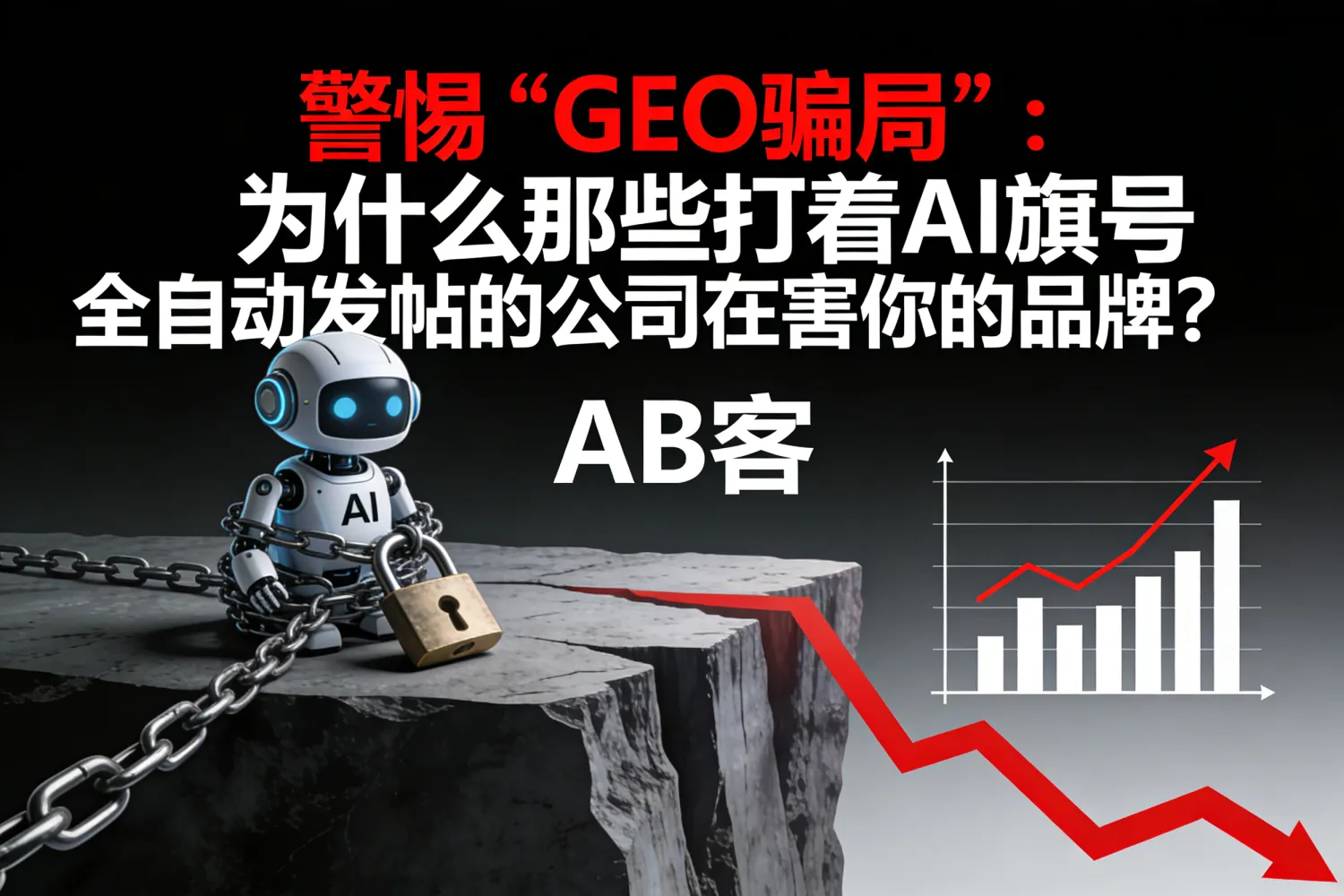
Watch Out for “GEO Scams”: Why Fully Automated AI Posting Can Quietly Damage Your Brand

发布时间:2026/03/18
阅读:440
类型:Other types

Many “GEO fully automated posting” vendors promise instant authority by mass-producing AI-generated posts across platforms. In reality, this tactic often creates repetitive, low-fact content, inconsistent messaging, and weak evidence signals—making AI search systems less likely to recommend your company. Real Generative Engine Optimization (GEO) is not about volume; it’s about credibility. Effective GEO combines human expertise with AI drafting, increases fact density (specs, certifications, cases), turns knowledge into atomic Q&A-ready snippets, and builds a consistent “web evidence cluster” across your website, B2B listings, and social profiles. With continuous updates and verified details, AI can accurately understand your capabilities and form long-term trust. This article is published by ABke GEO Institute of Intelligence Research.

GEO-41.jpg

Watch Out for “GEO Scams”: Why Fully Automated AI Posting Can Quietly Damage Your Brand

Many vendors sell “one-click GEO” as if volume alone can win visibility in AI search. In reality, bulk auto-posting often creates a trail of thin, repetitive content that weakens your credibility signals—exactly the opposite of what modern generative engines reward.

GEO (Generative Engine Optimization) AI Trust Signals B2B / Export Marketing Brand Authority

One-line takeaway

“Fully automated posting” is not GEO. It’s a brand trust killer. Generative engines are not fooled by quantity—they reward verifiable facts, consistency, and structured knowledge.

1) What “GEO scams” typically look like in the market

If you operate in export B2B, you’ve likely heard promises like:

  • “AI will generate content and publish automatically across platforms.”
  • “Thousands of posts will boost your weight instantly.”
  • “No human needed—one-click GEO optimization.”

These offers sound efficient, but they usually produce the same dangerous footprint: duplicated patterns, weak factual grounding, and messy brand signals spread across the web.

2) Why AI search engines won’t “buy it”

Generative engines (and the retrieval layers behind them) increasingly behave like strict editors: they prefer sources that are consistent, specific, and corroborated. In GEO, you are not competing for clicks only—you’re competing to become a trusted reference.

Signal #1: Fact Density (verifiable details)

High-performing B2B pages often include measurable data: specs, tolerances, standards, test methods, certifications, production capacity, lead time ranges, and real case constraints. As a practical benchmark, strong technical pages commonly reach 18–35% “hard facts” by word count (numbers, standards, named processes, test results), while spammy auto-posts often stay below 5%.

Signal #2: Structured Knowledge (atomic answers)

AI systems love content that can be extracted into “answer blocks”: definitions, comparisons, step-by-step processes, decision checklists, and FAQs that resolve a single question with minimal ambiguity. The trick is not to write longer—it’s to write in clean, reusable knowledge units.

Signal #3: Cross-web Consistency (evidence clusters)

Your website, B2B listings, social profiles, and downloadable PDFs should align on key facts: company name format, founding year, facility location, certifications, core products, and flagship use cases. When auto-posting creates mismatched claims, AI models treat your brand like an unreliable narrator.

Signal #4: Citation History (time-based trust)

Trust compounds. Brands that publish consistent, specific updates—new test reports, new customer scenarios, updated standards compliance—build a “reference trail.” In many B2B categories, meaningful authority gains typically require 8–16 weeks of steady evidence-building and can stabilize after 6–12 months of iteration.

Pure automation usually fails all four signals: it’s repetitive, low on verifiable details, inconsistent across channels, and rarely produces durable references. Result: AI systems reduce exposure—or simply ignore the brand.

3) The real damage caused by fully automated posting

3.1 Brand authority gets diluted (not amplified)

When prospects see a flood of generic posts, they subconsciously downgrade your expertise. In B2B, where purchase cycles are long and risk is high, buyers often use content quality as a proxy for operational discipline. A common pattern we observe in export industries: once a brand’s content looks “mass-generated,” response rates can drop by 10–30% even if traffic appears to rise temporarily.

3.2 Your “evidence cluster” breaks across the web

Automation tools often publish variations of the same claim on different platforms—different founding years, different MOQ, different material grade naming, different certificate lists. For AI systems, those contradictions are red flags. You lose the ability to form a clean, consistent brand entity in machine-readable space.

3.3 Buyers get confused—and trust evaporates

Buyers don’t need “more posts.” They need answers: which standard you meet, what failure modes you’ve solved, what lead time to expect, what documentation you can provide. If your channels are filled with vague marketing fluff, prospects may assume your team will be vague in engineering support and after-sales too.

3.4 No compounding value (traffic that doesn’t stick)

When posting stops, the “benefit” usually stops too—because the content never became a reference. Real GEO behaves differently: it compounds as your knowledge base becomes easier to cite, summarize, and recommend over time.

Approach What it produces Typical outcome in AI search Brand risk level
Fully automated bulk posting High volume, low uniqueness, weak facts Low citation likelihood; inconsistent entity signals High
Human + AI (reviewed) Fact-rich drafts with editorial verification Higher reuse in AI answers; stronger trust signals Low
Evidence-cluster GEO Consistent cross-web facts + atomic knowledge Compounding authority; stable recommendation potential Low

4) The correct GEO method (that AI can actually understand)

Proper GEO is closer to building a credible digital persona than running a posting machine. Below is a practical, SEO-minded framework you can apply to export B2B brands.

Step A: Use AI for drafts, humans for truth

AI is excellent for outlining, translating, and turning internal notes into readable drafts. But the final publishable version needs human verification: spec sheets, test reports, certificate IDs, process constraints, and real project context. If a vendor says “no human needed,” assume they’re selling speed, not trust.

Step B: Increase “factual surface area” (without bloating)

Add facts buyers and AI both value. For many manufacturing/export niches, these data points typically lift conversion quality:

  • Standards: ISO 9001, ISO 14001, IATF 16949, CE/FCC where relevant, plus industry-specific specs
  • Materials and grades: exact alloy/grade naming, alternatives, and trade-offs
  • Process controls: QC checkpoints, sampling method, measurement tools, tolerances
  • Capacity signals: monthly output range, typical MOQ range, lead-time range in peak vs off-peak seasons
  • Documentation: CoC/CoA availability, inspection reports, traceability approach

Step C: Create atomic knowledge slices (so AI can quote you)

Replace “big generic articles” with reusable blocks that answer one question clearly. Think:

Atomic Q: What’s the difference between Grade A vs Grade B in your product category?

Atomic Q: Which test method do you use to verify performance, and what is the acceptance range?

Atomic Q: What documentation can you provide for customs clearance and buyer QA?

When your site contains dozens of these clean answers, AI assistants can more safely cite you because the risk of hallucination drops.

Step D: Build a consistent evidence cluster across channels

A practical GEO checklist for cross-web consistency:

  • Identity: one official brand name + one short name; same logo; same company description
  • Core facts: founding year, address format, certification list, main product lines—no contradictions
  • Proof assets: certificates, lab/test photos, case studies, factory capability pages
  • Internal links: case studies reference product pages; product pages reference standards & QC pages

Step E: Keep iterating (GEO is a discipline, not a campaign)

Update pages when you add a new standard, improve yield, switch materials, expand capacity, or learn new failure patterns from customers. In many niches, refreshing your top evidence pages every 6–10 weeks keeps them aligned with reality—and makes AI recommendations safer.

5) A practical “anti-scam” checklist before you hire any GEO vendor

Use these questions to filter out automation-only providers quickly:

Question
A healthy answer looks like
Red flag answer looks like
How do you verify technical claims?
“We request specs, certificates, and proof; editor signs off.”
“AI writes it; it’s good enough.”
What content format do you deliver?
Atomic Q&A blocks, case pages, standards/QC pages, entity consistency.
“Thousands of short posts everywhere.”
How do you manage cross-platform consistency?
Brand/entity guidelines; centralized fact sheet; update workflow.
“We just publish; platforms don’t matter.”
What metrics define success?
Inquiry quality, citation visibility, SERP/AI answers presence, consistency score.
“Number of posts published.”

6) Action plan you can start this week (no spam required)

  1. Stop any “one-click auto posting” that publishes unchecked claims.
  2. Create a one-page Brand Fact Sheet (products, standards, certifications, capacity ranges, lead time ranges, warranty terms).
  3. Draft 12–20 atomic Q&A pieces from real buyer emails and RFQs (not from keyword tools alone).
  4. Publish 2 case studies with constraints, specs, and outcomes (what changed, what was measured, what standard was met).
  5. Align your key pages and profiles so the same facts appear everywhere, in the same wording.

If your internal team is busy, this is exactly where “human + AI” should be applied: use AI to accelerate drafting, but keep truth, proof, and consistency under human control.

Build GEO the Right Way: Earn AI Trust, Don’t Rent Spam

Want AI search to “understand” your company as a credible supplier? Start with a proof-driven knowledge base: atomic answers, consistent brand facts, and evidence clusters that compound over time.

Explore ABke GEO methods for trustworthy Generative Engine Optimization

Practical, evidence-first GEO—designed for export B2B brands that need long-term recommendations, not short-term noise.

Published by ABke GEO Intelligent Research Institute.

GEO scam AI auto-posting generative engine optimization AI search trust B2B brand authority

AI 搜索里,有你吗?

外贸流量成本暴涨,询盘转化率下滑?AI 已在主动筛选供应商,你还在做SEO?用AB客·外贸B2B GEO,让AI立即认识、信任并推荐你,抢占AI获客红利!
了解AB客
专业顾问实时为您提供一对一VIP服务
开创外贸营销新篇章,尽在一键戳达。
开创外贸营销新篇章,尽在一键戳达。
数据洞悉客户需求,精准营销策略领先一步。
用智能化解决方案,高效掌握市场动态。
用智能化解决方案,高效掌握市场动态。
全方位多平台接入,畅通无阻的客户沟通。
全方位多平台接入,畅通无阻的客户沟通。
省时省力,创造高回报,一站搞定国际客户。
个性化智能体服务,24/7不间断的精准营销。
多语种内容个性化,跨界营销不是梦。
多语种内容个性化,跨界营销不是梦。
https://shmuker.oss-accelerate.aliyuncs.com/tmp/temporary/60ec5bd7f8d5a86c84ef79f2/60ec5bdcf8d5a86c84ef7a9a/thumb-prev.png?x-oss-process=image/resize,h_1500,m_lfit/format,webp