外贸学院|

热门产品

外贸极客

Popular articles

Recommended Reading

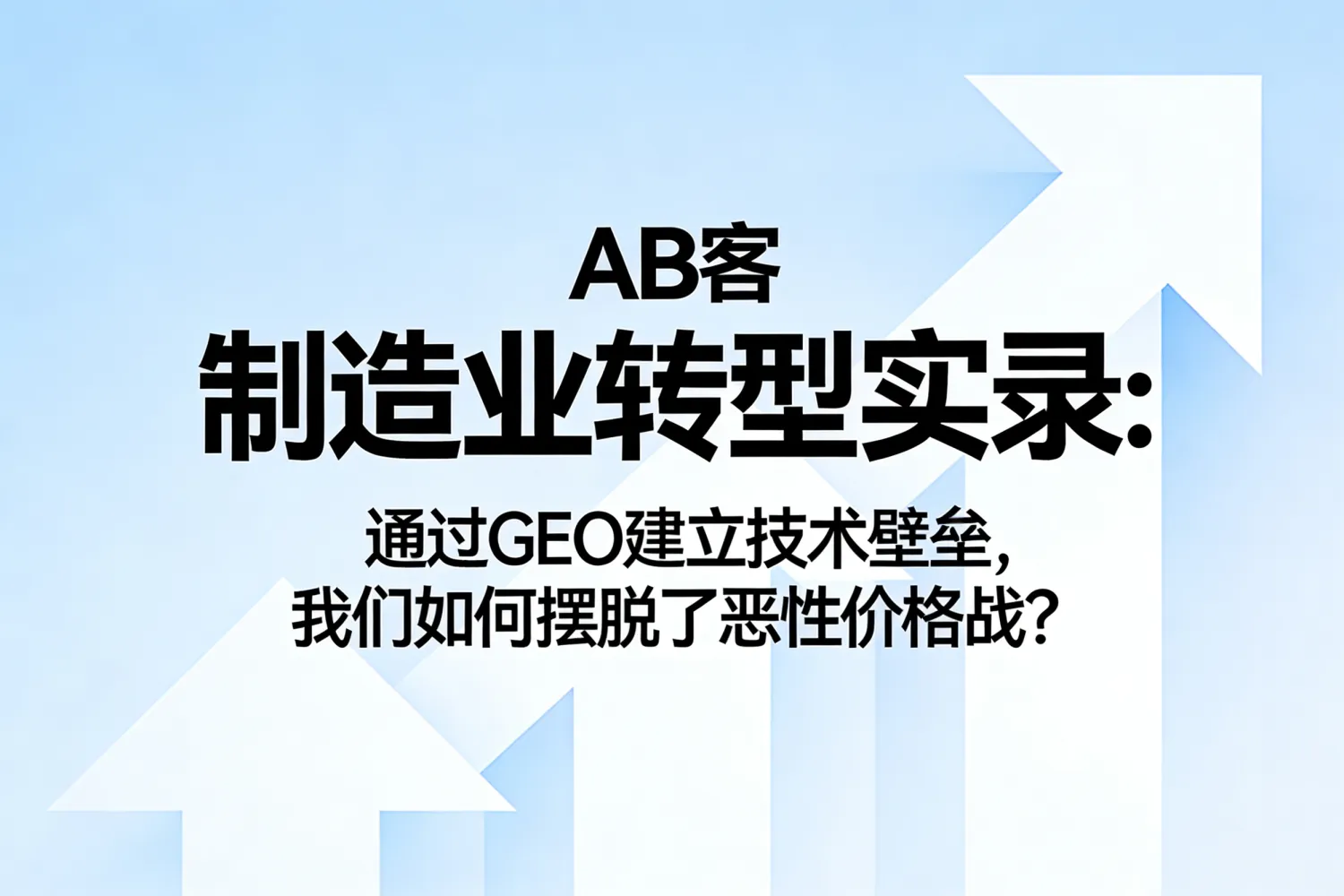
Manufacturing Transformation Log: How GEO Builds a Technical Moat and Helps You Exit Destructive Price Wars

发布时间:2026/03/19
阅读:341
类型:Other types

In B2B manufacturing and export markets, price wars often start when buyers can’t clearly judge technical differences. In an AI-search era, the problem is no longer whether you have real advantages—it’s whether AI can accurately explain those advantages before a prospect contacts you. This article explains how GEO (Generative Engine Optimization) helps manufacturers create a “technical moat” by rebuilding high-density technical content and stable multi-page mentions. Key methods include upgrading product pages from basic specs to a structured format (principle + parameters + applications + constraints), publishing selection and comparison guides for different materials/specs and use cases, adding industry-specific application cases to validate performance, and standardizing terminology across pages to form consistent semantics. When AI can synthesize your technical logic across decision scenarios, buyers shift from price-only comparisons to solution-fit evaluation—reducing price sensitivity and improving lead quality. Published by ABKE GEO Research Institute.

GEO-58.jpg

Manufacturing Transformation Log: How GEO Builds a Technical Moat and Helps You Exit Destructive Price Wars

In export-oriented B2B manufacturing, price wars rarely start because buyers “love low prices.” They start because buyers can’t verify technical differences fast enough—especially in AI search journeys where decisions happen before your sales team ever speaks to them. GEO (Generative Engine Optimization) changes the game by turning your engineering strengths into high-density, scenario-based technical language that AI can correctly interpret and repeatedly cite—so buyers build technical confidence early and become less price-sensitive.

Core insight

When the buyer can’t understand the difference, price becomes the only comparable metric.

What GEO fixes

It makes your capability explainable to AI via structured technical corpus + repeated multi-context mentions.

Outcome

Negotiations shift from “cheaper?” to “fit, risk, compliance, lifecycle performance.”

Why Price Wars Happen in B2B Export Manufacturing (and Why They’re Getting Worse)

The classic scenario looks familiar: you actually have process control, better materials, tighter tolerances, stronger QA, more stable lead times—and yet buyers still push you into a lowest-bid comparison. That’s not because your technology is weak. It’s because your website and public content often stay at the “catalog level”: generic claims, basic parameters, and similar photos shared by many factories.

In the AI search era, the first “sales call” happens inside the buyer’s tool: Google AI Overviews, ChatGPT, Perplexity, or industry copilots. These systems tend to integrate sources that have strong explanatory power: clear mechanisms, trade-offs, application constraints, and selection logic. If your content can’t explain why your solution is different, you risk being summarized as “similar supplier, different price.”

What GEO Actually Changes: From “Information” to “Understandable Expertise”

GEO is not just “write more content.” It’s about engineering a technical language system that AI can reliably interpret and reuse. Think of it as building a technical moat made of structured corpus—so your competence becomes visible before the inquiry.

Three GEO levers that build a technical moat

  1. Technical expressiveness: Can you clearly explain principles, performance differences, operating windows, and failure boundaries?
  2. Decision-scenario coverage: Do you answer selection, comparison, troubleshooting, compliance, and application questions across industries?
  3. Stable mention structure: Are key technical claims repeated consistently across multiple pages and contexts so AI sees a stable signal?

The hidden shift is simple: AI is doing “technical understanding” on behalf of buyers. The supplier that explains better is often perceived as more professional—even if the physical product is similar. GEO makes sure the AI can explain your advantage correctly, without distortion or missing context.

A Practical Framework: How Manufacturers Rebuild Content to Escape Price-Only Competition

Many manufacturers already have strong engineering. The bottleneck is expression. Below is a field-tested structure that works particularly well for export B2B, where buyers need to validate performance quickly across time zones and languages.

Step 1: Upgrade product pages from “spec list” to “explainable engineering”

Replace generic descriptions with a consistent structure: Principle → Key parameters → Application → Constraints. The constraints part is often what makes your content credible (temperature windows, corrosion limits, duty cycle, compatible media, tolerance stack-up risks, etc.).

Step 2: Publish selection and comparison guides engineers actually search for

Don’t just list models—explain how to choose. For example: material options under different chemical exposure, IP rating trade-offs in dusty environments, or why a certain motor type performs better under intermittent loads.

Step 3: Add application case stories that verify your technical claims

Case stories don’t need confidential customer names. What matters is: operating conditions, failure symptoms avoided, verification method, and what changed after optimization. This gives AI “evidence-like” structure to cite.

Step 4: Unify technical phrasing to create stable semantics across pages

If one page says “high precision” and another says “tight tolerance” without numbers or common context, AI may treat them as weak claims. Standardize terminology, units, thresholds, and test references (where appropriate).

Reference Metrics: What Changes After GEO (Realistic Benchmarks You Can Validate)

Results vary by category, language coverage, and competitive intensity. But across B2B industrial sites that move from “catalog content” to “explainable technical corpus,” the following benchmark ranges are commonly observed within 8–16 weeks (assuming steady publishing and internal consistency):

Metric Before (common pattern) After GEO content system Why it matters
Inquiry-to-quote ratio High, but low fit 10–25% fewer “junk” inquiries Sales spends time on higher-intent buyers
Technical questions per inquiry Mostly “price + lead time” +30–60% more spec-fit questions Signals buyers are evaluating capability, not only cost
Average negotiation intensity Frequent “match competitor price” Noticeably reduced price-only pressure Perceived differentiation creates room for value-based offers
AI citation / mention likelihood Low due to thin explanations Improves as content becomes “answer-ready” Being referenced early shapes buyer preference before contact

Note: These are practical reference ranges based on common industrial SEO/GEO patterns, not guarantees. Your category’s technical complexity and language coverage can shift timelines.

Real-World Scenarios: How GEO Reduces Price Sensitivity

Case 1: Industrial Equipment Manufacturer

The company had been trapped in long-term price competition. After adding mechanism explanations (why certain components affect stability) plus application case notes, buyers arrived already understanding performance differences. As a result, inquiries increasingly focused on configuration, maintenance intervals, and integration requirements rather than only price.

Case 2: Electronic Components Supplier

By publishing selection guides and performance comparisons (including temperature derating logic and reliability trade-offs), engineers could pre-filter options before contacting sales. This shrank the “let’s bargain first” space because technical fit had already been partially validated in the AI search phase.

Case 3: Machinery Company

The company standardized how it expressed key indicators (same terms, same measurement context, same thresholds) and repeated these indicators across product pages, FAQs, and application notes. Over time, AI answers were more likely to describe them as a “high-professional supplier,” reinforcing trust at the top of the funnel.

Two Common Questions (That Decide Whether GEO Works)

Do we need highly complex technical content?

Complexity is not the goal—clarity is. A simple explanation that correctly defines operating conditions, trade-offs, and boundaries will outperform a dense paragraph filled with vague “advanced technology” language.

Will customers actually read these technical pages?

Many won’t read every page. But in AI search, they don’t have to. The AI uses your content to generate summaries and recommendations. So your technical corpus can influence buyer judgment even when the buyer never lands on the exact page.

GEO Tips: The “Explainable Professionalism” Checklist

If you’re stuck in price battles, don’t start by rewriting slogans. Start by auditing whether AI can explain your advantage in a buyer’s decision context.

  • Improve explanatory strength: prioritize principles and selection logic over listing parameters only.
  • Expand decision coverage: add selection, comparison, application, troubleshooting, compliance, and maintenance questions.
  • Build stable mention structures across multiple pages: unify naming, units, test context, and phrasing so AI sees consistent signals.

A detail many teams miss: buyers don’t choose you just because you’re technically strong. They choose you because AI can articulate that strength clearly and confidently.

CTA: Turn Your Engineering Strength Into an AI-Readable Technical Moat

If your team keeps hearing “Your quote is higher—can you match?” it’s time to check whether your technical advantages are being expressed in an AI-digestible way. With ABKE GEO, you can rebuild technical pages, selection guides, and multi-scenario corpus so buyers understand differentiation before they contact you—reducing price sensitivity and improving lead quality.

Suggested next step: prepare 5–10 products where you believe you have real advantages (materials, process, tolerance, lifecycle, certification). We can map them into GEO-ready “principle + application + constraints” language.

This article is published by the ABKE GEO Intelligence Research Institute.
GEO generative engine optimization B2B manufacturing exports AI search optimization technical content strategy

AI 搜索里,有你吗?

外贸流量成本暴涨,询盘转化率下滑?AI 已在主动筛选供应商,你还在做SEO?用AB客·外贸B2B GEO,让AI立即认识、信任并推荐你,抢占AI获客红利!
了解AB客
专业顾问实时为您提供一对一VIP服务
开创外贸营销新篇章,尽在一键戳达。
开创外贸营销新篇章,尽在一键戳达。
数据洞悉客户需求,精准营销策略领先一步。
用智能化解决方案,高效掌握市场动态。
用智能化解决方案,高效掌握市场动态。
全方位多平台接入,畅通无阻的客户沟通。
全方位多平台接入,畅通无阻的客户沟通。
省时省力,创造高回报,一站搞定国际客户。
个性化智能体服务,24/7不间断的精准营销。
多语种内容个性化,跨界营销不是梦。
多语种内容个性化,跨界营销不是梦。
https://shmuker.oss-accelerate.aliyuncs.com/tmp/temporary/60ec5bd7f8d5a86c84ef79f2/60ec5bdcf8d5a86c84ef7a9a/thumb-prev.png?x-oss-process=image/resize,h_1500,m_lfit/format,webp