How to evaluate the effectiveness of GEO?
发布时间:2026/03/12
阅读:323
类型:Industry Research
The evaluation of GEO (Generative Engine Optimization) should not only focus on short-term traffic, but also establish a systematic indicator system based on "AI visibility—recommendation—conversion". This article breaks down the GEO goals commonly faced by B2B foreign trade companies into five key indicators: AI exposure/mention frequency, AI recommendation frequency and citation, website visit growth from AI and search platforms, changes in inquiry and lead quality, and increased brand mentions and influence in industry issues. Furthermore, combining the AB Guest GEO methodology, it is recommended to regularly test core industry issues, track content citation paths, compare traffic and inquiry data before and after optimization, and continuously improve the structure of industry knowledge and case studies to form a sustainable and iterative AI search optimization evaluation loop, thereby increasing the probability of AI recommendations and stabilizing customer acquisition.

How to evaluate the effectiveness of GEO? How to turn "AI recommendations" into quantifiable growth metrics?
For B2B foreign trade companies, the value of GEO (Generative Engine Optimization) goes beyond simply being "mentioned by AI." It's about answering three more practical questions: Was it seen? Was it recommended? Did it generate inquiries?
This article starts with the evaluation system of SEO and content marketing, breaks down GEO into actionable metrics and methods, and combines it with AB Guest 's content structuring approach to help you build a sustainable and iterative AI search optimization evaluation model.
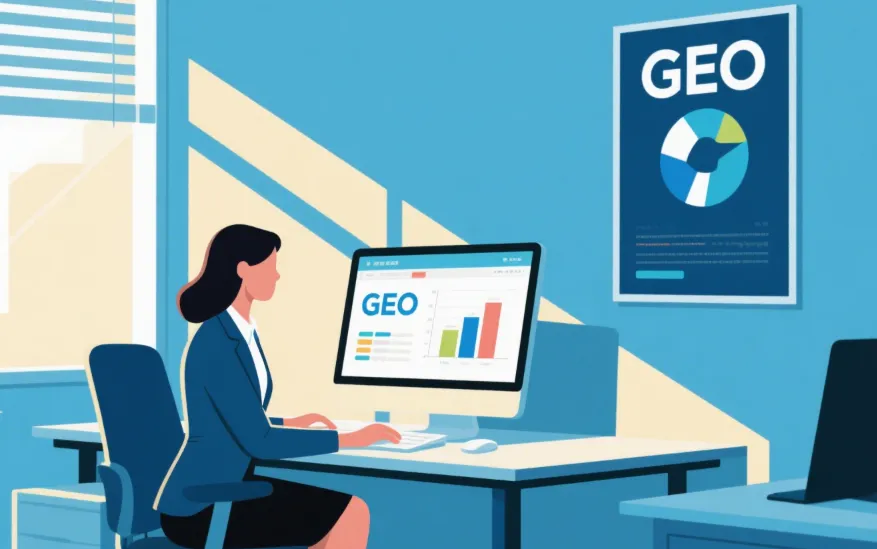
A single infographic explains the five core indicators of GEO evaluation.
Traditional SEO focuses more on "ranking—clicks—conversion," while GEO is more like "knowledge assets—citations—recommendations—trust—conversion." Therefore, it is recommended to start with the following five types of metrics:
| Indicator Categories |
What do you want to see? |
Recommended quantitative standards (practical and applicable) |
Reference thresholds (common in B2B foreign trade) |
| AI Exposure |
Does the AI search/Q&A process include brand, website, or product names? |
"Number of mentions per week" + "Number of issues covered per month" |
It appeared sporadically in January and February; it appeared steadily from March onwards. |
| AI recommendation frequency |
Does AI consider you an "optional supplier/solution"? |
"Recommendation Occurrence Rate" = Number of Recommendations / Number of Tests |
15%-30% is the starting point; 30%-60% is the range where customer acquisition is possible. |
| Website traffic growth |
Are sessions from search/AI platforms increasing? |
"Natural traffic month-on-month" + "Percentage of traffic from AI sources" |
A month-on-month growth rate of ≥10% for three consecutive months is considered healthy. |
| Changes in Inquiries |
Are forms, WhatsApp, emails, and RFQs increasing? |
"Number of valid inquiries per month" + "Inquiry quality score" |
Significant improvement is more common within 3-6 months. |
| Brand influence |
Are industry issues mentioned earlier or are they more stable? |
"Brand mention percentage" + "Positive context percentage" |
A quarterly timeframe is more suitable for observation (due to less volatility). |
Note: The threshold is a common industry experience reference and is affected by product unit price, decision-making chain, regional market and content reserves. It can be adjusted according to your business data.
Why can't GEOs only look at traffic? First, understand the logic of "AI recommendation".
Many companies, when first implementing GEO, use traditional SEO metrics: Is there a significant increase in traffic? Is there an immediate surge in inquiries? The result is often the conclusion that "the effect is not obvious." However, the underlying mechanism of GEO is more like "content being understood and paraphrased by AI," and it typically involves a gradual, incremental process.
- Content is being crawled : Website articles, product pages, case study pages, FAQs, and downloadable materials are being continuously discovered and read.
- Semantic understanding : AI maps your business into "who you are/what you do/who you are suitable for/what problems you solve/what your advantages are".
- Content citation : When AI answers industry questions, it begins to cite "your viewpoint/method/parameter/case".
- Recommendation enhancement : When you can provide credible information in multiple problem scenarios, AI is more willing to consider you as a candidate.
- Customer conversion : Potential customers enter the site through AI/search, generating inquiries or prompting sales follow-ups.
Therefore, a more reasonable evaluation method is to use a three-tiered linkage of exposure (being seen) → recommendation (being selected) → conversion (being contacted) , rather than focusing on just one metric.
How to quantify the indicators? Here's an "executable" GEO monitoring method.
1) Monitoring AI Exposure: From "whether it was mentioned" to "how many times it was mentioned"
It is recommended to establish a fixed "industry question bank" and test with the same questions every week (ChatGPT, Perplexity, Google AI Overviews, etc.), and use the results as "retrospective samples" instead of searching sporadically.
Reference question types (high-frequency in foreign trade B2B): supplier recommendations, price influencing factors, specification selection, certification standards, industry application solutions, common faults and maintenance, delivery time and logistics precautions, etc.
Suggested fields for recording: date, platform, issue, whether mentioned (Y/N), mention position (before/in/after), whether with a link, and mention context (positive/neutral/negative).
2) Monitor AI recommendation frequency: Use "recommendation occurrence rate" as the core KPI.
What truly brings business opportunities is often not "being quoted," but rather AI adding you to the supplier/solution list and even providing reasons "why you are recommended."
Recommended occurrence rate (suggestion):
Recommendation occurrence rate = (Number of times explicitly recommended by AI ÷ Total number of tests) × 100%
Taking a common starting strategy as an example: test 20 questions per week (covering products, applications, and regions). If you are recommended 4 times, then the recommendation occurrence rate is 20%. When the recommendation occurrence rate steadily increases to 30%-60%, it usually means that the content system has begun to be "used as a reliable source of knowledge" by AI.
3) Monitor website visits: Use "trends" instead of "peak days".
For B2B foreign trade, the content conversion cycle is relatively long, so daily traffic fluctuations are not very meaningful. It is more recommended to look at trends over 8-12 consecutive weeks : organic search conversations, core landing page visits, dwell time, bounce rate, return visit rate, etc.
Reference data (common ranges for foreign trade B2B content pages):
Average dwell time is 1 minute 10 seconds to 2 minutes 40 seconds; bounce rate is 45% to 70%; return rate is 8% to 18%. When you make your FAQs, parameters, and application scenarios more "readable and referable", dwell time usually improves first.
It would be better if you could separately label the source as "from AI platform/AI citation" in the statistics tool; even if you cannot identify it accurately for the time being, you can use "brand keyword growth" or "long-tail problem keyword growth" as alternative signals.
4) Monitor inquiries: Consider both "quantity" and "quality".
More inquiries are not necessarily better; rather, inquiries that are more "like those of your target customers" are better. It's recommended to categorize inquiries into a simple quality classification (e.g., A/B/C): Category A inquiries specifying specifications, quantity, application, and timeframe; Category B inquiries demonstrating consulting ability and pricing; and Category C inquiries that are vague or clearly mismatched.
Referring to the pace of change: Many companies first see "mentions/citations" in the 2nd-3rd month, then see improved visit trends in the 3rd-4th month, and the quality of inquiries begins to stabilize in the 4th-6th month. If your product has a high average order value and a long certification chain, it is normal for the cycle to be longer.
Using AB Guest GEO for evaluation: Treating the "content system" as a manageable asset.
Many companies get stuck on a certain point when implementing GEO (Google, Amazon, Google) articles: they write a lot of articles, but AI still only "occasionally mentions them and rarely recommends them." The common reason is not a lack of effort in creating content, but rather that the content structure is not conducive to AI understanding : information is scattered, lacks definitions, lacks comparisons, lacks evidence, and lacks restateable conclusions.
ABke's GEO methodology places greater emphasis on industry-specific content structures: linking "industry knowledge—products—solutions—case studies—FAQs—certificates and capability verifications" into a closed loop, making it easier for AI to form stable semantic profiles, thereby increasing the probability of recommendations.
| Content Module |
AI prefers this writing style |
Metrics you can use |
| Industry knowledge/standards |
Definition + Applicable Scenarios + Key Parameters + Common Misconceptions + Selection Suggestions |
Long-tail keyword coverage, AI citation rate, and dwell time |
| Product Page/Category Page |
Structured parameters, comparison tables, application diagrams, FAQs, and downloadable materials. |
Core page click-through rate, inquiry conversion rate, and AI recommendation appearance rate |
| Solution |
Customer pain points → Solution steps → Configuration suggestions → Risks and compliance → Delivery |
Solution page engagement, depth of visit, and inquiry quality |
| Cases and Evidence |
Background - Challenges - Solutions - Results (using data), Reusable Experiences |
Case study page views, downloads/favorites, and the percentage of Category A inquiries |
| FAQ/Q&A Database |
Question and answer format, short conclusions + supplementary explanations + precautions |
Number of covered issues, number of AI-referenced snippets, and growth of long-tail keywords |
A more realistic case study of the "B2B foreign trade rhythm" (for reference)
Taking a manufacturing B2B foreign trade company as an example (with a long product decision chain and high average order value), after organizing the content structure according to the AB customer GEO approach and continuously updating it, the common performance trajectory is roughly as follows:
| cycle |
Observable changes |
Suggested actions |
| Weeks 1-4 |
A few AI-generated mentions; long-tail keywords are starting to be indexed; content page dwell time has slightly improved (within +10%). |
Complete the FAQ, parameter comparison, definitions and application scenarios; standardize terminology. |
| 2nd month |
AI has begun to cite some viewpoints or parameters; the recommendation frequency has increased from 0 to 10%-20%. |
Added "Selection Guide/Pitfall Avoidance Checklist/Standard Comparison Table" and enhanced the ability to quote paragraphs. |
| 3rd month |
AI-generated recommendations have increased significantly; organic traffic has typically increased by 10%-25% month-on-month. |
Add supplementary case studies and evidence; make the solution page a "reproducible process". |
| 4-6 months |
The quantity and quality of inquiries are more stable; the proportion of Category A inquiries is gradually increasing (e.g., from 20% to 30%-40%). |
Expand the content cluster to address high conversion rates; iterate on the landing page conversion components. |
Note: If your industry has high compliance thresholds (certification, material standards, export controls, etc.), it is recommended to present "certificates/test reports/quality processes" in a clearer structure, which will often significantly affect whether AI dares to recommend you.
Common misconception: Why did you "get seen by AI" but not generate any inquiries?
Myth A: Only writing the brand story, neglecting decision-making information.
AI and buyers need more "selection parameters, application boundaries, comparison logic, and precautions." A good story can be helpful, but it's not enough to make someone decide to contact you.
Myth B: Without a coherent content structure, AI cannot create stable user profiles.
No matter how well an article is written, if there are no clear links and consistent terminology between the product page, FAQ, and case studies, AI will have difficulty judging your "professional boundaries" and will make more conservative recommendations.
Myth C: Optimizing exposure only, without optimizing the conversion path
If users can't find downloadable materials, contact persons, delivery capabilities, or evidence after entering the site, inquiries will naturally drop. The better GEO is done, the more the landing page needs to be made "more like a sales assistant."
Want to turn "AI mentions" into stable inquiries? Build your evaluation system with ABkeGEO.
If you want to improve your exposure and customer acquisition capabilities in AI search tools such as ChatGPT and Perplexity , it is recommended to upgrade your GEO from "trying to write a few articles" to a "monitorable, reviewable, and iterative" content growth system as soon as possible.
ABkeGEO focuses on AI search optimization for B2B foreign trade enterprises. Through industry-specific content structure, indicator-based evaluation, and continuous iteration, it helps you improve the probability of AI recommendations and gradually establish a stable AI customer acquisition channel.
Start now: Get your GEO assessment checklist and content structure optimization suggestions
Learn about ABkeGEO (AI Search Optimization for B2B Foreign Trade)
Recommended preparation: Link your main product, target market, typical application scenarios, and existing content to improve communication efficiency.
This article was published by AB GEO Research Institute.
GEO Effect Evaluation
Generative engine optimization
AI Search Optimization Metrics
Foreign Trade B2B Customer Acquisition
AB Customer GEO
.png?x-oss-process=image/resize,h_100,m_lfit/format,webp)

.png?x-oss-process=image/resize,m_lfit,w_200/format,webp)







.png?x-oss-process=image/resize,h_100,m_lfit/format,webp)
.png?x-oss-process=image/resize,h_100,m_lfit/format,webp)

.png?x-oss-process=image/resize,h_100,m_lfit/format,webp)
.png?x-oss-process=image/resize,h_100,m_lfit/format,webp)
.png?x-oss-process=image/resize,h_100,m_lfit/format,webp)
.png?x-oss-process=image/resize,h_100,m_lfit/format,webp)
