.png?x-oss-process=image/resize,h_100,m_lfit/format,webp)

.png?x-oss-process=image/resize,m_lfit,w_200/format,webp)

热门产品

热门文章
自动外贸询价跟进系统零代码快速部署流程详解
构建多语言关键词监测系统,用于对外贸易融资的精准预警和风险控制
外贸SOHO必备数据分析平台使用技巧:销售数据驱动决策的技术知识
真实案例:3个月转化率翻倍!零基础也能上手的外贸网站优化指南!
马来西亚SIRIM认证流程:无线设备出口的必要本地测试策略
行业研究:国际贸易中B2B报价谈判的关键策略与技巧
外贸B2B全行业指南:消费品行业为什么一定要做独立站?
外贸B2B独立站:如何平衡Google排名与客户体验?
外贸网站运营与数据分析:从流量到询盘的闭环优化
外贸SEO长期有效策略:建立内容-流量-转化的数据闭环机制
Recommended Reading




How can foreign trade enterprises gain a foothold in the "front end of decision-making" amidst the changes in the procurement decision-making process in the AI era?
Customer purchasing decisions are shifting to the AI-driven question-and-answer stage. This article provides an in-depth analysis of how AI is reshaping the B2B procurement decision-making process in foreign trade, and how enterprises can build a digital identity through GEO (Generative Engine Optimization) to be understood, trusted, and prioritized by AI at the customer decision-making front end. AB-K's B2B Foreign Trade GEO Intelligent Customer Acquisition Solution helps enterprises seize the AI decision-making entry point.

Over the past decade, foreign trade B2B companies have had a highly consistent understanding of "customer acquisition":
Customer → Search keywords → Compare suppliers → Contact you.
But in 2025–2026, this path is being rapidly rewritten.
More and more overseas buyers have completed 70%–80% of the information assessment before actually contacting suppliers;
This judgment did not occur on the Google search results page, nor on the B2B platform rankings—
It happens in the AI's "answer".
When customers start asking AI questions first, the real competitive position of foreign trade enterprises has been quietly shifted forward.
Additionally, the latest 2026 Foreign Trade GEO White Paper has been released and can be downloaded and viewed for free. The link is here: 2026 Latest Foreign Trade GEO White Paper Released: Seize the AI Recommendation Dividend and Break Through the Bottleneck of Customer Acquisition in Foreign Trade!
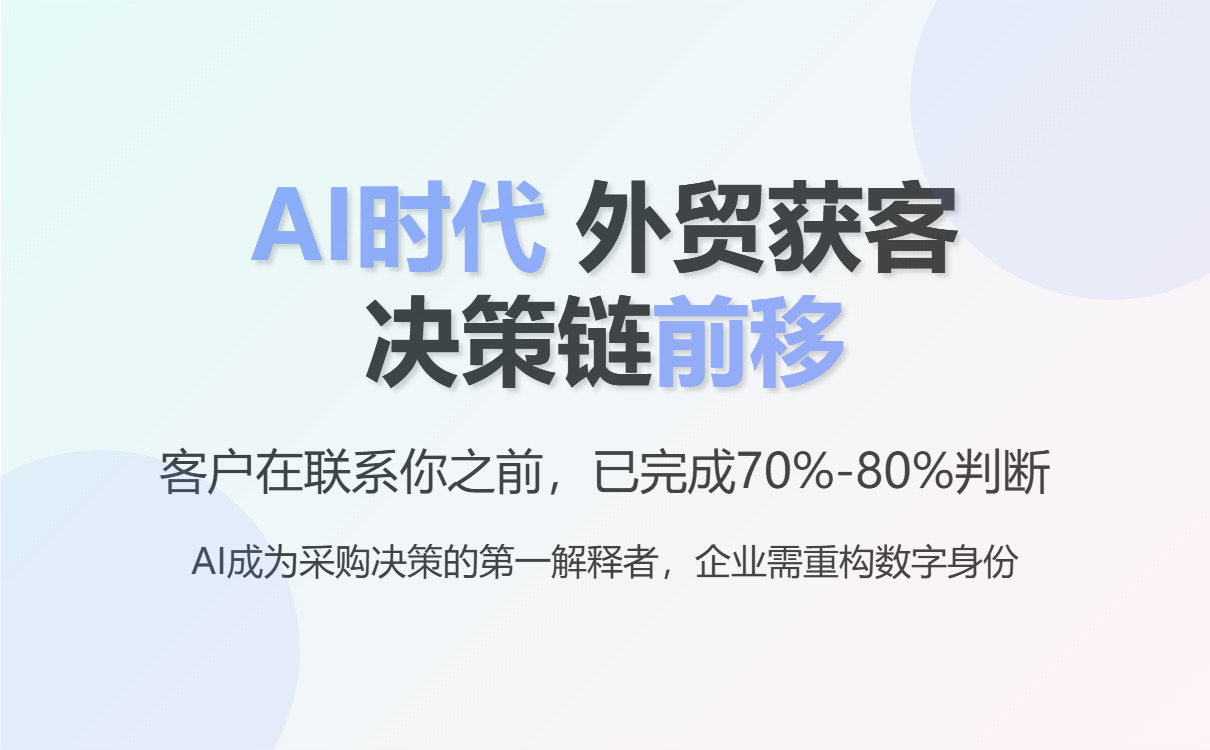
I. Procurement decisions are moving forward: Customers have already made their choices "before they contact you".
In traditional procurement models, the main competition among companies focuses on two stages:
-
Search Phase: Who ranks higher?
-
Comparison phase: Which has a better-designed page and a more attractive price?
However, with the intervention of AI, a fundamental change has occurred in the procurement decision-making chain:
The judgment no longer occurs when "browsing a website," but when "asking a question."
A real change in the procurement path
Traditional approach:
Demand arises → Google search → Open multiple official websites → Compare → Inquiry
A New Path in the AI Era:
Demand arises → Ask AI a question
→ AI provides a "recommended list + reasons for the judgment".
→ Clients only contact 1–2 “recommended companies”
In other words—
Whether you enter the AI's "recommendation field of vision" determines whether you enter the candidate pool.
If your answer isn't in the AI's answer,
Then your website, case studies, and technical details will never be seen by your clients.
II. How can AI reshape every key node in the procurement decision-making chain?
From "demand generation" to "final connection", AI is systematically involved in every step of the judgment.
1️⃣ Demand Clarification Phase: AI Becomes the "First Explainer"
Buyers no longer look for suppliers first, but instead ask:
-
Which supplier is suitable for this application?
-
What solution is typically used in this scenario?
-
What should I pay attention to when sourcing this product?
At this point, AI is not "displaying ads".
Instead, it involves organizing industry knowledge and providing logical judgments .
👉 If your enterprise knowledge is not structured and not understood by AI, you are "invisible" at this stage.
2️⃣ Solution selection phase: AI directly completes the first round of elimination.
AI will perform implicit filtering based on the information it "understands":
-
Is it a genuine manufacturer/solution provider?
-
Are there any real-world application scenarios and case studies?
-
Does it possess professional depth, rather than just generalities?
This step determined:
Who gets nominated and who gets ignored?
3️⃣ Comparison and Decision-Making Stage: The Impact of AI on the Final Trend
Even if the customer later visits the official website and discusses details,
However, AI has already implanted a "cognitive anchor" at the front end:
This supplier is more suitable for your scenario.
At this point, the company is no longer starting from scratch to persuade others.
Instead, it was the conclusions given by the AI that were being verified .
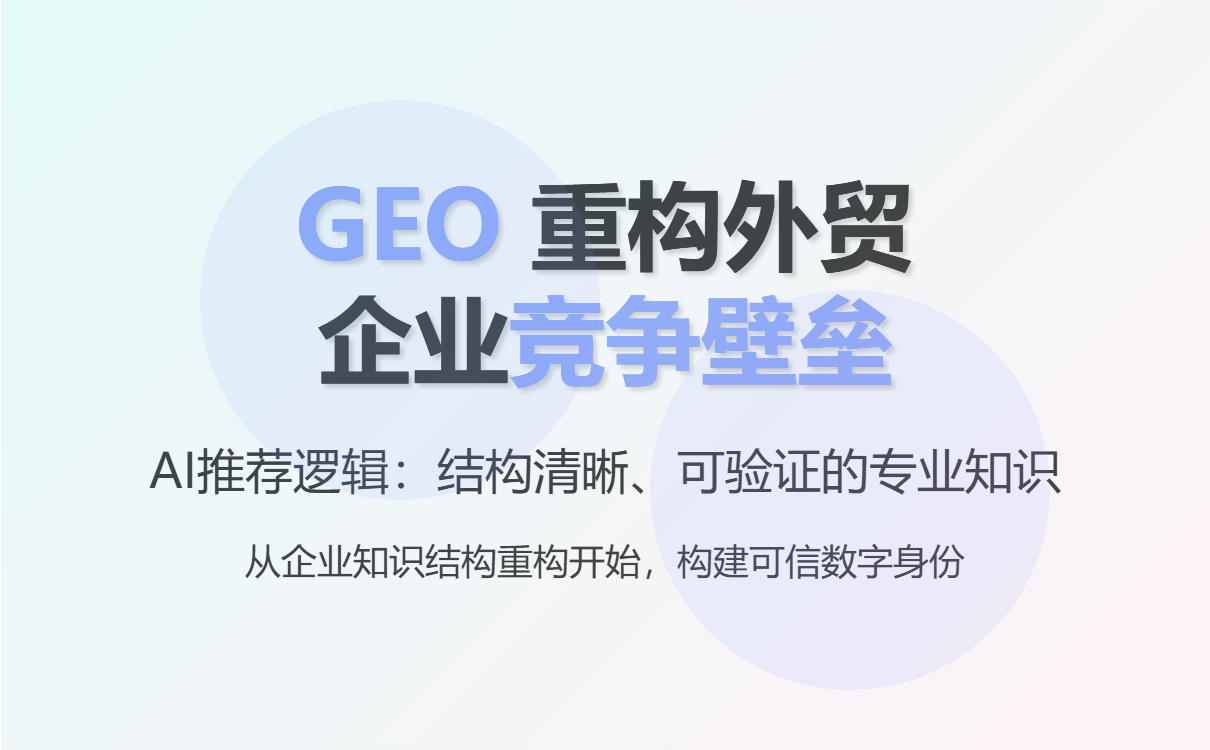
Third , what truly differentiates us is not "exposure," but rather "whether or not AI is used as a criterion for judgment."
Many foreign trade companies fall into a misconception at this time:
"Is it true that as long as we create more AI-generated content and mention our brand more often, we'll get recommended?"
The reality is quite the opposite.
AI's recommendation logic does not consider how many times you say you're good.
And look:
-
Is the information clearly structured and verifiable?
-
Does professional judgment come from real experience?
-
Are the expressions consistent across different channels?
-
Can it support a complete industry assessment?
This means that the essence of GEO has never been the quantity of content, but rather the enterprise's knowledge structure.
IV. What role does the GEO play in the early stages of procurement decision-making?
The core function of GEO (Generative Engine Optimization) is not "to make you visible".
Instead:
Make AI consider you a "credible source of answers" when answering industry-related questions.
At the forefront of procurement decisions, GEOs address three key issues:
1️⃣ Does AI know "who" you are?
-
Are you a manufacturer, solution provider, or trading company?
-
Are your core products and boundaries clear?
👉 This depends on the construction of enterprise identity and semantic anchors .
2️⃣ Does AI know what problems you are good at solving?
-
In which real-world scenarios is your product suitable?
-
Do you possess industry-level professional judgment?
👉 This relies on professional judgment content such as solutions, application scenarios, case studies, and FAQs .
3️⃣ Is AI willing to "recommend you" on key issues?
-
Does the information come from a unified and authoritative source?
-
Can it be cited and cross-validated multiple times?
👉 This depends on whether the content has been assetized, rather than existing in a fragmented manner.
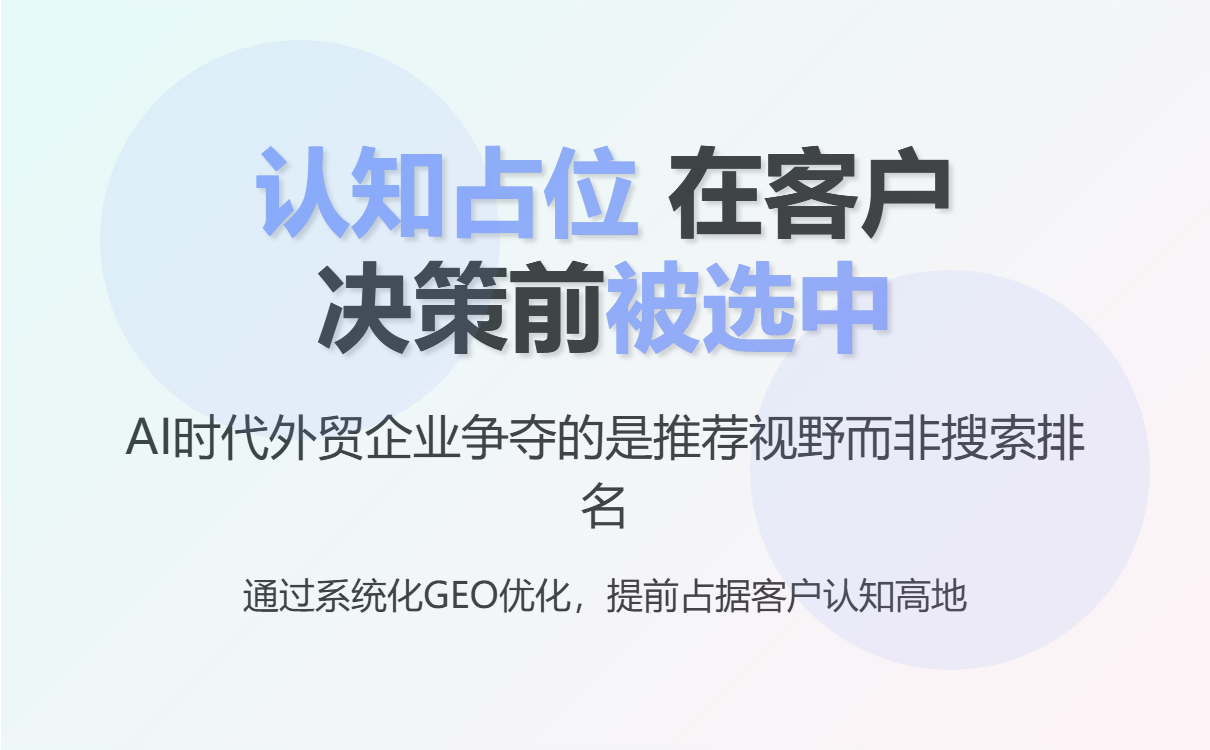
V. Case Study Perspective: How to influence customer perception in advance "outside of traditional processes"?
Take a multi-category export manufacturing company as an example:
Traditional dilemma
-
The official website has many products, but the logic is scattered.
-
Unable to be identified as a "solution-oriented enterprise" in AI search.
-
Customers often only see them during the comparison phase.
Changes after GEO reconstruction
By systematically reconstructing enterprise knowledge:
-
Define the company's role and the identity of its core products.
-
Form a complete judgment path from product → application scenario → solution → case study.
-
The official website has been upgraded to an AI-enabled "knowledge source".
The result was not a "surge in traffic," but rather:
-
It was directly used as a recommendation in AI question answering.
-
When the client contacts you, it's already clear whether you're a good fit for me.
-
Inquiry quality has significantly improved, and communication costs have decreased markedly.
This is a typical example of establishing cognitive position at the forefront of decision-making .
VI. Digital identity is becoming a new "competitive barrier" for foreign trade enterprises.
In the AI era, every enterprise is essentially having a "digital identity" constructed for it:
-
How would AI describe you?
-
In what situations would AI mention you?
-
What labels did AI assign to you?
If you don't build it actively
This identity will be pieced together from scattered information, third-party descriptions, and even misunderstandings .
The core value of GEO is precisely:
Help foreign trade enterprises build a clear, stable, and AI-trusted digital identity.
7. Why are more and more companies choosing systematic GEO instead of piecemeal optimization?
Because AI's judgment is a "system judgment," not a "single-point hit."
This is also the core logic emphasized by AB Customer's Foreign Trade B2B GEO Intelligent Customer Acquisition Solution :
-
Starting with the restructuring of corporate knowledge structure
-
Using intelligent website building to support content assets
-
Amplify the impact through AI recommendations and multi-channel collaboration.
-
Continuous Evolution with Marketing Intelligence and Data Loop
There is only one purpose:
This allows businesses to be "selected" before customers make a decision.
In conclusion:
AI will not recommend you based on your "existence".
It's simply because you are "easier to judge, verify, and trust".
In an era where AI is redefining the procurement decision-making process,
What foreign trade companies really need to compete for is not search engine rankings.
Instead—
Can we gain a foothold in the public consciousness before the customer even contacts anyone else?
This is precisely where the value of GEO lies.
.png?x-oss-process=image/resize,h_100,m_lfit/format,webp)
.png?x-oss-process=image/resize,h_100,m_lfit/format,webp)

.png?x-oss-process=image/resize,h_100,m_lfit/format,webp)
.png?x-oss-process=image/resize,h_100,m_lfit/format,webp)
.png?x-oss-process=image/resize,h_100,m_lfit/format,webp)
.png?x-oss-process=image/resize,h_100,m_lfit/format,webp)
