.png?x-oss-process=image/resize,h_100,m_lfit/format,webp)

.png?x-oss-process=image/resize,m_lfit,w_200/format,webp)

热门产品

热门文章
外贸获客痛点解析:从无询盘到稳定出单的智能解决方案
为什么外贸B2B企业必须拥有独立站?全面解析独立站价值与必要性
目标市场消费者需求调研全攻略:实操方法与工具指南!
【揭秘】顶级外贸人如何通过AI工具每日新增50+精准客户?
干货:不同类别、突出产品优势的外贸开发信写作技巧!
外贸AI超级营销员:企业应对关税战的解决方案
解密:如何用数据提升外贸开发信的说服力和专业性?
获客就靠这招!AB 客 AI引擎精准锁定目标客户,业绩翻倍不是梦!
一文带你全面了解“1+AI”外贸新营销模式,外贸人快上车!
正式加入!东帝汶成为东盟第11个成员国!东帝汶市场全面开发指南!
推荐阅读







.png?x-oss-process=image/resize,h_1000,m_lfit/format,webp)

How can small farms/small processing plants establish a closed loop for customer acquisition in food export within 6–12 months?
This article details how small farms and processing plants can establish a closed loop for customer acquisition in the food export market within 6–12 months, through B2B platforms, Google Ads, origin-based content, and official website systems, and consistently obtain high-quality inquiries.
(5).jpg?x-oss-process=image/resize,h_1000,m_lfit/format,webp)
In the field of food and agricultural product foreign trade, the most easily overlooked type of entity is often not large groups, but rather the most numerous small farms, small processing plants, and family-run production entities.
They possess genuine production locations, stable raw materials, and years of processing experience, but they generally face three difficulties in acquiring customers in foreign trade:
-
I have the goods, but I don't know where to find overseas buyers.
-
Once on the platform, I only receive inquiries about low prices and repeated price comparisons.
-
I placed an ad, but then the customer disappeared after asking a question.
The problem isn't with the product, but with:
Most early-stage food startups never successfully establish a "complete customer acquisition loop" from the very beginning.
This article will break down a food export customer acquisition model suitable for small farms/small processing plants to implement within 6–12 months from the perspective of real foreign trade practice. The goal is not to "increase exposure", but to make it work, stable and replicable .
Practical tools for food and agricultural products:
Food & Agricultural Products Customs Data Inquiry ⎪ Food & Agricultural Products Email Mining ⎪ Food & Agricultural Products Website Building ⎪ Food & Agricultural Products Customer Management ⎪ Food & Agricultural Products Email Marketing
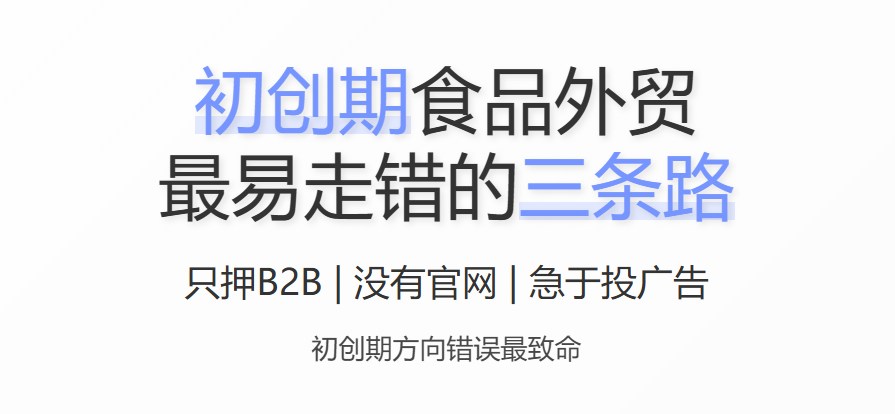
I. Three Common Mistakes for Startups in the Food Foreign Trade Industry
After interacting with numerous food and agricultural product companies, it becomes clear that the most common failure in the early stages is not a lack of effort, but rather a wrong direction.
1. Focusing solely on B2B platforms and treating "platform traffic" as everything.
Undeniably, platforms such as Alibaba, Made-in-China, and Global Sources...
There were indeed plenty of inquiries in the food category (nuts, dried fruits, grains and oils, seasonings, etc.).
However, the platform faces three unavoidable realities:
-
With severe homogenization, price has become the primary criterion for judgment.
-
The buyer does not belong to you, but to the platform.
-
It is difficult to establish long-term trust relationships.
The platform is suitable for scaling up, but not for building a lasting customer base .
2. No official website, or the website is just a "business card-style website".
Many small processing plants believe:
"Our customers mainly come from platforms or exhibitions, so it doesn't matter whether we have an official website or not."
But the reality is:
-
Almost all buyers with a modicum of expertise will check the official website before making an inquiry ;
-
A website that lacks content and information on the origin and compliance of its products will be skipped.
A business card-style website, simply addressing "your existence".
However, it cannot solve the problem of "you are trustworthy".
3. Eager to advertise, yet unable to build trust.
Food advertising has a relatively low CPC, making it suitable for initial testing.
However, the problem for many companies is:
-
Ads can generate clicks
-
However, they were unable to answer the questions that buyers cared about most.
turn out:
Traffic came, but trust was broken.
II. The most realistic goal in the initial stage: First, establish a successful customer acquisition loop.
For small farms/small processing plants, the first stage does not require pursuing large-scale growth, but rather identifying a core objective:
Get overseas buyers from "seeing you" to "being willing to contact you".
A complete and healthy customer acquisition loop in the early stages of a startup includes at least 5 stages:
-
Found (platform/search/advertisement)
-
Being understood (Official website/Content)
-
Trustworthiness (origin/process/compliance)
-
Contacted (inquiry/email)
-
Follow-up (continuous communication)
If any link in the chain breaks down, the investment will be ineffective.

III. Low-cost scaling packages that can be implemented in 6–12 months
Based on the real-world experiences of numerous food companies, a combination of B2B platforms, Ads, and official websites featuring products from their origins is the most reliable and cost-effective approach for startups.
1. B2B Platform: Solving the "Are there any inquiries?" problem.
Positioning principles:
-
Treat the platform as a "traffic entry point," not a transaction endpoint.
Key areas of focus:
-
Focus on promoting 1-2 core products
-
Specify MOQ, specifications, and packaging.
-
All information points to the official website, rather than repeated explanations.
The platform has only one task:
Guide buyers who want to learn more to your official website.
2. Google Ads: Validating Real Demand with a Low Budget
The advantages of advertising for food and agricultural products are:
-
Clear keywords
-
CPC is generally lower than that of industrial products.
Initial recommendations:
-
Only submit applications for "product + supplier/manufacturer".
-
Controlled areas (such as the Middle East, Southeast Asia, Europe and the United States)
-
Small-budget testing, not aiming for large-scale deployment.
The essence of advertising is not about making a sale.
Instead:
Verify which products people are actually contacting.
3. Official website: This is the most crucial link in the entire closed loop.
For early-stage food startups, their official website must address four key issues:
-
Who are you (the real subject)?
-
Where do you come from (origin and raw materials)?
-
How do you do it (processing steps)?
-
What guarantees your quality (testing and certification)?
If the official website cannot do these four things
Both platforms and advertisements will become "funnels".
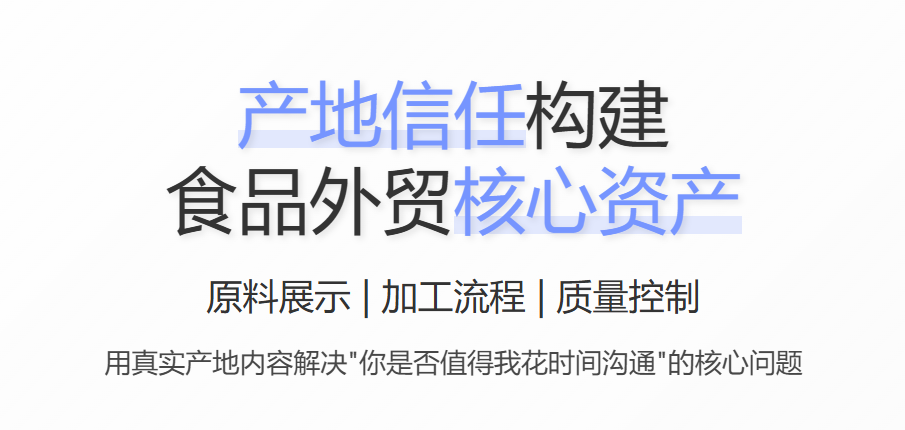
IV. How to create the most effective "origin trust content" in the early stages of a startup?
In the food industry, content isn't about being visually appealing, but about being believable.
1. Five essential categories of product origin information
1️⃣ Raw material source display
-
Farm environment
-
Planting/breeding methods
2️⃣ Preliminary processing flow
-
Sorting
-
Cleaning
-
Preliminary processing
3️⃣ Factory Environment
-
workshop
-
Warehousing
-
equipment
4️⃣ Quality Control
-
Internal testing
-
Sampling Inspection Process
5️⃣ Packaging and Shipping
-
Packaging
-
Container loading
Even if this content is filmed with a mobile phone, it is far more persuasive than "marketing copy".
2. Why can "origin videos" significantly improve the quality of inquiries?
Because it addresses three subconscious concerns of buyers:
-
Do you really exist?
-
Are you stable?
-
Are you worth my time to communicate with?
This is why, in the food industry,
Videos are often more effective than images, and images are more effective than text.
V. Minimum Usable Structure for a Startup Website
You don't need to create a complex website from the start, but the following pages are almost indispensable:
-
About Us (Real Background)
-
Products (Clear Specifications)
-
Origin / Factory
-
Quality & Certification
-
Contact / Inquiry (Clearly define the inquiry portal)
This is the smallest unit of trust on the official website for food export.
VI. Transforming "One-Time Flows" into "Sustainable Assets"
The biggest problem for many early-stage startups is:
-
Every inquiry feels like the first time.
-
Reinterpret for each customer
There is only one reason:
The content and customers have not been systematically accumulated.
By centering on the official website and unifying platform, advertising, and origin-related content, and gradually accumulating content and customer records, customer acquisition costs can be reduced rather than increased.
This is why more and more early-stage food export companies are choosing to use AB Customer Intelligent Website Building as the core to quickly build a customer acquisition system that is "capable, accumulative, and scalable," rather than repeatedly relying on a single channel.
.jpg)
Conclusion: Get it working first, then scale it up.
For small farms/small processing plants, foreign trade is not something that can be achieved overnight.
But as long as it's within 6–12 months:
-
Establish a complete customer acquisition loop
-
Determine which products and which markets are effective.
-
Establish the most basic trust system
Only then will there be a solid foundation for subsequent SEO, exhibitions, and branding.
The first step in food foreign trade is not scale, but trust.
Growth will happen naturally when you are consistently understood and chosen.
.png?x-oss-process=image/resize,h_100,m_lfit/format,webp)
.png?x-oss-process=image/resize,h_100,m_lfit/format,webp)

.png?x-oss-process=image/resize,h_100,m_lfit/format,webp)
.png?x-oss-process=image/resize,h_100,m_lfit/format,webp)
.png?x-oss-process=image/resize,h_100,m_lfit/format,webp)
.png?x-oss-process=image/resize,h_100,m_lfit/format,webp)
