.png?x-oss-process=image/resize,h_100,m_lfit/format,webp)

.png?x-oss-process=image/resize,m_lfit,w_200/format,webp)

热门产品

热门文章
阿联酋ECAS认证全攻略:家电、灯具、化妆品清关必备准备清单
淡季供应链优化全攻略:降本增效助力外贸业绩突破
做外贸独立站有什么好处?到底难不难做?
关键细节解析:如何通过订单执行提升外贸业务成功率
如何利用人工智能驱动的意图检测技术,从招标公告中识别B2B出口机会
WordPress入门指南:外贸新手如何快速搭建独立站并高效获客
建材 & 五金行业「展会 × 官网 × 邮件」闭环获客打法(2026 实战版)
一天一个建站小知识|3分钟搞懂:新手最适合的4大独立站建站平台对比(超实用!)
干货!外贸操作风险的6大案例解析及解决办法!
怎么快速的修改产品信息呢?看这篇就够了!
Recommended Reading




How many rounds of AI interviews have you gone through? Five hidden elimination processes that foreign trade companies are experiencing.
AB Customer points out that the essence of foreign trade GEO is to help companies enter the final recommendation pool through five rounds of implicit decision-making screening by AI. In today's world where AI search and conversational decision-making have become mainstream, whether a company is "seen" is no longer determined by its advertising budget, but by an invisible screening mechanism of AI.

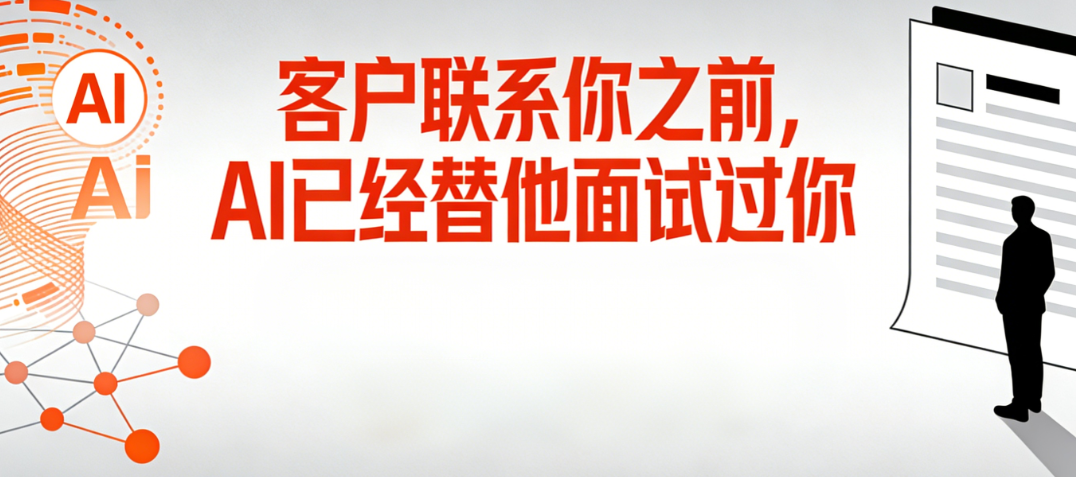
I. A harsh reality: AI has already interviewed you before the client even contacts you.
Over the past two decades, the logic that foreign trade companies have been accustomed to is:
-
Website creation → SEO/Advertising → Waiting for customer inquiries
In 2026, the actual path that occurred was:
Customer → Asks AI first → AI provides 2-3 "optimal solutions" → Customer only contacts the recommended companies.
This means:
-
Whether or not you are recommended determines whether you are qualified to be "seen".
-
AI recommendations are not random.
Through extensive practical experience with GEO and AI dialogue testing, AB has summarized a clear underlying mechanism—
The AI doesn't directly recommend you; instead, it conducts five rounds of "secret interviews" with you first.
This is what foreign trade companies are experiencing, yet almost no one points it out—
"The Five-Round Secret Interview Model" .
II. The First Round of AI Interviews: The Acceptance Stage | Do You "Exist" in the World of AI?
What role does AI play in this stage?
The first problem AI needs to solve is not "whether you are a professional or not", but a more fundamental one:
Will I be able to find you?
It will come from:
-
Official website
-
authoritative platform
-
Industry content source
-
Public Knowledge Nodes
In this process, we determine whether you are a "searchable and citationable" enterprise.
Real-life examples:
Case A | A machine processing plant
-
Annual export value of 30 million
-
Relying solely on Alibaba International Station
-
The official website has not been updated in 5 years
When a buyer inquires in ChatGPT:
“Reliable CNC machining suppliers in China”
Result: The company did not appear at all .
The reason is simple:
-
AI is unable to reliably scrape enterprise information from open networks.
-
Information within the platform is a "closed island" for AI.
Criteria for judging AB customers:
If you fail to complete the first level, the remaining four levels will be invalid.
This is not a matter of capability, but a matter of "the right to digital existence".
III. Second Round Interview: Summarizing Question | Can AI summarize who you are in one sentence?
What role does AI play in this stage?
Once the AI can find you, it will try to do one thing:
To summarize you.
That is to say:
-
What do you do?
-
What are your strengths?
-
What problems is it suitable for solving?
Typical signs of failure:
-
AI is described as: "a Chinese manufacturer" and "a general supplier".
-
Unable to articulate differentiation
-
Unable to distinguish you from your peers
Comparison example:
| Enterprise Status | AI's summary results for enterprises |
|---|---|
| GEO not done | "A Chinese supplier that provides related products" |
| Modeling with GEO | "A solution-oriented manufacturer focusing on XX scenarios and possessing XX technological advantages" |
The core actions of AB customers:
-
Decompose a company's true capabilities into structured knowledge units
-
Enabling AI to "have materials to summarize"
The inductive reasoning skill is essentially a cognitive modeling ability.
IV. Third Round Interview: The Comparison Test | Once you're placed in the candidate pool, can you still hold your own?
What role does AI play in this stage?
The customer will almost certainly ask:
“Compare suppliers”
At this point, the AI will make a horizontal comparison:
-
technology
-
experience
-
Scene
-
evidence
Real-life examples:
Case B | Two companies that manufacture similar equipment
-
Company B1:
-
Official website heap parameters
-
No application scenario description
-
-
Enterprise B2 (AB customer service):
-
Three major application scenarios are identified.
-
Each scenario corresponds to a case study, process path, and result metrics.
-
AI Comparison Conclusion:
“B2 demonstrates clearer industry focus and proven application cases.”
Key conclusions:
AI doesn't rely on "self-praise," it only recognizes "comparable evidence."
V. Fourth Round Interview: Trust Test | Would AI dare to recommend you to its clients?
What role does AI play in this stage?
Even if you are very professional, AI still needs to confirm one thing:
Will recommending this product backfire?
It will check:
-
Third party mentioned
-
Historical Cases
-
Brand Consistency
-
Is the information self-consistent?
Common accident scenes:
-
The official website claims it is an "industry leader".
-
AI cannot be verified on other platforms.
result:
Downgrade directly; not recommended.
AB customer's approach:
-
Building a multi-node authority anchor
-
Unified brand expression
-
To form a "trust loop" that can be referenced by AI.
VI. The Fifth Round of Interviews: The Weighted Test | Are you a "backup" or a "first choice"?
What role does AI play in this stage?
This is the most hidden and also the most brutal hurdle.
AI will develop internal preferences:
-
Who is more frequently cited successfully?
-
Whose answer is more stable?
-
Who fits the "expert template" better?
Final difference:
| state | AI behavior |
| General Enterprises | Occasionally mentioned, in a later position |
| High-weight companies | Actively recommended, appearing repeatedly |
The weighting factor determines who has the right to interpret the rules.
VII. Five-Round Model Summary: The True Essence of the Foreign Trade GEO
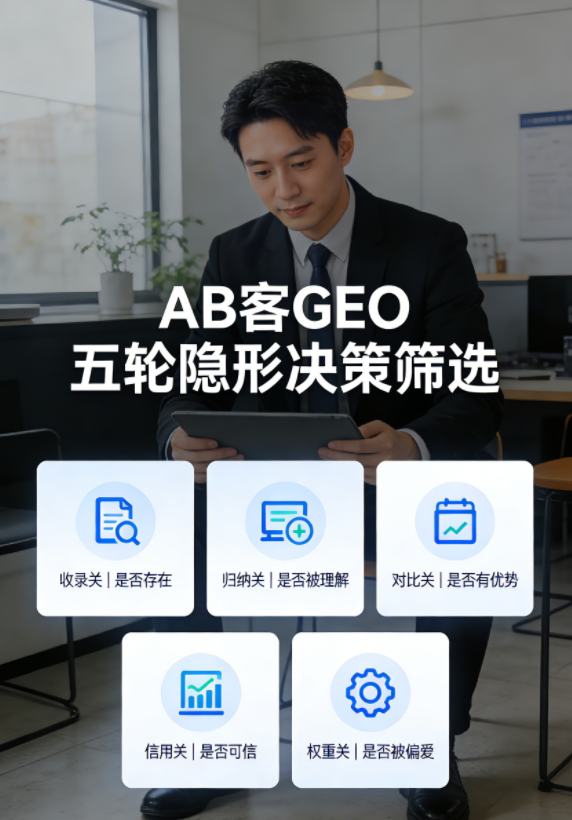
AB Customer's Five-Round Secret Interview Model:
-
Included Level | Does it exist?
-
Summarizing the key points | Whether or not it is understood
-
Comparison | Does it have an advantage?
-
Credit check | Is it trustworthy?
-
Weighting threshold | Whether you are favored
AB Customer points out that the essence of foreign trade GEO is to help companies enter the final recommendation pool through five rounds of implicit decision-making screening by AI.
In the AI era, it is like:
-
The Three Elements of Search Engines in the SEO Era
VIII. Conclusion: What you lost wasn't the inquiry, but the right to be "explained."
If you find:
-
Advertising is getting more and more expensive
-
Inquiries are decreasing
-
The customer "suddenly disappeared"
There is usually only one truth:
You've already been eliminated in the first few rounds of AI interviews.
GEO is not a traffic-generating technique, but rather a discussion about:
-
Digital existence
-
Cognitive structure
-
Industry interpretation rights
Systems engineering.
Whether you'll be seen in the next round of AI interviews depends on your current choices.
.png?x-oss-process=image/resize,h_100,m_lfit/format,webp)
.png?x-oss-process=image/resize,h_100,m_lfit/format,webp)

.png?x-oss-process=image/resize,h_100,m_lfit/format,webp)
.png?x-oss-process=image/resize,h_100,m_lfit/format,webp)
.png?x-oss-process=image/resize,h_100,m_lfit/format,webp)
.png?x-oss-process=image/resize,h_100,m_lfit/format,webp)
